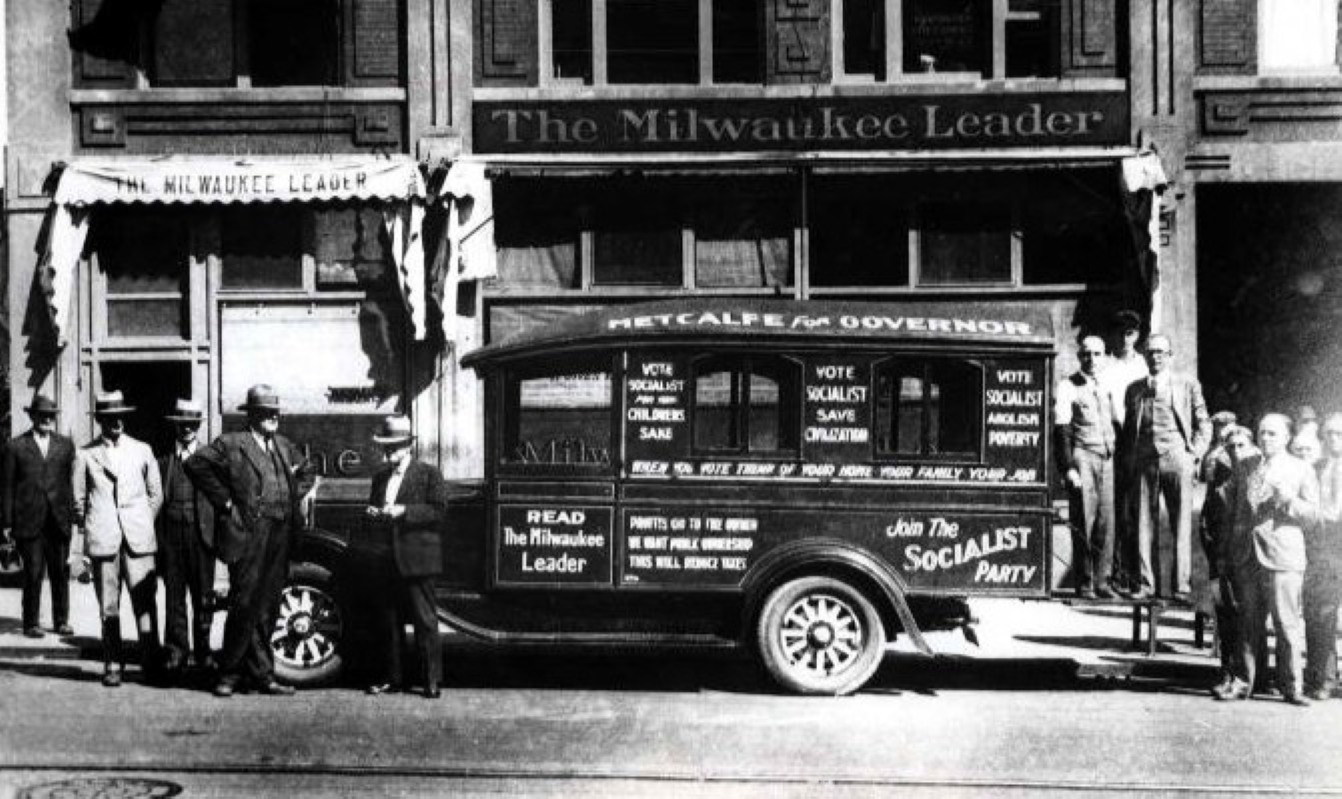
Ouch. Thurber Lewis, a former member of the Socialist Party and it’s Left Wing who became a founding Communist in 1919 reports back on the conference of his former organizations held two years after, as the final fight over international affiliation would have the ‘Committee for the Third International,’ the Workers Council group of J. Louis Engdahl, William Kruse, Alexander Tracthenberg, Moissaye J. Olgin, et. al., leave the Socialist Party to join with an above-ground Communist Party to form the Workers Party in December of that same year.
‘A Convention of Indecisionists: The Socialist Party at Detroit’ by Thurber Lewis from The Toiler. No. 178 & 179. July 2 & 9, 1921.
NATIONALISTIC SPIRIT RULES–DELEGATES REPUDIATE AFFILIATION WITH THIRD INTERNATIONAL–LEFT WING HOPELESSLY WEAK–“MILWAUKEE SOCIALISM” IN COMPLETE CONTROL.
At last they have performed the task! Hillquit and Berger have done what they have been trying for years to do they have divorced the Socialist Party from the Revolution. And the Party, if one is to judge by the delegates, for the most part glory in the separation.
This is just what was expected, but it was not anticipated that it would be done so sweepingly. It took but one day to cook the goose and eat it. I took but one afternoon to silence the upstarts of the Left. The machine: worked beautifully.
Our Chairman, Mr. Hillquit.
The ceremonies were enacted in the auditorium of Northeastern High School, Detroit. It was very kind of the School Board to grant them this privilege, and judging from Secretary Branstetter’s financial report, it was a timely donation. Branstetter opened the convention. He refrained from making an opening speech, as he said, “to expedite matters”, but in fact, because he wanted Hillquit to do it. Of course Hillquit was elected. Chairman and upon nomination of his crony, Berger. With this, Secretary Branstetter gleamingly remarked that this was the ninth time, successively, a Socialist Party Convention was honored by comrade Hillquit’s initial gavel.
Comrade Hillquit was every bit himself–both as to his usual consciousness of his superiority and as a purveyor of soothing salve. He opened his speech with this remark, “This is not a convention, it is a conference. The purpose of a convention is to convene, of a conference to confer.” The was later noticeable that it was neither, it was a walk-over. Then came the sob-stuff. The Socialist movement has been crippled by the war and the peace. It has been reduced to one fourth of its original membership. It has lagged way behind the movements of other countries. What is needed, he went on, is to rebuild the movement (at which one was struck by the thought that it needed it, badly). And then, waxing optimistic, “The capitalist order of society has sustained a deathblow from the war.” Is their still not a large sentiment for socialism as the elections demonstrated?
One would expect that so experienced a chairman would remember to strike a key-note, but he either forgot it or purposely avoided it. One remark, however, stood out in bold relief over the creamy remainder, “No matter what stand we take, no matter how revolutionary, in the eyes of the Communists and the Third International we shall always remain a handful of social-patriots and traitors.” Which was true and which henceforth will be more true than ever. He closed with, “we are here to perform a tremendous, historic task” (he forgot to add, infamous). And they proceeded to do it.
The Preliminaries.
Dan Hoan, of Milwaukee Mayor fame, was elected Vice-Chairman. There was considerable trouble getting a secretary, six declining. Jones of New Jersey was finally drafted by Hillquit. The agenda came up. It made no provision for a constitution committee. Berger moved for its provision, “it might be necessary to change it a little”, and added that it ought to expedite matters somewhat and he wanted to get home quick. Engdahl touched a soft spot in the N.E.C. when he called for the inclusion of the report of the International Delegates and Secretary. But since it could do no real harm it was allowed to be carried with a feeble opposition from Milwaukee.
Lee, Berger, Engdahl, Coleman and Hoen were elected on the Resolution committee. Only five, Kruse among them, accepted for the Constitution committee. Since there were to be only five, on the committee Hillquit was about to declare nominations closed. Sensing something wrong, Milwaukee asked that nominations be reopened. They thereupon nominated another, Plunkett, and the convention proceeded to elections. The results were: Hoan, Wilson, Davidow, Willert and Plunkett, Kruse conspicuously ditched.
Report of N.E.C.
Branstetter reported for the N.E.C. He deplored the very depraved condition of both Party finance and members. There are not even sufficient funds to tour speakers. Three organizers are being served notice. Hardly any progress is being made, “even in the industrial centres.” After tendering the bad news, he entered upon an appeal that reminded one very much of a failing business man advising his help. What we need is a little more religion in our work. We have got to make sacrifices. We must do more work with less cost. In ending, the reporter reminded the comrades of what struggles “we” went through and what sacrifices were made fifteen years ago. All in all, the report must have indeed been a tasty morsel for our once proud and haughty Socialist Party.
International Relations
For the past two years the eyes of the radical world have been watching for the Socialist Party to take a definite stand on International affiliations. The Party has declared itself; it is the Socialist Party of America, nothing more, nothing less. This question forced out in lurid tints the real color of the S.P. It showed once and for all that the S.P. is destined to be the historic counter-part of the German Majority Party, the Party of Scheideman and Noske. The decision reached international relations was the undoing of the “Left Wing”. In fact, there was no left wing. It was a mere feeble, nerveless effort giving way under the blind and irresistible stampede of reaction. The Third International was right when it said in its appeal to the American workers. “Leave the Socialist Party. It are our enemy and yours.” And the workers seem not to have let the advice go unheeded.
“The Left Wing.”
The left wing started out pretty well. Judging from the noise they made before, it was expected they would be able to put up a good fight at the convention. But how many delegates could really be recognized as left wingers? Two, Kruse and Engdahl. And they were instructed by their constituents to vote for non-affiliation with the Third International, the “Right” position.
So it was finally discovered that the Left wing was largely a hot air organization. The old crowd didn’t seem to be the least put out by the presence of Kruse and Engdahl. In fact Algernon Lee later made clear, with a smile on his face, that even Kruse and Engdahl were not at one. Of the two, Engdahl made the more virile opposition, Kruse, after his usual, anaemic manner, showed little sign of fight. The truth was that Engdahl came flat-footedly for unconditional affiliation with the Third International. But when his motion was beaten, he voted for non-affiliation.
The only saving grace of the fiasco was the gallery. It was plainly Communist. And it showed it vigorously. It caused the Chairman and Papal Berger considerable annoyance.
“Where Do We Belong.”
The speeches on International affiliation ranged all the way from revolutionary exhortations to downright white-guardism. There were four motions submitted covering every possible position. The first, supported by Engdahl, asked for complete acceptance of the twenty-one points of affiliation. The second, supported by Kruse, demanded that the S.P. renew its application for admittance to the Third with the reservation that it accept no binding formulas for the “attainment or organization of the Socialist Society,” and that complete autonomy should obtain in matters of membership, organization and tactics. In other words, it wanted the Third International to affiliate with the Socialist Party. The third motion, supported by Hoen of St. Louis, required affiliation with the International Working Union of Socialist Parties, The Vienna two-and-a-half International. The fourth, sponsored by Hillquith and Berger, provided for non-affiliation,
Engdahl Opens Debate.
Engdahl opened the debate. He pointed out, quoting Hillquit, that if the party needed rebuilding it must have a firm foundation, this was to be found in the Third International. We must draw strength from our international affiliations and get right on socialist philosophy. There are only two sides to the question, either we are for the Third International or we are against it. We could discuss the twenty-one points separately. But what’s the use? Either we swallow them whole or reject them. In commenting on the other motions, he remarked that the second was a mere repetition of the one by Hillquit last year. Speaking on the third, he showed that Vienna was merely trying to gather sufficient elements to be able to demand better) conditions of admission to the Third International. The fourth places us where we were and means only the continuation of the struggle. It would mean a victory for those who are fighting the Third International. “It remains for us to decide whether or not we shall take our place by the side of the only International movement that is able to function, that has a programme and can carry on the struggle for Socialism,” Engdahl concluded. Uproarious applause from the gallery, none from the delegation.
For the “Two and a Half.”
Hoen, an unquestioned disciple of Scheidemannism, spoke for the third motion. Engdahl had spoken of the achievements of the Third International and mentioned incidentally, the risks taken by comrades going to Moscow. Hoen opened with the queries, Where is the risk of going to Moscow, are not the Communists in control? What has the Third International accomplished the last two years? The Third International is not a concentrating force, it is only a movement for splitting. When Zinoviev made his four hours speech before the German Independents, did he appeal for solidarity? No. He asked that the movement in Germany be broke up.
The Third International tried to break up the movement in Italy, but the Italian Socialist Party is as strong now as ever before. Sam Gompers and Zinoviev go hand in hand, Sam from one side Zinoviev from the other. The Third International belongs to the same category as the Sam Gompers’ International. (Much applause from delegates, none from gallery.) “I will not accept a single point, even if there were three hundred.” Thus is shown the true temper of the Socialist Party.
Hillquit.
Hillquit spoke for the fourth motion. A motion which brands the Socialist Party as a renegade movement, which disdains the outstretched hand of the embattled revolutionary workers of the world. Of course, Hillquit spoke cleverly, as becomes a corporation lawyer of some repute. And he spoke carefully and deliberately, choosing well the middling course that he hoped might save him the grief of criticism from either side, a true American Kautsky. He opened, “The Third International will never be satisfied and will always denounce us as traitors.” He realized that the movement must be international, but an International must be a fraternal bond of all the socialist movements in the world. And suppose, he continued, we affiliate with the Vienna International. Although they present the soundest views of any international movement, at the same time they are not, strictly an international. As for the Third International they have told us too often that they don’t want us. Affiliation with them would mean the expulsion of many of our members, myself among them, and the application of the rest for membership in the Communist Party of America. The first motion is a motion to commit suicide for the glory of being affiliated. Still, even the Third International is not an International; it is an intensely national Russian movement. He could not, he said, criticize the Soviet Government–so long as the comrades there take care of their own country, very well. But their ignorance of the situation here is proven by the twenty-one points, Do you admit that we are on the verge of Civil War? Must we have an illegal organization as well as an open? Do you consider it proper to adopt the policy of denouncing all movements–renouncing, denouncing, splitting up? The Third International has hurt the socialist movement more than any capitalist institution. Europe is split all over by the action of the Third International. The time will come when sober socialist sentiment will triumph. Our organization is shot to pieces, our press is in frightful condition, our first task is to create a movement here, not to cheer Lenine. So spoke, the champion of American socialism.
Smaller Fry Make Merry.
With the exception, perhaps, of two or three, the rest merely followed in the wake of the master. But their declamations were much more blunt, and vicious. Holman, of Milwaukee, for instance said, “Gompers is backing up the capitalist class and Moscow is playing the same game”. And then, evidently animated by patriotism, “I say as an American that we should send this message to the American workers: keep your eyes off Moscow, our stomachs are here, we must build a movement here.” Cameron King, a native son, speaking for the California state organization threatened, “If we endorse the IIII International, California will step aside.” He deplored that the great majority of the former socialist movement of California flocked to the standard of Communism. And then, brightening, he told of how they were now broken up and underground while the Socialist Movement was being rebuilt. He did not say exactly that they were broken up by wholesale raids and persecutions while the socialists remained unmolested.
Professor Algernon Lee, of the Rand School, served out this profound deduction, “In justice to ourselves we must admit that there are two sides to the question, first, the Soviet Government fighting for existence and second, the Third International dealing not so much with Russian affairs, but with the affairs of the whole world.” He laid hopes upon the recent change of policy of the Soviet Government but denounced the Third International for its action in Italy and France. No one remembered to remind him that Lenine, Trotzky, Tchitcherin and Kalenin, leaders of the Soviet government, were also the leaders of the Third International.
Willert of Ohio, also evidently moved by patriotism, said that he was not opposed to the Third International but as an American he thought it was his duty first to look after the interests of his own country. The atrocious misunderstanding of the policies and tactics of the Third International can be no better shown than by the following remark from Willert, “Why don’t my Communist friends go into the A. F. of L. and help to throw out Sammy? No. They prefer to split it.” Dreifus of the German Federation swells the chorus, “Will we get rid of capitalism in the U.S. by joining the Third International. Will we still not have our courts and our capitalist government?” And, continuing in a passion, he exclaimed, “I wanted to join the Third International, but they kicked us out and called us names.”
Berger Feels Called Upon.
And then our old friend Victor Berger, of whom Engdahl remarked, “you carry the Socialist Party of Milwaukee in your pocket”, takes a hand. “I suppose I am expected to say a few words”, he began. And then, throwing out his chest he eulogized the Socialist Party of Milwaukee, which in effect, as everyone knew, is the S.P. of A. “We have the only socialist Mayor in captivity, we have carried Milwaukee seven times, our paper has a circulation of 48,000” etc. He suddenly became theoretical, “I am not a Communist. I believe there is a wide theoretical difference between socialism and communism. Socialism cannot exist without democracy. Communism is the common ownership and the common distribution of the means of life, Socialism is the collective production but private consumption.”
“The Communists are not only the wreckers of Russia but also the murderers of mensheviki and socialists.” And in his characteristic, German manner he continued, “I want no dictatorship, I want democracy. I want no dictatorship of Wilson, Burleson or Palmer, or even of Kruse and Engdahl. If any dictating is to be done I want to do it myself”, he said, supposedly in fun, but which contained more truth than humor.
Speaking of the motions, he characterized them, “the first is indecent, the second dishonorable and snaky, the third indefinite. The fourth puts us where we were, and that’s where we belong.” In finishing he reminded the delegates that Wisconsin has one third of the membership. In other words: remember this when you vote–the age old threat of withdrawal.
No Affiliation.
The first three motions were lost. The fourth, for non-affiliation carried by a considerable majority. The socialist Party is now free from all international obligations. It is strictly a national (and nationalistic) movement. Nothing can now prevent it. from striking out on its predestined course, a party of social reformists.
The Dictatorship of the Proletariat.
How far the Socialist Party, is from the historic trend of the revolutionary movements of the world, is no better proven than by the limitations of its understanding of and its summary repulsion of the principle of the Dictatorship of the Proletariat. It is left entirely on the program of the party, it remains a dead letter for American “Socialism.”
There were five motions submitted on the question. The first was a fairly clear but inexact presentation. The second asked for the dictatorship of the proletariat, with provisions, that is, “because we have a majority we are justified”. The third motion rejected both previous ones stating that the situation had not developed sufficiently for consideration of that tactic. The fourth motion, made by Hillquit was in substance: The term dictatorship means the political rule of the working class during the transition period. It is not necessarily to be associated with the restriction of the political rights of our opponents or with terror. The Socialist Party stands for Democracy and Majority Rule decision but that principle is not inconsistent with energetive measures in defense of the working class government. The fifth motion stated that the dictatorship of the proletariat was not of sufficient importance to necessitate a decision either way.
The discussion was confusion itself. It seemed as if the subject were one that was introduced but yesterday. It was as something extremely new, few understood it. Ridiculous conclusions were reached and odious objections devised. How sincere the interest was, is shown by a remark of Hillquit’s in which he said that if Marx were to some back, he would say, respecting the Dictatorship of the Proletariat, “Boys, don’t you understand a joke.” And again, “Orr’s objection to Hillquitt’s motion was that Hillquit wanted to make the Dictatorship of the proletariat “Kosher”.
In the voting confusion continued to reign. All five motions were beaten. They didn’t want the Dictatorship of the Proletariat in their platform, but they did not have the courage to plainly say so. Hence, they made no decision. The Dictatorship of the Proletariat, a tactic subscribed to by all the revolutionary movements of the world, even adopted by the Vienna International, will remain but a foreign phrase to the Socialist Party of America.
Read next week’s Toiler for concluding reports of the convention.
***
SOCIALIST PARTY WOBBLES ONWARD TOWARD FUSION AND DISSOLUTION–INDECISION MARKS CONVENTION ACTIONS ON ALL VITAL QUESTIONS
Hillquit has again well performed the task of helmsman for the Socialist Party Ship. Again, an experienced hand at the wheel, he has guided the almost floundering vessel between the breakers of avowed conservatism on one side, and the shoals of unmistakable radicalism on the other. If Milwaukee had its way, the party would go completely into the petty reform business, it would effect blunt compromises with anything that might add to its parliamentary strength, it would throw up the sponge and disavow even its revolutionary phrases. Dissimilarly with those to the left, although certainly not embracing communism, they would impart a disagreeable odor to the usual socialist election, they would place the party in a position to sustain the stigma of “sovietism’, and worst of all, they would be constantly playing up the “impossible fetish” of “the dictator ship of the proletariat.” Hence, Hillquit sought to avoid both.
Asks for Fusion.
It was altogether, I think, unexpected when Dan Hoan moved the “fusion resolution.” It was introduced irrelevantly, but nevertheless recognized by the chair, under the agenda heading of General and Political Strikes. The first paragraph read as follows, “The present status of the socialist and labor movements of America does not warrant a general or political strike as the starting point for the attainment of our aims.” In place of this, it insisted, that the time had come for the Socialist Party “to sound the clarion call” for a conference that shall make for [missing word] working alignment of militant workers,” and added “for the purpose of formulating such cause of action,” that “will result in the peaceful attainment of our revolutionary aims.” The resolution then asked that the N.E.C. arrange a conference of those organizations that stood for (1) the collective ownership and democratic management of all means of production and distribution monopolistically owned, (2) to oppose and abolish war, (3) to restore our liberties, (4) the attainment of these aims by the employment of both economic and political action along working class lines.
This resolution certainly does not impart dignity to an organization that claims to be revolutionary. To anyone who has even passing acquaintance with the principles of Marxian socialism, this proposal is immediately recognized as an abominable attempt at political horse trading. And yet it! was enthusiastically supported by not a few delegates. Still, for the socialist party, it is a timely stitch. Sooner or later it will be forced into a charlatan and compromising alliance with the “progressive” labor movement of the country, if for no other reason, to save its neck.
The source of the resolution immediately reveals its purpose. It emanated from Milwaukee. This is not the first time that Berger, Hoan, et al, have made known the pressing, necessity of fusion with the Non-Partisan League and other elements lest they lose out altogether. Engdahl pointed out that Berger had printed in the Milwaukee Leader re quests, in one instance, for the workers of Milwaukee to vote for a Non-Partisan Candidate. And Berger didn’t deny it. Yes, the S.P. needs fusion, and eventually, it will get it.
Watchful Waiting.
Then came Hillquit–the lawyer. Although he could not disagree with the sense of the resolution, “at this time,” he did not think it practicable. He did not oppose it because it was not commensurable with the revolutionary policies that he even, once espoused but because it was not “practicable.” And why did not he think it practicable? Because the Farmer Labor Party was a failure, the Non-Partisan League was taking a downward slide, and there were no really worthwhile organizations with which to unite. And then, who could say whether or not any organization eared to form an alliance? It takes two to make an agreement.”
Thereupon, Hillquit presented a resolution. Always choosing a safe and middling course, he delivered his plan with careful, barrister-like precision. He agreed, in his resolution with Hoan, that the “present status of the socialist and labor movement does not warrant the consideration of a general strike.” But unlike Hoan, it continued “for reconquering and maintaining our civil rights and liberties, and for securing substantial measures of economic relief.” Why this last? He is cautious. He was not prepared to say, bluntly, as Hoan did, that the situation does not warrant a general strike for the attainment of our aims. Though it cannot be denied that he equivocated, he hides naively in the confusion of the last provision: “a general or political strike for reconquering and maintaining our civil rights,” etc.
Instead of jumping immediately into fusion, the resolution recommended “a careful survey of all radical and labor organizations in the country, with a view of ascertaining their strength, disposition and readiness to cooperate with the socialist movement upon a platform not inconsistent with that of the party.” Always wary of the shoals, he concluded, “and on a plan which will preserve the integrity and autonomy of the Socialist Party.”
The Hillquit resolution carried. But, careful as it was, it commits the party to a willingness to engage in political trading. On a whole, it is “not inconsistent” with the policies of Hoan and Berger.
General and Political Strikes.
As before noted, these motions were more or less amendments to those on the agenda General and Political Strikes. Of the former, there were two motions submitted. The first, “regards the general strike as a powerful weapon of the working class.” But, “It is evident that the advocacy of a general strike in the U.S. under present conditions is folly.” The second insists, “A political party cannot call a general strike for any purpose,” and, trying to find a reason for its existence adds, “that is the function of the workers organized in the unions.” With the assurance that such a thing as a general strike will not be a very proximate obligation, the delegation carried the first motion. The motion on the political strike, the possibility of which seems to be but a recent admission of the S.P., was similar to the other. It starts out, “a political strike is a strike for the purpose of compelling the enactment or repeal of legislative measures or for the purpose of influencing the policies of the administrative officials.” Even though it may have occurred to them that a political strike might serve other ends, i.e. control of industry, etc., since such things are beyond the pale of the narrow political limits they have set for themselves, they summarily discard them. It ends, after applying a number of straight-jacket reservations, “The socialist party therefore, warns against the attempted use of the political strike as a general or customary weapon and declares that it should be used only on rare occasions and In connection with matters of supreme importance to the workers.” But, even this sickly and enervated pretense to revolutionary activity was disowned. The motion lost by a vote of 20-19. The motion on the “attitude toward labor organizations” merely reaffirms the old socialist party stand, a meagre policy of individual “boring from within.” “The position of the socialist party is one of constructive, not destructive criticism.” It is through this policy of Loyal constructive work within the Labor Unions that the Socialist Party strives to strengthen these organizations and bring about a better understanding and cooperation between the militant economic and political organizations of the workers.” The motion said nothing about the I.W.W. and other really “militant” organizations.
Throw Them Out.
Next on the agenda came the famous “Branstetter resolution.” It starts out by saying that the Third International is attempting to disrupt the Socialist Party. It quotes an appeal from the Third International that asked the members of the S.P. to leave the Socialist Party and join the Communist Party. And, it continues, “whereas, it is our duty to protect our party against such treachery on the part of unprincipled and unscrupulous members serving the interests of either the Communist International or the Department of Justice, and in either case serving the interests of the American capitalists.” It therefore appealed to the convention to provide for the expulsion of “members supporting or endorsing the Communist International or advocating affiliation therewith”.
Many of the delegates, Hillquit among them, tried to pass the thing off as a “joke” or a “scare”. But there were many others, who spoke for it in all seriousness, but at the same time said that though they agreed wholly with its sense and purpose, did not think it a wise move at this time. Branstetter delivered a vehement plea for its passage, and he was interrupted many times by peanut politicians like Solomon and Berger offering evidence that the Communists “distributed sabotage leaflets on election day in our strongest sections. Berger insisted that it was not necessary to pass the resolution at the convention, “this is a question for the state organizations, I was for state autonomy twenty-one years ago and I still am.” Hoehn, of St. Louis remarked that they did not need a resolution to expel them. The resolution was defeated, but not forgotten.
Principles and Platform.
The motions submitted under the agenda heading of Principles and Platform were a source of considerable annoyance to the delegates. There action on them was characterized by a positive unwillingness to commit themselves to anything that smelled as if it might be an uncompromising or revolutionary tactic. This indecision was almost universal; most of the proposals were laid on the table without dissent.
Two motions on political action, one definitely limiting this field of activity to “participation in elections to public office”, the other defining it as,” any organized, concerted endeavor of government, were both defeated.
Likewise, two motions on mass action were tabled. The first defined mass action as “nothing illegal or improper in itself,” “mass action may be for social progress or against it.” The second said, that mass action includes,” such activity as national petitions or popular demonstrations in which large masses are engaged for some definite end, such as release of political prisoners etc.”
Motions on direct action and sabotage were of course tabled. Two motions on the soviet system, one for, the other against, were lost. The latter opposed the soviet system upon the ground that, “it is a system of delegated power which deprives the working class of any direct voice in the election of responsible public officials”.
Jim From Pensy.
James Maurer came to honor the convention with his presence. He was given an enthusiastic ovation. Called upon to speak, his talk was in conformity with the extreme right position maintained in the body by Milwaukee. He denounced the “red, red revolutionists” in the usual “labor-fakir” fashion. He asked for “sober” consideration of the problems before the convention. All his denunciation and anathematizing of the “revolutionists” was wildly applauded of the delegation.
A letter from Meyer London, the only Socialist representative in Congress was read. He took three pages to excuse his inactivity for the past years. He bragged that he had, in the last session, introduced five resolutions and bills. Two resolutions deal with the international situation, one of which demands the recognition of Russia, the other “the establishment of on international parliament as a substitute for the Leage of Nations”. He drove home a disagreeable reminder when he said that the latter “carried out the program of the Socialist Party on international relations.”
As expected, he didn’t forget to impress the convention that it must express its unqualified disapproval of those “who accept dictation from abroad.”
Jewish Federation Objects.
A refreshing letter, printed by the Jewish federation, was distributed among the delegates. It recounted some of the past infamous history of the party; stressed the moral collapse of the organization, and asked the convention to do everything that the convention (the letter evidently came late) refused to do. It was not brought on the floor.
Tuesday morning, the convention went into executive session, to see what could be done about the frightful financial condition of the Party. It was reported that they are $21,000 in debt, and going deeper. Hillquit proposed that a campaign be immediately entered upon to raise $10, 000 in thirty days. It was amended to twenty. Berger arose to boost it up to fifty. Twenty was finally decided upon.
The Invasion.
On Wed, the “Disabled Veterans of the World War,” one hundred strong invaded the hall. Their spokesman was Horr, from Seattle. He said that the news had reached them that there was evidence of disloyalty at the convention. He “hoped to God the reports were untrue.” But if it were true, that someone said that the red flag of Internationalism was the only flag (Engdahl), if there were those here who advocated force, he went on in a passion, let them come outside. Of course, no one arose to comply. He then warned the convention that “force would be met with force.”
It must be said, that Cameron King, chairman at the time, handled the affair tactfully. “As Americans we demand the right of free speech, free press and free assemblage.” “You have suffered, it is true, but we too have suffered,” he went on, “if we had had our way you would not have had to suffer.” The Vets were of course whipped, and they showed it as they meekly filed out. But they were applauded by the delegation, coming in and going out.
The convention of counter-revolutionists is over. They will go home and tell their membership what radical departures they consummated, what great achievements they performed. The membership will believe them, largely, and will continue in the old petty-reform rut Vote-catching will continue as the order of the day, petty-bourgeois socialism will persist as the guiding star. Compromises will be effected with “liberals,” and Communists will be derided as disruptionists and Department agents. They will await patiently the formation of a new, more yellow international with which to align themselves. The convention of the Socialist Party is over, the Socialist Party is a carrion.
The Toiler was a significant regional, later national, newspaper of the early Communist movement published weekly between 1919 and 1921. It grew out of the Socialist Party’s ‘The Ohio Socialist’, leading paper of the Party’s left wing and northern Ohio’s militant IWW base and became the national voice of the forces that would become The Communist Labor Party. The Toiler was first published in Cleveland, Ohio, its volume number continuing on from The Ohio Socialist, in the fall of 1919 as the paper of the Communist Labor Party of Ohio. The Toiler moved to New York City in early 1920 and with its union focus served as the labor paper of the CLP and the legal Workers Party of America. Editors included Elmer Allison and James P Cannon. The original English language and/or US publication of key texts of the international revolutionary movement are prominent features of the Toiler. In January 1922, The Toiler merged with The Workers Council to form The Worker, becoming the Communist Party’s main paper continuing as The Daily Worker in January, 1924.
PDF of issue: https://www.marxists.org/history//usa//pubs/thetoiler/n178-jul-02-1921-Toiler-rsz-chronAM.pdf
PDF of issue 2: https://www.marxists.org/history//usa//pubs/thetoiler/n179-jul-09-1921-Toiler-rsz-chronAM.pdf

