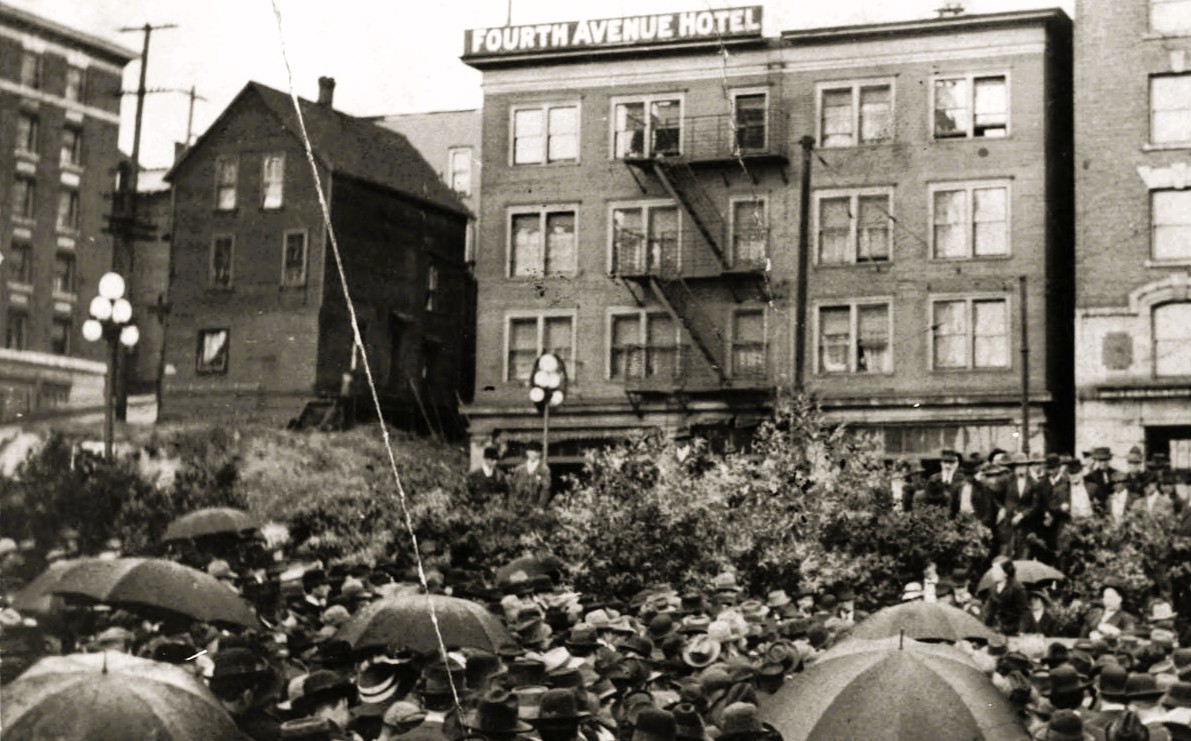
One episode in a wave of mob violence unleashed against the left as the United States entered World War One. While happening in the general context of the Summer of 1917’s war-time crackdown on labor and radicals, the June 16, 1917 assault on the I.W.W.’s Seattle hall by a mob of soldiers had its own specific background.
‘Soldiers and Sailors Attack I.W.W. Hall’ from Industrial Worker. Vol. 2 No. 11. June 23, 1917.
Repulsed After Seattle Press Had Inflamed Them to Action In Interests of Shipping and Lumber Bosses; Fifty-One Members Arrested, All But Ten Released.
For some time there has been a conspiracy to murder being hatched up by some of the business interests of Seattle. What was hoped would be the culmination of this conspiracy came on Saturday evening, June 16th. That the conspiracy did not result in murder was no fault of the conspirators, but rather a result of fortunate circumstances and the cool judgement of the members of the I.W.W.
Since the wrecking of the I.W.W. hall in 1913, the Seattle Times and P.-I. have been using every possible endeavor to have all members of the organization punished on any charge or no charge of everything in the catalog of crime. But for the past week the conspiracy has taken a definite form, as is shown by at least one editorial that was printed in the Times on June 15th.
On June 13th it was learned through releiable sources that the U.S. Marines were to be used as tools to wreck the hall here again, and a delegate of the I.W.W. was sent to lay the case before Mayor Gill, while later in the week Commander Koontz at the Naval Station was called up and informed of the situation. Each of these officials was doubtful of the correctness of the source of information, but when the time for the raid arrived, had sufficient men on the ground to handle the situation.
Orders for Raid.
On June 15th the Times printed the following editorial, which in effect was an order to the citizens and soldiers to raid the hall and attack any I.W.W. member found:
“Several lively fist fights occurring in this city recently, in which the participants have been members of anarchistic organizations and loyal citizens, either soldiers or civilians, point to the need for a clean-up of the disturbing element before something more serious occurs.
“In their present temper, the people of Seattle will not long endure the mouthings of these individuals, who are presuming to denounce the nation’s war policies. Every time one of the trouble-breeders clashes with a husky patriot, the scene is laid for an incident infinitely more serious than a man-to-man encounter.
“Unfortunately for Seattle, this city has been for years one of the “stamping grounds” of certain disloyal organizations, whose sole aim is the overthrow of law and the destruction of organized government. A nuisance during times of peace, they become a serious menace to public order in a time of war because their seditious utterances will not be tolerated by right-thinking men.
“Numbers of these individuals are “slackers.” Some of them probably have registered because of a wholesome respect for the penalties carried in the conscription law. “Others, however, not only have failed to enroll, but have openly boasted of their refusal to do so. The task of dealing with these malcontents rests upon both the municipal and the federal authorities. The latter should apprehend them without delay if they have defied the draft law. The former should deal with them in such a way as effectually to suppress their noisy clamor.
“Reports indicate that a somewhat similar situation obtains elsewhere in the state, particularly in the lumber camps and in the fruit-growing districts. Here the federal and state authorities should get busy at once, with a view to compelling a wholesome respect for law and order and in order to avert even more vigorous action by an exasperated citizenry.”
The connection between this editorial and the proposed raid will be better understood when it is known that Col. C.B. Blethen of the Washington National Guard is the editor of the Times which published the editorial. The editorial states that the authorities should take action “to avert even more vigorous action by an exasperated citizenry.” The implication is that the authorities have been so lax in their enforcement of the laws that it is now up to the common citizen to lay the law aside and use mob methods. And had the circumstances been right that would have been the result of the conspiracy.
Authorities Did Not Want Riot.
On the evening of June 16th there were several hundred soldiers and marines on the streets of Seattle on “leave.” Many civilians were seen talking with the uniformed men, and the main topic of discussion was what the I.W.W.’s had done and the proper method of getting back at them. While the I.W.W. was holding a street meeting at the corner of Occidental and Washington, several marines congregated in a dance hall near by and had soon arranged their proposed attack. But the naval authorities had no wish for a conflict at this time, and had a large provost guard on duty in the town. Just as the attack was about to be made, the guard lined up the marines and marched them past the street meeting and on into the next street. After that the provost guard was busy for some time keeping the soldiers and marines on the move, and none of them were allowed to congregate within a block of the entrance to the hall.
At the conclusion of the street meeting the members of the I.W.W. adjourned to the hall. At about this time a large number of soldiers and marines who had not been in the dance hall while the meeting was being held had collected in the alley at the rear of the I.W.W. hall and tried to gain admittance by the fire escape. The police had by this time arrived, and were assisting the members of the I.W.W. to keep the soldiers and marines from gaining an entrance by the front way. While the raiders were trying to force an entrance at the rear, there was a shot fired from some unknown place which caused a slight flesh wound in the leg of one of the soldiers, no one else being hurt. Who fired the shot, or where it) came from, has not yet been learned.
Arrested Why?
Something had to be done to placate the blood-thirsty ones who had demanded the raid, and as soon as the shot was fired fifty-one men who were in the hall at the time were placed under arrest. Three marines were also arrested, and all were taken to the city jail. As soon as the arrested I.W.W.’s were taken to the jail the police placed a lock on the I.W.W. hall, and it was kept locked ’till Monday morning, June 18, when it was reopened for business.
By Monday morning all the members of the I.W.W. arrested had been released except some ten who are being held for investigation as to their age for registration, but these are held for the Federal authorities on that charge alone, and not for any part in what the city papers are pleased to call a “riot.”
The chagrin of Col. C.B. Blethen over the fiasco must be indeed keen. In the Times on the “morning after,” this statement was made: “A greater measure of responsibility rests upon the municipal authorities than upon either the anarchists or the soldiers and sailors.” The position of the Times in the past shows that this “measure of responsibility” is because the police department took action in time to prevent any serious consequences of the prepared raid on the I.W.W. hall.
On Sunday, June 17, a meeting of the I.W.W. in Seattle was held, and action taken to meet the situation, A committee consisting of J.H. Beyer, C.W. Davis and A.B. Wimborne was elected to act for the I.W.W.
The true animus of the fight in Seattle against the I.W.W. is not because of any action or statement that has been made regarding registration and conscription. Within the past week the Seattle ship building firms have received contracts for vessels amounting to fourteen million dollars.
Within the past few months the I.W.W. has been making good headway in education and organization among the Seattle ship-builders, and this was beginning to bring results that the companies do not like.
Taking these two facts together, and realizing that the Times and P.-I. have for years been fostering the shipbuilding plants of the city, it is readily seen where the trouble with them is. To protect the profits of their class these spokesmen for the industrial pirates will not hesitate to inflame the enlisted men to do their dirty work for them.
As we go to press we learn of one bet being made on the streets of Seattle that there will be another raid on the I.W.W. hall on the night of June 20, and that there will be one hundred men killed. The bet was for one hundred dollars, and found no takers. That the offer of the bet was made with almost a certainty of winning may be judged by the following from an editorial in the P.-I. on the morning of the 19th:
Want More Lawlessness.
“No resident of the United States has the right to encourage resistance to the law and the national policy in time of war, or any other time. One who does so invites trouble, and if the police department is alert to its duty it will not be permitted; otherwise, the penalty may be imposed by private citizens who rightfully resent such utterances and are not temperate in checking them.”
Perhaps the best answer that can be made to the ranting of the Times and P.-I. about “treason” will be to state that on the evening of June 18 at a meeting of nearly five hundred members of the I.W.W. held in the hall in Seattle, a motion was unanimously adopted to the effect that “our speakers be instructed to talk nothing but straight Industrial Unionism in the future, as they have been in the past.”
The names of those still eld are, Paul Kahey, E. Stafford, W. St. Germain, Harvey King, H. Bernstein, John Coffee, W. Pabst, C. Wold, J. A. Getz, J. Johnson, H.B. Hoffman.
The Industrial Union Bulletin, and the Industrial Worker were newspapers published by the Industrial Workers of the World (IWW) from 1907 until 1913. First printed in Joliet, Illinois, IUB incorporated The Voice of Labor, the newspaper of the American Labor Union which had joined the IWW, and another IWW affiliate, International Metal Worker.The Trautmann-DeLeon faction issued its weekly from March 1907. Soon after, De Leon would be expelled and Trautmann would continue IUB until March 1909. It was edited by A. S. Edwards. 1909, production moved to Spokane, Washington and became The Industrial Worker, “the voice of revolutionary industrial unionism.” A victim of finances and internal disputes, the IW ceased publication in 1913, only to be revived in 1916 and surviving as a weekly, sometimes more, until 1931. Easily among the most important working class newspapers in U.S. history and an essential resource on the wobbly, and larger radical labor experience.
PDF of full issue: https://washingtondigitalnewspapers.org/?a=d&d=IWW19170623

