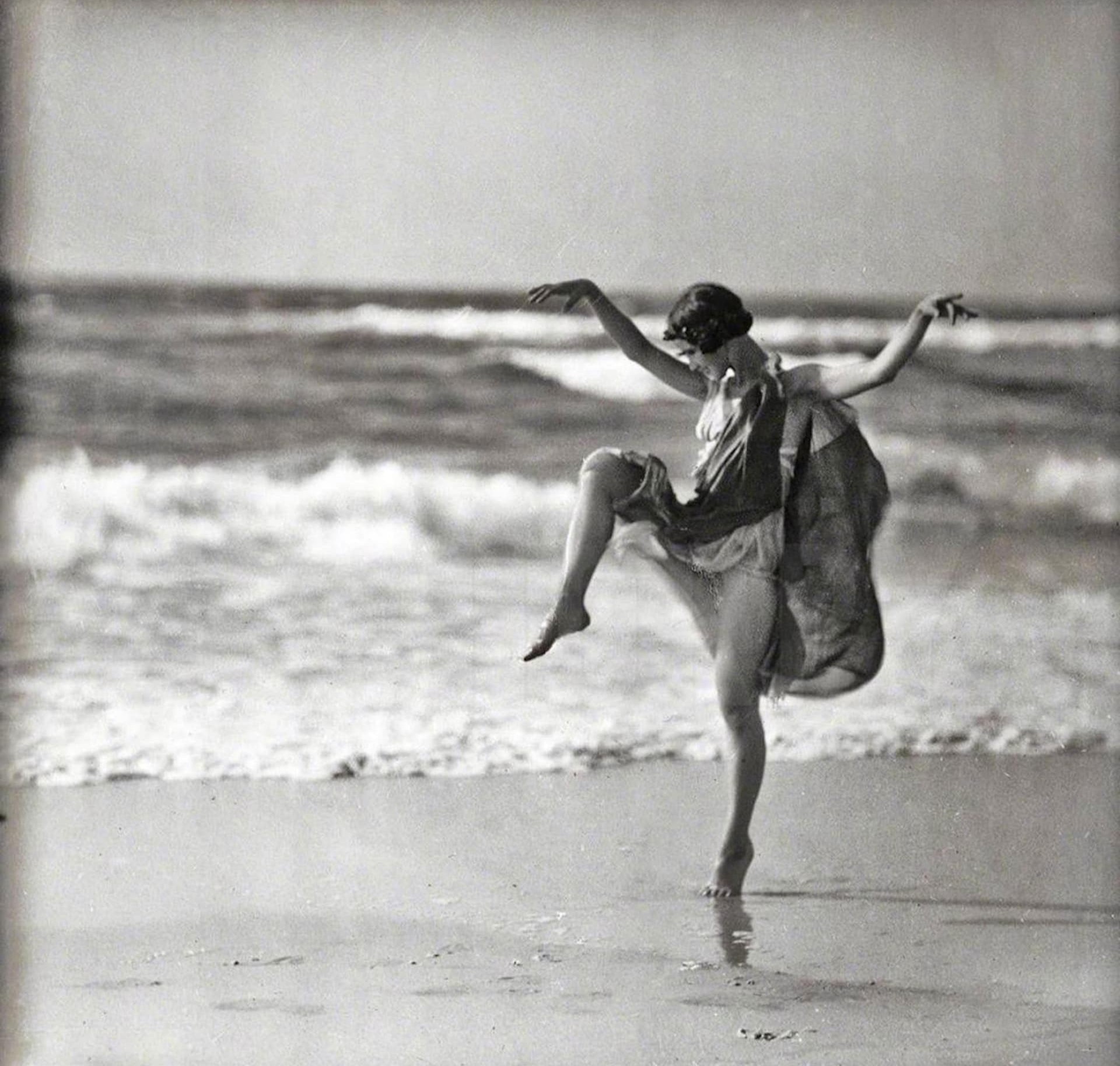
Two years after her tragic death and Michael Gold attempts to come to grips with the person and art of Isadora Duncan, who helped to reinvent dance and whose life and work was brilliant, politically charged, and contradictory.
‘The Loves of Isadora’ by Michael Gold from New Masses. Vol. 4 No. 10. March, 1929.
1.
Isadora Duncan was a genius.
That word has been so cheapened by hacks it has no meaning left. But it can be applied to Isadora.
She destroyed the Ballet. She restored the Dance. Her work marks a new epoch. Her work is permanent.
She set humanity free in a new and important way.
2.
Among savages the dance was a sacred art.
In “our” civilization it became a sex perversion, and a form of ostentatious waste.
The dance is probably older than speech. It is the poetry of materialism. Animals dance.
It is their mating speech.
Among our hairy savage fathers, the dance was the speech of philosophy.
The dance was man’s first comment on earth, fire, air, love, sun, plant—the world.
There are sacred dances thousands of years old. Their emotions are as exactly organized as science.
3.
Under “Christianity”, the primitive dance split into two streams.
One was the folk dance, the mass joy of the people.
The other was the Ballet, fungus of the courts.
The ballet expressed the sterile formalism of the courtiers, their parasitism, their cheap, useless elegance.
The ballet ruled Europe for two centuries. It had no rivals and seemed secure as the European thrones.
Generations of flunkey art critics chanted its praise. Its stupid acrobatic stunts were worshipped as if they meant something.
No one dared attack the ballet in the art world. This would have been Bolshevism.
No one had any alternative to suggest. The dance instinct had become atrophied.
4.
Isadora Duncan, a little Irish-American girl born of a poor musician’s family in San Francisco, arose like David.
She toppled the giant fake to the ground. She was a new primitive. She discovered the motor of the savage dance. She created a new dance. She was a genius.
She did what Walt Whitman had done for poetry. She ripped off all the corsets. She let herself go. She denied the rights of private property in the dance. She made it free for everyone. She rushed into the sunlight. She laughed at the technical acrobats. She sneered at their mindless, soulless dancing.
Her dancing was not a stunt, but her philosophy of life.
She inspired others. Hundreds of new dancers have followed in her trail. Dancing has mystery in it again, and belief.
The court ballet now seems as futile and old-fashioned as a hoopskirt.
5.
This should have been enough for Isadora. Walt Whitman was satisfied with one career. But Isadora entered upon a second career.
Love!
In her book, “My Life,” (Horace Liveright, publisher) Isadora never spells Love without a capital letter.
O Love! Love again! Her book is one of the great autobiographies. Isadora was as direct as a man. She tells about her dozens of lovers, the famous and the infamous.
Among the famous ones were D’Annunzio, the operatic tenor, antique collector and world-known thesaurus.
Another was her last, Sergy Yessenin, a mad, gifted young Soviet poet who hung himself in exhaustion.
Isadora describes her men lovingly. She holds no grudges. This is not a book like the ones Casanova and Frank Harris used to write in idler days. Isadora does not crow and ask you to admire her prowess. She is not defiant or Luciferian.
She is like a mother who has had 22 children, and has loved each in turn.
Isadora is charming. She suffers through the 22nd accouchement as romantically as she did during the first. This is a gift.
6.
The old sex standard, based on private property, is breaking down in this revolutionary day.
The penalties have been lessened, and everyone has begun to practise Love.
Bernard MacFadden has made it popular in the tabloids, and Margaret Sanger now offers it as a cure for poverty and war.
V.F. Calverton, an authority, has made a statistical survey of the rubber goods counters in Baltimore drug stores. He declares almost the entire population of Baltimore has been converted to the philosophy of Life and Love.
Love is respectable now. Businessmen come to Greenwich Village on pilgrimage, and drink at the many fountains of Love. Congressmen mention it in speeches, and the President of a Bank recently admitted to a reporter he had read a book on Love.
There is no doubt of it: Ping-Pong and Love are the two most popular indoor occupations in America today.
The movement has triumphed! And Isadora Duncan was the Joan of Arc of this mighty movement! Her sacrifice was enormous! She suffered, and suffered, and suffered—Christ, how she suffered!
7.
She was a genius, and a wonderful woman. But it is difficult to accept her prayerful approach to sex. She sounds too much like the novels of Laura Jean Libbey. I wonder, does every woman feel that way about Love?
Sometimes I suspect Isadora is the first woman who has written down what every woman actually feels about Love.
If this is true, the future is a black one for males. The day will come when the human female will devour the male in the moment of Love, exactly like a female spider or locust.
8.
Sex will become free as air. This will be good. No one will have to think about it anymore. No one will pray to it, or feel noble or degraded over it.
Sex is the mechanical means by which life is continued. Lobsters and buzzards, equally with man, use this mechanism.
It is not intrinsically sacred, except in the sense that all life is sacred.
What has given it its mysticism, its poetry, its romantic beauty, is the human mind.
When sex is free, friendship will assume its rightful importance.
And the social instinct will be found as fiercely romantic as the sex instinct seems today to repressed Americans.
The human mind can do all this.
It should. Sex has become a sort of bourgeois opium. It is a form of escape.
When sex is free, men and women may become friends.
They are not friends at present, they are enemies and lovers.
9.
Poor Isadora! Her life held tragedies. But it was a crowded and glorious life, and one worth living.
All of us must suffer and die. This is not too tragic. What is tragic is that so many millions suffer and die in a gray fog futility.
Isadora, with her splendid flamboyance, made speeches at her dance-concerts.
“Yes, I am a Red,” she said once, “and I am proud to be one, because most people are Gray.”
She was a Red, but not a real revolutionist. It was all emotion with her, glorious and erratic.
She was a genius of the transition period between two worlds, a forerunner, like Walt Whitman.
She prophesied the future, when in a free society there will be neither money nor classes, and men will seem like gods, when the body and mind will form a radiant unity.
Her own mind and body approached that unity. But she was the product of an environment, and never shook it off.
She sensed the future, but she would have been unhappy if forced to live in that future.
With all her beautiful Platonic theories, in actual life she was spoiled like most stage prima donnas.
Some intimate followers and friends have written two books recently about Isadora. The books are an anti-climax. They are like reports of a valet who reveals his master’s secrets.
Irma Duncan whines and whines. She whines about Soviet Russia, and Isadora’s hardships there.
She never lets one know for a second that 140 million people were suffering more extreme hardships during the time. Thousands of them even passed beyond the luxury of whining. They died.
Yes, little Irma complains that during the famine period Lenin and the Soviets had no time in which to provide Isadora with adulation, money and Parisian comforts.
This book should not have been written or published. It leaves a bad taste in the mouth.
Irma has not a word to say about working-class Russia, and the great creation of a world. She is busy with gossip about crazy Bohemian artists, and nepmen who gave Isadora good things to eat, and sleek “cultured” Soviet bureaucrats, the ones that had not yet been caught.
Isadora gravitated to this kind of crowd all her life. It was not her fault, but the fault of her world.
She was a Californian, too, and at the end returned to the native blanket, and used a Ouija board, Irma tells us.
Never mind. Hurrah, Isadora, you will never be forgotten! You had the courage and open-handedness of an old-time cowpuncher. You were a good sport. You were a genius.
You were a prima donna, too, but it was not your fault. You were born hundreds of years too soon, and in the wrong country.
* Isadora Duncan’s Russia by Irma Duncan and Allan Ross Macdougally Covici-Friede, N. Y. $3.50.
* The Untold Story—Life of Isadora Duncan by Mari Desti, Horace Liveright, N. Y. $3.50.
The New Masses was the continuation of Workers Monthly which began publishing in 1924 as a merger of the ‘Liberator’, the Trade Union Educational League magazine ‘Labor Herald’, and Friends of Soviet Russia’s monthly ‘Soviet Russia Pictorial’ as an explicitly Communist Party publication, but drawing in a wide range of contributors and sympathizers. In 1927 Workers Monthly ceased and The New Masses began. A major left cultural magazine of the late 1920s and early 1940s, the early editors of The New Masses included Hugo Gellert, John F. Sloan, Max Eastman, Mike Gold, and Joseph Freeman. Writers included William Carlos Williams, Theodore Dreiser, John Dos Passos, Upton Sinclair, Richard Wright, Ralph Ellison, Dorothy Parker, Dorothy Day, John Breecher, Langston Hughes, Eugene O’Neill, Rex Stout and Ernest Hemingway. Artists included Hugo Gellert, Stuart Davis, Boardman Robinson, Wanda Gag, William Gropper and Otto Soglow. Over time, the New Masses became narrower politically and the articles more commentary than comment. However, particularly in it first years, New Masses was the epitome of the era’s finest revolutionary cultural and artistic traditions.
PDF of full issue: https://www.marxists.org/history/usa/pubs/new-masses/1929/v04n10-mar-1929-New-Masses.pdf

