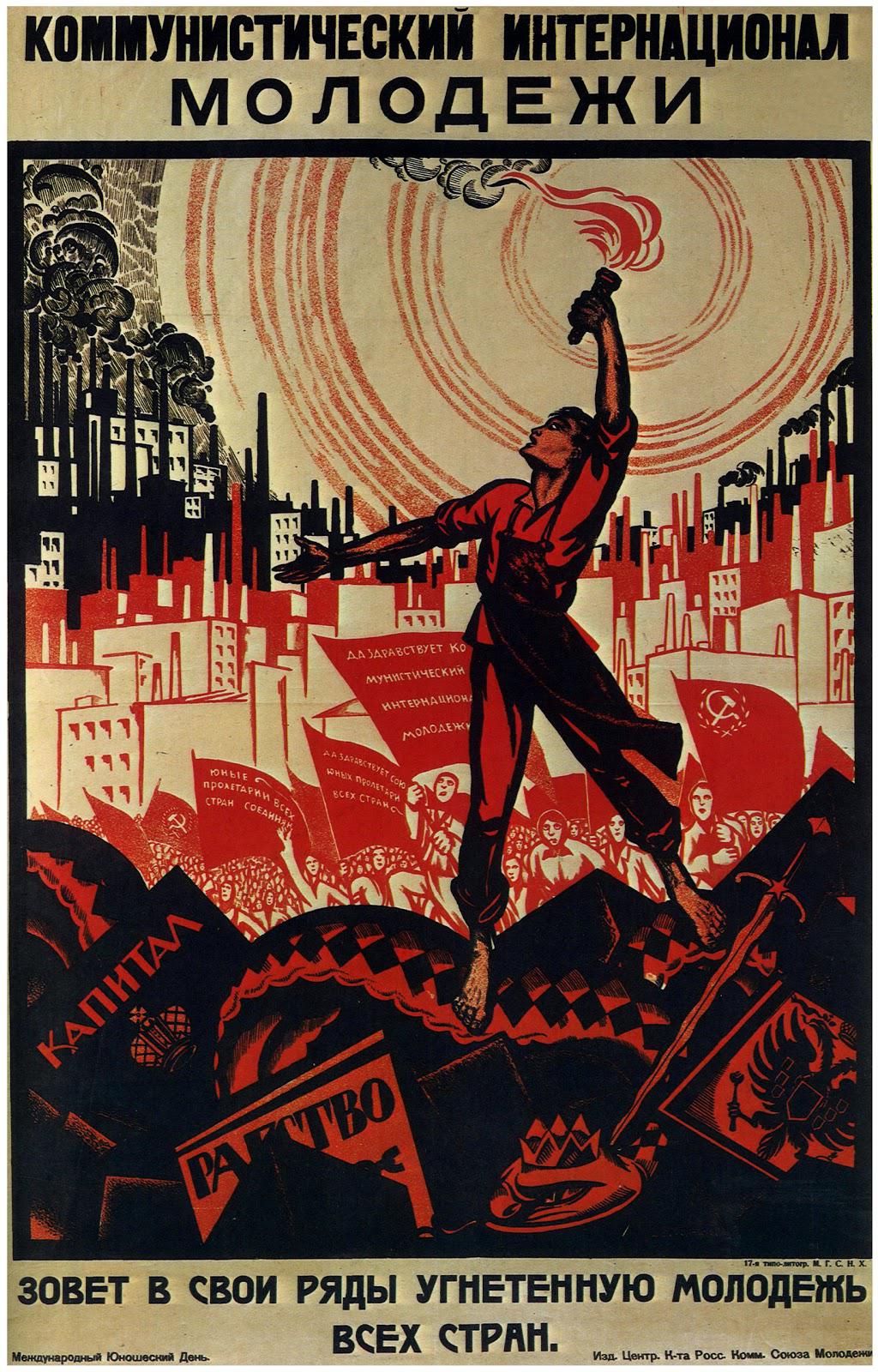
A resolution from the Y.C.I.’s Third Congress on the relationship between immediate, partial economic demands, and the revolutionary struggle to overthrow capitalism.
‘Economic Demands of the Young Communist International’ from Programs of the Y.C.I., 1923.
RESOLUTION ON THE ECONOMIC DEMANDS OF THE PROGRAM OF THE YOUNG COMMUNIST INTERNATIONAL
SINCE the Second World Congress issued its call to battle for the economic demands of the working class youth, the economic movement amongst the young workers has grown considerably. Increasing economic pressure is sowing the seeds of dissatisfaction in the ranks of the young workers and apprentices, and is giving them a great impetus in their economic struggle. Under the leadership and with the cooperation of the Young Communist Leagues a number of battles were fought. In these struggles the Leagues left the realm of theoretical propaganda and took up the struggle for practical demands. In spite of the different conditions in the various countries, the basic and fundamental facts of the situation of the working class youth are the same everywhere, and in all the struggles a need for definite common aims and for joint economic action of the Young Communist Leagues became evident. This was all the more necessary as, in the present stage of historical development, this fight must ever more and more assume an international character.
(2) The fundamental feature of the position of the working class youth in capitalist society (their inclusion in the process of production as fully developed workers and objects of exploitation under the system of wage slavery, and their deliberate exclusion from education) is the same in every country and demands the united application of the lever of our basic demands. The sweating methods prevailing today in the apprenticeship system, and the exclusion from vocational training of the overwhelming majority of the working class youth, due to the endeavors of capitalism to reduce the number of highly paid skilled workers and to compel still more workers to perform underpaid unskilled labor, are also international phenomena. In some countries there is an attempt to veil these facts by a system of compulsory continuation school training. The obsolete conditions prevailing in such schools, which in most cases only serve to intensify the exploitation (by the extension of working hours, by causing extra expenses, etc.) call for an energetic struggle for a number of measures towards their systematic and thorough revision. The fact, furthermore, that the young workers, performing the labor of adult workers, receive lower wages than the latter–wages which hardly suffice to sustain life, and still more, the miserable wages of the apprentices and the discrimination in the treatment of young as against adult workers in the matter of unemployment benefits–all these facts necessitate the establishment of immediate and concrete demands on the wage system of juvenile labor. The long working hours which menace the physical and mental well-being of the young workers, the night work, the lack of recreation and holidays, lead the working class youth of all countries to set up definite demands. The present hygienic conditions under which the youth is working are horrible; child labor is still being employed. The agricultural young workers are subject to particular exploitation. In spite of the varying local conditions, the miserable situation of the working class youth is the same everywhere in the capitalist world. From this fact arises the necessity of setting up economic demands of an international character and of combining them into an international program of demands.
(3) The working class youth has previously had an international economic program, “Demands for the Economic Protection of the Youth”, adopted a the first congress of the Young international at Stuttgart, in 1907. Although the fundamental basis of this program is still the property of the working class youth, it can no more be considered as the basis of the economic struggle of the Y.C.I. and must be revised and amended. This program does not give attention to the all-important question of wages of the young workers, nor does it demand the radical transformation of the system of education and vocational training, but contents itself with reformist demands for the improvement of the present system of apprenticeship. Furthermore, the age limit for shorter working hours must be extended, and the problem of holidays, which is omitted in the old program, must be dealt with. Above all, however, the Stuttgart minimum program is a program of demands for reforms to be carried into practice within the bounds of capitalist society by means of reformist methods. It lacks those elements which go beyond the limit of capitalist society and which serve to break it down, and which can be fully realized only after the overthrow of capitalism. Its avowed purpose is to “eliminate the worst instances of exploitation which prevent its victims even from participation in the struggle against the present economic system”. The militant program of the Young Communist International, however, cannot respect the exigencies of the capitalist economic system nor be merely a means to eliminate the worst instances of the exploitation of the working class youth. It must become an instrument for the elimination of all exploitation and must proclaim the ultimate and fundamental aim of the economic struggle of the young workers: the complete transformation of the conditions of juvenile labor and its socialist reorganization.
Therefore, the Young Communist International, the leader of the class conscious working class youth, has elaborated a new program of economic demands of the young workers which it herewith submits to the great mass of the oppressed and exploited young proletariat and to the entire working class.
The basis and aim of our program is the SOCIALIST REORGANIZATION OF JUVENILE LABOR This means ABOLITION OF WAGE SLAVERY FOR ALL YOUNG WORKERS UP TO 18 YEARS, WHO MUST BE CARED FOR BY THE STATE AND TREATED FROM AN EDUCATIONAL POINT OF VIEW UNTIL THEY HAVE ATTAINED THIS AGE.
Our partial demands for all young workers of both sexes up to 18 years (relentless opposition to all child labor is a matter of course) are the following:
Minimum wages ranging from the subsistence minimum upwards. Equal wages for equal work for young and adult workers of both sexes. Progressive grading of apprentices’ wages during the course of apprenticeship.
If the six hour day is established, wages are to be paid for eight hours.
Wages of all young workers to be determined by trade union agreements.
Six hour working day with the inclusion of, and full pay for, continuation school hours.
Forty-four hour week-end rest.
Strict prohibition of night work for all young workers up to 20 years.
Prohibition of piece work and the speeding up system. Fully paid four weeks’ annual vacation. Free accommodation of young workers in recreation homes, sanatoriums, etc.
Prohibition of young workers up to 20 years being employed in shops and industries injurious to their health (glass works, underground work in the mines, certain branches of the chemical industry, etc.).
Equal unemployment doles for young and adult workers; unemployment doles ranging from the subsistence minimum upwards.
Compulsory employment of the unemployed youth either in shops or training schools which guarantee continuation of training for the young workers who have been compelled to interrupt their apprenticeship.
Regarding technical training and the apprenticeship system our demands are as follows:
Compulsory free and complete trade education for all young workers up to 18 years.
Technical training to be based on practical work and regulated according to the principles of the work-shop schools (factories, etc.). The basis for this is the establishment of special apprentices’ departments in the factories.
Establishment of common training shops for a number of home and petty industries, in which part of the working hours are to be spent.
Abolition of individual indentures, and the inclusion of the apprentices in all collective agreements.
Abolition of apprentices’ sweating by strict regulations regarding the right to employ apprentices (maximum number of apprentices in proportion to a definite number of workers, severe punishment for mistreatment and for offences against working hours and protective legislation).
Two years apprenticeship, including the probation period, which is quite sufficient in consideration the present capitalist character of work.
Prohibition to occupy apprentices with work not belonging to their trade.
Prohibition of the “living in” system.
Strict supervision of apprenticeship by the organs of the working class (trade unions, shop councils).
Labor organizations and their representatives to have a voice in the supervision of the training shops and trade schools. Apprentices (pupils) to elect councils for the same purpose.
For the establishment of a militant front with the adult working class, the Y.C.I. has formulated the following demands:
Young workers to have full rights on all shop councils. Young workers to be accepted on equal terms into the trade unions, but to pay lower dues.
(4) These demands of the Young Communist International require of the capitalist system a complete change of the present wage system for the young workers. The determination of the wages of the young workers, as well as of the apprentices, must not be left to the arbitrary decision of the rapacious employer, but must be done by collective contracts of the trade unions. Under no circumstances can we further tolerate that the wages of the young workers not even suffice for their bare necessities of life; the minimum of subsistence must constitute the basis for the minimum wage of the young workers. The disgraceful custom, fatal to the entire proletariat, of paying to young workers who do the work of adults, lower wages than to the latter, thus causing continuous competition between young and adult workers, must be abolished. Equal wages for equal work! The intensified exploitation of the proletarian girl must cease. The demand for equal wages for equal labor applies to her as well as to the young male workers. The six hour day, once established, must not be of disadvantage for the young workers; they must receive wages for an eight hour day. As long as capitalist apprenticeship continues to exist as a feature of juvenile wage-slavery, and as long as the socialist reorganization of youth labor and the care for the welfare of the young workers is not yet brought about, the apprentices must receive increases in wages corresponding to the skill acquired, i.e. graded increases in wages corresponding to the respective wages of the skilled workers. With regard to the present shameful wage system, the fact must be mentioned, that in most countries unemployed young workers and apprentices receive, at best, much lower unemployment doles than the adult workers, and in most cases none at all. The young workers, however, must not only sustain life just as the adult workers must, but they are exposed much more to the dangers of misery and often lose the possibility of learning a trade. From these facts results the imperative necessity for the demands of the Y.C.I. for equal unemployment doles for young and adult workers and for the establishment of training shops for the former.
The six hour day for young workers was also a demand of the Stuttgart program and, under the pressure of the young workers, even the antagonist Internationals of Youth had to include this demand in their programs. Considering the critical and early stage of development of the youth and their need for mental education and physical training, no one will today deny the imperative necessity of the six hour day. Furthermore, the prohibition of night work for all youths up to this age and of their employment in shops and industries injurious to their health, is a matter of course for the working class which does not want its youth to be destroyed in the bloom of its years. We strive for a physically and mentally younger generation; every young worker must receive sufficient holidays and good care during these holidays, as well as sufficient week-end rest.
The Y.C.I. furthermore, advocates a number of demands for the transformation of the present apprenticeship system and for trade education for all young workers, which capitalism has made the expensive privilege of a few. This compulsory trade education is not to have the character of the present bourgeois apprenticeship and continuation schools where the pupils are exploited and receive no real training in their trade but these schools must provide practical training based on the principles of the workshop school and excluding all exploitation. Although this demand can be realized only under the rule of the working class, it must, nevertheless, be raised even today. The basis of this education must be the apprentices’ department in every industry, which is to be completed by the workshop schools, by the organizations of the working class, apprenticeship must be by the abolition of individual indentures and through strict control wrested from the control of capital and regulated by the collective agreements of the trade unions. The exploitation of juvenile labor in apprenticeship, the sweating of apprentices, the claim of the rights of the employer, must be ruthlessly fought, and the apprentice who performs the labor of a worker must have the status and the rights of a worker. If, for purposes of exploitation, the training of apprentices in industrial enterprises is entrusted to a worker in the general shop or takes place in piece work squads, this state of affairs must be radically changed. Special apprentices’ departments equipped with all modern conveniences for training must be established in all factories and must provide the principal part of education. Under capitalism these apprentices’ departments must be strictly controlled by the working class in order to prevent the numerous abuses by the capitalists.
The small medieval workshop, whose hour of doom has struck, cannot be the sole place of modern technical education, for today the chief object is to train useful workers for industry. The establishment of collective training shops for a number of home and petty industries in which apprentices devote part of their time to technical education is a necessity, as long as the apprenticeship system continues to exist in handicraft. The form of these depends upon the practical possibilities: either apprentices’ departments in great industrial enterprises or practice in continuation schools. Under the slogan of socialist reorganization of juvenile labor the Young Communist International demands the education of all young workers up to 18 years. But this extensive education which can only be realized in a socialist society, has nothing whatsoever to do with the technical training under a specialized capitalist system. For every apprenticeship, lasting longer than two years, capitalist greed it the only motive. Hence, the Y.C.I., now as before, demands of the capitalist system the old Stuttgart demand: A two years maximum for all apprentices–which is today more justified than ever since the division and specialization of labor has advanced considerably in the course of the fifteen years since the Stuttgart congress.
(5) What is the essence of our partial demands and their relation to our revolutionary struggle? Above all they can be judged only as part of the whole, of our entire militant activities, and of which they constitute an inseparable part. Hence, if we formulate a program of partial demands, we do so with a view to our ultimate goal: the proletarian revolution and the establishment of a socialist society. All our propaganda and all our work is governed by the knowledge that capitalism is incapable of granting a decided improvement in the situation of the proletariat and in the organization of juvenile labor.
Our partial demands are those which the working class must formulate to keep intact the life and health of its youth, who must be strengthened both physically and mentally for the class struggle and must be made valuable assets of the proletarian state that is to be. When preparing such demands, the working class cannot follow the example of the Social-Democrats and consider whether or not such demands may be adjusted to the interests of capitalist economy. Only the degree of pauperization which the proletariat can endure and yet retain its fighting qualities, can determine our actions, not the needs and the exigencies of capitalist society. On the contrary–in the hands of the communists these partial demands become a lever of action with which to bring about revolutionary movements and to undermine the power capitalism. This can be accomplished all the sooner since the minimum demands for the workers’ standard of living which were commonly acknowledged before the war, are today no longer being realized in the period of the decline of capitalism, and will lead to bitter struggles between the working class and capital. While the Y.C.I. is thus fighting for a decisive improvement in the economic situation of the working class youth, it subordinates this struggle to the interests of the general revolutionary struggle of the working class.
The realization of the most modest demands can today be achieved only by bringing into play the economic and political power of labor, i.e., by means of the revolutionary struggle. A clear recognition of this fact, which finds its expression in the communist policy in parliaments and municipal councils, distinguishes the economic struggle of the communist organizations from the reformist policy of the Social-Democrats who, driven by the fear of the necessity for a revolutionary struggle, have sacrificed the most elementary and vital demands of the working class to the capitalist dictatorship; who have carefully refrained from calling upon the masses and who discriminate between “economic” problems and political struggles. This is a very serious mistake which the social democrats share with the “pure” syndicalists.
The more determined the struggle becomes which the masses make for their demands, the greater will be the resistance of capital. The determination to struggle will increase in the masses and they will learn to look with confidence upon the communist organizations while, on the other hand, they will have the practical experience of the shallowness of the social democratic policy. The Communist Party or the Young Communist League will fight on the side of the masses, showing them by clear and cutting criticism, the connections between the various problems, the reasons for their successes and their defeats, and the significance of their struggle. To the degree in which struggles for partial demands mobilize ever greater masses of workers (and it is the task of the communist organizations to extend, intensify and combine such struggles under concrete slogans); to the degree in which, in this struggle, the needs of the proletarian masses are opposed to the needs of capitalist society–in that degree will the working class realize that if it wants to live, capitalist society must perish. This knowledge is the basis of the determination for the struggle for the proletarian dictatorship.
Thus the struggle for the economic partial demands becomes the training school for the broad masses of the working class youth which are still apathetic or muddled.
PDF of full issue: https://www.marxists.org/history/international/young-communist-international/programs-yci.pdf

