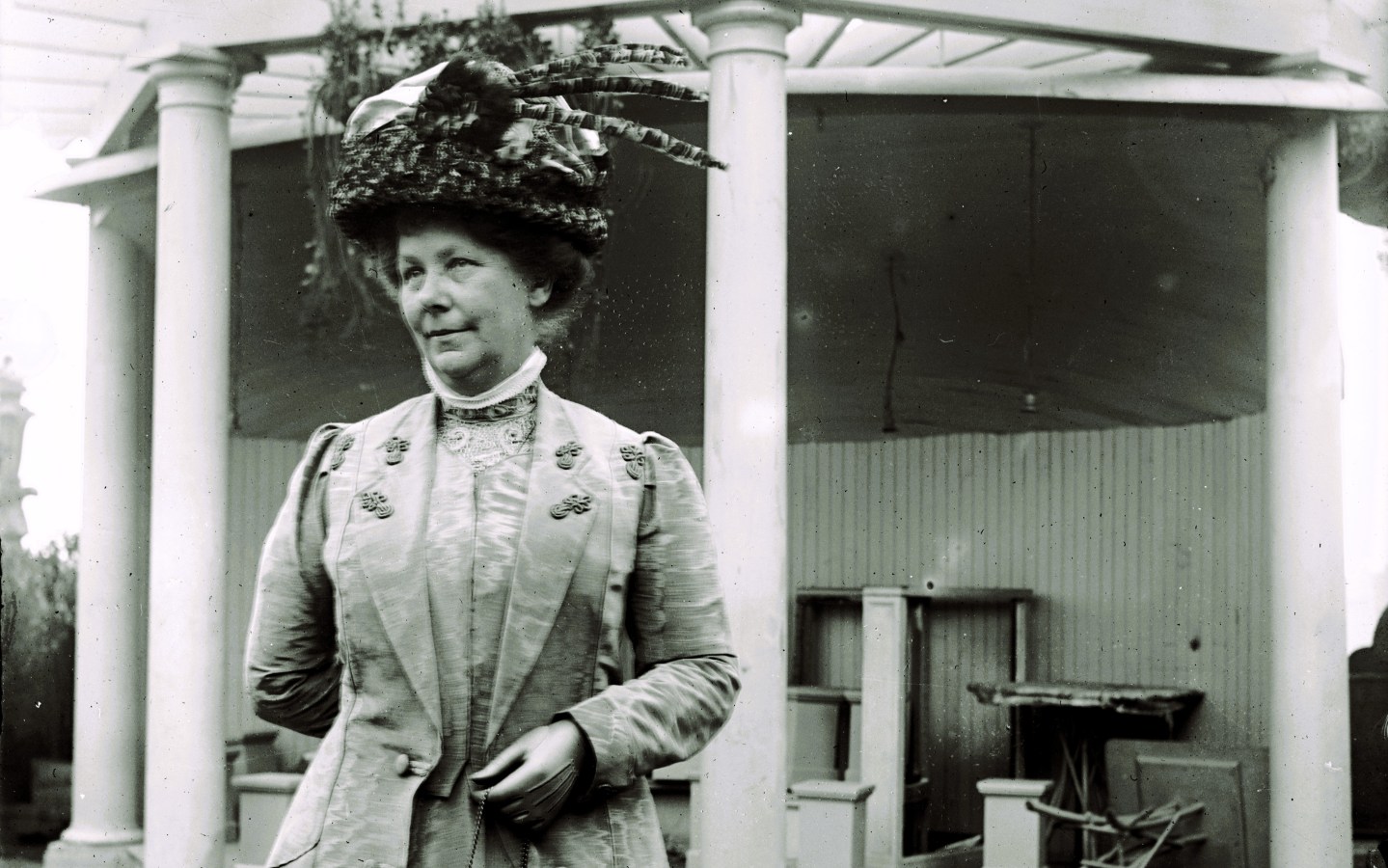
Long have British Labour ‘leaders’ been an embarrassment of forelock tugging and dirty knees before their ‘betters.’ Dora Montefiore takes Hardie and Snowden to task for their ‘conciliation’ with Churchill and Balfour on women’s suffrage.
‘Votes for Some Women’ by Dora Montefiore from The New York Call. Vol. 3 No. 203. July 22, 1910.
“Conciliation” Suffrage Bill a Cunning Effort to Bolster Property-Owning Class—Labor Member Fooled
LONDON, July landed England on the day of the debate in parliament on the “votes-for-some-women bill.” In consequence of the temporary slump in political life over! here, while Tories and Liberals are performing one of their masterly juggling tricks known as “seeking the basis of compromise on the question of the lords,” the government finds itself this session with several unoccupied days, and the bright idea struck them that they might propitiate the suffragettes by giving them two whole days of talk, talk, talk.
So the program was drawn up on both sides: the ladies, as usual, spent their money freely in a prancing pageant to demonstrate in favor of bill giving the vote to women house-holders, and members of both front benches, and the rank and file who had a prejudice or, fad to air, all began to study up their speeches and take parts in a glorified academic debate.
Shackleton Does Job.
The unfortunate Labor member Shackleton (who at the trade union congress at Ipswich last year took the chair in frock coat and tall hat with the idea, no doubt, of emphasising the class struggle) was selected as the victim who was to perpetrate this joke. He did not much want to do it at first, but when they all, Liberals and Tories, told him what a just and good and wise man he was, and how eminently fitted he was to be the champion of ladies: and how well he looked in a frock coat and tall hat: in fact he might almost in the distance be mistaken for Arthur Balfour, don’t you know, he began to think that really he was designed by Providence to bring in this bill, which no one else seemed burning to father.
So a few weeks back he formally moved the first reading of his so called “conciliation bill,” and on Monday, July 11 moved its second reading. In his speech on this latter occasion he stated that “householders” would number more than 90 per cent of those who come under the bill. It would also enable women living together to rank as joint occupiers, provided the house was worth £10 for each occupier.”
For Property Only.
But he did not say what, as a Labor member representing a great industrial constituency he should have said, that this measure was first and foremost a measure to give extended representation to property, and that those whose business and interest it was to stem in every way the oncoming stream of educated democracy were fighting tooth and nail to get this measure placed on the statute books, so as further to buttress up prosperity and privilege.
In the article on the debate in the Daily News, we are told that:
Conservative members tell their supporters frankly that they stand to gain by it, both by immediate proportionate increase in the Conservative vote, and also by shelving indefinitely proposals for wider enfranchisement. Mr. Asquith interpreted the bearing and tendency of the bill in the following words:
What you are really doing–what leaders of the Labor party and others responsible for the bill are really doing, is, in the name of democracy, introducing to the electoral roll of this country a principle of propertied voters–a principle of introducing persons, who, so far as I know, have no special claim of any sort or kind to be distinguished from their fellow women, but at the same time deliberately leaving out the class of women who have the best title to be on the roll–the best fitted by the circumstances of their lives, and by the functions they are daily performing, to exercise political rights…I do not understand by a democratic measure, a measure such as this, which in its direct application would enable an enormous number of new qualifications to be manufactured by well-to-do people, and in that way to adulterate the constituency of the country.
Balfour Scoffs.
Mr. Balfour indulged in his usual scoffing, detached tone; sneered at the use of the word “democratic,” remarking, “We are almost sick of it.” And while promising support to the bill, told the ladies who were backing it that he did not think it would do them much good.
Mr. Churchill, the home secretary, showed up even more clearly than did Asquith the class and privilege basis of the measure.
The more he studied the bill, he said, the more astonished he was that members could possibly have put their names to it. It was not a democratic bill, but an anti-democratic bill, giving an unfair representation to property as against persons. “How many of the propertied voters would be increased,” he said, “by the husband giving the ten qualifications to his wife and his five or six daughters? My honorable friend, Mr. McLaren, said the bill would be accepted for many years to come. Very likely. If a large body of propertied women are added to the list they are not likely to be in a hurry in that respect. I think we must recognize that this proposal may very likely only prove very vicious halting place. I can understand the honorable member for Oxford hurrying from his academic groves to welcome this windfall. But when I see a Liberal member voting for such proposals I feel he is very Innocent or very intimidated.”
After recapitulating some of the absurdities contained in the bill, such as a woman being given a vote under it while she was living a life of prostitution, which vote she would lose if she married and became an honest woman, Churchill wound up his speech by saying:
“I shall, after long reflection, but without any doubt whatever, give my vote this evening for the rejection of this measure upon its second reading.”
Lloyd George made no speech, but his vote was cast against the bill, as were the votes of most leading Radicals like Sir Charles Dilke. J.M. Robertson and Masterman.
As readers of The Call will already know. 299 M.P.’s voted for the second reading and 190 against, making the majority for 109. There was a time in the course of the first day of the debate when the interest flagged, so much that attention was called by one of the members to the fact that forty were not present in the house, and a count-out nearly took place.
How Hardie and Snowden Voted.
Keir Hardie and Snowden both defended and voted for the bill–a curious position, surely, for Labor members to be champions of the extension of property, rights, which even Liberals and Radicals find it impossible to defend. Both these things will happen in the best regulated political party which possesses no program, and only believes in the class struggle when it wants to get representation at an international Socialist congress.
“Compromise,” says Keir Hardie. “Conciliate,” murmurs Snowden. “Observe how bravely I have defended the ladies,” coos the solemn faced Shackleton, as he wipes his forehead and polishes his tail hat.
And the Labor members tumble over each other in the division lobby in their eagerness to follow such eminent examples.
And the experienced statesmen who pull the strings of this puppet show see to it that the bill is sent to a committee of the whole house, instead of to a grand committee, which might have been packed with these unintelligent and fluid wabblers. And before this gets into print in New York the English police may be again on extra duty and Holloway be filled with suffragettes.
And the conclusion of the whole matter to those who can read between the lines is that when Whig Asquith can be got out of the way, and Lloyd George and Winston Churchill are going nap, we shall have an adult suffrage bill on a residential qualification, and it will be a case of sic transit suffragetter.
The New York Call was the first English-language Socialist daily paper in New York City and the second in the US after the Chicago Daily Socialist. The paper was the center of the Socialist Party and under the influence of Morris Hillquit, Charles Ervin, Julius Gerber, and William Butscher. The paper was opposed to World War One, and, unsurprising given the era’s fluidity, ambivalent on the Russian Revolution even after the expulsion of the SP’s Left Wing. The paper is an invaluable resource for information on the city’s workers movement and history and one of the most important papers in the history of US socialism. The paper ran from 1908 until 1923.
PDF of full issue: https://www.marxists.org/history/usa/pubs/the-new-york-call/1910/100722-newyorkcall-v03n203-DAMAGED.pdf

