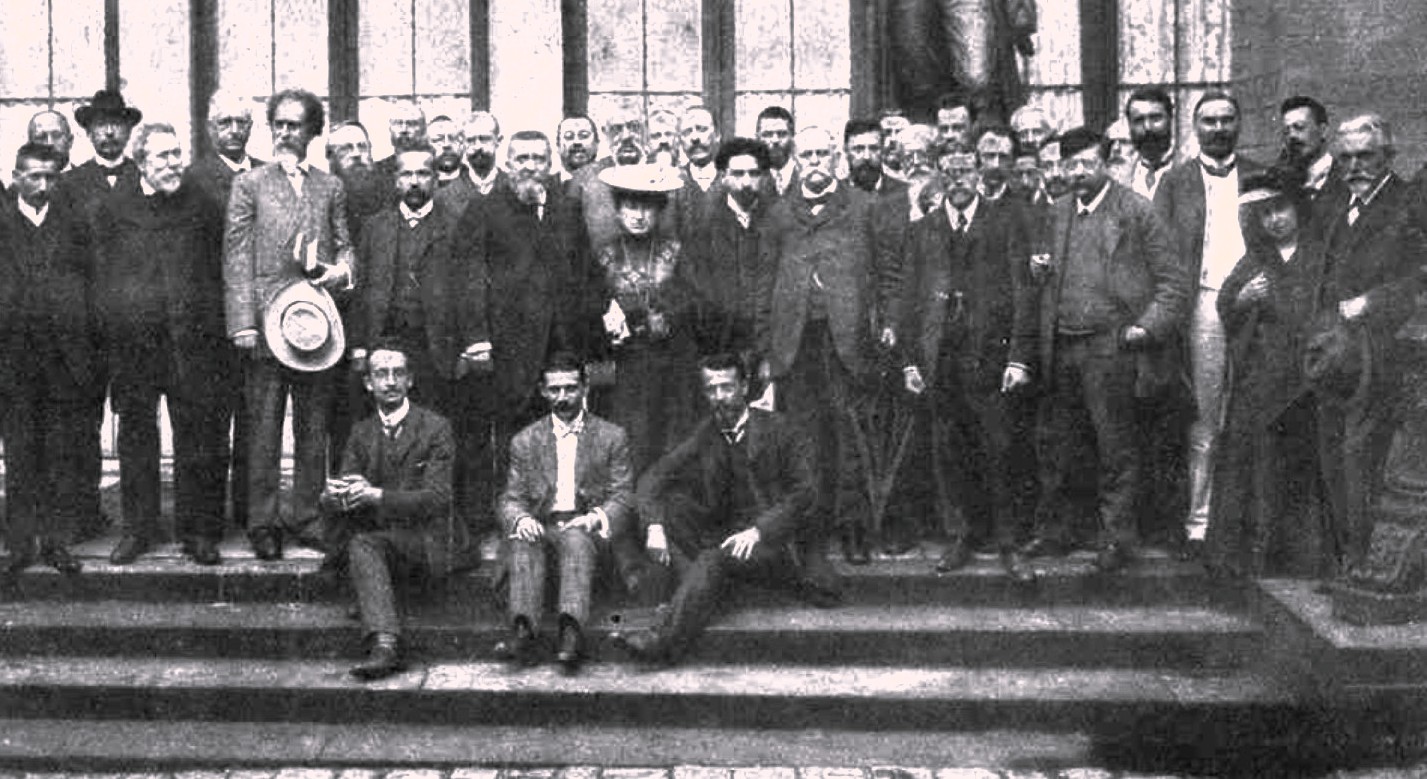
This report back to his organization on the Stuttgart Congress of the Socialist International from the delegate of the Industrial Workers of the World includes texts of motions and speeches as Socialist Party delegates dispute the I.W.W.’s position on the American Federation of Labor.
‘Report of Delegate to Stuttgart’ from Fred W. Heslewood from Industrial Union Bulletin. Vol. 1 No. 31. September 28, 1907.
Chicago, Sept. 20, 1907. To the Members of the Industrial Workers of the World:
Fellow Workers: As your representative to the International Socialist Congress, held at Stuttgart, Germany, from August 18 to 24, I desire to submit the following report, so that you may become acquainted somewhat with the work of the congress and also of my actions as your representative.
You may readily understand that a congress of this description, with over 1,000 delegates, representing all countries of what is known as the civilized world, with all the different languages to be interpreted, with only six days to do the business in, would be a very unwieldy affair, if every delegate was given a chance to air his or her opinion on the floor of the congress. And it will have to be admitted that among socialists there is a wide diversity of opinion as to the proper method of attaining the Cooperative Commonwealth where the worker will enjoy the full social value of the product of his toil.
To simplify matters as much as possible the International Bureau, in advance of the convening of the congress, has acted somewhat in the capacity of a resolution committee: they having the resolutions condensed in simple form and ready for the congress.
The principal propositions which were discussed by the congress were divided into five sections, as follows:
Section 1. Militarism and international conflicts.
Section 2. Relations between the political parties and trade unions.
Section 3. The colonial question.
Section 4. The immigration and emigration of the workers.
Section 5. Women’s franchise.
The work of these five sections are taken up by commissions, each commission being composed of four delegates selected from each country. The conclusions of the different commissions are then submitted to the full congress, to be voted on. In many instances there are majority and minority reports as the result of the work of the commissions.
Besides these five principal propositions, the International Bureau submitted to the congress the following proposals to be voted on:
1. To endorse en bloc the resolutions which have been passed by the International Bureau since the Amsterdam Congress.
2. To adopt the Standing Orders of the congress, the statute of the International Burean, and of the interparliamentary committee, also en bloc.
3. To decline an amendment of the English Independent Labor party asking to admit to the congress such bona fide trade union organizations as do not endorse the principle of class war.
4. To decline a proposal of the Italian socialists of Switzerland, concerning the introduction of a uniform ticket of membership for all the socialist parties of the world.
5. To pass on to the interparliamentary committee the proposal of the English Social Democratic Federation, demanding that in all parliaments the socialist representatives shall at one and the same time move a resolution demanding that the maximum working hours be fixed by law.
6. To decline as premature the proposals of the South African and the French sections regarding the utility and the selection of an international artificial language.
7. To decline the proposal of the social-democratic women of Germany, who re and simple politician, who would ask the congress to discuss the democratic extension of the franchise, but to accept the proposal of the social democratic women of Austria, who ask the congress to discuss women’s suffrage.
The International Bureau further pro pass to the congress to regulate the voting power of the different national sections in the following way: Germany, Austria-Bohemia, France, Great Britain and Russia: 20 votes each. Italy: 15 votes. United States: 14 votes. Belgium: 12 votes. Denmark, Polonia and Switzerland: 10 votes each. Australia, Finland, Holland and Sweden: 8 votes each. Spain, Hungary and Norway: 6 votes each. South Africa, Argentina, Australia, Bulgaria, Japan, Roumania and Servia: 4 votes each. Luxemburg: 2 votes.
According to the new regulations of congresses each national section will have to decide whether organizations of the country in question shall be admitted. If for instance a French organization not belonging to the socialist party (the French section of the International) wishes to send delegates, it must first of all apply to the party Such organizations as have been refused by the national section shall be allowed to appeal to the International Bureau. The national sections have themselves to distribute the votes ac corded to them. In case of serious difficulties the International Bureau shall be entitled to intervene.
Some difficulty was found in getting a proper distribution of votes among the representatives of the different organizations from America. After a lot of parleying and discussion as to the merits of the I.W.W. and the Sherman faction, your delegate was allotted 1 votes, while the Sherman delegate was accorded a vote, he not being able to show that Sherman had an organization in existence. He claimed he was elected at their annual convention, which was held in Chicago on the 4th of July. It later transpired that he was visiting his relations in Germany and got $20 from the Shermanites to attend the congress. He voted against our resolution and in favor of a “boring from within” one, that was supported also by defenders of that very revolutionary organization, the American Federation of Labor. He made a motion while attending the meeting of the American delegation that he should not have to qualify his credentials with any evidence as to the strength of his organization, and his last request was that he be excused from serving as one of the four delegates representing America on the commission for the discussion of “The Relations Between Trade Unions and Political Parties.” Just why he accepted the $20 from the sluggers is a mystery. It certainly was not for the purpose of defending Industrial Unionism.
As I consider the work of the commission on the relations between trade unions and political parties, the most important of all the work of the different commissions, I will give it more attention than the others–first, because it is really the only commission which is of interest to our membership: and secondly, because your delegate served on it.
The four delegates to represent America on this commission were, Simons, Lee, De Leon and Heslewood. De Leon and myself moved and spoke on the following resolution:
“Whereas, the integrally organized industrial organization of the working class is the present embryo of the Commonwealth of Labor, or Socialist Republic, and foreshadows the organic form of that commonwealth, as well as its administrative powers;
“Whereas, Craft unionism, wherever capitalism has reached, untrammeled full bloom, has approved itself what the plutocratic Wall Street Journal of New York hailed it, in hailing the Gompers-Mitchell American Federation of Labor, the bulwark of capitalist society,” that bred the officialdom which the American capitalist Mark Hanna designated as his “labor-lieutenantship”; therefore be it
“Resolved (1), That “neutrality” towards trades unions, on the part of a political party of socialism is equivalent to “neutrality toward the machinations of the capitalist class”;
“(2) That the bona fide or revolutionary socialist movement needs the political as well as the economic organization of labor, the former for propaganda and warfare upon the civilized plane of the ballot; the latter as the only conceivable physical force with which to back up the ballot, without which force all ballot is moonshine, and which force is essential for the ultimate lockout of the capitalist class;
“(3) That without the political organization, the labor or socialist movement could not reach its triumph; without the economic, the day of its political triumph would be the day of its defeat Without the economic organization, the movement would attract and breed the debauch and sell out the working class: without the political organization, the movement would attract and breed the agent provocateur, who would assassinate the movement.
“Industrial Workers of the World.
“Socialist Labor Party (America).”
This resolution was defended by delegates from Switzerland, Italy, France, of the S.L.P. of America and myself. Under this resolution the Industrial Workers of the World was advocated as the only solution for the workers of America, and in fact every other country. In showing the folly of craft and trade unionism in America, it was necessary to enlighten the delegates somewhat on how the capitalists contracted with the American Federation of Labor in America: how the workers were forced to scab on each other: how the craft unions denied the class struggle and asked for nothing better than a fair day’s pay for a fair day’s work: how the A. F. of L. was in the complete control of the labor faker: and how the labor faker and labor skinner met together at the Civic Federation for the purpose of creating peace between the master and the slave
Simons of Chicago denied these assertions and claimed, on the contrary, that the A. F. of L was class conscious because “they had recently raised large sums of money for the purpose of defending Mover. Haywood and Pettibone”; and Simons further went on and informed the delegates that, the business of the Industrial Workers of the World was to divide the workers and not unite them: that the socialist party of America did not believe in disuniting the working class. On these grounds he was opposed to the Industrial Workers of the World. That our membership may know who Simons is, it may not be amiss to state here that he is the editor of the Chicago Socialist; that he signed the manifesto and call for the first convention of the I.W.W., and further, that he has written and spoken for the I.W.W. since its organization, which is proof enough that he is a smooth liar and hypocrite. Like other working class pilots, it took time to find him out. That our membership may not think I am exaggerating as to this gentleman, I will here submit an extract taken from the Official Bulletin of the Congress, in Simons’ speech:
“Simons of Chicago denied that corruption had invaded the whole body of trade unionism in the States, though some of its leaders had been corrupted. That it constituted a menace to capitalism was evidenced by the fact that the masters’ association had raised recently a sum of $1,000,000 to combat Unionism. He thought we had something to learn from the rank and file of the workers as well as something to ask from them. The workers had become revolutionary in America, not because theorists had indicated to them the class-struggle, but because the stern logic of facts had brought them face to face with its existence. The socialist party of America did not condone the offenses of corrupt labor leaders, but it opposed itself to the attempt to create new unions, such as the I.W.W., in rivalry with older organizations, and thus creating disunion instead of cleansing unionism. They did not attempt to capture the trade unions, for socialism and trade unionism are two battalions of one army and it would be ridiculous for one to endeavor to capture the other.”
As your delegate I do not intend to air my views on political parties in this report, but I trust that you will do some hard thinking when it comes to having people who claim to be revolutionists go thousands of miles from America for the express purpose of defending the American Federation of Labor as against the Industrial Workers of the World. The following is the majority resolution which was submitted to the congress and the one which carried:
“To enfranchise the proletariat completely from the bonds of intellectual, political and economic serfdom, the political and the economic struggle are alike necessary. If the activity of the socialist party is exercised more particularly in the domain of the political struggle of the proletariat, that of the unions displays itself in the domain of the economic struggle of the workers. The unions and the party have therefore an equally important task to perform in the struggle for proletarian emancipation. Each of the two organizations has its distinct domain, defined by its nature, and within whose borders it should enjoy independent control of its line of action. But there is an ever-widening domain in the proletarian struggle of the classes, in which they can only reap advantages by concerted action and by cooperation between the party and the trade unions.
“As a consequence the proletarian struggle will be carried on more successfully and with more important results if the relations between the unions and the party are strengthened without infringing the necessary unity of the trade unions.
“The congress declares that it is the interest of the working class in every country that close and permanent relations should be established between the unions and the party.
“It is the duty of the party and of the trade unions to render moral support the one to the other and to make use only of those means which may help forward the emancipation of the proletariat. When divergent opinions arise between the two organizations as to the opportunism of certain tactics they should arrive by discussion at an agreement.
“The unions will not fully perform their duty in the struggle for the emancipation of the workers unless a thoroughly socialist spirit inspires their policy. It is the duty of the party to help the unions in their work of raising the workers and of ameliorating their social conditions. In its parliamentary action the party must vigorously support the demands of the unions.
“The congress declares that the development of the capitalist system of production, the increased concentration of the means of production, the growing alliances of employers, the increasing dependence of particular trades upon the totality of bourgeois society would reduce trade unions to impotency if, concerning themselves about nothing more than trade interests, they took their stand on corporate selfishness and admitted the theory of harmony of interests between labor and capital.
“The congress is of the opinion that the unions will be able more successfully to carry on their struggle against exploitation and oppression, in proportion as their organizations are more unified, as their benefit system is improved, as the funds necessary for their struggle are better supplied, and as their members gain a clearer conception of economic relations and conditions and are inspired by the socialist ideal with greater enthusiasm and devotion.
“The congress invites all the trade unions that accept the conditions laid down by the Brussels Conference of 1899, ratified by the Paris Congress of 1900, to be represented at the International Congresses and to keep themselves in relation with the International Socialist Bureau. It charges the latter to enter into relations with the International Secretariat of Trade Unions at Berlin so as to exchange information respecting working class organization and the workers’ movement.
“The congress directs the International Bureau to collect all documents which may facilitate the study of the relations between trade organizations and the socialist parties in all countries and to present a report on the subject to the next congress.”
Many other resolutions were submitted, but afterwards withdrawn in favor of the majority resolution. They were all practically along the same line. Some were in favor of the general strike and others were much opposed to it, on the ground that when we were ready for the general strike we were at the same time ready for the revolution. The English resolution is of some interest, especially in view of the fact that the English trade and craft unions are organized on much the same lines as the A. F. of L in America. This resolution was introduced and defended by Mary McArthur, who is an organizer of trade unions in England, and who does not believe in Industrial Unionism. The resolution is as follows:
“The congress being convinced that the working class will only be able to work out its freedom completely by the combined power of trade union and of political action, and in conjunction with the organized socialist parties in their respective nations in order to bring about eventually the overthrow of capitalism.
“Convinced also that this double action is both natural and effective, seeing that when trade unions enter politics their immediate demands and ultimate objects must be the same as those of socialism.
“Considering, further, that this fundamental agreement of the political and of the industrial action of the proletariat is bound to secure without confusion, domination or mistrust a free and complete co-operation between the two organisms, invites all militant socialists to do their best to remove all misunderstanding between the trade unionist and the political organizations of the working class.”
Resolutions like this one are generally advocated by organizers who are in the pay of the trade unions. They are anxious to have socialism, but they are not anxious to help build up a true economic movement that will be the means of abolishing craft divisions and substitute a class organization that will be the means of setting on foot a true political party. Their highest ambition is to have the craft unionist vote the socialist ticket, permeate their unions with socialism, etc. To show that this plan has not worked out satisfactorily, I will use an extract from the speech of Delegate Romeo, a diamond cutter of Antwerp, Belgium, which also shows that where the political party has gotten strong in the trade unions the trade union has then lost its powers of initiative and has been dominated by the political party. Here is what the Official Bulletin of the Congress has to say of the remarks of Romeo:
“Citizen Romeo, delegate of the Antwerp diamond cutters, while recognizing that trade unions are a school in which the workers receive useful practical lessons as to the reality of the class war, and agreeing that socialists should propagate their creed within the trade unions, regretted that in Belgium the socialist party dominated those organizations and had deprived them of the faulty of initiative.”
The resolution of the French section is probably in closer touch with the ideas of Industrial Unionists than any of the others, inasmuch as it is cleaner cut and comes from men who are not afraid to go the limit for what they want, regardless of consequences. These men voted at the finish for the resolution which was submitted by your delegate. This resolution, which is of interest, is as follows:
“The congress being convinced that the working class will only be able to completely work out its freedom by the combined power of political action and of trade union action by syndicalism up to the general strike and by the conquest of political power in order to bring about the general expropriation of capitalism;
“Convinced also that this double action will be all the more effective seeing that these political and the economic organisms will have their full autonomy, trade unionism having the same end in view as socialism;
“Considering further that this fundamental agreement, of the political and of the economic action of the proletariat is bound to secure, without confusion, domination or mistrust, a free co-operation between the two organisms;
“Invites all militant socialists to do their best to dissipate all misunderstanding between the corporative and the political organization of the working class.”
As revolutionary as this French resolution sounds, it, like the rest of them, is all moonshine to an Industrial Worker in America All these resolutions wind up by asking the politicians to try and dissipate all misunderstandings between the trade unions and the political parties. The Industrial Worker of America believes in just the reverse of this. We believe that what Marx said was correct; that “only through the economic organization can a true political party be set on foot.” We believe that the political party is merely the reflex of the economic organization. The republican party of America is the reflex of organized capitalists, such as the steel, oil, beef and other large trusts. The democratic party is the reflex of another organized band of capitalists of America, and the socialist who tolerates and even believes in craft and trade divisions of the worker, namely, organized scabbing, finds, according to Simons and his colleagues, a place to reflex his beliefs in a political party in America.
The word trade union, as stated in the resolutions from the old countries, does not have the same meaning as trade unions in America. In many places they may mean a form of int trial unionism, not a form as far reaching as the I.W.W., but a closer unity of the workers than applied to a trade union in America. For instance, in Switzerland the metal workers and the wood workers are industrially organized, especially the metal workers, who are a very revolutionary body of men.
Although the majority resolution which was passed may not meet with as much favor among our members as our own, yet it is a resolution that no one I can fight under and at the same time stay in the American Federation of Labor.
The French Socialist Congress, which adjourned at Nancy, France, on the 15th of September, and where I attended for a day on my way to Stuttgart, is worthy of mention here, owing to the fact that it instructed its delegates to the Stuttgart congress to stand for revolutionary unionism. These delegates realized that nothing could be accomplished until revolutionary economic organization was established.
Our organization was ably introduced in the emigration and immigration commission by Delegate Bohm, who was formerly an organizer for the Industrial Workers of the World. Much dissatisfaction was shown by the delegates on this commission to the high initiation fees charged foreigners in America by the A. F. of L. When the Industrial Workers’ organization was explained to them they were very much interested, and all agreed that it was correct.
Although it is a long and expensive trip for our organization to undertake in sending a delegate to Stuttgart, yet I believe that much good will come from it. It is deplorable that two factions should be represented at the congress, one voting in open congress against the other, and that men who claim to be socialists should be found at the congress (as Simons was) accusing us before delegates from all over the world of disuniting the workers in America. The actions of these men will only reflect on themselves and their party in the near future.
As the delegates who were representing unions at the congress were anxious to know more about the Industrial Workers of the World in America, our literature was anxiously inquired for, and the only difficulty I met with was in not having enough to meet the demand.
While in Berne, Switzerland, on my way to Genoa to take the boat, and where I stayed for several days, I had several meetings with the secretary of the Syndicalist movement in Switzerland. This is a class-conscious body of workers numbering 70,000 persons. While at Berne I made arrangements for the exchange of our Bulletin with four of the European labor papers, including Switzerland, Austria, Italy and Germany. The translating will be looked after by Mrs. Faas of Berne, who is a staunch advocate of the I.W.W., and who spoke in favor of our resolution at the congress. She is secretary and translator of the Swiss Syndicalist movement, and through her we will have no trouble in getting our organization well-advertised in many of the European labor journals. I consider this an important move, as through this line of communication the workers in Europe will become acquainted with the Industrial Workers of the World, our form of organization and the work we are carrying on, so that when they arrive in America, which many of them will do, they will not be hoodwinked and robbed by the A. F. of L.
There is no doubt but that when the next congress meets at Copenhagen our organization will be thoroughly understood by the workers in Europe. The congress invites all organizations of labor which have accepted the class struggle to become affiliated with the International Socialist Bureau, and to keep in closer touch with the Bureau. With the one recommendation that we accept these invitations, I will close my report on the trade union question. The other propositions which were discussed by the congress I will take up through the columns of the weekly Bulletin.
Respectfully submitted,
FRED W. HESLEWOOD.
The Industrial Union Bulletin, and the Industrial Worker were newspapers published by the Industrial Workers of the World (IWW) from 1907 until 1913. First printed in Joliet, Illinois, IUB incorporated The Voice of Labor, the newspaper of the American Labor Union which had joined the IWW, and another IWW affiliate, International Metal Worker.The Trautmann-DeLeon faction issued its weekly from March 1907. Soon after, De Leon would be expelled and Trautmann would continue IUB until March 1909. It was edited by A. S. Edwards. 1909, production moved to Spokane, Washington and became The Industrial Worker, “the voice of revolutionary industrial unionism.”
PDF of full issue: https://www.marxists.org/history/usa/pubs/industrialworker/iub/v1n31-sep-28-1907-iub.pdf

