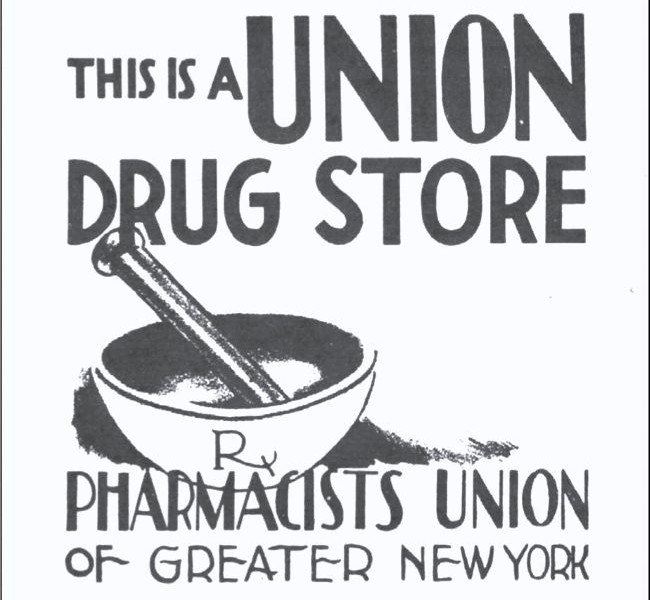
Today’s SEIU 1199, with over 450,000 members and historically among the most important locals in the U.S. labor movement, was largely organized by Communists, started in 1932 as the Pharmacists’ Union of Greater New York, and included all drugstore workers. The conditions that gave rise, and early the work of the union.
‘The Union for Pharmacists–Its Aims, Its Purpose and Its Relation to the Public Health’ by James J. Burton from Health Vol. 1 No. 2. June, 1934.
WHILE grievance of the licensed pharmacist-employee, the person dubbed by the public, erroneously, the drug “clerk,” is not only the same general grievance of employees in other callings,–that of long hours and starvation wages. It is in addition to these, the grievance of men, who, having spent years in school and college to qualify for the practice of their calling, find themselves looking on helplessly, while that calling sinks daily deeper into the ruthless clutches of “big business”; while their employers, also pharmacists, do little to save it from extinction.
It is a peculiar yet actual circumstance that in pharmacy, as in no other vocation, it is the employee pharmacist, rather than the store-owner pharmacist, who feels most keenly the pride of his profession; who most often resents the commercialization of his art and who perceives most readily, with dismay and despair, its gradual degeneration and decline. This is due, in the first place, to the fact that a great many owners of drug-stores are not themselves pharmacists, at all; but are in the drug business merely as a speculation, with no particular sentiment for its ideals or ethics. Secondly, of those proprietors who are licensed pharmacists, a vast number have long since succumbed to the greed of Big Business, which decrees that the ethics of the arts and sciences must bow before the Altar of Profit. The “clerk,” the employee pharmacist, always resents being used as a cover for shady and unethical practices unbecoming his profession. On the other hand, the majority of drug-store owners, the employers, instead of organizing to fight the degenerating influences which slowly eat into their livelihood, and make the ethical practice of pharmacy almost an impossibility, choose rather to quarrel and squabble among themselves and to mimic the selfish chain-store interests in their ruthless cut-throat methods of competition, with disastrous results to themselves and their profession.
Pharmacy as a business and profession, is today the most chaotic and haphazard of pursuits in this country, when for the sake of the National health, since it is the source of supply of its medicinal necessities, it should at all times be the most stable and orderly. This condition is directly traceable to number of causes, the most important of which, we believe, is the lack, in this State at least, of proper and adequate means of supervising the practice of pharmacy and the neglect on the part of the New York State Board of Pharmacy to enforce the State Pharmacy Law, meager and inadequate though it is. The dangers to the Public, to the citizens whose taxes pay, ostensibly, for safeguarding their health, have increased so manifold in the last few years, due directly to this lack of supervision and enforcement, that we feel it should be of interest to the taxpayers to know more about what goes on behind the scenes.
In 1923 a law was passed in this State making it compulsory for the owner of a drug store to be a licensed pharmacist. This law was passed after years of labor on the part of those pharmacists who saw with alarm that Prohibition was causing an influx into the ranks of pharmacy of an army of undesirable characters, whose sole aim was to obtain a pharmacist’s license for use as a camouflage for the illegal traffic in alcohol. With the help of an aroused public opinion similar laws were adopted in many other States. Despite the many loopholes in these various laws, the influx was somewhat reduced and incidentally the ever-greedy chain-store corporations found it a little harder to exploit the drug field. When these Chain-Stores exhausted all means, legitimate and otherwise, of breaking this ownership law, they embarked upon a ten-year battle to have it declared unconstitutional and finally succeeded a few months ago in having it wiped off the books.
It is a strange phenomenon in our country, that whenever a law or ordinance is passed in the interest of the average citizen, if it interferes with the interests of “Big Business” in its systematic gouging of the public, “Big Business” always finds a way of having such law or ordinance declared “unconstitutional.” A convenient scrap of paper that constitution of ours, but unfortunately,–for the wrong people.
As a result of this voiding of the law, every Tom, Dick and Harry who pays a two-dollar fee and declares in his application that his “pharmacy” is equipped with an “adequate” scale, a copy of the United States Pharmacopceia, a copy of the National Formulary, a graduate and a mortar and pestle, must be granted a certificate of Registration for his “Pharmacy” even if his education is limited to the signing of his name with his fingerprint. This is exactly the situation in this State today.
Until the voiding of the Pharmacy Ownership Law, there were in the State of New York a little over 7,000 drug stores. About 4,000 of these were located in Greater New York City. This number has almost doubled since then, due to the fact that every cut-throat cosmetic-shop owner who has thought it worth while to do so, has added the aforementioned “equipment” to his shop and demanded a certificate of registration as a pharmacy.
Now, to supervise, inspect, investigate and report upon the activities of these, approximately ten thousand drug-stores in the State, the New York State Board of Pharmacy in charge of enforcing the State Pharmacy Law, maintains the ridiculously insignificant number of six inspectors. If these drug stores were evenly distributed throughout the State, each inspector would have a territory of some 1,600 stores. But they are not. The great majority of them are located in New York City. The inspectors are appointed: two to Greater New York with its five thousand stores, and four to the rest of the State. This gives each New York City inspector a territory of about 2,500 stores, and thus we have the disgraceful condition of a city of six million population–a small nation in itself, dependent for the protection of its source of medicinal necessities upon the inadequate supervision of but two men.
The Board of Health of the City of New York maintains a far larger staff of inspectors, and yet the courts are always full with grocers, dairymen, butchers and other food-dealers who are constantly trying to “get away with it.” Is it hard to imagine what measure of safety would remain to us in our food supply if this staff of inspectors were reduced to two for the entire city? And yet, the danger to the Public Health would not be quite as great as it is in the drug-field, because the housewife is to some extent a connoisseur of foodstuffs and can tell fairly well between good food and bad. But what chance does the layman stand in a specialized field like pharmacy, if he must rely regarding the quality of the drugs he purchases either upon his own judgment, or upon the judgment and honesty of the man behind the counter, who by the laxity of those entrusted with the enforcement of the law is constantly tempted to violate that law, as a means of coping with the ruthless and unrestrained competition of the chain and cosmetic shop?–surely, very little. The results of a decade, or more, of neglect on the part of the State Board of Pharmacy and indifference on the part of the public have reached a point where silence on the part of those who are loyal to the ideals of pharmacy, is nothing short of criminal.
There are drug stores in this city which have not been entered by an inspector of the State Board of Pharmacy even once in as long as two or three years. In the past twelve years, I have worked in drug stores in practically every section of the city and I have even owned my own store. I can honestly state that in all these years I have seen an inspection just once–and that in my own store, exactly eleven months after I had opened for business. During these eleven months, as far as the Board of Pharmacy knew, there may have been in place of my store an empty lot. As for the assurance of the Public regarding the merchandise they were buying from me, every bottle on my shelves could have been filled with colored water; every powder, drug and chemical could have been a little colored talcum or chalk. I could have sold deteriorated, sub-standard, misbranded merchandise, or other medicines in many ways as useless as some 90% of the widely advertised patent “medicines.” For such shameful neglect of the public welfare the State, through the Board of Pharmacy, spends yearly thousands of dollars of the taxpayer’s money.
A further condition resulting from this neglect, is the large percentage of drug stores which operate without the supervision of a licensed pharmacist for days at a time. The State Pharmacy Law requires that a pharmacy shall at all times be in charge of a licensed pharmacist. In addition, a ruling recently made by the State Board of Pharmacy requires that every pharmacy owned by a non-pharmacist must employ two licensed pharmacists, so that the establishment shall be under constant supervision of a qualified person from opening to closing. While this law and the more recent ruling are most desirable from every instance of safety, the value of it to the public is entirely lost because of the inability of the State Board to enforce their observance. With two inspectors in charge of some five thousand drug-stores and with no means of identifying the man behind the counter as a pharmacist beyond his own assertion that he is the man whose license is displayed in the store, the whole thing is a farce and mockery, an insult to the intelligence of the citizens of this city and a betrayal of their confidence in the authorities.
Since the chances of discovery and punishment are about one to two thousand or more, a great many drug stores are left in charge of apprentices for days at a time, especially during evenings, Sundays and holidays, when inspectors do not usually bother to operate. Where a drug store is owned by a partnership with one of the partners not a pharmacist, in many cases, in order to avoid the salary of a licensed man, the non-pharmacist partner operates the store during evenings and weekends under a license borrowed, for a consideration, from a non-practicing pharmacist–usually an ex-bootlegger, out of business since repeal of Prohibition.
So much for the conditions directly affecting the public in a field of endeavor which, along with medicine, should stand guard over its health, ready at all times to serve, but which, alas, is in a condition of degeneration and chaos. A really complete picture and analysis of conditions in pharmacy would require a volume, and some day perhaps it may be written. As employees, however, we pharmacists are also interested in the economic side of the drug-business. When our welfare and our ability to practice our profession with some measure of security and assurance of our bread and butter is affected we feel that the public is indirectly concerned.
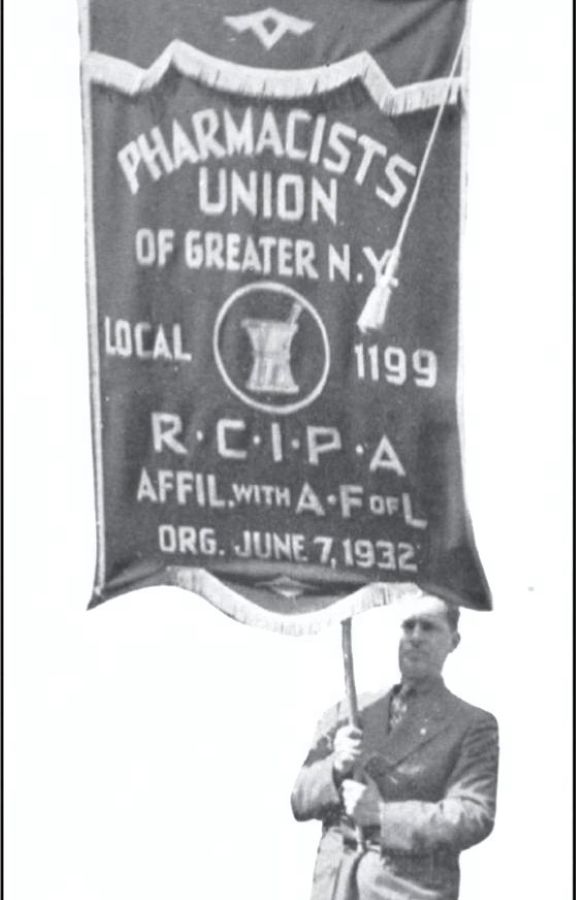
The same lack of supervision, the same neglect on the part of the New York State Board of Pharmacy is also responsible, to a great extent, for the fact that hundreds of licensed pharmacists walk the streets without jobs. The failure of the State Board to devise a plan whereby the opening of Pharmacies would be confined to the requirements of the population has encouraged young men to flock: to pharmacy with the intention of opening a pharmacy at the first opportunity on the first available corner store. The failure of the State Board to restrict licensing examinations to the needs of the people has encouraged the colleges of pharmacy to turn their instructions into “mills,” grinding out pharmacists by the thousand, year after year, over a period of some fifteen years. This in addition to the waste of thousands of dollars of the taxpayer’s money upon unnecessary examinations, has flooded the field with a surplus of half-baked pharmacists.
But the failure of the State Board of Pharmacy to properly supervise the Drug. Stores of the City, its failure to heed the requests and the advice of those interested in the field who from time to time raised a voice of protest against this attitude of laissez faire, has resulted in a contemptuous disregard for the provisions of the State Pharmacy Law to an extent that hundreds of pharmacists are out of jobs; due to the fact, alone, that apprentices are taking the place of registered pharmacists. As a result of this, licensed pharmacists today will work for salaries which in other callings are scarcely offered to porters.
The licensed employee, who greets you with a smile from behind the counter in your drug-store, who has spent years to train himself to answer those confidential questions you often ask, is compelled to dress presentably, and to support himself and often also a wife and child, on an average of eighteen dollars a week, and while people are discussing thirty and thirty-five hour work weeks, he still works under a pharmacy-law which permits his employer to exploit him seventy hours a week.
Fifteen years of unrestricted licensing of pharmacists by the thousand-lots yearly, together with the epidemic of bankruptcies in the drug field soon after the stock market crash of 1929, which threw many proprietors into the ranks of unemployed drug clerks, have produced a class of men in pharmacy who must reconcile themselves to the fact that they will never be proprietors of drug stores, for the very simple reason that there are not enough available stores for all of them in New York City. The old saying, “the clerk of today is the proprietor of tomorrow” is not true anymore. The field of pharmacy is saturated over and over again with drug stores; and not only the employees but the proprietors, too, must make up their minds, that there has arisen in the drug field a definite class of pharmacists–a permanent class of employees–a working class; and this class must be reckoned with in the same way as the employees, the workers, of other callings are being reckoned with. Their rights must be respected. Every pharmacist employee has a right to expect decent hours and a living wage from his employer. To assure each man these rights, the employee pharmacists of New York, those whom suffering has awakened to a realization of conditions as they really are and as they can be made, have organized a body that will fight for the recognition of those rights.
The Pharmacists’ Union of Greater New York, which has a membership of over 1200 was organized a little over a year ago. Its immediate purpose is to gain recognition of the employees in the drug field, and of their rights to decent working conditions; a work-week which will give each man sufficient spare time to enjoy his home life, improve his mind and usefulness through study, and permit him to enjoy the fruits of his labors to the same extent as employees of other callings who are inclined to do so; to raise his pay to a level commensurate with the extent of the preparation required of him and the standard of living to which his education entitles him. The more distant aims of the Pharmacists’ Union of Greater New York is to raise the ethical standards of Pharmacy to its practice as a profession, instead of a sideline, or as an outlet for patent medicine manufacturers.
The program of the organization may seem ambitious, but with the help of our sister professions, medicine and dentistry, and an aroused public opinion, we hope to put it through. At a state convention of Drug Store employees held during the past summer in New York City, the assembly of nearly a thousand passed resolutions calling upon the State Board of Pharmacy to enact a number of reforms which would definitely put a stop to a number of the abuses of which I spoke above; but so far the Board of Pharmacy has been passing the buck. The Pharmacists’ Union, however, is determined upon its program and we know that perseverance will finally win out.
To eliminate the abuse of operating drug stores without licensed pharmacists, the Pharmacists Union of Greater New York has called upon the State Board of Pharmacy to institute the requirement that every pharmacist’s license shall bear the photograph of the licensee.
By this means a layman or an inspector entering a drug store will not be in doubt as to the identity of the man he speaks to. By comparing the man with the picture on the license displayed in the store, both layman and inspector will be certain. In order to introduce some standard of humane treatment of drug store employees, the organization is working to amend the State Pharmacy law to reduce the maximum of working hours for an employee to 48 instead of the 70, as now permitted. This would be one more measure of Safety for the benefit of the public health. For it is a well-known and accepted fact that people who are over-worked and underpaid, who constantly drudge and never play, can not be counted upon to be alert on their jobs, and in a calling such as pharmacy, where a mistake may easily result in a fatality or, at best, severe illness, such conditions should certainly not exist.
To this end, the Pharmacists Union of Greater New York which during the past year has done so much to bring to light the inhuman conditions under which the licensed pharmacists toil in this City, is doing its utmost now to squeeze from the N.R.A. administration some measure of relief for the exploited drug clerk. The administration at Washington is now busy “revising” the various industrial codes. There certainly is no Code in any industry which has given employees as raw a deal as has the Drug Code. We hope that the desperate plight of the drug clerk will be reckoned with in the new Code. We can not believe that the administration which, supposedly, is seeking to better the economic condition of the Working classes intentionally left the employee pharmacist out in the cold; we believe that the N.R.A. officials as well as the President, were ill advised by the “big shots” in pharmacy upon whom they relied for guidance in the intricacies of an unfamiliar field, but who betrayed their confidence shamefully.
The foregoing is but a glimpse of the chaotic conditions in pharmacy. There are many more abuses of as great interest to the public; I should like to discuss them individually from time to time. Meanwhile I believe I have shown that there are sufficient grounds for an intelligent public to understand the dangers which they incur in permitting so important a calling as pharmacy to carry on with a minimum of regulation and supervision. I hope that the public, the medical and dental professions will realize the necessity of bringing some reform into the present system of enforcing the State Pharmacy Law and support the Pharmacists’ Union in its fight for an adequate number of inspectors–at least ten for the City of New York; a photograph on the license of every pharmacist and a shorter work-week.
All these reforms must be brought about through new legislation and we hope that when we are ready to sponsor such legislation that the public, the medical and dental professions will bring pressure to bear upon recalcitrant legislators who are usually blind to the public good.
[Neither the N.R.A. nor the Legislature will do anything for the exploited drug clerks. Their only salvation, like that of the rest of the working class, lies in organizing themselves into a body having enough strength and solidarity to impose its will upon the employers, by mass action–Editor.]
Health was the precursor to Health and Hygiene and the creation of Dr. Paul Luttinger. Only three issues were published before Health and Hygiene was published monthly under the direction of the Communist Party USA’s ‘Daily Worker Medical Advisory Board Panel’ in New York City between 1934 and 1939. An invaluable resource for those interested in the history history of medicine, occupational health and safety, advertising, socialized health, etc.
PDF of full issue: https://www.marxists.org/history/usa/pubs/health-luttinger/v1n2-jun-1934-Health.pdf

