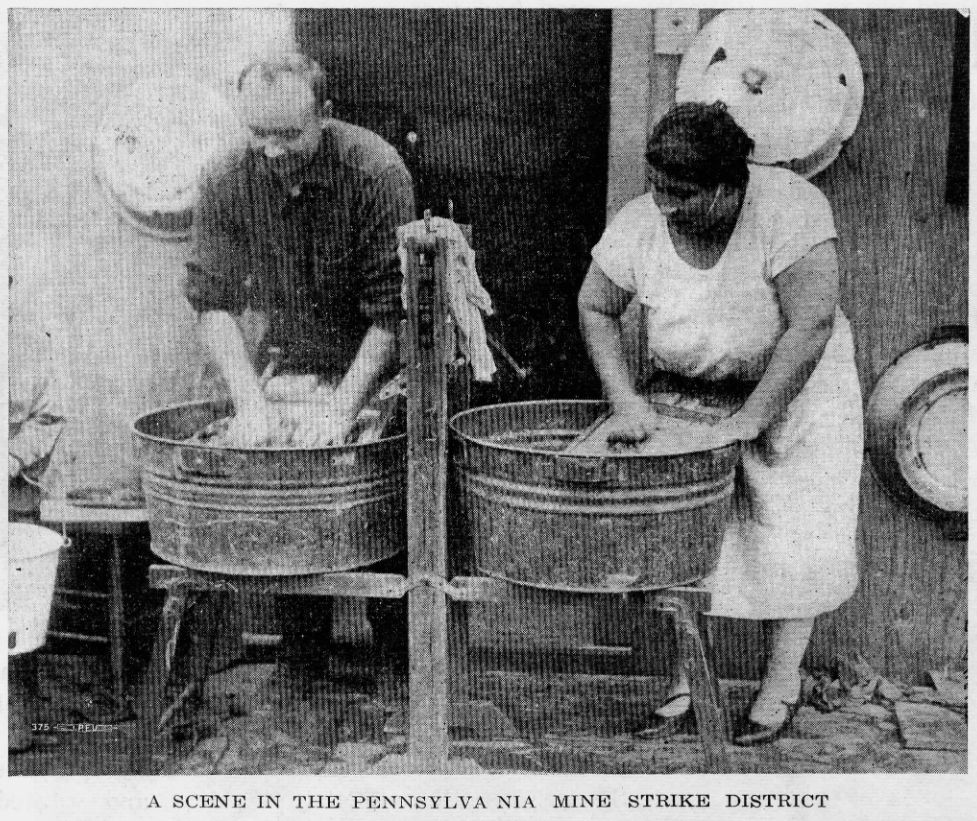
Foster on the hugely consequential, massive coal strikes of 1927. Even during the thick of the fight, U.M.W.A. leader John L. Lewis sought to facilitate the operators restructuring plans, and began wholesale expulsions of militants and rivals after the expiration of the national Jacksonville Agreement. The Communist Party counted many hundreds of miner members and supporters, including important local and regional leaders, for example winning the U.M.W.A.’s District 5 in Pennsylvania. Those supporters formed the ‘Save-The-Union’ caucus. By September of that year, the U.M.W.A. expelled enough locals that it was decided to establish the National Miners Union.
‘Tasks and Lessons of the Miners’ Struggle’ by William Z. Foster from The Communist. Vol. 7 No. 4. April, 1928.
The struggle now going on in the mining industry against the coal operators coal operators and the corrupt Lewis administration is of the deepest importance to the whole working class. Not only is the Miners Union at stake, but also, to a large extent, the entire labor movement. Consequently, our Party’s most vital interests are at stake. It is not surprising, therefore, that this basic struggle presents a whole series of valuable lessons as well as urgent tasks for our Party and the left wing.
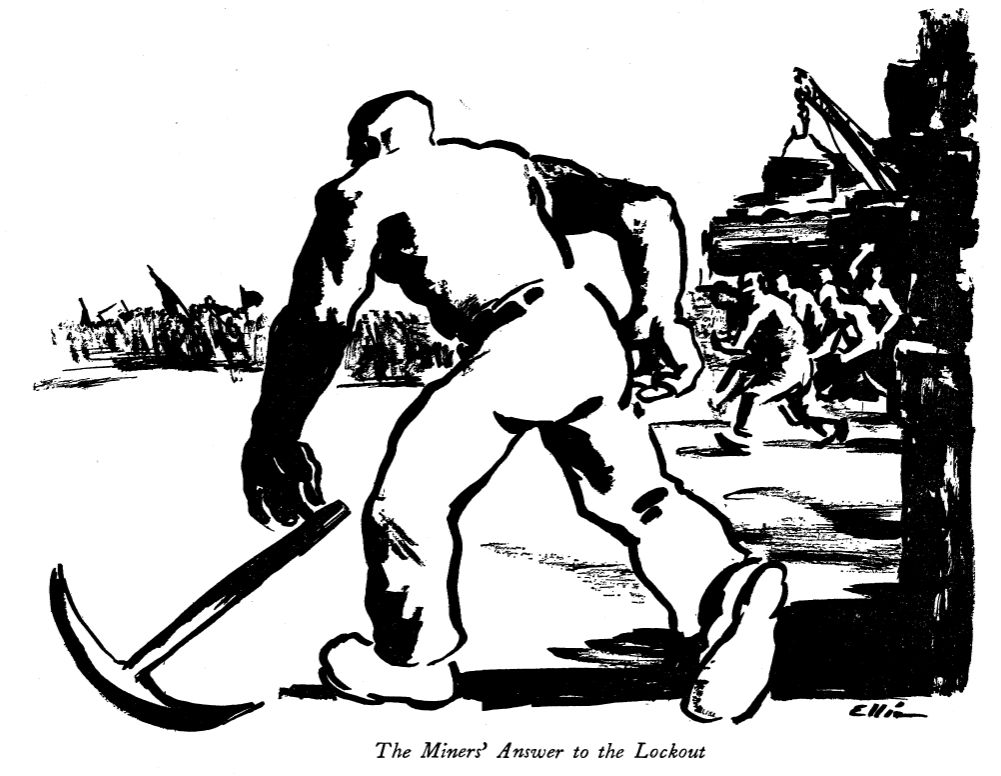
Outstanding in the Pennsylvania-Ohio strike phase of the general struggle is the unparalleled resistance of the strikers. No American strike has ever shown such tremendous tenacity in the face of overwhelming odds. Many of the strikers have been out for two years or more, living on mere crusts of bread and in windswept shacks. Troops, state police, injunctions, betrayal by the union officials, have not served to break the miners’ indomitable spirit. At the end of a year, their strike is now actually becoming stronger. Their splendid proletarian resistance is a forecast of the bitter revolts American capitalism is going to encounter when it makes serious attacks against the standards of the workers. The miners’ strike is a brilliant answer to those class collaborationists who try to convince us that the class struggle is over in the United States. It is a storm signal of the new spirit of revolt brewing deep in the ranks of the American working class.
THE UNITED FRONT IN THE STRUGGLE
The miners’ struggle, especially the inner union phases of it, has been rich with experience in the application of the united front tactic. It is a striking example of the correctness of this Leninist policy. On the basis of a program of elementary proposals necessary to the very life of the union’s broad masses, ranging from the mildest progressives to the Communists, all in revolt against the Lewis machine, have been united in the broadest, most sweeping Opposition movement in the history of any American labor union.
At first, this united front was carried out too much at the top solely, due in part to the existing terrorism which temporarily prevented the crystallization of a broad mass movement in the union. But now it is based on wide masses of the rank and file, who have united themselves through a score of great delegates’ conferences in the various districts. This, of course, puts the whole movement upon a much sounder, healthier basis.
During the strike, many progressives feared that to criticize the Lewis administration would tend to weaken the strike and to put the opposition movement at a great disadvantage as regards Lewis’ attacks on it. This was the old familiar one-front theory of fighting. But the left wing steadily maintained that criticism of Lewis was basically necessary during the strike. Otherwise, Lewis and his gang would have a free hand to strangle and betray the strike. Events have completely justified this contention. The rapid development of the Save-the-Union movement, with its open attack upon the Lewis reactionaries, has enormously strengthened the strike and given it its first real chance for victory. The entire opposition now understands this clearly.
The struggle has also developed other weaknesses of the progressives, most of which the Party has failed to sufficiently criticize. Among these were a widespread failure of middle group bodies to realize the gravity of the struggle and to take the necessary decisive measures; the initiation of movements to establish a separate anthracite miners’ union, attempts in the various districts to fight the local fakers but to avoid fighting Lewis, etc.
The strike has placed tremendous calls upon the opposition for actual leadership in the struggle. Consequently, many new, young leaders are being developed, real fighters who are destined to lead the miners in the great battles looming ahead. Not only have they been called upon to lead the fight for mass picketing, mass violation of the injunctions, etc., but now they must put through the opposition’s basic strategic plan for winning this strike and re-establishing the union, namely, the stiffening of the immediate strike itself, the drawing in of Illinois, Indiana, Kansas and other signed-up districts, together with the great masses of unorganized in Pennsylvania and West Virginia, and eventually also drawing in the anthracite miners. The strike presents a tremendous problem of strike strategy, with the opposition endeavoring to mobilize the whole mass of bituminous miners under one national agreement, and while the tricky Lewis administration is desperately seeking to get any sort of individual or arbitration agreements at all costs.
ORGANIZING THE UNORGANIZED MINERS
The strike situation also thrusts up in the most imperative form the question of organizing the unorganized. This matter, a burning issue in all phases of the labor movement, is a life and death question for the Miners Union. The Save-the-Union committee is attacking this problem vigorously, it is undertaking organization on a mass scale. Preliminary conferences are being held all through the unorganized Pennsylvania and Ohio districts. A real foment is stirring through vast masses of miners. They are rapidly travelling the road to joining the strike struggle. In the coal industry the slogan: “Organize the Unorganized,” which all too often remains mere words, is being translated into living reality on a huge scale.
The mining situation also instructs us valuably regarding the use of the slogan “Save the Union,” which the left wing put out two years ago when pointing out that the union’s life was in danger. The trade unions are in a deep crisis everywhere. Shall the left wing advance the slogan “Save the Trade Unions?” Some say not, declaring that it is meaningless. But the answer to this controversy is to be found now in the Miners Union, which is now facing the brunt of the employers’ offensive. The great masses do understand this slogan, and they do rally around it for real struggle against the bureaucrats and the employers to protect and build their union and to defend their living standards. This slogan should be given far wider and more intensive application by our Party and the Trade Union Educational League throughout the labor movement, the life of which is now jeopardized by the attacks of the employers.
The situation of the miners is also highly instructive regarding how the left wing must fight the reactionary labor bureaucracy. No section of the A. F. of L. bureaucracy is more corrupt and ruthless than that in the Miners Union. Stealing elections, packing conventions, expelling and blacklisting militants, grafting off employers and workers, are all part of the day’s work for the misleaders of the miners. For a while, its terrorism shattered the o position and reduced it to an underground existence. But now the left wing and progressives, although menaced in every district with union gunmen, working hand in glove with the police, have found ways and means, through the mass conferences and network of rank and file organizations of the Save-the-Union committee, and the living issues behind the movement, to burst through this shell of terrorism and organize a great mass opposition for a head-on clash with the reactionaries. Long have we discussed the ways and means to “legalize” the Trade Union Educational League in the trade unions and to give it a real mass base. The building of the Save-the-Union movement, with its mass paper, The Coal Digger, shows how this can and must be done. Many mistakes have been made in this work, but these are of minor importance compared with the successes.
Practically all of the major problems confronting the labor movement are especially emphasized in the case of the miners. Unemployment, for example, everywhere a living issue, is of the most immediate and vital importance among the miners. It is a real fighting issue against the employers and the official union leaders. Approximately 50 per cent of both hard and soft coal miners are now unemployed. Starvation is stalking all the mining districts. The reactionary union leaders, supporting the program of the employers, declare “there are 250,000 miners too many in the industry.” As against this criminal betrayal, the opposition must organize a real fight to meet the unemployment problem around the issues of the six-hour-day and five-day-week, equal division of work, state relief for unemployment, etc.
The nationalization of industry also looms up in the sharpest manner among the miners. It also is a direct issue of struggle. In Illinois the employers are introducing machinery wholesale, forcing the union miners to produce two to five times as much coal for the same money. In the anthracite district the speed-up is being brought about in other forms. In both instances, with the life of the union threatened, the union officials are co-operating with the employers. The opposition movement, with its program of tonnage rates in Illinois and no speed-up in the anthracite and general policy of division of work, comes into direct and violent conflict with both the bosses and the union misleaders.
THE DANGER OF DUAL UNIONISM
The problem of dual unionism also looms up in various and complicated ways in the mining industry. The I.W.W. is in Colorado and is anxious to grow; the coal operators have launched a dual union in Missouri and Iowa; and widespread dual sentiment exists among the rank and file of the U.M.W. of A., who are deeply disgusted and incensed at the treachery of the union leaders. For a time, immediately after the spectacular beginning of the Colorado strike, which raised the I.W.W.’s prestige very high in the coal industry everywhere, the I.W.W. would have been able to lay the basis nationally for a dual union movement. But it was not alive to the situation. It made no national move and it soon lost its golden opportunity. The Save-the-Union committee, with its program of militant attack against the Lewis machine, gained almost complete ideological and organizational leadership over the opposition masses. Now this movement has the difficult task of ousting the corrupt Lewis bureaucracy (which will split the union if it can), and at the same time holding the vast mass of miners intact. It must rid the miners of their faker leaders, who refuse to obey any democratically expressed will of the membership, and simultaneously avoid a danger of two mass unions in the coal industry.
THE LABOR PARTY AND THE MINERS
The labor party, which is a matter still of propaganda in most sections of the labor movement, is a living issue among the miners, especially in Pennsylvania. In many localities the labor party takes on a real mass character and serves as the miners’ party against the coal operators and their henchmen, the Lewis machine. In some places, where other forms of left wing organization have been difficult to build up, the labor party, in addition to functioning as the mass political party of the workers, has also served as an instrument of direct struggle in the union against the Lewis forces. In such cases it was a sort of combined trade union left wing and political party. A basic necessity for us in the coming election campaigns is to make a live political issue of the miners’ grievances, and demands, not alone in our party’s general program, but also directly for the building of the labor party.
The injunction menace is another issue that is now plaguing the whole trade union movement. Nowhere does it sharpen to such a point as in the coal industry. Never were such sweeping injunctions issued as in this present strike. The bureaucrats of course make no effective resistance to them. The opposition movement is confronted definitely and widely with the imperative necessity of putting at once into practice the policy of mass violation, which it has done. This has greatly strengthened the strike and raised left wing prestige. At present writing even some of the conservative district officialdom have to give at least lip service to mass violation of injunctions, and even to mass picketing.
THE IMPORTANCE OF STRIKE RELIEF
The political importance of strike relief work has also been drastically illustrated in this strike. The Pennsylvania-Ohio committee has an enormous influence in the strike zone. The union officials, the coal operators, and the local arms of the government oppose it with a deep and abiding hatred. The bitter attacks made upon it by the Senate Investigation Committee testify eloquently to its splendid work among the miners. The great trouble was that the opposition forces did not become more active in relief work much sooner, during the several months when the union officials were doing absolutely nothing to feed the hungry strikers and their families.
The question of work among the youth, women, and Negroes is enormously emphasized in the strike and general union situation.
The young workers, numerically very strong, play an increasingly important part. In the opposition forces, young miners make up the greater part of the active leadership. The militant part always played by the miners’ womenfolk in strikes (and this one is no exception), stresses the vast importance of work among this section of the working class. One of the weaknesses of the opposition was especially in the women’s department. This is also so in the case of Negro workers. Large numbers of Negroes are strikers, great numbers of others have been brought into the mines as strike-breakers, the whole question is raised in acute form. But little has been done to carry on work in this very important field.
Much depends for the future of the labor movement upon the outcome of the present struggle in the Miners Union. It is a key situation, a turning point in the history of the labor movement. Our Party is most vitally interested in bringing the historic struggle to a victorious conclusion. We must devote all the energy that we possibly can to the fight. In the past we have more than done our share in developing the movement, in analyzing its problems, in outlining its problems, and in leading and fighting its battles. It is a situation especially demanding the militant action of the left wing. But we must redouble our efforts. Our slogan must be “Everything for the Coal Miners.”
And in fighting against Lewis and the coal operators, we must not forget the basic task of building our own Party. Never have we had a better chance for Party building than now in the coal industry. We must utilize it to the utmost. Out of this great struggle, among other substantial conquests of the miners, must come a strong miners’ section of the Workers (Communist) Party.
There are a number of journals with this name in the history of the movement. This The Communist was the main theoretical journal of the Communist Party from 1927 until 1944. Its origins lie with the folding of The Liberator, Soviet Russia Pictorial, and Labor Herald together into Workers Monthly as the new unified Communist Party’s official cultural and discussion magazine in November, 1924. Workers Monthly became The Communist in March, 1927 and was also published monthly. The Communist contains the most thorough archive of the Communist Party’s positions and thinking during its run. The New Masses became the main cultural vehicle for the CP and the Communist, though it began with with more vibrancy and discussion, became increasingly an organ of Comintern and CP program. Over its run the tagline went from “A Theoretical Magazine for the Discussion of Revolutionary Problems” to “A Magazine of the Theory and Practice of Marxism-Leninism” to “A Marxist Magazine Devoted to Advancement of Democratic Thought and Action.” The aesthetic of the journal also changed dramatically over its years. Editors included Earl Browder, Alex Bittelman, Max Bedacht, and Bertram D. Wolfe.
PDF of full issue: https://www.marxists.org/history/usa/pubs/communist/v07n04-apr-1928-communist.pdf

