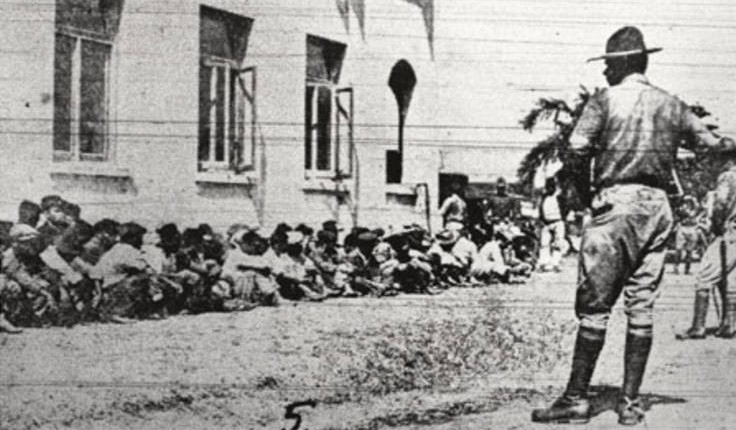
On strike for months, over ten thousand Filipino and other sugar workers in Hawaii faced enormous obstacles in their struggle. A look at the situation in the aftermath of the Hanapēpē Massacre of September 9, 1924 in which 16 strikers and a number of police were also killed.
‘Filipino Strike in Hawaii Displays All Aspects of Mainland Capitalism’ from Industrial Worker. Vol. 6 No. 67. October 25, 1924.
That the methods by which capital hopes to subdue the rising aspirations of labor are much the same in all countries is evidenced by the sentence of 1 to 15 years hard labor imposed upon Pablo Manlapit and Cecilio Basan, Filipinos who were prominent in the Hawaiian plantation strike, which has been going on since April. This strike, which was brought about by the unbelievably low wages and unbearable conditions under which the plantation laborers were forced to toil is a shining example of solidarity and determination. Without any support from labor elsewhere in the world, the plantation laborers have presented an unbroken front all summer, and, according to the Hawaii Hochi, a Japanese newspaper friendly to the strikers, “Even today the strike can be called a victory for the strikers. Sufficient damages have been inflicted on the planters. The planters will be forced to raise wages. Some day in the near future the strike may have to be called off but the laborers have actually won the strike.”
That the above quotation is true is evidenced by the recent actions of the planters in fomenting a riot at Hanapepe, Kauai, at which four policemen and sixteen strikers were killed. Throughout the summer the strikers have been law-abiding and orderly, realizing, it seems, that their continued absence from the job was their winning card, and remained indifferent to all attempts to break their solidarity. Maddened by their inability to break the strike even through connivance with the Labor Commissioners, who allowed strike-breakers to be brought in from the Philippines on every steamer, the planters succeeded in at last breaking the patience of the workers, and on September 8 a bloody battle took place.
Then the entire machinery which capitalism always has at its disposal for disciplining rebellious slaves was set in motion. The National Guard was called out and sent at once to the scene of the riot. This was the first time the National Guard has been called on for strike duty and it is interesting to note from a clipping taken from a Honolulu newspaper that the man chosen for instructor of the guard is an individual named Jackie Saunders who received his training in the Pennsylvania constabulary, that notorious gang of terrorists which the steel and coal barons maintained to insure docility among their slaves.
Then the sugar barons went into consultation with the Governor-General and succeeded in having appointed a special strike attorney. They also agreed to pay all cost of prosecuting the strikers implicated in the riot. A little later, another tactic, one which is familiar to victims of the criminal syndicalism in California, was resorted to. Two men were arrested and reported to have “confessed” to having set fire to cane fields. The scene is all set for the making of more martyrs for labor’s cause.
That the riot was a premeditated affair on the part of the sugar planters is evidenced by the complete preparations which it developed, after the riot, had been made. And that one of the chief reasons for instigating violence was a desire to “get” Manlapit and Bason is not difficult to see, in view of the fact that immediately following the riot, both of the leaders were arrested again and the charge of inciting to riot added to those already held against them.
Success has crowned the efforts of the planters insofar as the removal of the two most prominent men on labor’s side is concerned, but that the strikers intend to carry on regardless of this is evidenced by statements made by the strikers since their conviction.
“We must win,” said a striker interviewed at Lihue, “loss of this strike means virtual slavery and we have been taught that freedom is one of the things guaranteed to everyone under the American flag. If the planters have conveniently forgotten this, we have not and our intention is to continue striking until our demands are won in spite of soldiers, special attorneys, labor spies or traitors. The entire future of the plantation laborers depends on this strike and we cannot afford to quit.”
Much is made of the fact that I.W.W. agitators are responsible for the unrest among the laborers. The Honolulu Star-Bulletin, mouthpiece of the planters, rants and raves about the “undesirables” who are responsible for the strike but so far as can be ascertained there is only one I.W.W. on the scene. This sheet has been particularly vicious throughout the strike and has been calling for blood in the most approved style of American capitalist sheets. The Honolulu Times, a liberal newspaper, says editorially:
“The responsibility for the riot at Hanapepe lies not with the strikers and supporters of the strike, but with the sugar newspapers of Honolulu which have continuously published the sugar planter propaganda and left no lie untold to assist the planters in beating down the laborers who demand more money for the work they do on the plantations.”
Thus we see that all of the legal, military and publicity machinery are under the control of the sugar planters in their efforts to make virtual slaves of the plantation laborers.
Capitalism in Hawaii, as elsewhere, owns and controls the entire life of the community by virtue of ownership of the job. That its methods should be the same everywhere is not to be wondered at. That its one great enemy, the solidarity of labor, drives it to frenzied use of all its means of subjugation is sufficient proof that in that direction lies the salvation of the workers of the world. Our most fervent hope is that the plantation laborers of Hawaii will continue their glorious struggle and that victory will crown their efforts. Truly theirs has been a remarkable stand in the face of almost unbeatable odds.
The Industrial Union Bulletin, and the Industrial Worker were newspapers published by the Industrial Workers of the World (IWW) from 1907 until 1913. First printed in Joliet, Illinois, IUB incorporated The Voice of Labor, the newspaper of the American Labor Union which had joined the IWW, and another IWW affiliate, International Metal Worker.The Trautmann-DeLeon faction issued its weekly from March 1907. Soon after, De Leon would be expelled and Trautmann would continue IUB until March 1909. It was edited by A. S. Edwards. 1909, production moved to Spokane, Washington and became The Industrial Worker, “the voice of revolutionary industrial unionism.” A victim of finances and internal disputes, the IW ceased publication in 1913, only to be revived in 1916 and surviving as a weekly, sometimes more, until 1931. Easily among the most important working class newspapers in U.S. history and an essential resource on the wobbly, and larger radical labor experience.
PDF of full issue: https://washingtondigitalnewspapers.org/?a=d&d=IWW19241025

