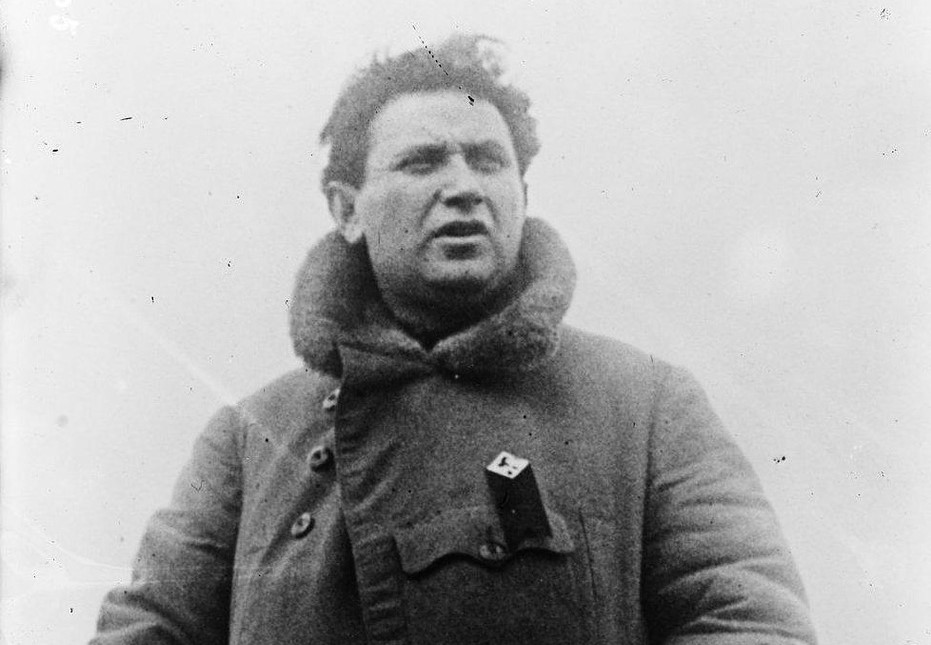
An interesting late piece from Zinoviev–acting as Lenin’s interpreter, as was his wont–on the broad debate, bound up with Comintern factional struggle, over the question of the necessity of war as a prerequisite of a social revolution.
‘Are New Revolutions Impossible Without War?’ by Grigory Zinoviev from The Communist. Vol. 9 No. 2. February, 1929.
IS it correct that Lenin considered that, in general, new revolutions are impossible without war? Is it true that in estimating the general situation in his works before his death, Lenin connected the coming revolutionary upheaval “directly” with the impending war?
This question is of the highest importance; it is one of the knotty problems of the entire tactics of Leninism.
Neither Marx nor Lenin ever considered that revolution is born only from war. They merely considered that some wars under given circumstances are accelerators of revolutionary development. The motive forces of all revolutions are the class contradictions, the class struggle. War is the continuation of politics by other means. War under given circumstances can, in given countries, accelerate the revolution. But revolutions are born from the antagonisms between classes, from the class struggle.
In such an authoritative document as Lenin’s thesis, “Socialist Revolution and the Right of Nations to Self-Determination,” he wrote as follows:
“The socialist revolutions can flare up, not only from a large strike, a street demonstration, a hunger revolt, a military uprising, or a colonial rebellion, but also from such a political crisis as the Dreyfus affair or the Zabern incident or in connection with a referendum on the question of separation of oppressed nations, etc.”
This programmatic declaration of Lenin leaves no room for any misinterpretation. Lenin cited this declaration at the time of the Third Congress of the C.I. in the Commission working out the tactical resolution. The idea entirely permeated the tactical resolution of the Third Congress, in the preparation of which Lenin took a leading part. In this way, Lenin pointed out that the Socialist revolution can begin, not only from a military uprising or a colonial rebellion, but also from a large strike, political crisis such as the Dreyfus affair, etc.
The nearer the real commencement of the proletarian revolution approached, the more attention Lenin paid to the exact road the revolution would follow. As in 1905, at the Third Party Congress, on the eve of the first bourgeois-democratic revolution in Russia, Lenin paid more attention to this than to anything else: What would be the concrete path of this revolution, what would be the concrete forms of the movement (the uniting of the general strike with the armed uprising, etc.)—so, on the eve of 1917, Lenin more deeply turned his thoughts to this particular question: What would be the concrete forms of the development of the Socialist revolution?
“The Socialist revolution cannot take place otherwise than in the form of an epoch, uniting the civil war of the proletariat against the bourgeoisie in the foremost countries with a whole series of democratic, revolutionary and in this number also national liberation movements in the undeveloped, backward and oppressed nations.” So wrote Lenin in his polemical article against the “Left” Communists at that time (Piatakov, Bukharin and others).
“To think that the Socialist revolution is possible without the uprising of the small nations in the colonies and in Europe, without the revolutionary upheaval of part of the petty bourgeoisie, with all its prejudices, without the movement of the unconscious proletarian and semi-proletarian masses against the landlord, Church, monarchy, national and other kinds of oppression, to think thus means to repudiate the Socialist revolution.” So wrote Lenin in a polemic against the supporters of Rosa Luxemburg.
“The Socialist revolution”—Lenin has pointed out many times— “us not an act or one struggle on a single front, but a whole epoch of sharpened class conflicts, a long series of battles on all fronts, i.e., on all questions of economics and politics; battles which can only end with the expropriation of the bourgeoisie.”
Wars of the oppressed nations, uprisings in the colonies growing into revolutionary wars; the wars of the imperialists among themselves; all this certainly played a very great role in the workings of Lenin’s system of thought. But under no circumstances can we find in these classical formulations the “idea” that revolutions are possible solely in connection with war.
War is the continuation of politics. Imperialist war is the continuation of imperialist politics. “These wars are the most important indications of the fact that the class contradictions are growing in the national and international arena, that the struggle is sharpening throughout the entire world, that the productive forces are cramped within the limits of their national frames, that capitalism is fast approaching its doom.
Imperialist wars, by the very fact that they take place, prove that imperialism is really the last stage of capitalism. Imperialist wars signalize the fast approaching downfall of capitalism. The development of the proletarian revolution, which cannot but end by the expropriation of the capitalists, is unavoidable. But the causes for proletarian revolution are not imperialist wars alone. On the contrary, imperialist wars themselves are the result of the class struggle. Lenin is a dialectician throughout, whose formula always breathe with life; Lenin takes the sum total of phenomena in their entirety. Lenin shows to us the real growth of the proletarian revolution as the result of a whole complex series of facts. Among these facts war does not occupy the last but certainly not the sole place.
War under given circumstances becomes a great accelerator of the revolutionary movement. The clearest example of this is the role of the imperialist war in connection with the Russian revolutions of 1917.
Beginning with 1912 the revolutionary crisis in Russia ripened with tremendous rapidity. In 1914 the revolutionary wave in Russia had already achieved a tremendous height, and on the eve of the declaration of war barricades had already appeared in St. Petersburg. In the beginning, the war, for a time retarded the revolutionary wave; but later, to an extraordinary extent, the war accelerated the revolutionary developments in Russia. In 1917 Russia was the scene of the first great revolution during the war, simply because, already in 1914, Russia was the country nearest the revolution, because in 1914 Russia was already pregnant with revolution. Such are the lying dialectics that are incompatible with scholasticism. Lenin later pointed out (in Left-wing Communism) that there are four factors, “four specific conditions,” as he expressed it, which aided Russia in being the first to start the Socialist revolution:
1. The possibility of uniting the Soviet revolution and the ending, thanks to it, of the imperialist war, which had unbelievably exhausted the workers and peasants.
2. The possibility of utilizing, for a certain time, the deadly conflict between two powerful world groups of imperialist plunderers.
3. The ability to withstand the comparatively long civil war, thanks partly, to the gigantic size of the country and the bad means of communication.
4. The existence of such a deep bourgeois-democratic revolutionary movement among the peasantry that the party of the proletariat took over the revolutionary program of the peasant party and, thanks to the conquering of political power by the proletariat, immediately put it into effect.
In this analysis of Lenin the imperialist war plays no mean role—but certainly not an exhaustive one. Lenin takes the historic preparation for the Russian revolution in all its complexities and many-sidedness. Such a real Leninist analysis does not show a grain of scholasticism.
In the same Left-wing Communism Lenin explains in a classical form, the conditions necessary for revolution. In one of the most famous places in this, one of Lenin’s best known books, he formulates what he calls “the basic laws of revolution.” He says:
“The fundamental law of revolution confirmed by all revolutions, and particularly by all three Russian revolutions of the twentieth century, is as follows: It is not sufficient for the revolution that the exploited and oppressed masses understand the impossibility of living in the old way and demand changes; for the revolution it is necessary that the exploiters shall not be able to live and rule as of old. Only when the masses do not want the old regime, and when the rulers are unable to govern as of old, then only can the revolution succeed. This truth may be expressed in other words; revolution is impossible without an all-national crisis, affecting both the exploited and the exploiters.”—Left Wing Communism, page 65.
In enumerating, so to say, the “obligatory” constituent features of revolution, Lenin did not say that among other features war is a necessary feature. Lenin’s formula of the “basic law of revolution” certainly does not at all exclude (but pre-supposes) that under certain conditions war can serve as an enormous accelerator of revolution. But nowhere in Lenin’s works can we find a hint that only from war can revolution begin.
Bolshevism entered the imperialist war of 1914 with the slogan of the “democratic dictatorship of the proletariat and peasantry,” for Russia. Towards the end of the war Bolshevism called for a Socialist revolution for Russia. The role of imperialist war not only as an accelerator but also as a “deepener” of revolution is here obvious.
Of course, in 1905 also, Lenin never advocated “self-limitedness” of the revolution, as the Mensheviks, including the then Menshevik Trotsky, at one time accused him. Lenin knew that in proportion to our forces, in proportion to the forces of the working class, we shall carry forward the successful democratic revolution to the Socialist revolution, to the unleashing of the international proletarian revolution. This was evident also in 1914, when at the beginning of the imperialist war, Lenin at first put forward the former program of the “democratic revolution” for Russia. But exactly the changing world situation, and particularly the changing situation within Russia, in the course of the imperialist war, hastened the approach and pointed out the peculiar course towards the Socialist revolution in Russia, and led to the transforming of the bourgeois-democratic revolution into a Socialist one, which took place in Russia during the course of nine months, from February to October, 1917.
In Left-wing Communism also, Lenin analyzes the situation, not only in Russia but also in Britain. He says: “In Britain both conditions for a successful proletarian revolution are obviously developing” (Left-wing Communism, page 66); i.e., that both the masses do not want the old and the rulers cannot continue in the old manner, that in England “both conditions for a successful proletarian revolution are obviously developing”
Lenin writes:
“Take, for example, Britain. We cannot know, and no one is capable of predicting truly, how soon a real proletarian revolution will break out there, and what, more than any other, will be the cause which will awaken and inflame the now slumbering masses to revolution…Possibly it will be a crisis resulting from the hopelessly confused colonial and imperialist antagonisms, which become more and more painful and acute from day to day.”—Left Wing Communism, page 76.
Lenin considered it very dangerous that in the ranks of the Communists there should prevail the idea that a revolution was possible only in the event of war. He made a detailed study of the question in connection with England, placing in the leading place the parliamentary crisis, etc. Lenin is not satisfied with the example of England, but takes France as well:
“Let us not forget how in the French bourgeois revolution, in a situation which, from the international and domestic aspect, was a hundred times less revolutionary than at present, such an unexpected and petty cause as one among thousands of dishonest tricks of the reactionary military caste (the Dreyfus case) was enough to bring the people face to face with civil war.”—Left Wing Communism, page 76.
That, which Lenin wrote of England and France is at present even more applicable to such a country as Germany.
Lenin said all this in Left Wing Communism, a work especially deep and mature. Not for a moment does Lenin revise his opinion in his later articles and notes. Then what are the bases to declare that Lenin awaited new revolutions only “directly” in connection with war? None! The general strike in England in 1926 could have played a gigantic, in reality a decisive role, in hastening the revolution in England. But there was no talk of any war in 1926. At the present time the strike movement in India is noticeable for its force and scope, and raises serious hopes for the significant acceleration of the revolutionary processes in India. And what a revolution in India would mean for the revolution in England! A revolutionary uprising in India would call forth, of course, attempts upon the part of England to “pacify” this uprising with blood and iron. Nevertheless, such a variant of the development of the revolution in England is not at all similar to the scholastic, anti-dialectical thesis that revolution can be born only from war.
Marxism has nothing in common with pacifism. Marxism knows that there are wars and wars. Marxism certainly does not for a minute hesitate to utilize one or another war of the slave-owners among themselves in the interests of the oppressed classes, especially utilising any war to arouse the slaves against the slave-owners. Marxism does not for a moment deny a revolutionary war, when the necessary historical prerequisites for this exist. On the contrary, Marxism openly speaks of the inevitability of revolutionary wars. But to say “revolution can only be born from war”—this means to be a pacifist turned inside out; this means, under present conditions, to give a finger to opportunism…and opportunism will take the whole hand.
* * *
The Bolsheviks say that the epoch in which we are living is an epoch of wars and revolutions. They are correct. Let us take the decade following the end of the World War. This decade is represented as a decade of “peaceful” development of capitalism. It really is “peaceful” in comparison to 1914-18, when blood flowed in rivers, when whole millions were perishing upon the imperialist battle-grounds, when cities and villages were burned down and entire districts devastated. But if we compare this decade (191828) with the pre-war decade (1904-14) then the nature of this “peaceful decade” becomes clear.
During the decade 1918-28 we have witnessed a series of wars, in any case a series of large war collisions, not only in Europe, but also in Asia, Africa and America. A brief and very incomplete review of the greater and smaller clashes that took place during this time will be sufficiently convincing.
Europe. Struggle between Germany and Poland for Upper Silesia. Armed occupation of the Ruhr and the so-called passive resistance of 1923. Occupation of Vilna by Poland and the endless chain of armed boundary collisions between Poland and Lithuania.
The occupation of the province of Fiume by Italy, and the Italo-Greek conflict. The Greco-Turkish war, i.e., in reality the Anglo-Turkish war. The Balkan armed struggle for territory, and the seizure of much of formerly Austro-Hungarian territory by Roumania.
Asia. Civil war in China and the imperialist intervention, with the repeated ruin of Chinese towns by British and other warships. War by France in Syria, and so on.
Africa. Moroccan wars.
America. U.S.A. and Mexico. The U.S.A.-Nicaragua, Bolivia, Paraguay and a series of others.
We are not speaking here of the great civil war in the U.S.S.R. and the external attack upon it in which, as is well known, no less than fourteen nations participated. We are not speaking here of the war of White Poland against the Soviets in 1920, etc.
What conclusion can we draw? During the last “peaceful” decade we have witnessed a series of military clashes almost in all parts of the world, a series of colonial wars, a series of wars against the Proletarian State, a series of conflicts between the bourgeois governments. And this—in the epoch of Wilsonian, the League of Nations, and their ilk.
There cannot be the slightest doubt that precisely during this “peaceful” decade of 1918-28, dozens of complications that will provide grounds for future wars have taken place. A characteristic feature of the so-called “third period” is embodied exactly in this, that the world contradictions are becoming sharpened and war is approaching at full steam.
More and more frequently and “unexpectedly” the world learns of this or another war agreement contracted between bourgeois countries against one another; the agreement between England and France; the agreements between France and Belgium; a series of agreements between the neighbouring countries around the U.S.S.R. —agreements concluded under the protectorate of Anglo-French imperialism. But this is not all by far. The most dangerous are those secret agreements which undoubtedly are abundantly concluded precisely against the U.S.S.R. There is also a series of more or less open war agreements against our Government concluded as well.
At the same time during the “peaceful” decade of 1917-27 we have witnessed the following revolutionary events:
1917—Two revolutions in Russia.
1918—Revolutions in Germany, Austria and the Balkans; Soviet power in Finland.
1919—Soviet power in Hungary and Bavaria; Spartacus uprising in Germany.
1920—National revolution in Turkey; seizure of factories by the workers in Italy.
1921—March uprising in Germany.
1923—Uprising in Bulgaria; revolutionary events in Germany.
1925—Uprising in Esthonia, Syria and Morocco.
1926-27—Chinese revolution; general strike in England. The Vienna uprising.
In 1928-29 a revolutionary rise is particularly evident in India and Germany.
We are living in the epoch of wars and revolutions—but this does not at all mean that all revolutions of necessity are at once victorious, and that all conflicts between States must immediately end in war.
We are living in the epoch of wars and revolutions. It has happened many times in history that war accelerated the revolutionary development and that revolution in its turn brought about new wars. Wars themselves have often changed their character “on their way,” so to say. The basic proposition of Marxian dialectics consists in that all features in nature and society are considered conditional and in motion, that there is no phenomenon that cannot under definite conditions become converted into its antithesis. In his brilliant works during the war period Lenin brings forward several striking historical examples of the dialectical conversion of one war into another.
“National war can transform itself into imperialist war, and vice versa,” Lenin wrote. An example: the wars of the great French revolution began as national wars and were such. These wars were revolutionary; the defense of the great revolution against the coalition of counter-revolutionary monarchies. But when Napoleon created the French Empire with the enslavement of a whole series of consolidated, large and virile, national European States, then the French nationalist wars became imperialist wars which in their turn gave birth to national-liberation wars against Napoleon’s imperialism.
No less brilliant are other examples cited by Lenin; England and France fought the Seven Year’s War for colonies, i.e., carried on an imperialist war (which is possible on the basis of slavery and primitive capitalism as well as in the present period of highly developed capitalism). France was defeated and lost part of her colonies. Several years later the national-liberation war of the American States, against England alone, began. France and Spain, who themselves continued to rule part of what is today the U.S.A., from enmity towards Britain, i.e., because of their imperialist interests, concluded a friendly agreement with the insurgent States against England. Here we have before us a war of national-liberation in which the imperialist rivalry appears relegated to the background, possessing no serious meaning.
We must study again and again these examples of Leninist dialectics.
When we, pupils of Lenin, follow him in saying that we live in a period of wars and revolutions—this does not mean for a second that revolution can be born only from war; a revolution may be born from a large strike, as Lenin said in 1916. Revolution could have been born from the great miners’ strike and the General Strike in such a country as England—in 1926. Revolution in England can be born from a general strike, developing into an uprising— in India. A revolution in Austria could have come out of the Vienna uprising. And who dares to state that revolution in Germany is impossible without war? Certainly from events of such a nature as May Day, 1929, in Berlin, a revolution can arise! Who dares to state that revolution in Italy—when Fascism decays—is impossible without war? Who dares to state that the revolution in the Balkan States is impossible without war?
Every such revolution, no doubt, can call forth, and most assuredly will, new wars. That is why we say that we live in the epoch of wars and revolutions. And thus we see today how Lenin’s prophetic words about the strings from which the great stream of world revolution “converges,” become clothed in flesh and blood. But to reduce Lenin’s teachings on war and revolution to the assumption that revolution is impossible without war—is to vulgarize Lenin’s teaching, to distort it in an opportunist spirit.
Why opportunist? Because to say that revolution arises only from war means in fact to “relegate” the revolution “a little” until war-time, to give assent, “a little” to those who want to take away the “extremist” slogans of Bolshevism (i.e., to all the Rights in the Comintern ).
That is just what the social-democratic leaders desire! For the main “social instructions” which they now receive from their masters, the capitalists, are to “prove” that the Communists are staking all upon a new war. Sowing this suspicion in the minds of the working masses is a dire necessity to the capitalists, since they are preparing war against the U.S.S.R. with all possible speed. The leaders of the Second International paint all Bolshevism as “a product of war.” Therefore they endeavour to use this opportunist, essentially incorrect, formulation in a double way.
Lenin “connected the next revolutionary upheaval directly (!) with the coming war.” This “analysis,” this explanation of the political testament was quickly picked up with great joy by the renowned Ustrialov, who, of course, hastened to “complete” it thus: “Lenin connected the next revolutionary upheaval directly with war, and since as yet there is no war, we must postpone the ‘revolutionary upheaval’.”
On the basis of this “analysis,” Ustrialov already proves that the “world revolution is dimmed in the fog of future decades”; that “revolution is in a lethargic sleep.”
The smallest retreat from Leninism in such a sharp and decisive question as “war and revolution—revolution and war” is pregnant with the most disastrous results. We have this proven here in a living manner.
Lenin’s and Marx’s teaching about war (and such exist in spite of the opinion of many) must be treated with particular care. This is necessary just because we are living in the epoch of wars and revolutions; just because the new war in which the fate of the Soviet power and the world revolution will again be decided, is doubtlessly approaching.
“History teaches us,” Lenin said, “that no- great question and no revolution was born otherwise than in a series of wars. We must be prepared because at the slightest change in the situation the imperialist brigands will once more attack us. We must be ready for this. The question stands thus: Until now, a long series of wars have always decided the fate of every great revolution. Our revolution is such a great 1evolution. We have finished one chain of wars; we must be ready for another.”
The fate of our revolution, the fate of the world revolution in general will be decided in a series of merciless battles, in a series of wars. To say this means to judge in a Leninist manner. But to say that revolution is born only from war, or to say that in relation to our conditions (as they are in 1929) the next revolutionary upheaval is connected “directly,” only with war—means to retreat from Leninism “a little” in the direction of opportunism.
Lenin considered war one of the component parts among those factors which lead to revolution, which bring about, under given circumstances, the conversion of a revolutionary situation into a direct revolution. To concentrate the attention of the proletariat of the U.S.S.R. and of the whole world to the fact that the danger of war is increasing—is an undeniably necessary task. But to change it so that one of the component parts is given as the sum total is not only theoretically incorrect but practically leads to that which the Right, opportunist sentiments within Communism are attempting, and politically help the worst enemies of international Bolshevism: counter-revolutionary social democracy.
The Socialist revolution can blaze up, not only from war but also from a large strike, a street demonstration, a hunger riot, a military revolt, a colonial rebellion, or also from such a political crisis as the Dreyfus case, a May Day of the “Berlin” type, an uprising such as the Vienna revolt of 1927, and soon. This is what we must teach the workers if we are to remain faithful to Lenin.
A new revolutionary upheaval in Europe, or the whole world, must never under any circumstances be “put aside” until a new war. Even the present “peace”—the peaceful chain of development of capitalism, with all its “stabilization,” “rationalization,” technical progress, etc., not only does not take revolutionary upheavals off the agenda of the day but brings them closer with gigantic strides.
He who, in all the ramified world situation, does not see, does not feel, the approach of a new revolutionary upheaval, he has indeed lost all feeling of a Bolshevik-revolutionary; he has become atrophied.
New revolutions are possible without war. But new wars must become impossible without revolutions. So Bolshevism places the question.
There are a number of journals with this name in the history of the movement. This The Communist was the main theoretical journal of the Communist Party from 1927 until 1944. Its origins lie with the folding of The Liberator, Soviet Russia Pictorial, and Labor Herald together into Workers Monthly as the new unified Communist Party’s official cultural and discussion magazine in November, 1924. Workers Monthly became The Communist in March, 1927 and was also published monthly. The Communist contains the most thorough archive of the Communist Party’s positions and thinking during its run. The New Masses became the main cultural vehicle for the CP and the Communist, though it began with with more vibrancy and discussion, became increasingly an organ of Comintern and CP program. Over its run the tagline went from “A Theoretical Magazine for the Discussion of Revolutionary Problems” to “A Magazine of the Theory and Practice of Marxism-Leninism” to “A Marxist Magazine Devoted to Advancement of Democratic Thought and Action.” The aesthetic of the journal also changed dramatically over its years. Editors included Earl Browder, Alex Bittelman, Max Bedacht, and Bertram D. Wolfe.
PDF of full issue: https://www.marxists.org/history/usa/pubs/communist/v09n02-feb-1930-communist.pdf

