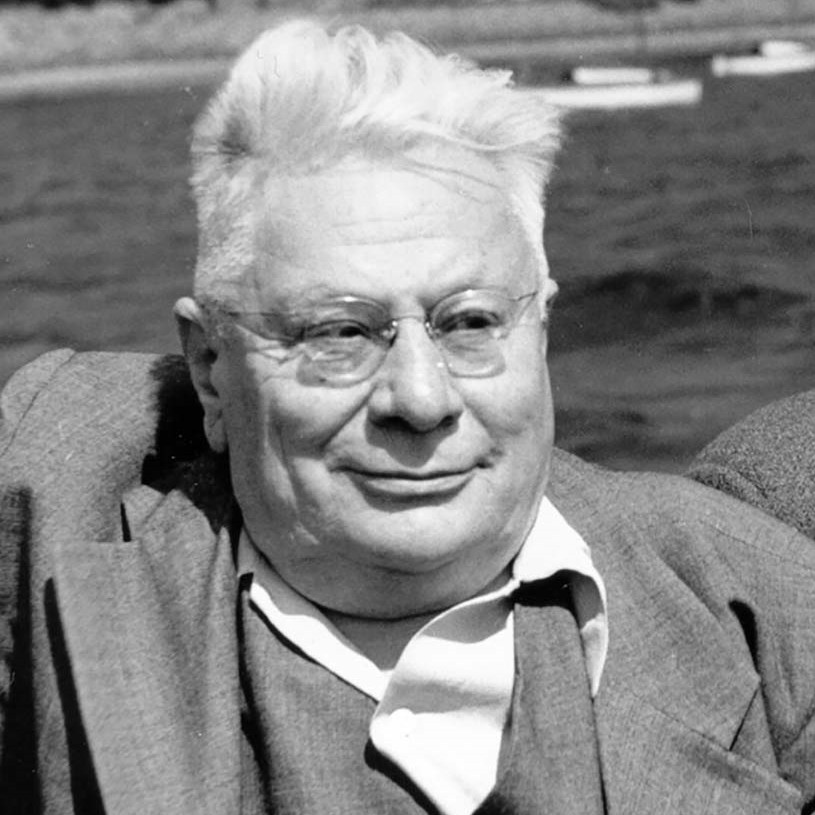
‘Branderlism’ as it was when while still in the German Communist Party. A document of obvious importance in the history and study of German Communism, this major piece by a the veteran and central leader of the German Party who, having called off the October 1923 Rising after failing to secure left Social Democratic support, largely took the blame for the failed ‘German October’. Spending the next several years in the Soviet Union, where this was written, returning to Germany several months after this was written, where he would, with August Thalheimer, lead an opposition to Ernst Thalmann. They and their supporters would be be expelled as ‘Rightists’ at the end of 1928 from the KPD, and from the Comintern in January, 1929.
‘Contributions to a Programme of Action for Germany’ by Heinrich Brandler from Communist International. Vol. 5 Nos. 3 & 4. February 1 & 15, 1928.
EDITORIAL NOTE: Some months ago the Editors of the “Communist International” received an article by comrade Brandler, “A Programme of Action” of the Comintern for Germany.
In view of the extraordinary importance of the questions raised by comrade Brandler (on the slogans of workers’ control, of nationalisation, our relations with the Social-Democrats, etc.) the Editors print the article in its entirety, despite its length and the fact that its statistics are a little out of date.
Al the same time we print the answer of the Politbureau of the German Communist Party, which also expresses the opinion of the E.C.C.I.
1. THE PRESENT POSITION OF GERMANY
(a) International Connections
In an introduction to “The Civil War in France” Engels says:
“A clear survey of the economic history of a given period is never contemporary, but can only come afterwards, after a collection and sifting of the material. Statistics are a necessary expedient, and are always hobbling behind. For a current period of history one is therefore only too often compelled to treat this, the decisive factor, as a constant one, which both at the beginning of the period in question as well as for the entire period, is unchanged with regard to the economic conditions encountered : or one is obliged to take note only of those changes in the position which arise from the first events in question, and are therefore also clear to all. It is obvious that this unavoidable short-coming of the contemporary change in economic conditions, the actual basis of all the events investigated, is a source of error. But all forms of a comprehensive survey of current history inevitably include sources of error, which, however, does not prevent anybody from writing current history.”
What is correct in a judgment of the economic conditions during and immediately after the revolution of 1848, is doubly true of the greatly developed, rapidly changing conditions after the world war. But of course that has not prevented the Communists from writing current history, or, to a certain extent, from making it. But today, when stabilisation has reached a kind of balance, it is necessary for us to take notice of a number of important changes in the mechanism of capitalist economy which have been proceeding in the years since 1914, and which were not clear a few years ago; for only by doing this shall we be able to find the key to an understanding of the present situation.
The fundamental fact in the present economic anc recently also the political development of the world in the years since 1914 is a tremendous growth in the means of capitalist production beyond all the present marketing possibilities. On one hand old industries have developed in the older capitalist countries, and new ones have arisen, while on the other hand industrialisation has to a considerable extent taken place in the colonies. Already the existing possibilities of production in the greatest and most highly-developed capitalist countries (America, England, France, Germany) are too great for all the present markets. The result is that machinery and an army of unemployed amounting to millions is constantly out of action. Only a great extension of markets is capable of freeing world capitalism for any considerable period from this vicious circle.
A relative widening of the market for one capitalist State at the cost of the competing other States, which is possible, merely transfers the contradiction from one country into the others, and accumulates still more inflammable matter. An absolute extension of markets by the opening up of China, Russia and other still undeveloped countries is out of the question because of the war of capitalism against the Russian and the Chinese revolutions, against the movement for liberation of the oppressed peoples, because, in short, of the most important upheavals which threaten capitalist domination. The additions of the undeveloped countries to the “normal” markets today, even if one admits that for the present China would go along the road of capitalist development, would not suffice to abolish the general characteristic of the epoch as one of the declining developments of capitalism.
The Problem of Markets
The purchasing power of the peasant masses of China is today still negligible (about four dollars a year); about 300 million dollars among 70 million peasant families. (The number is, of course, only a rough calculation, and would change with the economic development of China.) The development of a native Chinese capitalism in China would, of course, create a new market for capital goods, a new sphere of investment for capital export, but it would also create a new competitor which will make itself felt and emancipate itself at an increasing rate. As for commercial relations between the capitalist world and the Soviet Union, an extension of the possibilities of trade would be made for a few countries if capitalism would quietly accept the fact of the Socialist construction of Soviet economy, and propose conditions which would correspond to the interests of Socialist economy in Russia. But even in these favourable circumstances the extension of the market would not be sufficient to exhaust the productive capacity of the most important capitalist countries to the extent of making possible a new progressive era of an obsolete capitalism. The Socialist constructive economy in Russia, planned on the basis of the development of her own forces of production, must, after the import of necessary capital goods and raw materials, lead in a relatively short time to a decrease of foreign imports.
No extension of the markets can keep pace today with the rapid increase of capitalist productive capacity by technical improvements (rationalisation, new inventions, etc.) which is forced on the capitalists by international competition, by the necessity to acquire space for themselves at any cost.
A certain degree of equilibrium in local and partial markets is of course possible if, for example, new cheap raw materials are found by new inventions, new methods of transport, new cheap processes of production are discovered. (As in Germany, the liquefaction of coal, electrification of the internal navigation, manufacture of artificial manures, etc.)
On the other hand, we must observe that the shrinking of the American market, which is necessarily of great importance in this matter, will have consequences of an international character, not the least in Germany, which is closely connected with American capitalism through loans.
These contradictions are intensified by the monopolistic organisation of capital, which today shows a higher degree of concentration than at any previous time. The struggle for markets is at its sharpest under the domination of monopolies. In free competition technical improvements mean the abolition of backward concerns. With the power of monopolies, however, this is changed, and concerns which are closed down, instead of being wiped out, become sources of interest (bargaining for quotas). The consequence of that is the tendency of monopolies to a still greater exploitation, to a further increase of their surplus profits.
The Extension of Capitalist Contradictions
International cartels, far from alleviating the contradictions within capitalism, only serve to intensify and extend them over a greater area. Competition within cartels takes the form of a struggle for quotas; competition on the world market takes the form of a struggle of national groups organised within the cartels.
These factors drive capitalism necessarily into preparations for a new military conflict. These preparations proceed along two lines. On the one hand, in the formation of opposing imperialist coalitions; on the other hand, in attempts, made above all by England, to create a sort of holy alliance against the Soviet Union. The attempts are not sharply divided from each other, but are closely interwoven. The present period is one of experiment, of tentative measures on the part of large opposing interests, around which new coalitions of Powers can be grouped.
The so-called “ultra-imperialism” is a social-democratic discovery. This theory has been deliberately spread by the social-democrats, in order to divert the attention of the masses from the actual position to the fanciful image of a peaceful capitalism free from contradictions. Temporary alliances of the imperialist Powers for the fight against the proletarian revolution in Russia and the national revolution, above all in China, are, however, quite possible. Bukharin rightly referred to the example of the crushing of the Boxer rebellion in 1900 by the Great Powers. Such temporary alliances, for various objects of the imperialist robbers, do not in any way abolish the fundamental contradictions inside the camp of world imperialism. Such alliances existed before the war, and did not save it from the war, but were, on the contrary, stages in its development.
Since the end of the European war there has been an almost uninterrupted series of colonial wars. (Greco-Turkish War, Morocco, Syria, etc.)
Considered as a whole, imperialism in the post-war period bears all the marks of a decaying form of society. What Rosa Luxemburg foresaw when she called imperialism a period of crises, conflicts and catastrophes, what Lenin meant when he characterised imperialism as the last phase of capitalism, has come true. The decline of capitalism is not, of course, to be understood as something for which a continuous and general decline in production is a necessary prerequisite, but in the sense that all its oppositions and contradictions, all its “inequalities” are driven to the surface: that the disproportion between conditions of production and distribution is greater than ever before, that industrial depression has become the normal condition of a number of capitalist countries, that millions are out of work, while the profits of the trusts attain to an extraordinarily high level, that the bourgeoisie will be able to find no other method of solution than a new war, than new world catastrophes. “An absolute development of the forces of production, which decreased the absolute number of workers, one, that is, which in fact enabled the nation to turn out its entire produce in a shorter space of time, would lead to revolution, because it would withdraw the majority of the population from employment. This again shows the specific limitations of capitalist production, and that it is not by any means an absolute form for the development of the forces of production and the production of wealth, but rather that at a certain point these will come into collision.” (Marx: “Capital,” Vol. III.)
The phenomena of stabilisation, that is, the reconstruction of world economy, dislocated by the war and by inflation, and the overcoming of most of the serious periods of trouble in the European post-war crisis (such as an absolute decline of production, etc.) only show up the fundamental contradictions more clearly. The momentary strengthening of the bourgeoisie is not to be denied, but this strengthening is only paving the way for a new revolution, is creating new and more extensive foundations for it.
The Communists do not deny any facts; they only point out how the mole of revolution burrows under the surface of a stabilised capitalism; they point out that the new problems unfolded by stabilisation, which are created by stabilisation, can only be solved by a revolution.
(b) Class Relations in Stabilised Germany
The Economic Position of Germany
The particular features of the situation in Germany fit into this general picture. Industrial concentration in Germany has reached a pitch attained not even by the United States, the classic land of trusts. The most important industries are trustified or cartellised. Wholesale business is dominated and controlled by the trusts.
In retail trade the revival of business is accompanied by a powerful concentration. The technical transformation of German industry is prepared and partially carried out. German industry is beginning to apply a number of important inventions practically—in proof of that it is sufficient to point out that the liquefaction of coal, when it has reached the stage of mass production, will place Germany in the front rank of the countries producing mineral oil, the most highly-contested of raw materials today. The annual accumulation of capital in Germany is approaching the pre-war level. The phenomena of deflation (financial crises, bankruptcies) have been almost completely overcome. The power of the German banks at first under the influence of American capital and now also on the basis of capital accumulation in Germany itself, has made great progress, which has enabled them partly to regain their old position in industry. The economic strengthening of German capitalism is therefore incontestable.
But the problem of markets, the decisive question for German industry, is not solved. The end of the English coal dispute brought this question into still greater prominence. Just as in England, so also in Germany, more than a million unemployed drag on from year to year. Production in Germany has in parts already exceeded the pre-war level, but has not reached the full present productive capacity. The burdens imposed by the Dawes plan have not so far inhibited development, but will in the future certainly lead to political and economic difficulties.
The Bourgeoisie and Squirearchy, Republic and Monarchy
The economic changes in the war and post-war period have brought about important changes in the ruling classes of Germany. The strengthening of the bourgeoisie, and above all of the trust magnates, has made them politically also the decisively dominant and ruling power in Germany. The Junkers were economically weakened by the war and the revolution, by inflation and deflation. A part of their property has passed into the hands of industrialists, who, of course, have no specifically agrarian interests. Capitalism has made the Junkers dependent on the artificial manure industry and on the banks. It is clear that the rulers of the trusts will no longer leave the occupation of government posts exclusively to the Junkers. The characteristic feature of the Wilhelm monarchy, however, was that although large industry was the most powerful, the Junkers were the governing class of Germany. The trust bourgeoisie is now ruling in the most direct form which is possible for them. That is the final, although not the only, basis for the consolidation of the bourgeois republic, for the bourgeoisie’s more or less silent renunciation of Fascist or legitimist plans for the overthrow of the republican constitution.
The bourgeoisie has in the last few years acquired the taste for ruling, and has seen that the republic in which it rules directly is more comfortable than one in which the government is left exclusively in the hands of the narrowminded Junkers, when the bourgeoisie would be dependent on the incalculable accidents of personal regiments, as was the case under the Wilhelm monarchy, when the bourgeoisie decided policy only in the last instance and indirectly as a consequence of their economic power. In the sphere of foreign politics the republic gives the bourgeoisie of Germany a much better opportunity of influencing public opinion in other countries than would be possible under a monarchy. Moreover, the result of the Referendum showed that not only the majority of the workers, but also large sections of the petty bourgeoisie reject any return to a monarchy. The bourgeoisie very quickly drew the lessons of the Referendum. (Dresden Industrial Conference.)
That does not, of course, mean that the bourgeoisie has given up all idea of a political alliance with the Junkers (the bourgeois bloc) in order to be able to carry out their “firebrand” policy the more relentlessly; but they will not in any circumstances allow the Junkers to play the leading or the decisive role in this alliance. The policy of the bourgeoisie is neither free from vacillation nor unified. The bourgeoisie will not simply renounce the means of influencing petty bourgeois masses which monarchist propaganda gives to them. In leading industrial positions there are many men, formerly active officers, who politically are very closely connected with all the Fascist and monarchist organisations. We have also to consider the political effects of opposing economic interests within trust capitalism. In the National Industrial Association the two strongest groups—chemicals and steel—are in opposition to each other; the masters of the steel trust, Fritz Thyssen, Rausch, Reichert, Vogler, closely connected with the German nationalists, the right wing of the Populist Party and the right wing of the Centrists, are fighting against Duisberg (chemical trust), Silverberg (brown coal) and Glockner (outside the steel trust). Whereas some time ago the heavy chemical industry had the leadership of the National Association, recently, as a consequence of the market created by the British mining dispute, the influence of the steel trust has increased considerably.
The general tendency, however, of the consolidation of the bourgeois republic remains. There is no talk of the danger of an immediate monarchist restoration. Like Silverberg, the panegyrist of the great coalition, so Loebell, the political adviser of Hindenburg and the guiding spirit of the bourgeois bloc, comes out for the recognition of the republic. The bourgeoisie knows that the republic represents today the only possible basis for their home and foreign policy. The bourgeoisie is attempting therefore to strengthen the plutocratic character of the republic by legal regulations (limitation of the franchise, strengthening the position of the President, etc.).
The more the bourgeois republic is consolidated, so much the more is it revealed as the dictatorship of the trusts of the bourgeoisie. The formation of the bourgeois bloc was preceded by a disgusting display on the part of the industrial firebrands, who demanded a radical cutting down of social policy, and above all the legal abrogation of the eight-hour day. The policy of the bourgeoisie in the sphere of taxation was very striking. Previously Luther’s system of taxation had been regulated from the point of view of obtaining the lion’s share of the tax receipts from taxes which would fall on the income and commodities used by the broad masses. In addition to that the capitalists had succeeded in carrying through a further decrease in the property tax. On the other hand, they have used their dominant influence in the State to allow millions to flow into their pockets in the form of subsidies from State funds. (From the subsidies to the shipowners and the 700 million indemnification to the Ruhr industry up to the most recent loan to Krupp’s.) Seldom has the State appeared so openly and shamelessly as capitalism’s machine for plunder, as it does in Germany today. During the first years of the republic, when the bourgeoisie was still playing about with plans of a Fascist rebellion, when the petty bourgeois parties governed the republic and carried on a sham fight against the “right,” illusions revived among the masses; but today, since the true character of bourgeois democracy, of the bourgeois republic becomes increasingly obvious as a capitalist dictatorship, new grounds for overcoming these illusions have emerged.
The Army and the Bureaucracy
The conflicts concerning the army show peculiar characteristics without, however, altering the general position. If the Reichswehr is to be reorganised into the future army of reawakening German imperialism, is it to be supplemented by the reactionary organisations (the Steel Helmets, etc.), or by the republican (the National Standard)? That is the basis of the present struggle. The old military clique, who formed the backbone of the monarchy, have kept all their positions. They are still a great power in the State today. The interests of the military clique have, of course, their political effects also.
It must not, however, be forgotten that in spite of, and partly on account of, this struggle concerning military policy, important overtures have taken place between the Steel Helmets and the National Standard. (Expulsion of the “Revanche” section from the Stahlheim, the speeches of Ehrhardt against the reestablishment of the monarchy, and the change of the “Jungdo,” who in 1923 sided with Hitler, to the republic.) The monarchist circles are not in the least unified, but divided according to dynasties. The Bavarian monarchists are adherents of the Wittelsbachs, and are anxious for union with Catholic Austria under the crown of the Wittelsbachs, whose sphere of power they are attempting to spread over the whole of Germany and in opposition to the Hohenzollerns. The Bavarian National Party, which broke away from the Centre after the war, is the embodiment of this ideology. With all the agreement between the bourgeois and agrarian circles of the Centre and the reactionary efforts of the Bavarian Nationalist Party, there are still some obstacles and some friction, which are heightened among the Protestant circles of monarchists, standing for the Hohenzollerns, within the German Nationalist and Populist Parties. This friction among the monarchists strengthens the general tendency of the bourgeoisie towards a “reasonable republicanism.”
In the years since the revolution a large number of new persons from among the social-democrats, the Christian trade unions, etc., have been drawn into the bureaucracy. For them the struggle for the republic is a defence of their positions against the old bureaucracy. Even here, however, there can be observed a tendency for the old elements to adapt themselves to the new situation, and to which they can adapt themselves the more easily because of the even more reactionary direction taken by the government. “Reasonable republicans” are today a very widely-dispersed type in Germany, corresponding to the “reasonable republicanism” of the ruling class.
The Peasantry
The harmful effects of inflation at first affected a small part of the peasant masses, those who possessed war bonds, and also those poor semi-proletarian ele-[sic] small part of the peasant masses, those who possessed [sic]-tion was so small that it did not suffice for their needs and who therefore had to buy agricultural products. But inflation created favourable conditions not only for the large and middle peasants, but also for a considerable section of the small peasants (working off mortgages by payments in devaluated currency, decrease in the burden of taxation almost to the point of complete disappearance, the formation of an inverted “scissors,” i.e., the relative lowering in the prices of industrial commodities in comparison with the prices of agricultural products).
The position changed with stabilisation. The peasantry have been partly satisfied–the upper sections of them—by protective tariffs. On the other hand, stabilisation, bringing with it the necessity to replace the industrial capital that was lost during inflation has brought with it a new indebtedness for the peasant masses. Credit conditions are extremely oppressive for the poorer peasantry. The increasing concentration of industry leads to a monopolising of the manufacture of agricultural machinery by the trusts, which makes the peasants completely dependent upon them. Since, however, in this case the monopolisation of industry is accompanied by technical progress (improvements in the tractor industry, in the agricultural machine industry, the projected production of latent and mixed manures) which to some extent leads to a lowering of prices, the peasants are not yet completely conscious of their subjection to the dictates of the trusts. The grain storage company for the financing of harvests, which this year could not yet expand, will lead in the coming year to a monopolisation of grain dealing under the domination of the artificial manure industry, and will make the farmers entirely dependent upon it. The effects of the policy of the trusts and their monopoly prices will in the future decisively influence the working peasant masses. What the peasant undoubtedly feels today is, besides the need for credit, which is caused by the policy of the large banks and the State Financial Institute, the burden of taxation, which has grown tremendously.
The Middle Classes of the Towns
Among the middle-classes of the towns there is proceeding a peculiar and sometimes uninterrupted process of radicalisation. The opposition of the German Nationalists to deflation, the demands of the ex-princes, have driven large sections of the petty bourgeoisie away from the monarchist idols. In their thousands they left the old parties whose passive and obedient voting herd they had been for decades. The new parties to which they adhered (the Party of economy, the Deflation Party) are just as reactionary in their policy as the old ones. This regrouping of the petty bourgeois masses is very important. In part they are coming nearer to the proletarian (as in the campaign against the ex-princes). The effects of rationalisation have been an important factor in the radicalisation of the middle classes, for it has made large numbers of officials and of commercial and office workers unemployed. The most lasting effect, and one which will become more and more strong, is exercised by the exploitation of the trusts, which, by their tariff policy, by their monopoly prices, are continually lowering the standard of living of the petty bourgeois masses, and which will continue to crush out the persons with a so-called “independent” means of livelihood. These effects are to be observed in all the bourgeois parties, and play an important part in the disintegration of the Centre. This, the strongest German petty bourgeois party, with an important working-class element, is faced by a serious crisis. On one hand there is the opposition of the Christian trade union workers against the leadership of the Party, which betrays the working class even more than the Social-Democratic Party; on the other hand there is the rebellious petty bourgeoisie, whose interests were also betrayed during the inflation, the deflation, the compromise on the question of the ex-princes, and on the question of rationalisation, just as were those of the petty bourgeois Mosel-Winzer, the electors and members of the Centre. Apart from this rebellion of the rank and file electors and members of this Party, there are also differences between the heavy industry and agrarian leaders of the Centre. All the Jesuitical arts of these party leaders can no longer cover this opposition.
The Working Class
Within the period of stabilisation new sections have arisen in the working class. Outside those who are working there are more than a million permanently unemployed, who must and do increasingly recognise that under the present conditions they have no chance whatever of obtaining work, that the present order of society can only guarantee them the existence of paupers. In the long run that can only work as a revolutionary factor. (Witness England, where similar conditions have changed the classic land of social peace into a gigantic battlefield of the class war.)
On the other hand, differentiation among the workers in industry has partly increased since stabilisation. This was consciously promoted by the employers, who reestablished the differences in wages which had been wiped out during the period of inflation. Although rationalisation in its general tendencies helps to establish a level among the working class by wiping out the differences between skilled and unskilled work (Fordism) it would be false to speak of the disappearance of the aristocracy of labour. To a limited extent stabilisation has undoubtedly led to a certain renaissance of the labour aristocracy.
The increase of investments in the Savings Bank alone is sufficient to prove that. With the present social structure of Germany, with the far-reaching proletarisation and penury of the middle classes, it must be recognised that a number of the better situated workers are in a position to save.
(The argument is often brought forward in our press that there is no possibility of a labour aristocracy in Germany because the German bourgeoisie has no colonies, and therefore possesses no colonial surplus profits with which to corrupt certain higher sections of the working class. As though in pre-war Germany the very meagre German colonies supplied all the surplus profits of the German bourgeoisie; and as though the German trusts today do not make surplus profits.)
The illusions which reconcile the mass of the workers to stabilisation will necessarily disappear. The social-democrats and the trade unions are spreading among the working class the idea that the consequences of stabilisation, mass unemployment, worsening of the conditions of labour, are only of a temporary nature, and merely serve to create the necessary conditions for a new capitalist boom which will wipe out all these evil consequences. These illusions have not yet been overcome, but the results of stabilisation and rationalisation must lead to the recognition by the working class that the methods of the social-democrats and the trade union bureaucracy have suffered shipwreck in the post-war period. The highly-praised achievements of the revolution have either disappeared or become insignificant. That is the source of the tentative and hesitating but undeniable movement to the left among the masses. The trade union bureaucracy is trying to awaken new illusions by a super-reformism of American extraction which they have recently been preaching (economic democracy, etc.). To prevent the approaching disillusionment of the workers the trade union bureaucracy has supplied this super-reformism which they preach with an adornment of radical phrases, such as participation by workers in the direction of production, etc.
Social-Democracy
That social-democracy, in spite of its continual betrayal of the interests of the working class, still has so many members and attracts about three times as many electors as the Communist Party of Germany, is not only and not in the first place a result of the mistakes of the C.P. of Germany but has objective causes.
German social-democracy became a mass party, a movement embracing millions in a period of furious growth of capitalism.
The great historical contribution of social-democracy in its flourishing period was its creation of wide proletarian mass organisations, which popularised the imaginary world of socialism and defended the interests of the workers against the employers and the bourgeois State as effectively as possible. In the period of rapid capitalist growth the proletariat could not place the revolution, the seizure of power by the proletariat, before itself as an immediate and proximate object. The content of the proletarian class struggle of that period was the fight for greater freedom of movement for the workers and the struggle for an improvement in their conditions within the framework of capitalism. What revolutionary Marxism emphasised as against petty bourgeois opportunists was that the struggle for reforms is not the proper object, and is only profitable and in accord with the general interests of the working class when it does not serve to reconcile the workers to the existing regime, but, on the contrary, proves to them, in their daily petty struggles, the irreconcilability of bourgeois and proletarian class interests; in short, when the final object remains the banner and purpose of the struggle. In this sense the old Social-Democratic Party was a party of the class struggle.
The limited content of the class struggle of that time gave the petty bourgeois, opportunist elements and opinions within social-democracy a chance of growing up, and these found support in the ranks of the labour aristocracy, a section which was constantly growing. These tendencies therefore became more powerful because the orthodox wing itself had no concrete notion of the revolution. The Marxist teaching on the tactics of the revolution, which was based on the experiences of 1789 until the Commune, was not worked out any further. The objective circumstance that direct revolutionary action was impossible, and the subjective circumstance of ideological gaps even in orthodox Marxism explain how it was that a split among the social-democrats did not occur at the time when Bernstein separated himself from them, and why every breaking away from the social-democrats to the left was a breakaway to the anarchists, as, for example, in the case of the youth section. Engels’ repeated challenge for a break with the purely opportunist elements, Rosa Luxemburg’s demand after Bernstein’s exclusion, were not understood and not considered by the orthodox social-democrats.
The progressing development of imperialism changed the situation. Historically imperialism appeared as the declining phase of capitalism. The practical demonstration of the fact, that the progressive role of capitalism, taken as a whole, was past; and that society had grown ripe for socialism was afforded by the increasing hopelessness of the struggle for reforms and improvements within the structure of capitalism. The monopolisation of capital radically changed the character of the trade union struggle. While the number of social-democrat members of parliament grew greatly, it was increasingly demonstrated that practically nothing could be attained through parliament.
New methods of struggle, new fighting machinery had become necessary. The Russian Revolution of 1905 announced the outbreak of a new revolutionary epoch. The left-wing radicals under the leadership of Rosa Luxemburg proceeded by an analysis of imperialism and demanded the organisation of revolutionary mass action, the utilisation of extra-parliamentary power. But Bebel, Kautsky and with them the majority of the Party, showed themselves incapable of recognising their new tasks. At a time when even Kautsky was compelled to maintain that objectively the conditions were ripe for socialism, they held on to their purely reformist activities. Incapable of understanding the true character of imperialism in their proposals for fighting it, they joined up on the side of the bourgeois pacifists. Kautsky’s Centrism wished to strain Marxism in the Procrustean bed of an exclusively parliamentary, exclusively reformist activity. The party bureaucracy, which had grown up with the labour aristocracy, would have nothing to do with a revolutionary outlook. So the foundations for the betrayal of August 4th were laid. The catastrophe came, as though a public confession had to be made.
Social-democracy in the post-war period fulfilled the wish once expressed by Bernstein. It behaved as it had grown, as a petty bourgeois reformist party. Even the words “class struggle” and “socialism” disappeared from their propaganda. The scrap of talk about socialisation was decisively refuted by the machine guns of their own Party comrade, Noske. Large petty bourgeois masses, who flocked to the Social-Democratic Party immediately after the war did so not because there was any talk of socialism in the social-democratic programme, but because they saw in it the shield against Spartacus, against Communism, against the carrying out of socialism. But in spite of the fact that social-democracy stood with both its feet in the soil of the capitalist order, of the bourgeois State, in spite of the fact that it bloodily overthrew the revolutionary workers, it found a large following among the proletarian masses. In their friendship for imperialism the social-democrats seemed to large masses to be the bringer of peace, while the proletarian revolution threatened to bring about intervention and a new war. Their coalition policy was called defence of the republic, and the bourgeois republic seemed, to great masses of workers who had been drawn into the struggle for democratic rights, to be a worthy achievement. Finally, the socio-political reforms of the November revolution, which gave more freedom to the industrial workers, were a further inducement for making the ideology of a petty bourgeois policy of reform acceptable to the workers. At the best this policy could only succeed in the twilight of inflation. The period of inflation practically abolished unemployment; while real wages fell nominal wages rose unceasingly.
Social-democracy relied upon a broad stratum of newly-baked officials of the republic. That also reacted on it, and it grew deformed together with the State apparatus of the republic.
Social-democracy has grown into the bourgeois State, just as in the period before stabilisation it appeared as the representative of the general interests of capitalist society as against the group interests of individual sections of the bourgeois, and played the part of the broker between the German bourgeoisie and international finance capital. The position was different after stabilisation. The fetish of social-democracy was deprived of its mass effect in the post-war period. The republic revealed itself as the government of the trust magnates; German foreign policy, with the revival of German imperialism, appeared less and less peaceful, the achievements in the sphere of social policy were destroyed.
In connection with that there arose a new differentiation among the social-democrats. A section, led by the Party and State bureaucracy, desired at any cost to forward a policy of coalition, so as not to lose their comfortable positions in the State service. If social-democracy wishes to carry through the “firebrand” programme of the trusts, as a responsible government party, it will have to surrender all its adherents among the masses. On the other hand, the working-class masses have been considerably sobered for reasons already mentioned, and this concerns the policy of coalition.
After the experiences of the policy of cooperation, of class conciliation, the idea of class struggle is gaining new ground. After the workers realised that the great battle cries of social-democracy, such as republic, peace, etc., have only served to make fools of the workers there awoke in them a longing for a new great object, which would ensure the liberation of the proletariat from the hell of capitalism. The workers are increasingly convinced that this object can only be the one with which social-democracy once grew great and which it then betrayed: socialism. That is the source of the newly-arisen interest in the work of socialist construction in Soviet Russia. The strengthening of the Centrist and left elements in the Social-Democratic Party of Germany, who pay lip-service to socialism and the class struggle, is a reflection of this feeling. The programme of the Centrist left is the more or less expressed rejection of the coalition government and the purely parliamentary opposition, and at the same time the rejection of revolutionary mass action. In the present situation, when the policy of coalition is becoming more and more difficult for the social-democrats, the left wing section of the Social-Democratic Party of Germany attains an increased importance. It reflects two things: one, the opposition of the masses to the coalition government, and, secondly, the attempt of a certain section of the party bureaucracy to stifle this opposition by a verbally radical policy. The formation of a separate Centrist party is not very probable today, for it is a characteristic feature of Centrism that it always goes hand-in-hand with open reformism, while continually grumbling at it. The possibility of the formation of a separate Centrist party is not completely out of the question, and particularly in the event of an acute revolutionary crisis, when the pressure of the masses is exceptionally strong. (Vide the Independent Socialist Party of Germany.)
It is the task of Communism to accelerate the disintegration within the Social-Democratic Party, for that disintegration is one of the prerequisites for, and a phenomena of the revolutionising of the workers. A Centrist party is not an instrument of revolution, but an obstacle in its path. If the revolution is to triumph and to maintain itself, the Centrist parties must also disappear. But at certain moments the Centrist ideology can be a stage in the progress of the workers from reformism to Communism. The workers will remain at this transitional point the less time the more quickly we convince them by an objectively clear and practical policy, that the Centrists do not desire any effectual struggle against the reformists, that, in fact, they are incapable of carrying on an effective struggle against the bourgeoisie in the interests of the workers. That is why the Communists must criticise the attitude of the left from the standpoint of Communist principles and in connection with the actual needs of the class struggle; in order to urge the workers forward, and to detach them from their leaders and enroll them in the ranks of our fighting vanguard.
Trade Unions and Co-operatives
The trade unions and co-operatives are proletarian mass organisations with millions of members, which are controlled by the social-democratic bureaucracy and used against the interests of the masses of the membership and in the interests of the bourgeoisie. It follows from that that the principal task of the Communists is to cleanse these proletarian mass organisations from their social-democratic leadership, as the first preliminary to making these mass organisations, which arose originally as organs of the class struggle of the proletariat, again serve the purpose for which they were founded. With regard to the trade unions it is also necessary to transform the organisation of the bureaucratically-administered central and professional unions into democratic industrial unions, directed by the members and organised on the basis of the factories, for only so can they, in an age of national and international trusts, fulfil their fighting tasks without bureaucratic intervention. The way to win over the trade unions, to permeate them with the spirit of the revolutionary class struggle, is for all Communists to participate actively in the daily work of the trade unions, in the organisation of the self-administration of the trade unions on the basis of factories and the limitation of the official bureaucracy to the unavoidable minimum. Every struggle about wages and hours must be thoroughly prepared among the workers and by the workers themselves. The Communists must learn the lessons of the strategy and tactics of the trade union struggles in the pre-war period, when the unions, which were then still very small, often with fewer resources, were able to lead the still unorganised masses into the struggle without any bureaucratic guidance, a result which they achieved by the intense activity and fighting resolution of their members. The activity of the members in those years of storm and stress for the trade unions allowed no traitors to the interests of the members to be at the head of the organisation. The organised, active trade union work of the Communists will have the same result. The real history of the trade union and cooperative movement has, to the great advantage of the present ruling bureaucracy, been forgotten. The Communist Party must revive this source of fighting energy. Many mistakes, such as discouragement among the members, and the lack of trained officials, can be traced to ignorance about the experience of the past and the character of the trade union struggle. This ignorance and the lack of understanding about the limits of trade union, economic struggles and their connection with the political struggle, are responsible for the fact that the Communists do not always take up the correct position in opposition to the reformists. The conditions of the trade union struggle in the present epoch of monopolies and trusts are characterised by the increasing hopelessness of the purely trade union struggle, because of the concentration of the power of capital. Even before the war Marxist theory had developed the idea, that in trustified capitalist industry, and particularly in mining, the trade union struggle must be transformed into a political struggle if it is to have any results at all. That is even more true for Germany today, where the relative and absolute importance of monopolies has increased tremendously. The insufficiency of the old methods of trade union struggle has recently been most conclusively manifested in England. If the trade unions want to carry out their task of defending the workers’ standard of living they must not be afraid of having political, revolutionary aims. If they do not wish to do so then they will have to go over more and more to the policy of avoiding any struggle, of conducting a policy of class collaboration in one form or another, in order to avoid coming into conflict with the bourgeoisie. In that lies the fundamental difference between the Communist and social-democratic conception of the task of trade unions.
The difference between the Communists and social- democrats does not consist in the fact that in any wage dispute the Communists demand a few pennies more than the social-democrats, but that they show that all the achievements of the minor struggles can be nullified by the bourgeoisie if the working class does not extend its fight to a struggle for political power, that the most important questions today, such as unemployment, can only be solved by such a course. The change of the economic into the political struggle, of the struggle of groups organised according to professions and industries into the unified class struggle, cannot come as a consequence of the simple addition of the wage struggles, of the totality of group and professional demands. The solution of uniting the separate wage struggles is therefore insufficient as a general solution; the change to a political mass struggle will follow from a political unification. Even within a limited sphere, uniting the separate wage struggles will only very infrequently be the correct method for carrying out a successful struggle about wages and hours of labour. The opposite method, that of a rapid succession of attacks by small but more powerful groups, has more often been successful for the workers in trade union struggles. If it is found impossible to extend a trade union into a political struggle the Communists, having exhausted all the possibilities offered by the trade unions, should not be afraid of breaking off the struggle. The Communists are also distinguished from the reformists in the matter of breaking off a struggle. The reformists strangle strikes, because they fear any struggle, and particularly do they fear the spreading of strikes. When Communists break off a trade union struggle they do so only after having faithfully attempted everything that might lead to success, by which they show the workers the further prospects of the struggle and strengthen them in their self-confidence.
It is difficult to use examples in the trade union struggle. To obtain success it is necessary to have a great capacity for maneuver, and to employ all, even the smallest, contradictions in the enemy’s camp. The Communists must therefore, until the movement has enough force to remove the system of arbitration, which was established in opposition to the workers’ interests, utilise that system and conclude agreements.
The Conditions of Winning Over the Trade Unions
A fighting, resolute body of officials, well trained in trade union work and propaganda which enlighten the working masses as to the limits and possibilities of the economic struggle, and by their own example lead the way in carrying on the fight—these are the conditions essential for winning over the trade unions. The limitations of the possibilities of the purely economic struggle must be stressed as against both the bureaucratic frauds and the ultra-left prattlers who run away from the trade union struggle because it cannot take the place of the revolutionary struggle for power and the overthrow of the bourgeoisie. For Communists, for real revolutionaries, the revolutionary work begins just when a well-conducted struggle concerning wages and hours is brought up sharp against its own limitations, when it is either carried on further as a political struggle, if the forces are sufficient for that, or, if the forces are insufficient, discontinued as a trade union struggle about wages and hours, with some success or compromise; to enable the recruitment of forces for greater struggles. These are the principal tasks of a practical fighting leadership, which will be learnt as quickly as the rate at which the Communist Party of Germany wins the masses to its side.
The most important task of the cooperatives is to supply the workers with good and cheap commodities, to eliminate the middleman and to carry on a political struggle as well for the cheapening of objects of mass consumption. The exclusion of trading profits, however, in a period of monopolistic price control which extends into commerce becomes a political struggle for economic and price-control against the trusts and the trading monopolies. Such fighting cooperatives can serve as schools for socialism, in so far as they show that the capitalist is unnecessary, and in so far as the workers are made familiar with the direction of concerns and with the functions of trade.
The c0operative bureaucracy is, however, more corrupt, more injurious for the transformation of the cooperatives into organisations of the class struggle of the revolutionary proletariat than the trade union bureaucracy. The cooperatives have a membership which, taken with their family dependents, is greatly in excess of that of the trade unions. The present consumers’ cooperatives under the leadership of Kasch and Kaufmann of the central organisation are only like centralised petty private shops, with petty souls at the head. In the struggle against rising prices they are today completely inadequate, if not useless, as a reliable organ of the fighting proletariat, as a school for education and recruiting in the revolutionary struggle. To clean the Augean stables is a gigantic task, but a revolutionary task which promises great success for the conscious activity of the Communists, particularly in the rallying of women. It is a task which must certainly be accomplished, in clearing out the last remnants of class enmity from the working-class ranks and in creating the largest possible mass foundation for the decisive struggle for the leadership of the working class.
THE RE-BIRTH OF GERMAN IMPERIALISM
The Objects of the Foreign Policy of the Bourgeoisie
The economic and political strengthening of the German bourgeoisie has led to a change in the position of Germany with regard to foreign policy which cannot but affect the internal position. While a few years ago the entire foreign policy of the German bourgeoisie consisted of crawling before the Entente and of saving what could be saved, and of finding support against the threatening revolution of the German workers, a policy which the bourgeoisie willingly left to the social-democratic and other petty bourgeois politicians to carry out, today the bourgeoisie is itself taking command of foreign policy in order to create a new imperialist world position for itself; the pacifist humbug is today only a means of propaganda for this policy, which is more suited to the exigencies of the time than the rattling sword which was the diplomatic method of the Wilhelm monarchy. Talk of class conciliation corresponds very well to the present period of tentative seeking for alliances, for only in alliance with other Great Powers can the German bourgeoisie hope to regain its longed-for place in the sun. It is evident that this policy cannot remain peaceful, and that Germany’s participation in the game of the grouping of imperialist powers must inevitably draw Germany into preparations for war, and finally into war itself, if the proletarian revolution does not happen first.

The foreign policy of the German bourgeoisie, since the question of reparations has for the present been settled by the Dawes Plan, is dominated by this object. The German bourgeoisie wants to win back the imperialist world position that it lost, to recreate an equal place for itself in the concert of Great Powers, in the choir of the great imperialist robbers, for only then can it dare to take up the struggle for new markets. That is the vital question for capitalist economy in Germany.
The bourgeoisie has undertaken a number of concrete tasks in order to attain this object. It is trying to get the Versailles Treaty revised, and, above all, to clear the Rhineland, to get the Saar district returned, the eastern frontier changed by winning back Danzig and the “corridor”; in fact, the reestablishment of the old German kingdom. The German bourgeoisie wishes to free itself completely from any military control in order to be able to create again a strong army and navy, without which in the long run an imperialist policy is impossible. The German bourgeoisie hopes to abolish the control measures which limit German sovereignty, and in particular to obtain a revision of the conditions of payment set up by the Dawes Plan. The German bourgeoisie is demanding the return of the German colonies in order to create the basis for a new colonial empire. It is trying to win a strong position in the sphere of commercial policy in order to ensure the internal markets for the trusts and to create possibilities for dumping on the world market. The anti-dumping laws of a number of States stand in the way of this, but, on the other hand, the international cartels, in which Germany plays a prominent part, serve as a powerful commercial weapon for the German bourgeoisie.
The Methods of German Foreign Policy
The methods of German foreign policy are determined for the German bourgeoisie by the peculiarities of its position. It is under the Dawes Plan and under military control, it cannot yet count on a strong naval or military power as a support in its foreign policy. The German bourgeoisie has made a virtue of necessity, and drawn many lessons from its defeat in the war. Instead of the Wilhelm policy of the mailed fist, the German bourgeoisie has established a more modern diplomacy, adorned with pacifist phrases. ‘The trust magnates’ principal weapon in foreign policy, after the American example, is economic power. This policy is the more dangerous, the more peacefully it conducts itself; its exposure the more necessary, the more strongly it is supported by the social-democrats. Never before was the close spiritual relationship and connection between social pacifism and social imperialism so obvious as it is today. They are the two sides of the same false coin.
German foreign policy is attempting, partially with success, to utilise the opposition of interests among the other powers for itself. The German bourgeoisie found a strong support in American capital. America’s interests went in two directions. Finance capital was concerned in assuring to itself the European, and, above all, the German capital market. For the farmers, the most important section of the American electorate, Central Europe was of tremendous importance as a market for foodstuffs. Both forces drove America to take up the case for the pacification of Germany, for the integrity of its borders, for an alleviation of its reparation obligations.
The exploitation of Anglo-French opposition has almost become a tradition in German foreign policy. Lately it has also attempted to exploit the opposition between France and Italy. (The Thoiry conversations are in opposition to the German-Italian treaty of arbitration.)
In its own way the German bourgeoisie is trying to exploit the opposition between Soviet Russia and the rest of the European States. It is making overtures to the Soviet Union not because it desires a serious rapprochement with Russia, but in order to have a tool in its hand for demanding concessions from the west European States. In the same way, employing its geographical position as a buffer State, it is trying to exert pressure on the Soviet Union to break down the barriers which the socialist State has erected against the intrusion of foreign capital.
The German trusts play an important part in clearing the way for German foreign policy. They determine the direction of German foreign policy by their policy in the international cartels. Their economic power, on the basis of which they play a dominating part in the international cartels, is today the strongest card in the game of German world policy.
The regained financial power of Germany also serves the German bourgeoisie as a weapon in their foreign policy. It is enough to remember the proposals to re-buy the Saar mines and German participation in the Belgian stabilisation loan.
The German bourgeoisie has achieved some success in this foreign policy, and has made a few steps forward. The first zone of the Rhineland has been vacated, Locarno establishes guarantees for the present western frontier and so ensures the Rhineland against any attempt to separate it. Military control has been set up in the mild form of control by the League of Nations. The Dawes payments for the first years have been fixed in a form more convenient to Germany. Finally, Germany has a seat on the Council of the League of Nations, i.e., it has at least obtained external recognition of its position as a Great Power.
At the present moment a certain stagnation has set in in German foreign policy; the further development of this policy now demands a closer association between Germany and other imperialist Powers. There are various currents inside the trust bourgeoisie itself. The formation of the continental iron cartel, in which the German steel trust is predominant, was the basis for Thoiry’s conference, where an agreement was sought between France and Germany. By such an agreement with France the vacation of the Rhineland and the return of the Saar district was to be first of all accomplished. In the same way the struggle about production quotas for the different countries in the international iron and steel cartel was smoothed out, but such discord will be repeated, which, of course, will react politically. Thoiry is temporarily shelved.
The German chemical trust, which is closely-connected with the British dye industry, shows a tendency towards an understanding with England. The Anglo-German Industrial Conference at Romsey, in which the leaders of the German chemical trust participated, was the first open effort in this direction. Hopeful negotiations for England’s entry into the iron cartel are also in progress. It is well known that on its side England is trying to win over Germany and Italy to its anti-Russian policy under pledge of colonial mandates.
These different currents within the trust bourgeoisie played an important part in the last government crisis. The bourgeois bloc was finally rendered impossible by the breakdown of the Thoiry negotiations.
In all probability the period of “steering” will continue for a long time in German foreign policy, if only because, for example, in the case of a rapprochement with France. Germany does not want to renounce having its English cards in the background, in order to force greater concessions from France and vice-versa in the case of a rapprochement with England.
The Imperialist Character of German Foreign Policy
German foreign policy is decided by the trust bourgeoisie: its object is the reestablishment of Germany as an imperialist world Power. These facts determine the character of German foreign policy. Of course the reconstruction of German imperialism is not complete. So far we only have the process of its rebirth. It is, however, somewhat idle to discuss whether the general characteristics of the Leninist definition of imperialism apply to Germany or not. Lenin did not deal with the imperialism of an individual country, but with imperialism as a world phenomenon. Therefore the argument that Germany cannot conduct an imperialist policy because it imports capital is of no value. If Lenin had so dealt with the question he would not have been able to speak of Russia’s imperialist policy during the world war, for Russia, as is well known, was a capital-importing land. But Lenin did not deal with the question mechanically, and therefore wrote:
“In Russia capitalist imperialism has entered into its most modern form in Tsarist policy in Persia, Manchuria and Mongolia, but on the whole Russia is still in the stage of military and feudalist imperialism.” (Lenin: “Collected Works,” German edition, Vol. XIII., p. 99.)
Lenin could see the basic factors of a phenomenon in all its actual complications and modifications. Since the capital markets in the epoch of imperialism must first be opened, an imperialist policy can be the preliminary condition for the export of capital. In any case the rapid growth of capital accumulation in Germany and the necessity of financing exports to an ever-increasing extent must compel the German bourgeoisie to export capital. The reparation payments are not made at the expense of capitalist accumulation, but at the cost of a lowering in the standard of life of the mass of workers.
Capitalist Germany has not completely regained its footing as an imperialist Power. The whole trend of German foreign policy shows that German imperialism is still making its way. That means, however, that sooner or later Germany will be faced by the danger of being drawn into an imperialist war. That is another important factor in the revolutionising of the broad masses. One of the most important psychological obstacles to revolution in Germany was that, until now, the masses feared war from a proletarian revolution, and saw the guarantee of peace in a bourgeois regime and in the bourgeois republic. But now the bourgeoisie is making it more and more obvious that it is the bourgeoisie itself which is responsible for the war danger.
***
STABILISATION AND THE GENERAL NATURE OF OUR DEMANDS
THE period of stabilisation does not remove the revolution from the actual order of the day (see also Bukharin’s speech at the last Party Congress in Leningrad).
That imperialism can only be succeeded by socialism has become the axiom of a revolutionary Marxism as the theoretical sequence of the analysis of imperialism (an axiom which Hilferding also formulated in “Finance Capital”). This signified a necessary advance on the Erfurt Programme, which was a programme of reforms within the bourgeois State and the capitalist system, calculated to ensure positions of vantage for the workers for the subsequent struggle with the bourgeoisie and to train them, in the class struggle for reforms, for the far-distant day of reckoning. It is well-known that Hilferding drew no practical conclusions from his theoretical deductions. The Left Radicals and above all Rosa Luxemburg were those who formulated the new demands of the hour in a practical manner.
Rosa Luxemburg in her polemic against Kautsky, who rigidly advocated a purely parliamentary struggle for reforms, demanded the preparation of revolutionary and non-parliamentary mass actions of the workers whereby the experiences of the Russian 1905 revolution should be utilised. Kautsky argued that the policy which Rosa Luxemburg advocated for the Prussian election campaign would force the Social Democrats “to come to grips with the Junker regime and either overcome it or be overcome,” he recoiled from the practical task of preparing the revolutionary struggle. At that time Rosa Luxemburg put forward the slogan for the republic and the overthrow of the Wilhelm monarchy. At that period when the entire German bourgeoisie clung to the monarchy as the instrument of its imperialist policy, such slogans were equivalent to raising the question of the struggle for power between the workers and the capitalists. In this manner the knowledge was brought home that in the imperialist epoch, the epoch of the dictatorship of capitalist monopoly, armaments and wars, the old methods of struggle for reforms were inadequate, that now the proletarian revolution had become an actual problem and the preparation for it a practical task.
The first world catastrophe brought about by imperialism and the first phase of world revolution have made this fact still clearer. There can, therefore, be no question of Communists interpreting the present stabilisation as a period in which they restrict the activities of the workers to struggles for reforms and slight improvements in their position; that as long as stabilisation lasts the possibility of revolutionary struggle for power is impossible; that Communists at best mention the revolution in their general propaganda and otherwise lock up their programme in their hearts and calmly await the end of stabilisation to get an opportunity for revolutionary activities, i.e., Communists become a revolutionary propaganda sect or a centrist party which keeps the struggle for daily demands and the revolutionary final aim in air-tight compartments absolutely without any inner connection. Such an interpretation would be merely a new edition of Kautsky’s lassitude strategy, doubly false at the present time when capitalism is considerably less stable and far more fraught with contradictions than was the case at the time of the Kautsky and Rosa Luxemburg controversy. Such an interpretation is only one step removed from liquidation–from Russian Menshevism. The Russian Mensheviks declared after the defeat of the 1905 revolution, after the “stabilisation” of the Tsarist regime by Stolypin, that there were no further prospects of revolution, an opinion against which Lenin and the Bolsheviks carried on a fierce struggle.
It would be a fundamental misinterpretation of the present epoch to assume that when we say “stabilisation” we imply the impossibility of revolutionary mass struggles or deny the possibility of sharp class struggle. Those who imagine that the period of stabilisation must pass before it is possible to organise political struggles for power capitulate before bourgeois stabilisation. To wait until the bourgeoisie is at the end of its tether would be to wait forever. Lenin pointed out that there is no such thing in the absolute sense of the word, as a hopeless situation for capitalism. Communists say that stabilisation is only temporary, that there must of necessity be an end to this economic and political strengthening of capitalism, but they do not imagine this end to be a purely mechanical one.
Stabilisation will enkindle revolution, because it is a contradictory process, because every advance of this process only helps to increase these contradictions in the final analysis, because its course conjures up mighty crises and drives the bourgeoisie on to make new attacks on the workers and colonial peoples who in their turn retaliate by increased opposition and revolt. Every step on the road to stabilisation raises new questions, new antagonisms and creates the basis for new and tremendous social conflicts. The stabilisation of the currency in Germany put an end to inflation and brought the German capitalist face to face with the task of solving the question of markets; social contradictions arose in a new form and the misery of inflation wages made way for mass unemployment. Rationalisation on the one hand increases the profits of the capitalists, whilst on the other hand technical improvements increase the capacity for production and accentuate the contradiction between production and market possibilities. The reestablishment of international trade and credits intensifies the competition between individual countries and creates new opposing interests. The political strengthening of the bourgeoisie leads to the unlimited dictatorship of trusts and slowly and surely drives democratic illusions, not only out of the heads of the workers, but also out of the heads of the petty bourgeoisie. The process of the “stabilisation” of the transitory strengthening of the bourgeoisie with every step accumulates causes for crises and big social conflicts, and at the same time strengthens the premises for victory over the bourgeoisie. Hence it would be a mistake to overlook the new causes of conflict and to fail to see how easily there may arise here the possibility for the struggle for power. An example of such a possibility was provided by the British General Strike and the miners’ lock-out. The attempt of the British capitalist to create the possibility for the rationalisation of industry by wage-cuts, whereby England’s old position in the world market was to be maintained, led to a tremendous class conflict. The only correct solution was that advocated by the Communists who aimed at a political intensification of the struggle and its transformation into a struggle for power. However, the assumption that stabilisation excludes mass struggles would be equivalent to the approval of the treachery of the British reformists, who called off the General Strike because in their opinion the aims to be pursued were purely trade union and not political.
Only Relative Stability
The relativity of present-day stabilisation is expressed in the formation of new and deep-rooted contradictions. That method must be rejected which does not look ahead, but backwards, which is incapable of recognising the new and is endeavouring to prove that really all causes of crises during the period immediately after the war arise out of stabilisation. Such a method is a direct caricature of Marxism. It is a platitudinous inversion of the bourgeois and social-democratic conception that now an unavoidable recuperation of capitalism is taking place devoid of inconsistencies or contradictions. Uncertainty and nervousness must result from such assumptions. Thus comrade Zinoviev considered the Stinnes smash in 1925 a sign that stabilisation was shaken and that the British strike denoted its end, whereas in reality the Stinnes affair marked the beginning of the so-called cleansing process in German capitalism and the British strike a struggle which decided the methods of stabilisation in England.
Stabilisation will not come to an end overnight. The point of departure may be an economic crisis, a war, an intensification of economic mass struggles. But neither an economic crisis nor a mass struggle, nor even a war can signify the end of stabilisation. The end of stabilisation will be a process of longer or shorter duration, a result of the joint effect of all economic crises and of all social conflicts. In no small measure does this end depend on the revolutionary activity of the workers.
It is unnecessary to point out that the opinion of the ultra-lefts, who deny point-blank the process of stabilisation, is both false and dangerous. Those who fail to see the changes in the economic and political situation lose all possibility of recognising the new modes of struggle of the workers and must needs develop a sectarian policy. This conception leads either to a putsch policy or to rank opportunism, to complete passivity which simply becomes revolutionary in name.
We do not dispute the facts of the situation, we do not fail to recognise the economic and political recuperation of the bourgeoisie. At the moment there is no “immediate revolutionary situation.” But on the other hand we do not cast our revolutionary perspectives overboard in order to limit our activities for the period of stabilisation to purely reformist petty activities. The new struggles which must arise from the advance of stabilisation can develop into revolutionary struggles. The revolutionary action of the workers will decide the end of stabilisation.
This does not imply that we refrain. from the struggle for reforms. Communists will do their utmost to attain even the smallest reform that will improve the position of the workers. But they must at the same time draw the attention of the workers to the inadequacy of these reforms and point out that as long as the bourgeoisie rules, these reforms will merely serve as the prelude for new measures of exploitation and oppression. The struggle for reforms cannot take the place of the final reckoning with the bourgeoisie. If the struggle for reforms is carried out in this spirit it can serve as the most important premise for the final struggle. It will strengthen and harden the workers for this struggle. If we admit that the tendency to impoverishment favours the revolution by convincing the masses of the necessity of the overthrow of capitalism, then we must admit, too, that the worker will not be victorious who meets impoverishment passively, but rather the worker who fights against it, and who in the struggle against it, and who in the struggle against poverty becomes strengthened both materially and morally, becomes organised and gains weapons and experience in this struggle.
The Need for a Programme
The Communist Party can only fulfil its tasks in this epoch if the masses of the workers are convinced that for the revolutionary party neither the struggle for daily demands or reforms, nor the revolutionary final aim are a phrase; if they are convinced that the Party sees its way, the path to victorious revolution, clearly marked out in its main contours; if they see that the partial demands which the Party puts forward are not merely advocated on account of the mood of the moment, but that they are in close contact with one another.
On the other hand Communists at the present time, if they are to remain real revolutionaries must consider how individual daily struggles are to be developed and their connection with the final aim.
In short, the Party must have a programme of action which links up the individual demands put forward systematically with one another. This programme cannot be a new edition of the Erfurt Programme as Maslov advocated in 1925. For reasons already mentioned we cannot limit our activities to a programme of reforms within the capitalist order and the bourgeois State. On the other hand a programme of action cannot be a mere collection of final slogans. It is the task of a programme of action to link up the daily demands with the final demands, to develop one from the other. The programme of action demands in addition to the daily demands (wages, hours of work, etc.), a number of measures comprehensible to the masses of the workers, based on their necessities, the realisation of which, however, denotes a revolutionary encroachment on the imperialist economic system and raises the question of the power of the bourgeoisie. They are transition measures, transition demands, but not in the sense of the Erfurt Programme which was to be realised within the bourgeois State; they are demands which in case of their realisation denote an advance towards the final aim and struggle. Already in 1847, Engels wrote about this kind of demand in the “Deutsche Bruesseler Zeitung”:
“All measures for the limitation of competition, the amassing of large sums of money in the hands of individuals, all limitation or abolition of the right of inheritance, ail organisation of State employees, etc., are not only possible as revolutionary measures but necessary. They are possible, because the entire mass of the workers in revolt are behind them and maintain them by armed force. They are possible in spite of all the difficulties economists put forward, because these difficulties and drawbacks will force the workers to go still further, to the final abolition of private property so as not to lose again that which they have already gained. They are possible as a preparation, as transition stages for the abolition of private property but nothing else.”
We see that today the trust bourgeoisie is the decisive force in German domestic and foreign policy. The struggle against the trust bourgeoisie must mark the starting point of our programme of action, the axis around which all demands turn. The nature of our programme of action will be made clear through this fact. It cannot be a reformist programme because trusts and monopolist capital cannot be overcome by a return to free competition, but only through revolutionary measures in the direction of socialism.
OUR DEMANDS IN THE POLITICAL FIELD
1. Workers’ and Peasants’ Government.
Communists put forward as a general slogan the demand for a Workers’ and Peasants’ Government; a government which substitutes the class organs of the workers for the bureaucratic machine of the bourgeois State. In their developed form these class organs are the workers’ and peasants’ councils, though they may develop in various ways such as control committees and the 1923 Hundreds. The Workers’ and Peasants’ Government is based on the armed workers who undertake to disarm the bourgeoisie.
2. Attitude to Bourgeois Republic.
In our referendum campaign the Party adhered too closely to a purely republican agitation against the princes and failed to devote sufficient attention to the connection between the expropriation of the princes and the current social problems. This shortcoming should now be made good. The development of the trust-bourgeoisie within the Republic compels us to make clear our basic attitude to the bourgeois republic and to expose the plutocratic nature of this republic. Mere republican phrases as preached by the social-democrats confuse the masses and help to disarm them in the fight against the bourgeoisie. Today the Republic is ensured and has ceased to be an object of struggle. The watchword, “the Republic is in danger,” just as in pre-war France, serves mainly at the present time as a convenient slogan to capture the masses, or as a cloak for struggles for office, of cliques within the bourgeois parties and the S.P.G.
This by no means signifies that it is a matter of indifference to us whether we have a monarchy or a republic. Nor does it mean any renunciation of the most energetic struggle against all semblances of reaction from the point of view of the bourgeois republic. Communists will wage an energetic struggle against any encroachment on electoral rights, limitation of the right of assembly and organisation, against the reintroduction of the censorship, in short against any limitation of the democratic liberties of the workers.
However, Communists cannot restrict their activities to the struggle for such bourgeois-democratic demands.
In carrying on propaganda it is essential to draw a parallel between the bourgeois republic where trusts rule and the workers are exploited and the Soviet Republic based on the large masses of the workers.
With the growth of our Party these basic explanations of our final objects become more necessary in view of the young untrained elements who join our ranks. Furthermore, use must also be made of the parliamentary platform for this propaganda.
3. Legal Questions.
The fact that Communists support every struggle for the dismissal of monarchist judges and the abolition of permanent judges does not prevent them from stressing the fact that juridical reforms in a bourgeois-democratic sense are by no means equivalent to the end of class Justice. American class-justice, famous for its brutality, is exercised by republican judges who are elected for limited terms of office. In Germany, too, the so-called republican judges have shown that they are just as anti-labour as any others, a fact which has been demonstrated by the democrat, Niedner, and the activities of the “State courts for the protection of the Republic” which has social-democratic juries. The general aim of Communists, which must be continually pointed out in propaganda, is proletarian class justice, a justice exercised by and for the workers, which naturally presupposes the hegemony of the working class.
In addition to this at the present time the demand must be made for the abolition of all statutes which in practice show that they are used for the oppression of the workers (law for the protection of the Republic, par. 48, etc.), and full amnesty for all who have been sentenced for political reasons.
4. Military Questions.
In the same manner Communists in contradistinction to social-democrats are not content with demanding a reform of the Reichswehr, i.e., also mercenaries under republican leadership; but demand a complete disbanding of this counter-revolutionary armed force.
Side by side with this general demand Communists support every struggle for the abolition of the worst abuses in the Reichswehr; but unlike the social-democrats, who consider it their main duty to agitate for the abolition of monarchist tendencies, Communists defend the interests of the rank and file of the Reichswehr and support them in their struggle against their political disfranchisement, barracks drill, military ill-usage, etc. Such reforms and abolition of abuses cannot be carried out by parliamentary decisions. The only method of dealing with officers is through the establishment of soldiers’ councils, from which officers and petty officers are excluded and which take over control of the management generally.
Communists demand the disbanding of all fascist, monarchist and other counter-revolutionary organisations such as “Stahlheim,” “Jungdo,” etc. They support the class conscious workers in the “Reichsbanner” in their endeavour to transform it from being a protective force for the bourgeois republic and instrument of the coalition policy into a weapon of the workers, to protect their interests against the entire bourgeoisie. The general aim of the workers must be: the arming of all toilers both in town and country and of the small peasantry.
To attain this object all proletarian class organisations must be developed which aim at the bodily training of the working population.
What of the Army?
The question of the restoration of the military power of Germany becomes acute through the newly-arrived imperialism of the German bourgeoisie. In the bourgeois camp the demand for the reintroduction of conscription is becoming more pressing. Some advocate conscription in the form of a militia; for example General Seeckt and now the German Democratic Party.
Left Social Democrats (Gerhardt Seeger in the “Leipziger Volkszeitung” and other pacifists) reply to the demand for the reintroduction of conscription by whining about the militarisation of the people and thereby drive workers into the arms of the fascists. They reject the militia also because it instils the spirit of war into the masses. The introduction of conscription denotes at the same time the strengthening of militarism and of the bourgeoisie. The militia, too, is merely a bourgeois contrivance and in bourgeois States an instrument of power for the bourgeoisie (as in Switzerland and the U.S.A.).
But in military questions our whole concern is with the interests of the class struggle. How are we to get the best conditions for the workers in their fight against bourgeois militarism?
Pacifists, who prefer a mercenary army to conscription, imagine that they can avoid a foreign war by chewing over pacifist phrases and giving the bourgeoisie weapons in the form of a mercenary army, to be used against the workers at home. But bourgeois militarism can only be overcome if the workers themselves take weapons into their hands and use them in such a way that they disintegrate the armed forces, the visible expression of bourgeois State power, and overthrow the bourgeois, feudal cadres.
Conscription?
It is to our interests that the largest possible number of workers secure arms, learn to use them and gain numerical control of the army. For this reason the mere rejection of conscription is only an empty phrase which is of use only to the bourgeoisie. From the proletarian class point of view conscription is better than a mercenary army, since a conscript army in Germany must in the main consist of workers who through revolutionary propaganda can be rendered useless for bourgeois purposes and can be more readily transformed into a revolutionary fighting force than a mercenary army.
In the interests of the revolutionary struggle Communists must now advocate that form of compulsory military service which gives the workers the best chance of using those weapons which they thus secure against the bourgeoisie. This form is the militia.
Such a procedure by no means implies that we join forces with the bourgeoisie in military propaganda. On the contrary, we must aim at an introduction of the militia on the lines advocated by Engels on a similar occasion, in the words of the Hildebrandt song: “Gifts should be received at the point of the bayonet, point to point.” We advocate the militia, because through it we are in the most favourable position to carry on propaganda for soldiers’ councils and the election of officers through class-conscious workers. We can most easily transform this instrument of the power of the bourgeoisie into an instrument for our own purposes, and utilise the possibilities of the militia for the arming of the workers and the disarming of the bourgeoisie. Such is and continues to be our aim.
5. Abolition of Independent States.
The demand to abolish these medieval remains in Germany is of especial importance at the present time when the existence of individual States hampers economic development (for example, the development of the electrification of the Hamburg port, etc.), and large sums are wasted in a mutual dog in the manger system of taxation. An example of this may be seen in the propaganda war between Prussia, Hamburg, Lippe-Waldeck and the fact that Germany must pay 2,600 representatives in 22 juridical bodies and 70 ministers. The maintenance of these independent States is in the interests both of the old bourgeoisie, who cling to their cushy jobs, and also of the social-democrats and other parties, who do not want to relinquish the rich harvest provided by 22 State apparatuses, regardless of the fact that these mean new burdens for the masses of the people.
But Communists favour neither the absorption of small States by big ones, nor a bureaucratic centralisation of Germany: they aim at the centralisation of Germany through the abolition of the rotten old bureaucratic machine and the establishment of the widest possible form of self-government. This aim can best be realised through the establishment of a German Soviet Republic, since the proletarian Soviet power presupposes complete annihilation of the bourgeois bureaucratic State machine. It is the task of every Workers’ and Peasants’ Government to proceed with this work which the bourgeois revolution has left undone.
6. Separation of Church and State, Church and School.
In this sphere the cessation of the bureaucratic tutelage of the State over the school should be demanded so as to protect children from the influence of bourgeois propaganda. The rights of parents’ councils should be extended and schools should be entirely under the control of parents’ councils and teachers’ trade unions; education and all educational requirements should be free. Schools should be reorganised on the plan of the workers’ schools.
7. Fight against Coalition Policy.
The most intense struggle should be waged against the social-democratic coalition policy, not merely by exposing the actual coalition policy, but also their purely parliamentary opposition policy; a special struggle should be waged against what is termed “positive work” in parliament and the fallacy of pure parliamentary methods exposed. Today less than ever can real improvements in the position of the workers be attained without the pressure of the masses outside parliament. The “positive work” of the S.P.G. is based on the notorious policy of the lesser evil and implies deception of the workers in small doses rather than by wholesale measures. Communist activity in parliament must be set against this; its revolutionary methods should not be confined to parliamentary obstruction, but must concentrate on a close connection between parliamentary action and the activity of the masses outside parliament. Obstruction can only be of real service when it is likely to increase the non-parliamentary activity of the masses.
CHIEF DEMANDS IN THE FIELD OF FOREIGN POLICY
1. Annulment of the Treaty of Versailles and the Right of Self-Determination for all territories under dispute (Dantzig corridor, Polish or German Upper Silesia). Communists reject any forced change in present day conditions by means of imperialist military adventures. The results of the Treaty of Versailles, especially national oppression, cannot be removed by diplomatic jobbery with nations and the much-praised “understanding” advocated by the social-democrats. In such “understandings” the nations usually serve as pawns in the game of forming new imperialist military alliances. The only way to liquidate the results of the Treaty of Versailles, the oppression of nationalities, in order to serve the interests of the masses of the peoples concerned is through the proletarian revolution. Communists urge that the victory of the revolution in Germany and the neighbouring States, the overthrow of the bourgeoisie in these countries will serve as a preparation for the peaceful solution of all frontier questions, for the removal of all national oppression by the introduction of complete self-determination for all peoples.
A struggle should be waged against the oppression and neglect of national minorities in Germany (Poles, Danes, etc.).
2. Rejection of all Colonial Policy and the most intense struggle against this and against colonial propaganda and united support for the struggle for liberation of the colonial peoples.
3. Fight against Germany’s participation in the League of Nations as an institution of imperialist alliance policy. Generally speaking, a struggle against any imperialist alliance policy on the part of Germany.
4. Removal of the Dawes Control and annulment of Reparation payments. For the present a struggle should be carried on for the transfer of these to the shoulders of the possessing classes.
5. Alliance with Soviet Russia and active defence of the Soviet Union.
TASKS IN THE ECONOMIC FIELD
The struggle against trust capital should be carried on from two standpoints in accordance with the double exploitation resulting from trusts in factories and through high monopoly prices. The latter method of exploitation ensures the struggling workers the support of the urban and rural middle classes who are likewise sufferers.
The first group of demands includes: improvement in working conditions, abolition of all results of rationalisation affecting the workers, increased wages, shorter working day, work for the unemployed or certainty of full support. The second main demand is the reduction of prices which are maintained at a high level through trust monopoly, and the supply of workers with cheap necessaries of life.
The Struggle for the Control of Production
In this struggle the comprehensive slogan is the control of production. Only through workers’ control of production can the main evil which today oppresses the masses be removed effectively; can the unemployed be given work and prices be reduced.
Control of production by the workers implies the removal of capitalists or their representatives from the management of enterprises, and the management of production and the regulation of the exchange of goods by workers’ organisations.
The attainment of the control of production signifies a revolutionary encroachment into the domain of capitalist economy, the first step to the expropriation of the expropriators, hence the struggle for power. The struggle for the control of production is, therefore, an eminently political struggle.
Since the realisation of the control of production implies the struggle for power, can this slogan be put forward today when there is no immediate revolutionary situation, when the workers do not even unite in the struggle against the onslaught of the bourgeoisie? Should we not limit ourselves to such demands as the immediate situation necessitates? We draw attention here to what we have already said in another place about the general nature of our demands during the period of stabilisation and add the following special points:
Naturally the slogan of control of production cannot be put forward as the slogan of immediate action as it was in 1917, with definite fighting tasks such as the occupation of factories, etc.; but for the present only by way of a propaganda slogan, as a slogan to assemble the masses in a united front struggle.
Methods of Struggle
If the struggles for the immediate daily demands are to be rendered more effective, then we must offer the workers better methods of struggle than those antiquated methods used in the fight against long working hours and mass unemployment, against rationalisation and low wages, against high rents and high prices. It will not suffice to expose the various betrayals of the proletarian struggle by bureaucrats still steeped in pre-war methods. In every individual case we must point out the method of struggle suitable to the given situation. Only by such practical and eminently revolutionary work can the Communist Party realise its leading role. In the period of stabilisation this is the only way to organise the revolution, because only by ousting antiquated methods of struggle and by working out higher methods is it possible to establish the revolutionary united front of struggle which will lead to victory over the bourgeoisie.
During the period of monopoly capitalism, when trusts not only determine the entire economic life, but also domestic and foreign policy, the exposure of this activity is the best key to all control measures employed by the bourgeoisie. The exposure of secret usages, the usurious exploitation by capitalist monopoly forms an essential part of the proletarian class struggle and is the prerequisite for the organisation and training of the masses in the struggle to oust the capitalist usufructuaries. That this cannot be an economic-democratic idyll, but rather calls for the sharpest proletarian class struggle is demonstrated by the actual capitulation of the armchair socialists in the Reichstag where these gentlemen at the slightest frown of the employers refrained from demanding the data on production costs. This fact signifies the retirement once and for all of the German political economists, who, in pre-war days by their collection of material on home workers, the position of agricultural workers, etc., indirectly supplied weapons to the proletarian class struggle, although they used this material only for the glorification of capitalism. Only the united struggle of the workers can penetrate into the “business secrets” of capitalism and by exposure put a stop to such usages.
Why Control?
The businesses of 12,392 limited companies in Germany with a share capital of 20} billion, 65 per cent. of which is locked up in enterprises at present, decide the fate of 65 million Germans, his is the ruling force which faces the German worker, which dictates wages and prices, introduces short time or lengthens the working day, closes down factories or enlarges them, throws the masses of the workers on the streets or exploits them by starvation wages. Without workers’ control, without exposure of “the business secrets” of this concentrated capital and the bitterest struggle against all kinds of fraud, the struggle for wages and shorter hours by the trade unions, the activity of the cooperatives in supplying the workers with cheap necessaries, all housing activity and social political activity constitute nothing but a vicious circle. Uncontrolled trusts and enterprises instead of the masses of the exploited workers decide their profit requirements and accordingly “what the enterprise can afford.”
The struggle for control of production is, therefore, no trick, no slogan to be taken up or dropped at will: the struggle for the control of production is the central task which will decide whether the hegemony of the small group of capitalist usufructuaries will decide the fate of the workers or vice versa. This is the most pressing question of the day in view of the existence of a permanent army of two million unemployed.
It has been and still continues to be the manner of the ultra-left to put forward as slogans of immediate action slogans which can only serve as propaganda and agitation slogans; such methods can lead to a putsch policy, but they chiefly denote that real educational work amongst the masses is being replaced by high-sounding words which mean nothing to the masses, b cause they fail to meet their requirements and are devoid of serious meaning.
When we put forward the slogan for the control of production this does not imply that we carry on a campaign for a few months and then switch off to some other slogan. The work of the Party during the period of stabilisation cannot only consist in attracting the attention of the workers through short-lived campaigns of varying tendencies. Stabilisation is a definite period which is marked by the fact that the stormy, changeable course of the class struggle during the period immediately after the war is replaced by a certain entrenchment in the correlation of forces within the bourgeoisie and a certain weakening in the power of the working class. It is our task to make clear to the workers the necessity of the revolutionary solution, for now they have lost interest in the big questions of our time through preoccupation with daily cares. And this cannot be accomplished by a campaign of two or three months’ duration. The slogan of control of production is not intended to be a momentary slogan, for it is the comprehensive slogan for the struggle that arises out of the circumstances of our age, the struggle against trusts.
Economic and Political
The campaign for the control of production is not a substitute for the daily wage and hour struggles. Only an anarchist can imagine that the bourgeoisie can be dislodged by a comprehensive economic struggle, or only a reformist can believe that the socialist order of society can be introduced by means of gradual wage increases. Only those who share these views can limit themselves to the purely economic struggle without setting themselves the task of developing the economic struggle into the political. (Re the general attitude to such “economic” conceptions, see Lenin’s classical interpretation in his “What Is to Be Done ?”). The manner of this development varies according to the concrete conditions. In Germany the slogan of the control of production fulfils this task under the conditions of the struggle against monopoly capital.
The slogan for the control of production permits workers to prove the necessity for a revolutionary attack on capitalist production in accordance with the necessities of the united working class elements fighting for daily demands. The slogan of the control of production as a main collective slogan unites individual and sectional interests of the workers; having attained a certain stage the struggle for control of production must lead to the formation and combination of class organs, factory councils, cost of living committees and councils of action, from the ranks of which at the decisive moment the Soviets, the organs of the government of the victorious proletariat, will develop. The struggle for the control of production will coordinate the partial and special struggles of the workers in the trade unions, cooperatives, sports and tenants’ organisations. This slogan supersedes all non-political and consequently incorrect and confusing slogans such as the attempt in the trade union sphere to conduct struggles for wages and hours as pure economic struggles instead of rendering them political and supplementing the purely economic demands by general class demands, in order to organise mass struggles if the forces involved permit.
The British General Strike
There is no example in history of a successful combination of the forces of the workers based on purely economic and trade union demands. It was possible for the reformists to throttle the British General Strike, because they carried it on as a purely trade union solidarity strike. The Communists who wanted to develop it put forward political demands. Whenever there is the possibility of mass trade union struggles it is the duty of Communists to put forward demands which exceed the bounds of a purely economic struggle. The possibility for this is given in the slogan for the control of production. It is not a question of tacking on political demands to those put forward by the trade unions, but of extending the concrete demands to general class demands. Hence the slogan of control of production is a propaganda slogan, a collective slogan which points the way to the masses in all economic struggles. Propaganda for control of production should not be of an abstract nature, but must be accompanied by examples and evidence of the exploitation and enormous surplus profits accruing from rationalisation. For example take the chemical trust which made a 60 to 8o per cent. profit on the production of nitrogen, attaining a clear profit of 100 million marks on a 250,000 ton transaction.
The Party and the workers generally must utilise every means to secure this information. Workers in factories and enterprises must act jointly with clerical workers in order to obtain an insight into the workings of trusts. As a first step in this direction the demand must be made for the abolition of business secrets and the introduction of public auditing.
When workers become aware of the extent of their exploitation and the vastness of their employers’ profits they must needs begin to think. The very fact of attempting to delve into the employers’ trade secrets and to penetrate into the sacred precincts of capital, not in the service of the employers, but in order to prepare the struggle in itself constitutes a struggle. The thoroughness of this propaganda is dependent on the volume of the masses involved therein and by the existence of large masses engaged in this struggle the transition to actual realisation of the control of production, i.e., management of enterprises, must ensue.
A Struggle against Rationalisation
The struggle for control of production will not render the fight for better wages and working conditions superfluous, on the contrary these struggles will gain vigour and new energy when the workers recognise the extent of their exploitation; manual and brain workers in large trusts will be brought more closely together and the workers as a whole will see more clearly the great class aim pursued in all petty struggles.
The slogan of control of production comprises the struggle against the disastrous effects of rationalisation for the workers. Therefore, when we declare our basic attitude to rationalisation we must first and foremost emphasise the fact that this catchword, boosted by the capitalists and the social-democrats to mislead the workers, is nothing but a series of by no means new methods to increase capitalist profits. A thorough examination of these methods will make our attitude clear. It will become clear that we do not oppose technical improvements, but that we must agitate against any prolongation of the working day and all schemes used to increase exploitation.
For the first time a concrete basis for an alliance of all toilers, an alliance of workers, peasants and urban middle classes under the leadership of the proletariat is created by the struggle against the policy of trusts, under the slogan of the control of production. Hitherto agitation among these various sections was on more general lines or carried on rather disconnectedly as occasion arose; we were unable to get into contact with the main body. Today the economic and political development makes it possible for the proletariat to bring the great mass of the urban and rural middle class under its influence in the struggle against monopoly, since they, too, are exploited by the prevailing price policy. Of special importance is the slogan for control of production by workers on the land. In a country like Germany with a highly developed capitalist system land hunger does not play a decisive role as is the case in eastern agrarian countries. But the other agricultural means of production gain in importance for him. He is hard hit by the monopolisation of the manufacture of these means of production (artificial manure, agricultural machinery, coal, etc.). In this connection it must be made clear to the small peasantry that they cannot fight against exploitation arising from monopoly by protective tariffs, which are imposed in the interests of the pig farmers and landowners and to their detriment; that the fact that workers do not work enough is not the cause of high prices, but rather the monopoly profits of trusts; that they should carry on a joint struggle with the workers against the trust bourgeoisie and that their only chance of help is to be found in a direct exchange between peasant cooperatives and industry under the control of the workers. slogans against the policy of trusts, mainly advocated by the social-democrats, are either in the interests of the opponent, or utterly inadequate.
“Industrial Democracy”
Industrial democracy is a perversion of the revolutionary slogan for the control of production. It is either a mere phrase or denotes preferential treatment for a small section of the workers at the expense of the large masses of the workers, by interesting them in the higher profits of the enterprise in question and thus assisting in the greater exploitation of all other proletarians.
The anti-trust law in America was not capable of preventing trustification. It simply forced the trust magnates to seek new ways and means of combination. In Germany thus far all combine legislation has been of direct service to trusts and industrial amalgamations. Thus it is clear that measures of control employed in bourgeois States are ineffective. But this does not signify that we should not utilise State control of trusts to help to expose the business tactics of trusts to the masses. We should make it our business to serve on all such committees in order to help the struggle of the masses there.
In a similar manner in special cases we can demand the nationalisation of enterprises as a method of retaliation for stoppage of work, etc., without, however, putting forward the slogan of the nationalisation of trusts and without cherishing any illusions about the nationalisation of factories, etc., by the bourgeois State. As long as the State remains a bourgeois State the nationalisation of trusts makes no fundamental change in the nature of these enterprises. The State factories in Germany serve as a good illustration of this. Nationalisation or a change in the present correlation of forces of the classes would only bring about the strongest concentration of capitalist power.
An I.L.P. Theory
A struggle must be waged not only against the false or inadequate slogans, but also against the widespread and apparently plausible conceptions circulated by the trade union bureaucracy. The most widely advocated measure by the trade unions as a solution of all present evils is the appeal to the understanding of the employers that wages should be increased. This is intended to satisfy all concerned; the employer by increased markets and the unemployed because the increased demand provides work. All crises are rendered impossible. Despite the plausibility of this argument it is absolutely false. It displays a thorough failure to understand the entire mechanism of capitalist economy, it ignores the decisive factors of markets in the capitalist system. Marx says:
“It is purely a tautology to say that crises are caused by the scarcity of solvent consumers, or of a paying consumption. The capitalist system does not know any other mode of consumption but a paying one, except that of the pauper or the “thief.” If any commodities are unsaleable it means that no solvent purchasers have been found for them, in other words, consumers (whether commodities are bought in the last instance for productive or individual consumption). But if one were to attempt to clothe this tautology with a semblance of a profounder justification by saying that the working class receive too small a portion of their own product and the evil would be remedied by giving them a larger share of it, or raising their wages, we should reply that crises are precisely always preceded by a period in which wages rise generally and the working class actually get a larger share of the annual product intended for consumption. From the point of view of the advocates of “simple” (!) common sense such a period should rather remove a crisis. It seems then that capitalist production comprises certain conditions which are independent of good or bad will and permit the working class to enjoy that relative prosperity only momentarily, and at that always as a harbinger of a coming crisis.” (Karl Marx: Capital, vol. II.)
Rosa Luxemburg also ridiculed this view which Sombart supported:
“Employers in case prices cannot be raised should increase production to meet wage increases. Employers do this of themselves whenever possible without the advice of Herr Sombart. It is true that periods of increased production provide the best opportunities for wage demands. With this difference that the increase of production is not a method to be applied at will to force wage increases, but on the contrary it is a premise making wage increases possible and which in its turn is bound up with the position of the markets, i.e., the realisation of the interests of capital! Or employers should cover wage increases by technical improvements. Oh, professor! your ‘lucky bride’ will believe that! Technical improvements have been used by employers since time immemorial in order to defeat the workers who agitate for wage increases and not to satisfy them!”
The fact that trade union bureaucrats today point to the example of America in order to prove this point of view is only an exposure of their profound lack of knowledge of American economic conditions. The American worker does not constitute the basis of the home market in America, but rather the farmer who carries on his enterprise independently. The farmer is the chief buyer of Ford cars, tractors and other articles of mass production. The mass of the farmers constitute the basis for standardized American industrial production.
Just as is the case with wage increases a shortening of the working day can give no permanent solution to present day mass unemployment. If working hours should be reduced so as to absorb all unemployed under the capitalist system this would result in a general introduction of short time or permanent over-production.
Despite the necessity of the struggle for wage increases and the shorter working day in which Communists must take the lead, still these measures at the present time do not suffice to bring about a permanent improvement in the position of the workers. If they are to attack the evil at the roots they must of necessity develop into the struggle for the control of production.
Further Demands in the Economic Field
1. The Question of Taxation: Abolition of all taxes which are a burden on the masses, (wage taxation, indirect taxes), tax exemption for all small peasants up to a certain standard, hut progressive income tax and property taxation for the possessing class.
2. Compensation: By maintenance of the principle of the clause in the Spartakusbund programme, which demanded the annulment of all war debts, small investors, who have lost their savings through inflation, should receive compensation at the expense of the possessing class.
3. Customs: Rejection of protective tariffs, criticism of the illusion of free trade whilst indicating that the national and international rule of cartels which now determines trade policy can only be obviated through the establishment of socialism.
4. The Agrarian Question: Agitation against the monopoly price policy is bound up with the general struggle for the control of production. In the land question, the question of property, which in a revolutionary situation must come into the foreground, we must take into consideration the fact that an agrarian revolution for the largest part of south and west Germany must begin with the second act of the Russian agrarian revolution. This was what was termed the “dekulakisation,” i.e., increasing the quantity of land held by the poorer peasants at the expense of the big peasantry, the “kulaks”; in Russia this second act followed upon the first which consisted in dividing up the large estates amongst the peasantry as a whole. It was necessary in order to strengthen the poor peasantry, who are most closely allied to the urban proletariat and at the same time to break the opposition of the “kulaks” who constitute a reserve force of the counter-revolution. The small peasantry in South Germany cannot be won over by a promise of a division of large estates.
In this instance, a more liberal allotment of land to the small peasantry must take place at the expense of the capitalist elements amongst the peasantry. To this category belong the middle peasants in addition to the big peasantry in Germany. But the German middle peasant must not be confused with the Russian who corresponds with the small peasant in Germany. (See Engels, 1894, “On the Peasant Question in France and Germany.”) In Lenin’s theses for the Second Congress the group which he terms middle peasants, whose neutralisation is demanded, does not comprise all those elements that are included in Germany under the term, but only the lower grade, i.e., those for whom labour plays a secondary role. (Statistics give the average size farm for a middle peasant at 5 to 10 hectares, but generally speaking the average is considered to be 5 to 20 hectares.) * During the war Lenin demanded in his draft theses on “The Tasks of the Zimmerwald Left” of the Swiss Social-Democratic Party, that in Switzerland where rural conditions are similar to those in northern Bavaria…all landed property over 15 hectares should be confiscated.
To Share the Land?
The capitalist elements among the peasantry have shown from 1918 onwards that they represent the kernel of German counter-revolution. (Southern Bavaria, Hanover, etc.). Only when they see some immediate advantage for themselves will the small peasantry help the workers to break the opposition of these elements. We do not demand complete expropriation of all capitalist peasants, but merely an equalisation of peasant property. Fritz Baade, the best expert on German agrarian conditions among the social-democrats, writes in his article “Agrarian Ideas of the Post-War Period”:
“The peasant in south and west Germany would exert all his energy to secure even one ideal possession in his own neighbourhood: he would sell his soul to the devil or at worst his vote to the social-democrats to attain this end. But the promise of thirty such ideals in Pomerania, Mecklenburg or East Prussia leaves him cold and his instinctive solidarity of interests with the possessing class will hardly suffer therefrom.”
Baade deduces therefrom that the “settlement policy” which the social-democrats, support, i.e., creation of small farms which are bought off the estate owners, will not bring about any immediate agrarian movement or meet with the support of the peasantry. And having made this statement, Baade, social-democrat that he is, rests on his oars. We, however, must put forward a different demand. By raising the land question in south and west Germany we can unfetter considerable revolutionary forces amongst the peasantry; the social-democrat who gives the peasant nothing will not get even the peasant’s vote, but the revolution which will give him the land will secure his support.
The same demands apply to large-scale agricultural enterprises as to industrial undertakings; today as first step towards expropriation propaganda should be carried on for the control of production by agricultural workers. In addition we demand that, at the expense of the large estates, all small peasants and a definite section of agricultural workers, who have land or desire to have some, should receive sufficient land to support them.
Our immediate demands are: Exemption from taxation for small peasants whose income is below a given minimum, cheap long term credits from State funds for the small peasantry.
However, our agitation amongst the peasantry must not be carried on regardless of the general struggle of the workers; we must formulate our demands in such a manner that we avoid the quagmire of the ideology of peasant self-aid. We must stress the fact that the toiling peasantry cannot help themselves nor make any progress without the assistance of the workers. If we fail to adopt such a policy we merely get to know the peasantry and their organisations, but we form no fighting alliance between the workers and the toiling peasantry.
The ECCI published the magazine ‘Communist International’ edited by Zinoviev and Karl Radek from 1919 until 1926 irregularly in German, French, Russian, and English. Restarting in 1927 until 1934. Unlike, Inprecorr, CI contained long-form articles by the leading figures of the International as well as proceedings, statements, and notices of the Comintern. No complete run of Communist International is available in English. Both were largely published outside of Soviet territory, with Communist International printed in London, to facilitate distribution and both were major contributors to the Communist press in the U.S. Communist International and Inprecorr are an invaluable English-language source on the history of the Communist International and its sections.
PDF of issue 1: https://www.marxists.org/history/international/comintern/ci/vol-5/v05-n03-feb-01-1928-CI-grn-riaz.pdf
PDF of issue 2: https://www.marxists.org/history/international/comintern/ci/vol-5/v05-n04-feb-15-1928-CI-grn-riaz.pdf

