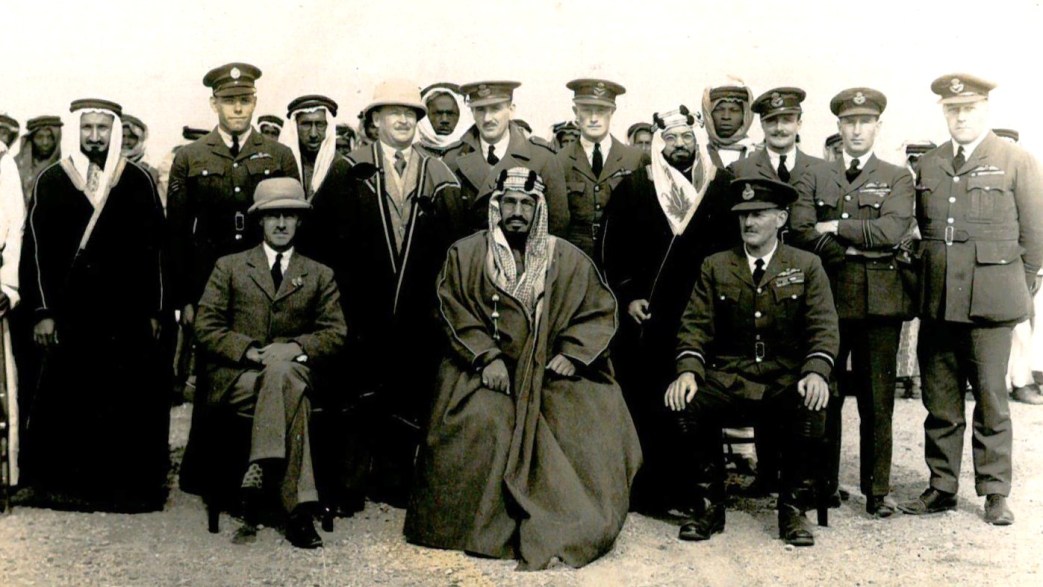
It is not possible to understand today’s relationship between Saudi Arabia and imperialism without knowing the origins of the kingdom in a victory over the British Empire’s first preference Hashemites in the 1920s. The dispatches of Palestine Communist Party leader Joseph Berger are an excellent primary guide.
‘England and Ibn Saoud’ by Joseph Berger from International Press Correspondence. Vol. 7 No. 57. October 13, 1927.
The negotiations which the representative of Great Britain, Sir Gilbert Clayton, conducted with the Sultan Ibn Saoud, who, as a result of his victory over King Hussein of Hejaz, has become the most important factor in Arabia, were very prolonged and tedious. At the end of 1925 there was concluded the first provisional agreement between England and Ibn Saoud; but this did not touch any of the questions which interested British policy in Arabia and are of vital importance for Ibn Saoud. The aim of British policy to secure the greatest possible influence in the kingdom of Ibn Saoud, to make the Bedouin king completely dependent on their favour and then to use him as an instrument, encountered great difficulties right at the beginning. Ibn Saoud would not give up his independence; he had no reason to. On the contrary, he wanted to consolidate his positions in Arabia which he won in the course of arduous and long years of military activity; he cherished the dream of a united Arabia under his rule. It is true that in order to reach this aim he needed a neutral attitude on the part of England, the certainty that he would not be disturbed by powerful British intrigues. He obtained this neutral attitude. by the Treaty of Behere (1925), in which he promised the British representative to respect the frontiers of the British mandatory territory.
Since then, however, the antagonisms between England. and Ibn Saoud have become acute. Ibn Saoud rejected the British proposal that his kingdom should be represented abroad by the British Ambassadors. He refused officially to recognise as legally valid the separation of Maan and Agaba (which occurred during the war between Hussein and Ibn Saoud) from the territory of Hejaz. He permitted a Congress to be held in Mecca (1926) which was in fact directed against England. He would not abandon his right in the administration of the Hejaz railway in favour of England. He took good care not to conduct an anti-English policy himself, but always acted on his own account. The attempts of Clayton to arrive at an agreement on the disputed points continually failed.
Thereupon British policy commenced to work by means of pressure against Ibu Saoud. In a quiet, unostentatious manner, every weakness, every failing of Ibn Saoud was taken advantage of in order to prove the necessity of British support.
In the first place there occurred a change in the public. opinion of the Indian Mohammedans who were at first among the most enthusiastic supporters of Ibn Saoud. There commenced an agitation against Ibn Saoud in all the Mohammedan countries which sent pilgrims to the “Holy places” of Islam. Ibn Saoud became involved in a conflict with the Egyptian government, which resulted in the proclamation of a semi-official boycott against him. In fact the English even began to resume their relations with the pensioned off king Hussein; the old man was suddenly given an English decoration; he was allowed to hold a conference with his sons and to write against Ibn Saoud in the pro-English press.
It was intended by these means to render Ibn Saoud docile. In addition there were the difficulties which the conqueror had in the interior of Hejaz itself. The “holy land” of Islam has a population whose social structure differs considerably from that of the highlands of Nedshd (the native country of the Wahabites and Ibn Saoud), which are inhabited by Bedouins who live by robbery or cattle-breeding. In Hejaz there are poor peasants, dealers. and merchants. The rigorous laws of the puritanical Wahabites are unpopular in Hejaz. On the other hand the efforts of Ibn Saoud to introduce technical achievements (automobiles, electric light etc.) encounter the mistrust and discontent of the fanatical “Ikhwan” (Wahabite fraternities). The result is the growth of a mood hostile to Ibn Saoud, which even finds expression in conspiracies, attempts etc. against the person of the king.
Finally Ibn Saoud is threatened by his rival and most powerful opponent, the Imam Jihie of Yemen. The latter has concluded an agreement with Italy under which he receives great stores of weapons from Italian factories, as well as technicians and officers. The Imam Jihie threatens the Southern frontiers of Ibn Saoud and forces him to make constant war preparations.
In spite of everything Ibn Saoud has not submitted to British pressure. The agreement that was ratified some days ago as the “Treaty of Jidda” and was published simultaneously in London and Mecca, takes no account of the chief desires of England. It is true Ibn Saoud pledges not to permit any conspiracies against England on his territory, not to interfere with the protegés of England, the principalities of Bahrein and Koweit (on the East coast of Arabia), to protect the pilgrims from the British countries etc. but in the main points, in the question of Maan and Akaba, as well as in the question of representation abroad, Ibn Saoud has not given way.
On the other hand the treaty of Jidda contains an important gain for Ibn Saoud: the English officially annul all the arrangements they have made with the Hachimitic dynasty.
The new treaty between England and Ibn Saoud does not in any way mean the solution of the Arabian question. It rather renders more evident than hitherto the profound antagonisms which exist between the imperialist designs of England and the efforts of Ibn Saoud to remain independent.
International Press Correspondence, widely known as”Inprecorr” was published by the Executive Committee of the Communist International (ECCI) regularly in German and English, occasionally in many other languages, beginning in 1921 and lasting in English until 1938. Inprecorr’s role was to supply translated articles to the English-speaking press of the International from the Comintern’s different sections, as well as news and statements from the ECCI. Many ‘Daily Worker’ and ‘Communist’ articles originated in Inprecorr, and it also published articles by American comrades for use in other countries. It was published at least weekly, and often thrice weekly.
PDF of full issue: https://www.marxists.org/history/international/comintern/inprecor/1927/v07n57-oct-13-1927-inprecor-op.pdf

