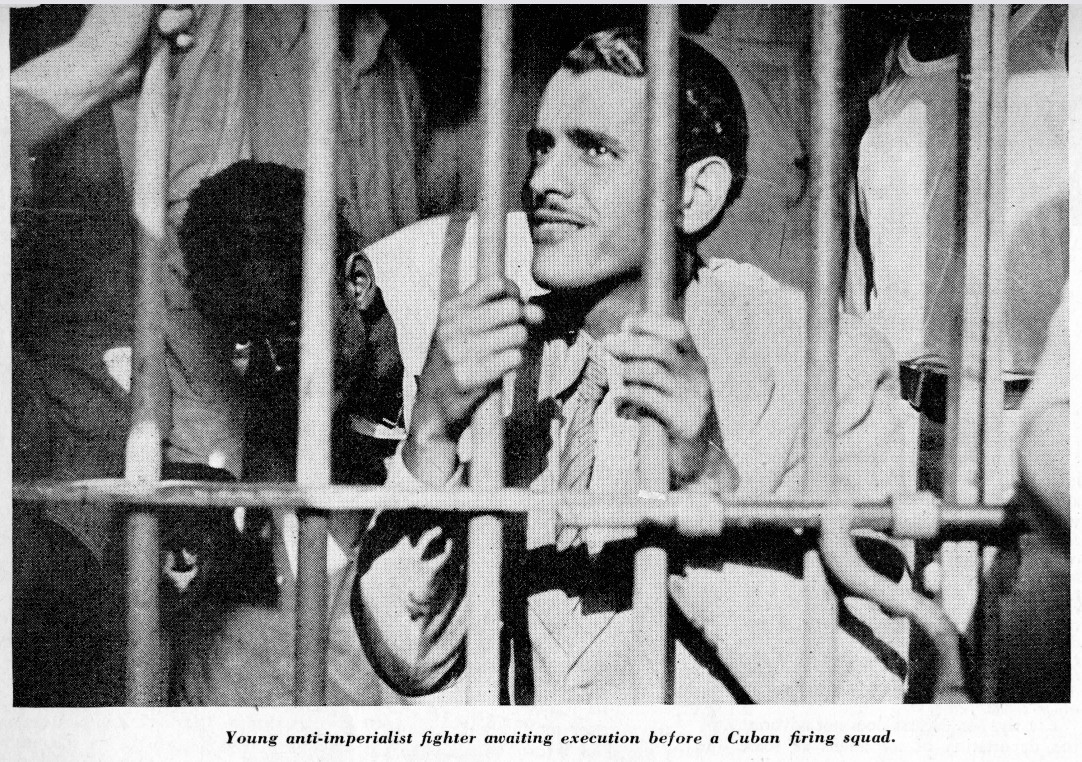
In March, 1935 a new general strike broke out against the U.S.-backed, Batista-controlled Cuban comprador government, to be put down with extraordinary violence. A key moment in the history of Cuba’s Revolution and essential background to 1959. A fine setting of the scene of the Empire’s Bad Old Days in Cuba by New Masses’ correspondent to the island, Josephine Herbst, whose series would become ‘Cuba on the Barricades.’
‘Cuba—Sick for Freedom’ by Josephine Herbst from The New Masses. Vol. 15 No. 1. April 2, 1935.
HAVANA. MACHADO was ushered out of power with a convulsive general strike that did not stop until it had rid itself of the hated ruler, Mendieta, head of the fourth provisional government since August, 1933, was greeted by a strike wave when he stepped into office in January, 1934.
The present general strike in Cuba is a boiling ferment of a deep underlying movement that will not be finished by jails or bullets. Mr. Caffery, Cuban politicians and commercial interests like to imagine that the present strike that took the strongest terroristic measures in the history of this island to repress, is caused by the juggling of political groups, now out of power, to get in.
Nothing could be sillier than the glib assurances put forth by administrators of sugar mills, commercial interests and representatives of the United States government that the Cubans are childish people, politically irresponsible and bent on quarreling.
This strike is the testimony of the people. Its motive power is hunger for bread and freedom. Its leaders, workers and sympathizers of many varied groups, are now in jail. Hundreds have been killed. The rights of assemblage, free press, free speech, free movement of any kind have been crushed for the moment. Batista’s assurances that the government would stop at nothing–clenching his fist, raising it, bringing it down like a hammer, the pale opal ring holding the eye like a monotonous portent–have been kept. Whether or not he is using this unrest to slide into an absolute military dictatorship is not so vital to determine at this moment as to remember that this strike boils up from a people sick for freedom. Even greater than the terrible need for food and shelter is the now universal craving to be free, to feel some personal security; for the family at home not to sit with sinking hearts if the son does not return, for the student to be able to speak without being beaten sometimes to death; for terror to be finished.
Terrorism on this island is of two kinds: that of the terrorists who in despair, irresponsibility and sometimes opportunism have used bombs and deaths to signalize their hatred of a regime that offers no solution to the young or old, and terrorism, calculated, planned and within the law, of a government whose police are military, where no legal court has jurisdiction over a military tribunal. The Urgency Tribunals, set up as an excuse for order, have not run down terrorists of the A.B.C. and Autenticos, but anyone who appears to fight for the rights of freedom or livelihood. Before the strike began, over three thousand political prisoners crowded the jails of Cuba.
The present coalition government of Mendieta began dissolving not because of some pressure from other political groups, but because a general strike of teachers and students on the entire island became the signal for an upsurge leading to the general strike. New cabinet officers have been stuffed into the seats of those resigning; Batista is reported to be shopping among the customers of various groups, anxious only to keep in power, but the groundwork of the profound discontent will be found sooner or later to have been unified, not dispersed by machine guns. Just as the arrest of the six editors of Masses was a signal for a united front movement of groups until that moment disunited, so will present tactics prove a cement. On a political program the united front demands were for freedom of speech, freedom of assemblage, free press, right to strike, legalization of all parties and unions, freedom of political prisoners. In different sections certain local demands played a part; the teachers adding demands for new schools, equipment and free lunches for undernourished children.
The old-line parties, sensing the way the wind was about to blow, had been busy prior to the strike holding forth bait to the public. Even the old Liberal Party tried to get rid of the smirch of Machado by promising a solution of the unemployment problem. Only the Autenticos party of Grau San Martin, the party of Guiteras to the left of Autenticos, the Agrarian Nationalist Party and the Communists were unrepresented in the Mendieta government. The A.B.C. was represented but sought to get rid of Mendieta without sacrificing Batista.
When the old glove began splitting, an attempt was made among old-line groups to sew up the seams and announcements kept appearing that they would get together and make some statement that would completely reassure the people. Elections were promised but no one believes in elections anymore. There has been no democratic election on this island as far back as most grown-ups can remember, which means never. At the same time, all opposition groups including the A.B.C. were attempting to form a united front of leadership to back the general strike. The leaders did not agree. But the rank and file bolted and followed the leadership of the Confederation of Labor and the Agrarian Nationalist Party in a general strike. And the general strike was waged at base on a purely anti-imperialistic line.
In Havana the intense hatred of American penetration of this island is obscured if one sticks closely to the business interests and the wealthy section of Vedado. But sit on a park bench, talk to people in stores, ride on busses over this island, and the hatred that foreign capital, particularly American, has bred in masses of people is as clear as daylight.
This island, never free of interference, never free of the kind of greed that made Cortez say petulantly, “come here for a gold mine, not to work like a peasant,” is bound hand and foot to a system of economy that brings only a starvation standard of living to the masses of people. Leadership of political parties may be only too glad to play ball with United States but that is no sign of the simple instinctive reaction of the people. American officers fraternized with Spanish officers after the Spanish-American War and Cuban patriots were forgotten except by General Wood who cleaned up the island for the health of American business men and ordered a decree that would annul the communal land holdings and initiate a system more amenable to the acquisition of private property. That little maneuver has now piled into a system of latifundo land ownership that is demoralizing to the people. That Mr. Welles trumpets the abolition of the Platt Amendment at this late date is nothing; the hands-off policy of the United States is not trusted on this island where we continue to hold a naval base at Guantanamo and Mr. Caffery sees eye to eye with. Mr. Batista as a man of practical affairs.
At this moment the streets are empty at night, the nine o’clock curfew can strike death if defied. The student running the elevator in my hotel has a serious face. He was smiling a little when the strike began. Many people of a neutral bent were not sure of themselves but a few nights of terror have set their beliefs. The brief regime of Grau San Martin with its Social-Democratic phraseology appears to have given people many doubts. So little was accomplished, they say, so much promised. Distrust of politicians has eaten into them like cancer. It is from the deepest depths that the movement comes. The unafraid are the really desperate, who have nothing to lose. But if one reads the papers, all government-censored, Mendieta has broken the strike and the government was never so strong. One must remember that no government, however backed by force, holds out forever without offering something to its people. Even Hitler had an unfriendly outside world and the humiliations of Versailles to aid him; Mussolini built up an “ideology.” Batista has nothing but an army. Whether he is a “man of the people” and not so much a killer as he seems, is as unimportant now as it is to decide whether Mendieta is or is not a personally honest man. Both are in the grip of a machine more powerful than any individual.
The entire economic machinery of this island that has set the lives of its people in a jelly of misery, is also geared beyond the power of anyone adequately to control it. Profits run thin; even now sugar-beet interests in the states deeply intrenched in Philippine and Hawaiian cane, maneuver for high tariffs that will wipe out Cuban sugar as if it did not exist. The Reciprocity Treaty is the last sponge to stop the flow of blood. Figures prove that exports and imports have practically doubled over last year. The sugar business has been propped up with a crutch for the benefit of the sugar business.
“Spill a little water on this table,” said a doctor in Santiago to me, “and it will give you an idea of how much benefits soaked through to the people. The top layer feels the water, the underlayers never know a drop was spilled.” Children beg, hundreds dangle lottery tickets in front of your eyes, the crazy framework is geared to an industry that cannot feed the country on which, in the past at least, it has fattened.
In order to control sugar quotas, small farmers have been crowded and their contracts cut, workers have been fired from more skilled jobs for the cane fields. The entire business of the mills needs a steady all-day, all-night, all-week grind until the job is done. The rubbish from cane feeds and runs the mill’s machinery. All day the huge carts topple cane into the giant maw. The speedup and the shortened quota have shortened the season for the zafra. Whatever profits come to the people come only through wages and with a shortened season, the long dead season where there is no work looms more ominously than ever. Moreover prices have risen, even when wages have gone up. In most mills the cutter of cane working the field gets just what they want to give him, no more. It may come to thirty cents a day, may rise to fifty, the most anyone dares say is paid, is eighty. Most field workers see no money. Scrip is their lot, redeemable at company stores. The Mercedes, an American mill, gives chips of metal; yet scrip is illegal.
Only laws against labor seem to be enforced; the others ride by the board. The death penalty for sabotage has been the excuse to jail hundreds of workers all over the island. Many have been driven from tiny huts to wander to relatives in towns. Carlos Garcia has a big family and he made a garden but they gave him twenty-four hours to leave. He belonged to a syndicate. Vincente Castillo was a sugar boiler; he was beaten for belonging to a syndicate, told to march on. Sugar workers, half smiling, shamed, tell of humiliations at the hands of soldiers, of heads shaved, of the chapapote, a hot, small red pepper, used for torture. These are details. The whole fabric is rotten; the life a lottery where only a few in Havana who can sneak into government jobs hog money. Small Cuban business men and bigger Cuban operators naturally lick the hand that feeds them but underneath, the population simmers.
Big business is largely in the hands of the American and British; smaller businesses and shops in the hands of Spaniards. There seems nothing left for the Cuban but graft. No wonder a cynicism has been bred in the intellectual worker, the doctor and journalist and often the teacher. Some of them disbelieve too much. It is only from below that belief bubbles and forces its way up into a strike, into continual demands that filter out to other classes, purge teachers and students and unify them all. Young men graduating from medical school, lawyers, teachers, all focus their hopes upon Havana, the one city into which money pours. The interior is drained.
Too many doctors, they say, while children in sick huts on mountain tops die with nothing to relieve their pain. There is only too much sugar here, that is all. Too much on top, too little below. Salaries for medical men today, even in Havana, are not very big plums. Doctors are in a bad way, with salaries of from $25 to $50 a month and private practices ruined. The mutual organizations of hospitalization, while excellent in detail, work out pretty much as everything else on this island. Due to hard times, membership has dropped off. Of those remaining, the rich pay no more than the poor, and many of those who once thought $2 a week a fair sum now should pay much more for the private rooms that they seem to get through political pull when they are ill. The doctors are striking too, demanding government aid, demanding that the rich pay more, the poor be served free, that doctors have membership on governing boards now controlled by business men.
“Things are better,” say hopeful business men, “look at rents, they are up, a sure sign.” But the answer comes from the head of the Tuberculosis Sanitarium on this island. “Tuberculosis is on the upgrade. We have 500 beds and need 5,000. People are hungry because rents take too much money. All diseases are on the increase.”
“Vegetables have increased in the export trade,” reads an article but the farmer cannot wriggle from the commission man to whom he signs away his crop before it ever grows, to whom he is always in debt. The colono growing cane and subsidized by the mill owner would have to turn over every cent coming to him for four years in order to liquidate his present debt.
This top-heavy structure is smothering the island. It will not let the fisherman sell fish directly to the poor field worker. It compels him to sell to the canteen of the sugar mill which in turn gets a profit for selling to the field worker. A whole people have been demoralized but they continue to raise their heads. The students have a word Tangana, meaning to make a big noise. They do not believe in promises of politicians any more. When six secretaries came to Santiago when the province of Oriente refused to pour taxes into Havana any more, they promised the boys a new school but the students continued their strike just the same, continued to make a big noise.
A big noise fills this island, even if under repressive measures it has become for the moment a whisper. Americans like to patronize Cubans, to say they are shiftless, do not want to cultivate land, cannot run their political affairs. All the while they forget that Cubans have never had freedom. They are renters in their own country, with only the pride to struggle in the bravest way for freedom. They may not cultivate land, but they die for freedom, without which cultivating land is only slavery. Much of what Cubans earn goes on the back. Shoes are precious. People are often on the move, going from cane fields to coffee mountain, hunting for food. Driven by hunger.
The sugar-cane worker who is three months or less at zafra must put on his shoes if he has any and maybe go to the coffee mountains. Sometimes he doesn’t get to wear his shoes even if he gets to the coffee mountains. That’s the rainy season and his feet swell, his belly swells, sometimes he dies and his shoes don’t ever go on his feet any more. There’s malaria in the barracones; it’s hard to find a dry place to put a sack to lie on. Sometimes the women never get to wear a good dress; just a gunny sack. It’s hell all right on the coffee mountains. Then there’s wood cutting too, deep in swamps. It’s full of mosquitoes there, and standing in water half to the waist isn’t healthy. The army doesn’t get around to boss. things so much though in a place like that but they came lately to a swamp near Havana and beat workers who had struck in sympathy with the secretary of their union, in jail in Havana.
It’s funny to hear foreigners talk about the way the cane workers don’t know how to raise gardens. There are few gardens on the island it’s true, but when sugar was high, gardens were forbidden by those that own the land, those who are not the cane workers. But even on the coffee mountains they made a union. A Jamaican told me about it, smiling and nodding, telling how he hid under piles of rubbish when soldiers came to look for him.
The interior of this island is the answer and the explanation of the strike. When the interior is answered, when the people of Realengo have their land in peace and can get goods for their hard labor on their land, when schools come, when sanitation and electric lights are common, then strikes will cease on Cuba. “We don’t have lights,” a worker says, “only the moon.” Little children eight years old go on strike in Santiago for pencils and paper. In an academy of fine arts in the midst of crumbling busts and plaster casts without arms or noses, students were patiently trying to learn to draw; an orchestra rehearsed on broken chairs; but over the doors of the rooms that crumbled, the names of students who have been murdered by regimes of tyranny on this island, stood out boldly in white paint, on each side of each name, a gleaming white star:
Mella. Rubiera. Trejo.
Tangana–a big noise.
Try and stop it.
The New Masses was the continuation of Workers Monthly which began publishing in 1924 as a merger of the ‘Liberator’, the Trade Union Educational League magazine ‘Labor Herald’, and Friends of Soviet Russia’s monthly ‘Soviet Russia Pictorial’ as an explicitly Communist Party publication, but drawing in a wide range of contributors and sympathizers. In 1927 Workers Monthly ceased and The New Masses began. A major left cultural magazine of the late 1920s and early 1940s, the early editors of The New Masses included Hugo Gellert, John F. Sloan, Max Eastman, Mike Gold, and Joseph Freeman. Writers included William Carlos Williams, Theodore Dreiser, John Dos Passos, Upton Sinclair, Richard Wright, Ralph Ellison, Dorothy Parker, Dorothy Day, John Breecher, Langston Hughes, Eugene O’Neill, Rex Stout and Ernest Hemingway. Artists included Hugo Gellert, Stuart Davis, Boardman Robinson, Wanda Gag, William Gropper and Otto Soglow. Over time, the New Masses became narrower politically and the articles more commentary than comment. However, particularly in it first years, New Masses was the epitome of the era’s finest revolutionary cultural and artistic traditions.
PDF of full issue: https://www.marxists.org/history/usa/pubs/new-masses/1935/v15n01-apr-02-1935-NM.pdf

