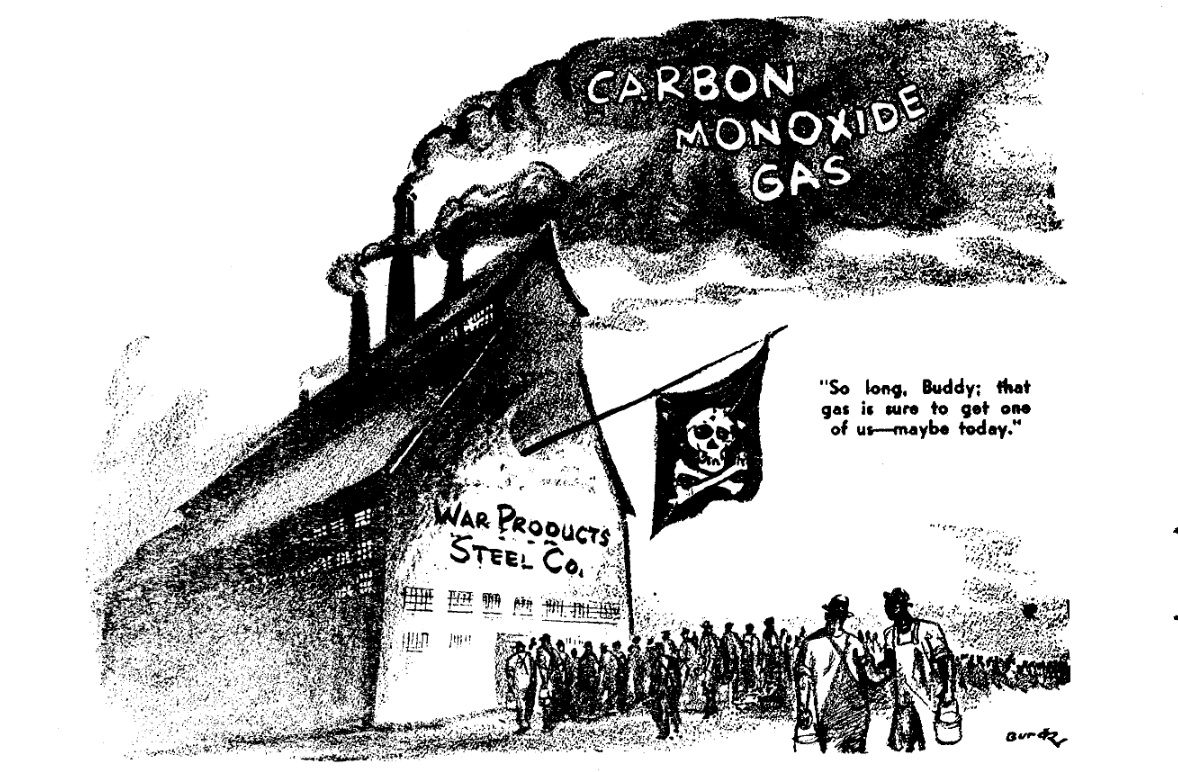
How many hundreds of thousands of our sister and brothers have died for lack of the most basic safety precautions at work? Proper ventilation would prevent illness from CO, but proper ventilation costs time and money.
‘Carbon Monoxide: Death Lurks in Industry’ from Health and Hygiene. Vol. 1 No. 3. June, 1935.
“CO” is the chemical formula for carbon monoxide. The formula often means death to workers. Invisible, odorless, deadly poisonous–carbon monoxide literally ambushes those workers whom it kills in industry.
CARBON monoxide poisoning is one of the most widely distributed and most frequent causes of accidental death, both in industry and in the home. With the introduction of fuels such as natural gas, producer gas, carburetted water-gas (illuminating gas), and gasoline for heaters and combustion engines, the number of cases of carbon monoxide poisoning has mounted alarmingly.
Workers are totally ignorant of the dangers and deadly properties of this gas, and are constantly exposing themselves to the fumes. Thousands of workers die annually of carbon monoxide poisoning, and many more thousands suffer the constant ill effects of exposure to the gas. Workers suffering from chronic non-fatal forms of carbon monoxide poisoning often become more susceptible to the inroads of various other diseases not immediately connected with carbon monoxide poisoning.
In industry the workers come in contact with a great many possible sources of carbon monoxide. In the iron, steel and allied industries, leaky blast furnaces, gas valves or mains are a particularly frequent source of gas poisoning, especially to workers engaged in cleaning out furnaces. Examination of the blood of one thousand blast-furnace workers in the steel industry in Illinois showed that about one-third of the men suffer from mild to fatal carbon monoxide poisoning during the year. The frequency of poisoning is particularly high in gas-producing plants where acute and fatal gas poisoning are not uncommon.
The carbon monoxide hazard attends all welding processes with acetylene gas, all soldering processes, and the melting and pouring processes in brass foundries. It is present in the garment industry and in steam laundries among workers using gas-heated ironing and pressing machines.
Carbon monoxide is present in death-producing quantities in the exhaust of all gasoline burning engines. Garage air is decidedly dangerous after an automobile engine has been running for only 15 minutes, particularly in small private garages. The newspapers often carry reports of death from this source.
The dangers of carbon monoxide poisoning are also prevalent in compressed-air work in tunnels, in mine fires, explosions, and blasting operations. The majority of deaths in mine disasters are to be laid to carbon monoxide poisoning; the actual force of the explosion causes a smaller percentage of deaths. Firing high explosives in improperly ventilated gun turrets, particularly on ships during the last war, often caused death from carbon monoxide poisoning. On one vessel alone, in the battle of Jutland, several hundred men were fatally affected by carbon monoxide produced by use of the explosive “Cordite.”
Finally, in the home, improperly constructed gas heaters and leaky gas ranges with lack of ventilation to carry off the deadly product of combustion, have contributed tremendously to the increasing death rates from carbon monoxide poisoning.
It Has No Odor
CARBON monoxide is an odorless and invisible gas which is formed whenever a fuel is burned without a sufficient supply of oxygen. The lack of oxygen usually comes about through improper ventilation. A fresh supply of oxygen is not brought to the burning fuel, and carbon monoxide is produced. In addition, combustible gases, such as illuminating gas, producer gas, natural gas, etc., originally contain high percentages of carbon monoxide, so that all unburned quantities of these gases escaping are also highly dangerous. Other gases which have an odor and are mixed with the odorless carbon monoxide generally serve the useful purpose of leading one to suspect the presence of carbon monoxide in a gas-laden atmosphere.
Inhaling carbon monoxide so affects the blood of humans that it becomes incapable of absorbing the oxygen which is essential to life. Thus it acts differently from the highly poisonous, irritating gases used in modern warfare. These war gases produce their fatal results by intensely irritating and burning the linings of the breathing passages.
In city fires, the dense black smoke also contains irritating substances which cause coughing and tearing of the eyes. But suffocation from this smoke is caused by its high carbon monoxide content.
Symptoms
DEPENDING upon the percentage of carbon monoxide and the duration of exposure to it, one finds the following symptoms in cases of gas poisoning. At first, headache, dizziness, dimness of vision, and weakness appear. These symptoms may occur among workers after one hour in an atmosphere containing two parts of carbon monoxide to every ten thousand parts of air. If exposure is continued, or the percentage of carbon monoxide rises to as high as fifteen parts per ten thousand parts of air–then nausea, vomiting, fainting and coma follow. If no treatment is given, then death results.
Workers who are constantly exposed to carbon monoxide fumes do not generally complain of the severe symptoms listed above. Usually, they suffer from headache, nausea and occasional dizziness. Loss of strength and awareness resulting from the “knockout” properties of the gas reduces the workers’ efficiency and leaves them open to other industrial accidents.
In those cases where recovery has followed severe carbon monoxide poisoning because of prompt treatment, after-affects are often found–such as blindness, mental dullness, constant headache, and severe disease of the brain and nerves.
Treatment
TREATMENT of severe carbon monoxide poisoning consists of the following:
1. The victim should be removed to the fresh air as soon as possible.
2. If breathing has stopped, or the patient breathes in occasional gasps, artificial respiration by the Schaefer method should be given until normal breathing is resumed.
3. A mixture of five per cent carbon dioxide and 95 per cent oxygen should be administered by an inhaler for at least 20 minutes, and sometimes for as long as three hours.
4. The body must be kept warm by means of blankets or hot water bottles.
5. The victim should be kept at rest lying down. Alcoholic drinks, such as whiskey, should not be given. After partial recovery, he should be removed to a hospital.
Prevention
PREVENTION of carbon monoxide poisoning is achieved when the source of the escaping gas is discovered and eliminated. Recently, a very delicate instrument has been perfected, through the use of which the smallest amounts of carbon monoxide gas can be immediately detected. This instrument uses a chemical–iodine pentoxide–which changes color in the presence of carbon monoxide gas. Formerly, birds and mice, which are particularly susceptible to the ill effects of carbon monoxide gas, were lowered into suspicious enclosures and observed for signs of poisoning. However, the birds and mice are not nearly so sensitive as the iodine pentoxide indicator.
Guard Against It
WORKERS must guard themselves against practices which expose them to the carbon monoxide danger.
1. Automobile engines should not be run in a small garage, unless the doors and windows are wide open.
2. Workers should insist that large garages install systems of artificial ventilation to carry off the poisonous fumes.
3. Workers should not sit in closed cars or trucks with the engines running, since exhaust gases often leak into the car and may produce symptoms of gas poisoning.
4. Heavy, long-continued labor should not be performed on still days by workers repairing streets on which automobile traffic is heavy. Short working-shifts with intervals of rest in the fresh air should be demanded.
5. Before entering manholes for underground power and signal circuits, sewers, blast furnaces or any other enclosures where the atmosphere is contaminated with gas, workers should insist that the air be tested for carbon monoxide. If the gas is found present, the enclosure should be thoroughly ventilated until no trace of gas remains.
6. In fighting fires, and in mine rescue work, special two-hour gas masks should be used by men who have been previously trained to use them.
7. In the home, a gas heater should not be allowed to burn in a closed room in which persons sleep, especially if the heater burns much gas and has no flue. Where such a heater is used, it is absolutely essential that one or more windows be opened to supply plenty of fresh air. Gas heaters used in the home are often of improper design. They lack a proper flue for ventilation, necessary for the carrying off of the deadly fumes. The tubing of cooking ranges is often defective, and the unburned gas escapes. through leaks.
8. In all industries where gas is produced or consumed, the iodine-pentoxide indicator should of the carbon monoxide fumes. Tanks, mains, be utilized to ascertain the presence and source valves, and blast furnaces should be kept in constant repair to prevent leaks. Where improper combustion produces carbon monoxide, a system of ventilation should be installed. The design of fuel burners should be modified to reduce the production of carbon monoxide gas to a minimum.
Workers are gradually coming to the realization that safeguards for their health are often neglected by the employers in a mad race to maintain profits.
The workers must demand of the owners of the industries that they be given proper protection. They must demand that proper tests be made, that rest periods be given those workers who may be exposed to the deadly fumes, that ventilation be installed and kept in repair.
Health was the precursor to Health and Hygiene and the creation of Dr. Paul Luttinger. Only three issues were published before Health and Hygiene was published monthly under the direction of the Communist Party USA’s ‘Daily Worker Medical Advisory Board Panel’ in New York City between 1934 and 1939. An invaluable resource for those interested in the history history of medicine, occupational health and safety, advertising, socialized health, etc.
PDF of full issue: https://www.marxists.org/history/usa/pubs/health/v1n3-jun-1935-health-hygiene.pdf

