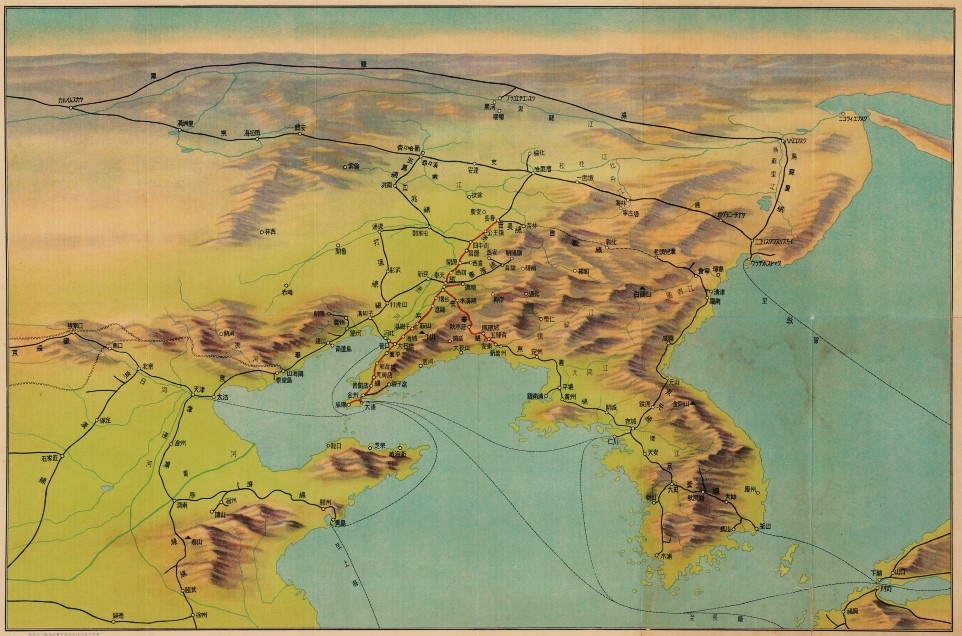
A generation before the full-scale September, 1931 invasion Japanese imperialism, embodied by the South Manchuria Railway Co., exercised control over ‘Southern Manchuria’, more or less today’s Liaoning province of China. Below, a useful introduction to the region’s working class at the time of the invasion.
‘The Labor Movement in Southern Manchuria’ by Satomi from the Daily Worker. Vol. 8 No. 31. December 16, 1931.
MANCHURIA AS A SEMI-COLONY.
MANCHURIA is rich in raw materials and food products, which the imperialists are anxious to control. In addition, it is a most important strategic point in the struggle for the Pacific and its coasts, and as a military base against the Soviet Union. Japan has long maintained monopoly rule through her transport and industrial combine, the South Manchurian railway; owns numerous enterprises railways, the Fu-shun and Yentay coal mines, the Anshan iron factories, electric stations, Port Dairen, warehouses, hospitals, schools laboratories, experimental stations etc. etc.
Manchuria for Japan is the source of raw material and food and her market for industrial commodities. The Japanese here get more profits from exploiting the fabulously cheap local labor power, the Chinese; they exploit the peasantry, by buying up their agricultural produce and raw materials at unbelievably low prices, through middle men and usurers. At the same time they sell their commodities in the towns and villages of Manchuria at high prices through the monopoly. During 1930 alone their net profits in Manchuria were over 12,000,000 yen.
As for the other imperialists, neither are they greatly inclined to be pushed into the background in Manchuria, so promising with profits. They also want to suck the blood of the tollers. Such is the nature of parasites. They gradually penetrate into Manchuria in railway and port construction, industry, mining, banks, gold mines, etc., pursuing at the same time the competition and the struggle for greater profits one going the better than the other in the innumerable ways of exploiting the toilers.
The local get-rich-quick capitalists, desiring to compete with their more primitive technique, with the imperialists, make up their losses at the expense of the workers.
Such is the environment of the 200,000 strong Chinese proletariat in Southern Manchuria!
The position of the Chinese workers is most unenviable. More often than not they work unrestricted hours. Even where the working day is restricted, it is as long as 11 and 14 hours. The miners begin their working day at three in the morning.
Wages are incredibly low. Skilled workers do not get more than 10 American dollars a month, and usually, the wages are as low as six dollars with deductions for food and crude lodgings in the barracks. The imperialists pursue their national policy in fixing wages. For instance, for performing the same work on the South Manchurian Railroad Japanese get about $1.50 while the Chinese only get 45 cents.
Wages are frequently not paid for months, and when they are paid it is in Chinese currency, “finpao”, and not in yens or silver dollars. For any bad quality production, even if not caused by the worker, the employers do their best to lower wages or to impose fines. There is no increase in wages. Quite frequently new impositions are introduced. There is also compulsory “savings” out of the miserable earnings of the workers, and the employers knowingly cheat the workers of part of their wages.
The workers know practically no rest days, with the exception of two or three holidays during the year. On the state holidays they are compelled to work, getting paid as for ordinary days. They do not get any vacations, not even for the most essential visits to their home places. The workers justly remark–“Once you’re here, you die here.”
The treatment of the workers is absolutely brutal–the overseers, foremen, and petty officials beat the workers, and no where can any “justice” be found.
All the burdens of the workers are beyond enumeration. The workers are colonial wage slaves, brutally driven and exploited by imperialism.
FIRST STEPS OF THE LABOR MOVEMENT
In the conditions of unsurpassed exploitation, since the world war when the expansion of Japanese imperialism in Manchuria, particularly, began, we see spontaneous and unorganized strikes of Chinese and Japanese workers breaking out for improved material conditions–wage increases, reduced working hours, etc.
The banner of struggle was first raised in 1916-1917, and is still kept flying by the workers in the railway shops of Shakako in Daireno and by the miners in the Fushung mines.
The next wave of analogous strikes was to be noticed in 1919-1920. These strikes involved a wider circle of participants and enterprises–the railwaymen in Dairen, the tobacco workers in Inkow, the miners in Penchin, ceramic workers in Mukden, tramwaymen of Fushan, etc. Despite this all of the strikes were of a local character, and conducted exclusively in defense of the workers’ economic interests. They were carried out without any preparations, without any trade union organizations existing, and in most cases ended in defeat for the workers.
THE CHINESE WORKERS’ UNION Was formed in December 1923, in the “Shakako” railway shops in Dairen, numbering 300 men, and was called the Chung-Hua-Gunsyuahut. The object of the organization was extremely moderate–mutual aid, and the maintenance of an evening school.” Later on this union was joined by the workers of other factories and workshops of Kwangtung numbering 3,000 men, Gradually this union began to assume an increasingly class character, and to become a mass organization. It carried on agitation for the unification of the workers in the union, and for the strike struggle against the employers, to improve the workers’ position (free food and housing, double pay for Sundays and holidays, recognition of the Workers’ Union, etc.). It was for these demands and under the leadership of the union that the strike broke out in the Fukusima weaving mill, near Dairen. Seven hundred workers participated in the strike, which lasted from the beginning of April to July. Despite suppression by the police, the union strengthened, and strikes rapidly spread to many new enterprises. In 1927 as many as 25,000 workers participated in strikes, and several enterprises were on strike for 30 days at a time.
The union set up connections with the Chinese Communist Party, which undertook the leadership of the work of this union, which was preparing for the general strike of the Kwangtung workers. This object, however, was not carried out. The Communists and leaders of the union were arrested. The police staged the trial of the so-called “Dairen Committee of the Communist Party” in 1927. The union and other organizations of the workers were broken up, but they were not liquidated, they went underground, and continue to maintain connections with one another, though considerably weakened.
Later, a Postal Workers’ Union was formed, and was officially broken up, though in many districts of Manchuria it continues to exist in fact. True, it is a Kuomintang organization, but the rank and file is extremely anti-imperialist.
STRIKE MOVEMENT
The dynamics of the strike movement are plainly demonstrated by the following official figures (actually they are considerably higher), given by the Japanese police:
Number of Strikes—Participants–Duration
1921 7—959–12 days
1922 25–4,021–93 days
1923 27–4,177–80 days
1924 29–5,256–128 days
1925 59–8,889–225 days
1926 67–12,642–325 days
1927 94–23,539–383 days
1928 81–17,845–376 days
1929 41–6,507–217 days
There is a temporary drop in the number of strikes, although there are sufficient reasons for this (temporary improvement of the economic situation in South Manchuria, which started only in 1929, several enterprises going over to payment of wages in Japanese currency or silver dollars, the raging white terror, etc.), but nevertheless, increasing forces are being drawn in.
By studying the materials on the strike movement in South Manchuria we can ascertain that the chemical, food and drink, mining and building workers are particularly active in the struggle. There are strikes in which there are more than 1,000 involved, but most involve from 100 to 500 workers, chiefly in such centers as Inkow, Dairen, Mukden.
Most of the strikes were for raising wages or regulating same, and most of them did not end in the workers’ favor, while repressions, were applied against the strikers, despite their relentless resistance to the employers and the strikebreakers. The struggle of the strike committee during the strike in the Japanese “Da-an-yan” tobacco factory in Mukden is particularly indicative, the workers, under the leadership of the strike committee, defeating the strikebreakers by force.
THE CRISIS AND OCCUPATION.
South Manchuria, like the whole of the capitalist world, has entered upon the third year of the crisis. The activities of practically all enterprises in this district have been restricted, unemployment increases, while foreign trade has dropped by 45 per cent, the active balance has fallen by 19 per cent, the receipts of the South Manchurian Railway have fallen by 34 per cent, while the stocks of beans have increased to 450,000 tons, and of salt to 240,000 tons, i.e., to 50 per cent of the yield; building works are being restricted, etc.,
The armed occupation of Manchuria by Japanese imperialism has still further intensified the oppression of the workers and toilers “accidental” murders of Chinese workers, as during the bombardment of the Mukden arsenal; the military regime and ruthless treatment of the Chinese by the Japanese, etc. All this has compelled the Chinese to leave Manchuria by the thousands.
This is how the “Bintsyanshi-bao” describes the economic situation of Manchuria in connection with the occupation:
“Economic life in Mukden has died out. The representatives of foreign firms have left. Some enterprises, under the pressure of the Japanese authorities, have opened up, but are not carrying on any operations. Big speculation is going on in the currency and food markets. The Mukden monetary unit, the “Finpao”, is accepted at a rate six times below the quoted established by the Japanese. Food prices have increased several times, while the purchasing capacity of the population has fallen greatly.”
All this has only tended to still further increase unemployment, poverty, and the starvation of the Manchurian toilers. The workers have endeavored to show resistance to the imperialists who cast the entire burden of the crisis and intervention onto their backs. The silk workers of Andung, numbering 15,000, went out on strike. The Chinese workers in the Anshang iron and steel works, have declared a strike, which is participated in by 2,000 workers. The results of this struggle are not yet known. It should be noted that the organizational state of the workers in South Manchuria is still very weak.
The order of the day contains the question of organizing the workers of Manchuria into revolutionary trade unions. Only united in revolutionary trade unions. Only united in revolutionary mass trade unions, and under the leadership of the Chinese Communist Party, will the workers of Manchuria, triumph over imperialism.
The Daily Worker began in 1924 and was published in New York City by the Communist Party US and its predecessor organizations. Among the most long-lasting and important left publications in US history, it had a circulation of 35,000 at its peak. The Daily Worker came from The Ohio Socialist, published by the Left Wing-dominated Socialist Party of Ohio in Cleveland from 1917 to November 1919, when it became became The Toiler, paper of the Communist Labor Party. In December 1921 the above-ground Workers Party of America merged the Toiler with the paper Workers Council to found The Worker, which became The Daily Worker beginning January 13, 1924.
PDF of full issue: https://www.marxists.org/history/usa/pubs/dailyworker/1931/v08-n301-NY-dec-16-1931-DW-LOC.pdf

