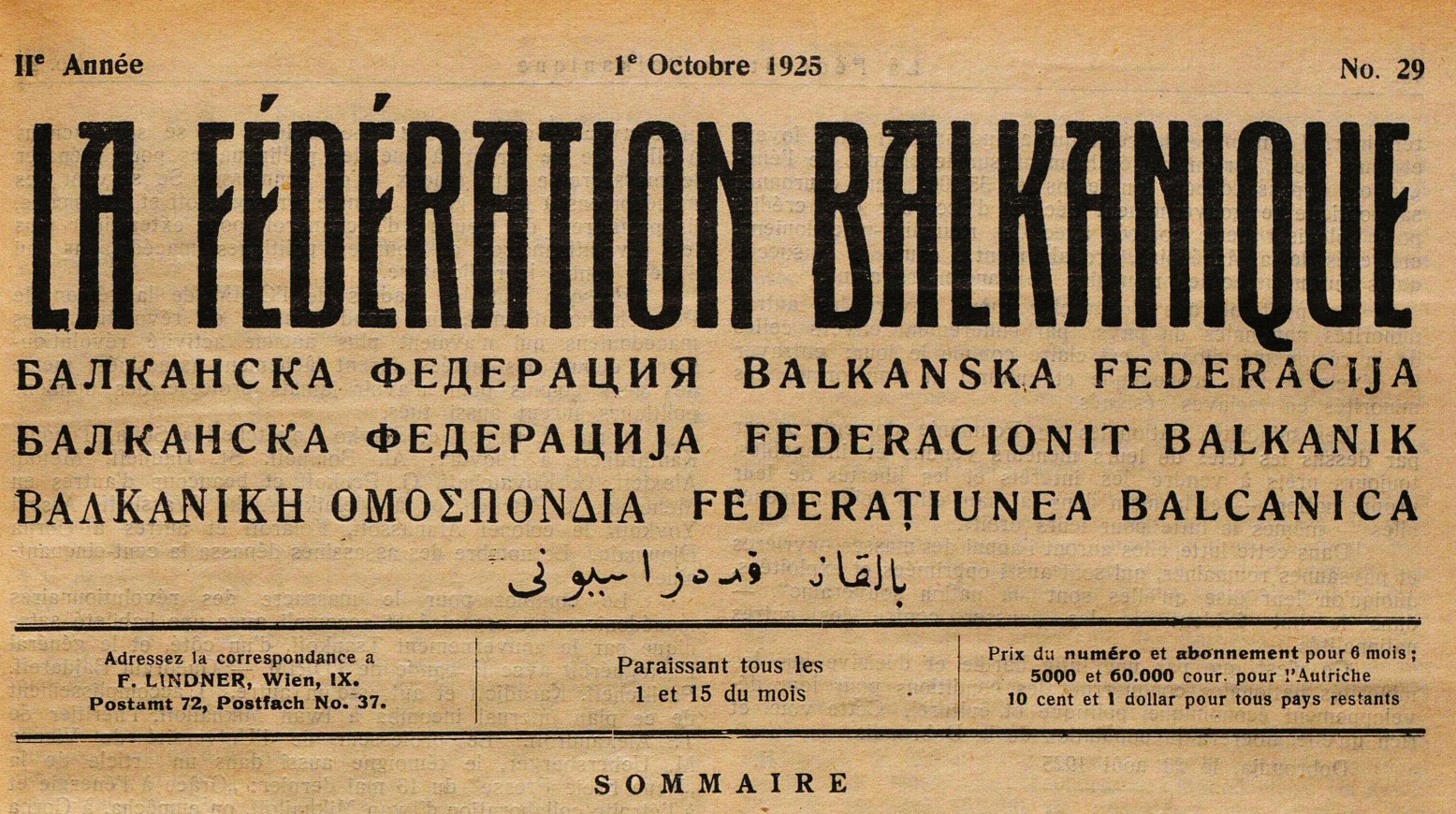
Codified with the founding of the Balkan Workers’ Social Democratic Federation in 1910, the best of the revolutionary workers’ movement in the Balkans was resolutely internationalist in the midst of a chauvinist cauldron constantly threatening to boil over into war. Many of those parties were among the first to answer the call of Zimmerwald and of the Third, Communist, International. Refounded in 1920 as the Balkan Communist Federation, during years of intense reaction at home it issued the primarily French-language, Vienna-published La Fédération Balcanique from 1924 until 1931. Subtitled ‘Organ of the National Minorities and the Oppressed Peoples of the Balkans,’ it had pages in Bulgarian, Croatian, Serbian, Albanian, Greek, Romanian, Turkish, and also German. A review of the journal below.
‘La Fédération Balcanique: Towards Balkan Unity’ by P.K. from Communist International. Vol. 4 No. 12. August 15, 1927.
LA FEDERATION BALCANIQUE. Organ of the National Minorities and the Oppressed Peoples of the Balkans. (Vienna: Fortnightly, first year, No. 1 to 23; second year, 24 to 58; third year, 59 to 65. Pages, 1,264+8.)
THE Balkan volcano is again active. The Jugo-Slav-Greek conflict for Salonika is not at present a burning question, the Italian—Jugo-Slavian conflict has for the moment been shelved and the latest Jugo-Slavian-Albanian conflict, which even led to a break of political relations, will also be “shelved.” This “shelving” takes place, and must take place, because the gravitational centre of the war, of the coming world war which will be further eastward, is aimed at the Soviet Union, and therefore not at the Balkans…The present interest of world imperialism, of British imperialism primarily, is to throw cold water on every spark which appears in the Balkans.
But these interests of Western imperialist States, which at the present do not desire war in the Balkans, cannot remove the contradictions in the Balkans, nay, the contradictions of the imperialist world. The Balkans are and will be of interest, and “La Fédération Balcanique” is the only periodical which illuminates clearly the conditions of the volcano.
“La Fédération Balcanique” is to-day the best periodical in this sphere. “Peninsula Balkanika,” which appears in Bucharest, the Parisian “Peoples and Nations of the Balkans,” the Athenian “Near and Far East”—all these are bourgeois, three-quarters government organs, not only because they lack the object and aim of “La Fédération Balcanique,” but also because all of them together do not publish as much material about the Balkans as “La Fédération Balcanique.”
The first number of “La Fédération Balcanique” appeared on July 15th, 1924, and from the very beginning made its aim not only to be an educational journal, but also a fighting paper. The article “Our Programme” says:
“The principal task of our periodical is, as the name itself shows, the propagation of the idea of the emancipation and the right to self-determination of the Balkan people, as well as of their federation.”
And what did the editors of the periodical, who not only propagated this idea for decades but also fought for it, mean by the emancipation?
“We want to see”—the article on “Our Programme” continues—”the end of European imperialism and Balkan Chauvinism using the Balkan peoples as their victim…For the Federation alone will destroy the roots of all national conflicts, will guarantee the free cultural development of national minorities, will give to all its members a free exit to the sea and to the large rivers, will assure to each complete political and economic freedom, and will at last bring peace to the Balkans and allow the cultural development of all peoples.”
Further it is emphasised that the “idea of the Federation must become the guiding idea,” that “all movements for national emancipation must pursue the same object,” that “reliance must be placed on one’s own powers,” that “the support of the labouring masses must be sought,” and “the fight will begin, though it will be a bitter one.”
No Easy Struggle
And in reality such a struggle is no easy task. One result of the world war has been the strengthening of Chauvinism in these important Balkan States, There is a mania in Greece, Greater Serbia and Greater Roumania. The editors of the periodical were aware of this difficulty, and since the fight must he carried on for and with the oppressed peoples of the Balkans, “La Fédération Balcanique” had to appear at first in all Balkan languages. To-day every number contains the following languages: Albanian, Bulgarian, Greek, Croatian, Serbian, Roumanian, Turkish and the French and German languages, French particularly.
This is indeed a good deal for one edition of a periodical, but this periodical was to publish from time to time articles in the following languages as well: Hungarian, Dalmatian, Russian and Slovak. The many millions of these nationalities in the present Balkan States shall and must be instructed on the general and basic problems of the Peninsula.
Up to January 1st, 1927, the periodical was called “La Fédération Balcanique,” but from that time onwards it received the sub-title, “Organ of the National Minorities and the Oppressed Peoples of the Balkans.” The fighting character of the journal was thus emphasised and made concrete, but at the same time to all appearances reduced. For when speaking of oppressed peoples it is implied that, firstly, there are unoppressed people in the Balkans, and, secondly, that the emancipation of the former is possible without the co-operation and fighting help of the latter.
The national chauvinism of the Greek, Bulgarian, Serbian and Roumanian bourgeoisie is so great and powerful that it is possible to speak of “oppressed and dominated” peoples of the Balkans. But if the problem is discussed from this aspect it is hardly possible to speak of the necessity of the Balkan Federation. The problem must be considered from the general position of the Balkans. The position of the Balkan States in relation to Western imperialism is the point of departure for the future Balkan Federation. And that, too, is the whole meaning of the periodical, which has already appeared for three years, which propagates the idea of emancipation of the whole of the Balkans by a Federation of Balkan States. The basis has therefore only apparently been changed. In reality, however, the editors of the periodical understand by “oppressed peoples of the Balkans” all the peoples of the Balkans, in so far as they are treated as semi-colonial peoples by the imperialism of the Great Powers and are exploited and used as cat’s-paws.
A Wide Enquiry
In propagating the idea of a Balkan Federation the periodical has endeavoured to learn the point of view of public opinion with reference to the fate of the Balkan peoples. An inquiry was instituted and hundreds of persons have replied to the following questionnaire:
1. Do you believe that the present solutions of the Macedonian question are in harmony with the principles of right and freedom as well as in the interest of peace?
2. Do you believe that the right of national minorities under the present Balkan reaction are heeded and guaranteed?
3. What in your opinion can end the oppression of national minorities, and, on the other hand, solve the contradictions among the Balkan States?
4. Do you believe in the possibility of realising a Balkan Federation by the present governments?
5. What is your general opinion regarding a Federation of Balkan States, and what are the conditions necessary for accomplishing this?
Replies to these questions were sent in by bourgeois partisans, Social-Democrats and Communists from practically all over Europe—Barbusse, Jean Longuet, Aulard, F. Buisson, Viktor Margueritti, Peri, Rappoport, Kianil, Balla, Maxton, Cook, Lansbury, Ellenbogen, Istrate, Auguste Forel, Dufour, Soukup, Bartoschek,- Nickolau, Husug, etc. Let the following serve as examples of the replies sent in by several Communist leaders of the Balkans:
1. Comrade Kolarov, in No. 58, December 15th, 1926, writes, among other things: “We Bulgarian Communists consider futile all efforts which the oppressors of Macedonian peasants and workers make, by a mutual understanding about the division of spoils, by physical and moral suppression of the will of the masses…The greatest difficulty consists in the moral and material emancipation of the Macedonian revolutionary movement from the ‘Protectorate’ and the ‘Alliance,’ from either section of the open or secret oppressors of the Macedonian people.”
2. In No. 66, April 15th, 1927, comrade Novakowitch from Jugo-Slavia gave the following reply: “The interests of peace in the Balkan Peninsula can only be secured if identified with the interests of the Balkan people…To us Communists the Balkan problem is as follows: It is primarily a Macedonian problem…In Macedonia, Balkan hegemony is being fought for…The postulate of a Federation of Balkan States means the full and complete emancipation of all Balkan people, and particularly the integrity and freedom of Macedonia.”
3. Comrade Rakovsky, one of the best authorities on Balkan conditions, wrote as early as November, 1924: “Without a radical change of the internal political and economic regime of these countries, a Balkan Federation will, in the present circumstances, be a betrayal of the weaker and an object of exploitation to the stronger. Therefore the fight for a real Federation will be completely covered by the fight of the working class, together with the peasants, for their emancipation from the capitalist bourgeoisie and from feudalism.”
4. Comrade Mosku from Roumania writes in No. 63 (1-83-27): “The articles and the facts which every number of “La Fédération Balcanique” publishes, show clearly that the disappearance of the Austro-Hungarian Empire, as well as the coming into existence of Greater Serbia and Greater Roumania, have not altered the conditions and the fate of the working masses of the Balkans…To prevent a new war among the Balkan peoples the slogan of a Balkan Federation, which can only exist as a Federation of Balkan Republics, must be adopted as the fighting slogan of every day for the workers of town and village, and of all nationalities of the Balkan Peninsula…”
In addition to a thorough treatment of the national revolutionary movement of Macedonia, Albania, the Dobrudja, Croatia, Transylvania, etc., the principal questions of the Balkans are also thoroughly discussed. The national question as a whole, the peasant question and the question of refugees. Moreover, the periodical contains interesting articles on the general economic and political relations of these States to the imperialist Powers of the West, the little entente, the treacherous League of Nations, and the fraudulent Social-Democracy—nothing is omitted by “La Fédération Balcanique.” The terror and the reaction ir general, the bloody deeds of the Balkan governments, and the courageous movements of protest in foreign countries against those deeds are reflected in this periodical.
The “Fédération Balcanique” is of the utmost interest, and must be read by all who want to be well informed on Balkan matters.
The ECCI published the magazine ‘Communist International’ edited by Zinoviev and Karl Radek from 1919 until 1926 irregularly in German, French, Russian, and English. Restarting in 1927 until 1934. Unlike, Inprecorr, CI contained long-form articles by the leading figures of the International as well as proceedings, statements, and notices of the Comintern. No complete run of Communist International is available in English. Both were largely published outside of Soviet territory, with Communist International printed in London, to facilitate distribution and both were major contributors to the Communist press in the U.S. Communist International and Inprecorr are an invaluable English-language source on the history of the Communist International and its sections.
PDF of full issue: https://www.marxists.org/history/international/comintern/ci/vol-4/v04-n12-aug-15-1927-CI-grn-riaz.pdf

