An industrial strike by the new CIO Shoe Workers Organizing Committee of thousands of shoe workers in Lewiston–Auburn, Maine saw the National Guard called out over its three hard-fought months. In addition to all the many usual obstacles and repressions faced by even the smallest of labor struggles, the strike was bedeviled by reactionary, Coughlinite local officers, as it was by old leader applying old methods. A look at a failed strike from 1937, a ‘before and after’ year for U.S. labor.
‘Maine Shoe Strike and CIO Leadership’ by Russell Scott from Socialist Appeal. Vol. 1 No. 4. September 4, 1937.
Oldline Chiefs, Methods, Fail To Bring victory
Today there is a local of the United Shoe Workers of America in Lewiston-Auburn. But on the other side of the ledger we read: Four months of exhausting struggle, $250,000 spent the final result: 500 union members out of the 6,000 originally on strike. A cost of approximately $500 per member, to say nothing of the mood of defeatism which now characterizes the Maine Shoe workers.
Notoriously an open shop state, whose chambers of commerce in shoe centers were publicly advertising “No labor trouble” and “cheap labor”, Maine had twice before, in 1929 and 1932, successfully crushed attempts to organize shoe factories.
Early in March 1997, the undaunted shopworkers of Maine, unable to tolerate conditions any longer, disgusted with the passivity and discredited leadership of the AFL, impressed by the militancy of the auto-worker strikes, invited the United Shoe Workers of America, affiliated with the CIO, to organize the 6000 workers in the nineteen factories of Lewiston and Auburn.
The rank and file of the United Shoe and Leather Workers and the Shoeworkers Protective Association, long rival unions, had just repudiated their reactionary leadership by voting for amalgamation into the United Shoe Workers of America and affiliation with the CIO.
Leaders Hang On
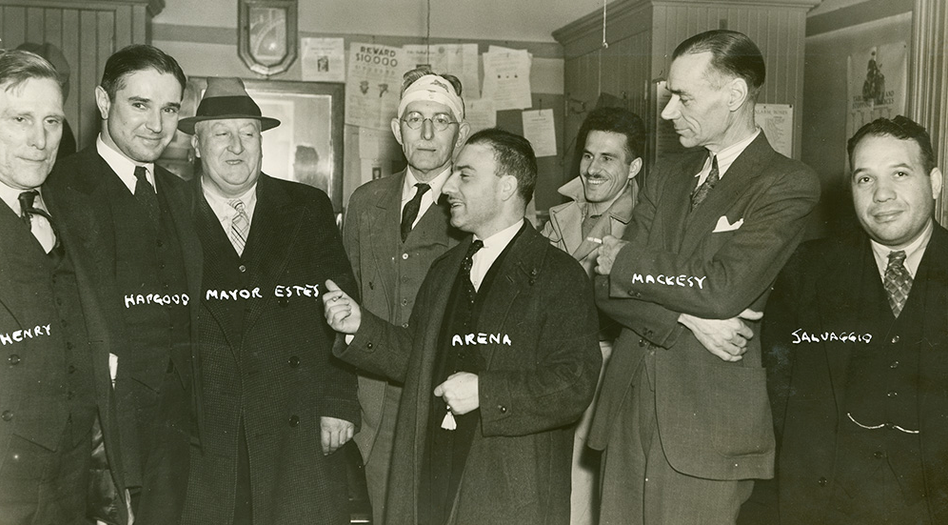
The discredited leadership of the two unions, however, manoeuvered so that they constituted the Shoe Workers Organizing Committee of the CIO under Powers Hapgood. The general organizer of the SWOC was William B. Mahan. Mahan’s history is instructive. Having lost an election in his own union, he conspired to sell out a strike his union was running, to John D. Nolan, head of the rival union. This attempted betrayal had resulted in Mahan’s suspension from his union. The other party to this conspiracy, John D. Nolan, is the present secretary of the SWOC.
Another AFL Type
In the midst of setting up new offices for the merged union came the call from Maine. William J. Mackesy was made chief organizer. A pacifist and opportunist, with a background of training for the priesthood, Mackesy is best characterized as a frail demagogue.
The second organizer, Paul Salvaggio, is an earnest and sincere worker with strong anarchistic leanings, whose fights with Mahan & Co. had been long and bitter. His work was hampered by Mahan, who was afraid that Salvaggio might outdo him and run for general organizer of the SWOC at the next convention. As a counter weight to Salvaggio, one of Mahan’s cronies, Martin J. Lawless of Lynn, Mass., pugnacious, red-baiter, arrogant, and a hard drinker, was made organizer. His tactics were typically AFL: as long as “his” cutters were out, the strike was won; the rest didn’t matter. Along with Lawless went May Dauphine, a staunch supporter of Mahan. May had been business agent of the Lynn Stichers Local for 2 years previous and that at a recent election had so well executed her duties of officers, she received only 40 votes out of a possible 1200. She is an ardent Coughlinite and had been a delegate to the Union Party’s national convention. She was notorious for her red-baiting. While on a picket line, she threatened to have one of the militant strikers arrested for distributing official strike bulletins! Her reason: she thought “It was Communistic literature”.
Over this conglomeration of discredited “leadership” was director Powers Hapgood, vice chairman of the SP. National Executive Committee. Hapgood was aware of the past records of these bureaucrats and betrayers. Nevertheless, he allowed this corrupt and discredited gang to determine the destiny of 6,000 militant shoeworkers. Hapgood elected to act as conciliator and peacemaker among the politicians and in so doing weakened his position as director of the SWOC and discredited himself as a Socialist trade unionist. He soon found himself so busy making peace among the “big-shots” that he lost touch with the rank and file and so lost their faith and confidence. It is significant that when Hapgood and the others were released from jail recently, only about six strikers were outside the jail to greet them.
Meanwhile, the local leadership, consisting of a group of young militants, rebelled and formed a progressive bloc within the organizational committee, fighting for mass demonstrations, for strike bulletins, for more effective picketing, for enlargement of the organizational committee. Mahan began a systematic red-baiting campaign against those local leaders, intelligent, militant workers who couldn’t be kidded any longer.
Relief Doled Out
Mahan took complete charge of the vital factor of relief. Every dollar which came to aid the strikers had to pass through his hands! He carried all the cash, sometimes thousands of dollars in his coat pockets and simply passed the money out according to the merit of the case in his eyes.
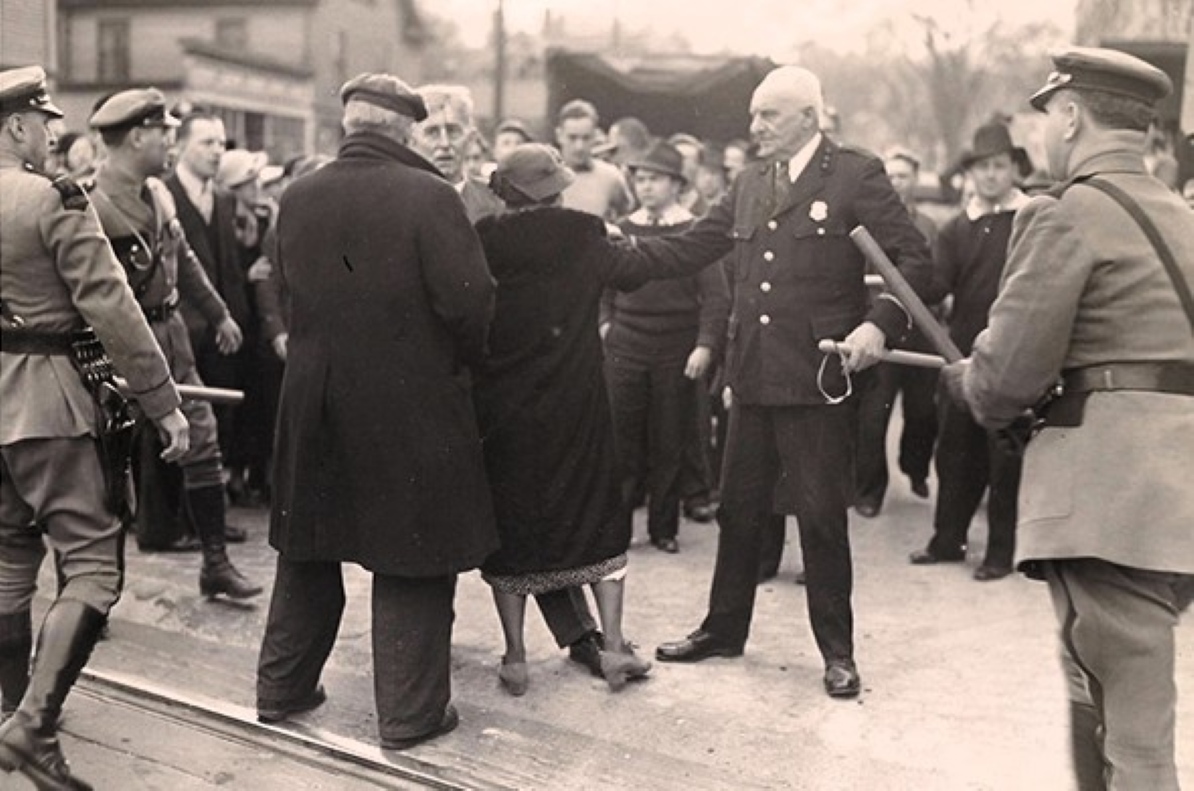
The reaction against Mahan’s dictatorial methods was so great that the strikers threatened to injure him bodily unless he was removed from his position. He was finally removed through the organized pressure of locals in the New England district which threatened to stop financial support of the strike if Mahan continued to handle the money. While these internal struggles were taking place, the shoeworkers were battling all the reactionary forces of the state. One of the first things which the local police did was to set up an arbitrary picket line limit not less than 500 feet from the factory area. This should have immediately called out a mass demonstration of workers in front of their factories, taking advantage of the lack of any state law on picketing. The damper was put on the striker’s militant determination to smash this police ruling, when Mackesy called on the workers to obey it and keep the peace! Later when strikers went over Mackesy’s head and broke through this arbitrary line, not one was arrested for the violations.
The manufacturers soon got a blanket injunction against the strike as illegal and all the leaders were jailed on contempt charges except Mahan who, when arrest seemed imminent, kept a safe distance from the masses.
The natural reaction of the strikers at the jailing was one of resentment. They wanted to demonstrate by surrounding the jail, but on advice of Attorney A. Raymond Rogers, this form of demonstration was prohibited as “it might antagonize the courts.” Rogers was a delegate to the Union Party’s recent National Convention and ran on its Coughlinite state ticket in Maine.
In addition to the injunction, the manufacturers invoked an old conspiracy law to arrest all the other organizers, even Mahan. A few were also charged with inciting to riot.
The jailed leaders were replaced. But if the previous leadership was bad, the new was even worse. There came Charles Murdock from Marlborough, Mass., who had run on the Democratic ticket for Congress in the last election. Every strike talk he gave was a campaign speech for Roosevelt. George Gorham was another, a vicious red-baiter and still a strong proponent of craft unionism. Charles Oldman, close to 70 years of age, realized his uselessness and begged to be allowed to return to Lynn. And o replace Hapgood, John L. Lewis sent Garfield Lewis of the United Mine Workers. His whole role is summed up in repeating his favorite phrases: “And now, my friends, when you go to the ballot box on election day, vote for your friends and defeat your enemies,” and “The greatest president this country ever had is Franklin Delano Roosevelt.”
Government “Help”
It was now June, after four months of strike, the leadership hopelessly entangled in legal technicalities, no secondary leadership built up, the strikers apathetic from lack of activity, and funds practically exhausted. Now a “savior” appeared: the National Labor Relations Board. For months the strikers had been told to put their faith in the government. Surely, they would get justice now, “the government was behind them”. Daily the hearing room was packed with eager, anxious strikers. The outcome:
1. Three charges of the union (interference with organization, existence of a bloc list, refusal to bargain collectively were dismissed on grounds of insufficient evidence.
2. The other two charges brought by the union (discrimination against employes for union activity, and the company-dominated nature of a local organization which appeared after the strike weakened) were withdrawn, the union fearing adverse ruling on these also.
3. The NLRB, after two weeks, finally ordered an election with the local (company) union on the ballot.
The final blow was the plaintive and apologetic resolution drawn up by Hapgood and approved by the SWOC as the only way to save the face of the union:
“…Whereas it is not our purpose to unnecessarily prolong a condition whereby manufacturers of shoes in Lewiston and Auburn may be unable to reopen their factories; or their business be permanently injured because of their refusal, heretofore, to deal with us on the ground that we did not represent a majority of their employees;
“…Be it resolved that at a meeting of Local 114…the strike now in progress be and is hereby terminated.”
There are definite lessons which the shoeworkers must assimilate:
1. The reactionary leftovers of the trade unions who are jumping upon the CIO bandwagon must be vigorously exposed and fought they are capable of betrayal only.
2. The workers must learn the strike-breaking role of the N.L.R.B. and the Roosevelt administration.
3. We must point out the relationship of the CIO leadership to capitalism. The CIO is a progressive step in trade-unionism, but the leadership’s class-collaborationist policies, its constant red-baiting, its bureaucratic administration, prove conclusively it will act as a brake upon leftward moving workers.
There have been a number of periodicals named Socialist Appeal in our history, this one was edited in New York City by the “Left Wing Branches of the Socialist Party”. After the Workers Party (International Left Opposition) entered the Socialist Party in 1936, the Trotskyists did not have an independent publication. However, Albert Goldman began publishing a monthly Socialist Appeal in Chicago in February 1935 before the bulk of Trotskyist entered the SP. When there, they began publishing Socialist Appeal in August 1937 as the weekly paper of the “Left Wing Branches of the Socialist Party” but in reality edited by Cannon and other leaders. Goldman’s Chicago Socialist Appeal would fold into the New York paper and this Socialist Appeal would replace New Militant as the main voice of Fourth Internationalist in the US. After the expulsion of the Trotskyists from the the Socialist Party, Socialist Appeal became the weekly organ of the newly constituted Socialist Workers Party in early 1938. Edited by James Cannon and Max Shachtman, Felix Morrow, and Albert Goldman. In 1941 Socialist Appeal became The Militant again.
PDF of full issue: https://www.marxists.org/history/etol/newspape/themilitant/socialist-appeal-1937/sep-04-1937.pdf

