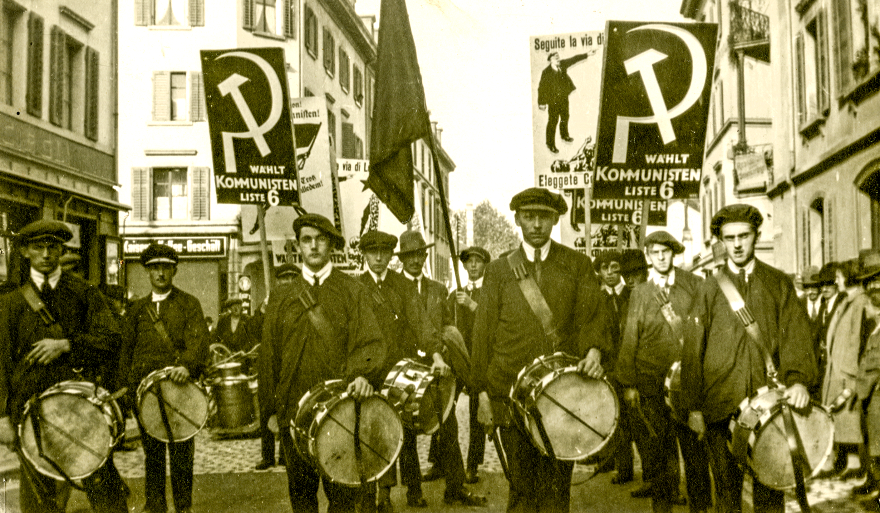
A report from the meeting in the party’s relative stronghold of Basel, Swiss Communists discuss the national and international situations, the fight of state employees, party reorganization, and the struggle against fascism in Switzerland, among other topics.
‘The Fourth Conference of the Communist Party of Switzerland’ from International Press Correspondence. Vol. 7 Nos. 27, 28 & 29. April 28, May 5 & 12, 1927.
Basel, 17th April 1927. The fourth conference of the Communist Party of Switzerland was opened on the 16th April 1927 in the People’s House in Basel. The conference is taking place in a town in which the Communist Party has in general the leading role in the working class movement.
There were fraternal delegates present from the German, French and Italian-Swiss Communist Parties. There were 22 delegates from territorial branches, 22 delegates from factory nuclei and 29 delegates from local sections. Further, there were present, 9 members of the Central Committee of the Party, 3 members of the Young Communist League, 3 auditors and 22 guests. The conference is also very well attended by spectators.
The agenda includes a discussion of the present international situation, the question of the struggle with fascism and the deprivation of political rights suffered by the state employees. Further, the question of re-organisational work, the strengthening and activisation of the factory nuclei and the new organisational statutes.
The conference was opened with the official news of the settlement of the diplomatic conflict between the Swiss government and the government of the Soviet Union which was caused by the murder of the soviet representative in Lausanne, comrade Vorovsky. The pressure of reaction and fascism in Switzerland had succeeded in preventing a settlement up till now. In a resolution which was adopted unanimously, the conference welcomed the settlement of the conflict and expressed its satisfaction at the fulfillment by the Swiss government of the basic conditions laid down by the Soviet government. The fulfillment of these conditions by the Swiss government is regarded as a sign of the strengthening international position of the Soviet Union and the demand has been raised that the Soviet government be recognised by the Swiss government de facto and de jure.
Comrade Welti (Basle) welcomed the conference in a speech of greetings in the name of the Central Committee of the Party. He expressed satisfaction at the successes of the Chinese national revolution and of the Russian workers revolution which will now celebrate its 10th anniversary. Eighty years had passed, he declared, since the publication of the “Communist Manifesto” and eight years of work since the foundation of the Communist International.
The Party conference decided to send a telegram of sympathy to the leaders of the Chinese revolution and a telegram of greetings to the Communist Party of the Soviet Union, The latter telegram stresses especially the work of socialist construction carried on in the Soviet Union under the leadership of the Communist Party and refers with satisfaction to the peaceful policy of the Soviet government as laid down in the note delivered to the Chinese reactionary government.
A telegram of greetings was read from the Communist Party of Germany amidst great applause. The elections to the Presidium and to the conference commissions took place without discussion. Speeches of greeting were made to the conference by a representative of the Red Aid section in Switzerland and representatives of the Basle Trades Council, the Central Committee of the Y.C.L., the C.P. in Alsace-Lorraine, the Baden district organisation of the German C.P. An official of the Red Front Fighters League greeted the conference in the name of a group of Red Front Fighters who had just arrived and demanded that an international defence front be formed against fascism by workers defence corps. A colony of Swiss comrades in Moscow sent a letter of greetings to the conference.
The Swiss Trades Union Federation had also been invited to send a representative to the conference, but declared that it would only send a representative if the Communist Party would revise its decisions concerning the formation of fractions inside the trade unions.
The political report of the Central Committee was made by comrade Welti who presented a good picture of the economic and political situation in Switzerland. The economic situation of the country, he declared, was characterised by a permanent uncertainty. Booms were of short duration and the export industry was faced with difficulties of placing its goods on the world market. However, the net profits and dividends of large-scale industry were increasing. The national and local authorities made ever fewer demands upon the money market and a considerable export of capital was taking place. This had as its consequence an ever closer alliance of the Swiss bourgeoisie with the imperialist great powers. The export of capital resulted also in an increase in the rate of interest for agricultural credit and this had caused a crisis in agriculture which was still prevalent. The Swiss bourgeoisie was endeavouring to bring about a decrease in the cost of production by reducing wages, lengthening working hours and carrying out a rationalisation. The wages of industrial workers had sunk by 20 and in some cases by 40%. The power of finance capital was becoming ever greater. There were 45,000 unemployed in the country representing 10% of the industrial proletariat. There were no signs of any general economic betterment to be recorded and violent labour struggles were to be expected.
There was no real basis for the illusions of the reformists. The policy of the reformist trade unionist and social democratic leaders is directed towards co-operation with the employers and with the bourgeois state and towards the avoidance of labour struggles. The shameful approval of a so-called “social Insurance” based upon the taxation of articles of mass consumption (Tobacco, alcohol etc.) and upon the high contributions of the workers, had been one of the results of this policy. These leaders were preparing no struggle against the coming law to rob Swiss civil servants of the right to strike and organise themselves in trade unions and to force them to work for low wages.
Social democracy is becoming ever more quickly the left-wing of the bourgeoisie. Despite all its revolutionary phrases it had joined the II. International of social patriots and expressed itself in favour of co-operation with the League of Nations in Geneva and with the International Labour Office.
The struggle of the Communist Party of Switzerland is directed against the rationalisation, against the impoverishment of the unemployed, against the high customs duties and against the danger of war. Efforts must be made to unite all revolutionary proletarian forces and to exercise mutual support in economic and political struggles despite the sabotage of the reformists. Demands must be made for the protection of tenants, for an increase of building activities for dwelling houses, for the introduction of a real system of social insurance and the reduction of the interest on mortgages etc.
The struggle for the international unity of the trade union movement and against the danger of war is the foremost task. Comrade Bodemann then delivered his report upon organisational questions.
***
On Sunday the 17th April Comrade Bodemann delivered the reports on the organisatory activity of the Party.
As regards the strength of the Party membership, attain stagnation is to be noted. Only in certain districts, particularly in Basle, has there been any considerable progress. The Party press, the “Basle Vorwärts”, the “Shaffhausen Arbeiterzeitung” and also the Zürich “Kämpfer” show an upward tendency.
The reorganisation of the Party on the basis of factory nuclei has made progress, but is not completed. The street nuclei predominate precisely in the very important localities, such as Zürich, Winterthur and Basle. Nevertheless in a number of factory nuclei the membership has doubled and tripled. Active, reliable functionaries have also been won as a result of the reorganisation. The trade union work of the Party is on a good basis. In Basle, 94 per cent of all Party members are members of trade unions, in Switzerland as a whole 90 per cent. The fraction work still shows many shortcomings.
The most important tasks of the Party in the sphere of organisation are: continuation of the reorganisation of the Party upon the basis of factory nuclei, improvement of the work of the factory nuclei, special attention to be paid to the big factories, winning new Party members, strengthening of the Party press (at least 1000 new readers to be obtained by November 7) building up of a good staff of functionaries, serious fraction work in the trade unions.
In the discussion the position of the organisation in the various cantons of Switzerland was dealt with. Special attention was paid to the question of work among women, the activity in the factory nuclei, the publication of factory newspapers and the shortcomings in trade union work. Taken as a whole there is to be seen a consolidation of the organisation.
In the afternoon session a representative of the Youth Central delivered a report upon the position of the Young Communist League and the tasks of the Party. The working youth comprises about 15 per cent. of the total of the working class, and the young Communist organisation is fighting to gain influence over them. Of the 28,000 apprentices in Switzerland only a very small portion is represented in the Young Communist organisation. The young workers in Switzerland receive very low wages; their material position is exceedingly bad. It is the task of the Young Communist organisation, supported by the Party and the trade unions, to fight for an improvement in the position of the working youth and to train them to be revolutionary class fighters.
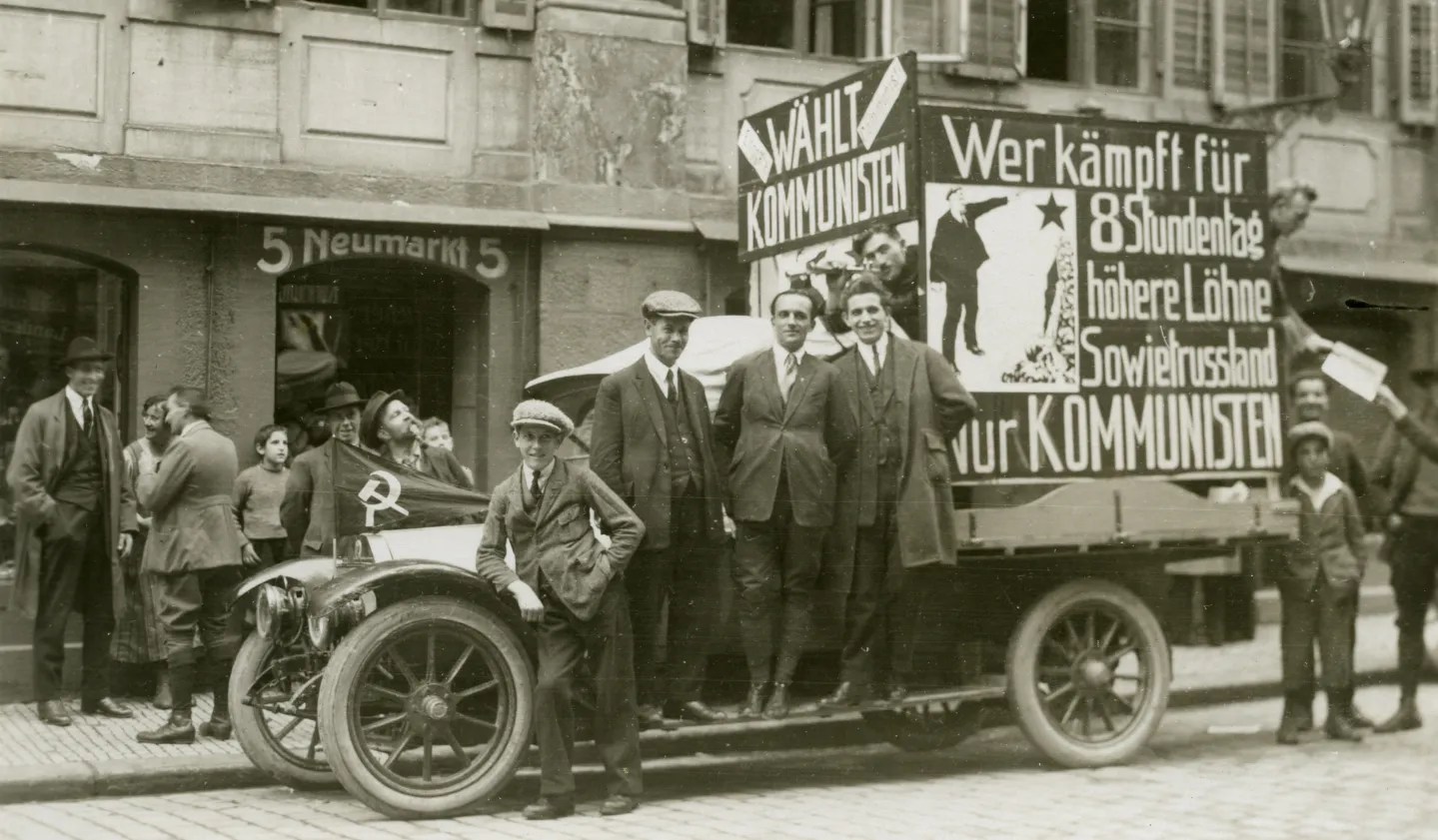
Comrade Bringolf (Shaffhausen) reported on the attitude of the Communist Party towards the bill of the Swiss Federal government regarding the renumeration of State officials. The Party is opposing the intended renumeration reform as, among other things, it aims at depriving the Swiss civil servants of the right of combination and the right to strike, and at cutting down the wages of the lower officials. It is an attack of reaction upon the achievements of the year 1918. The reformists share responsibility for this proposed law. The Communist Party must take over the lead in the fight against this renumeration bill; it must combine the work of enlightenment with a campaign for a referendum; it must finally oppose this bill by putting forward another measure which will be in accordance with the real interests of the civil servants and the whole working class.
The report was followed by a short discussion.
The Conference then unanimously agreed to the motion of the Central regarding the Civil servants’ renumeration bill, the chief slogans of which are: “against the concession policy of the reformists, for strengthening the fighting power of the trade unions, against the deprival of the right of combination and the right to strike, against the prolongation of the working day, for adequate wages for the lowest sections of the civil servants.”
In the evening session Comrade Walter, the representative of the Executive of the Communist International, delivered the Report on the International Situation.
He stated:
“We communists have sharply emphasised that there will not be any lasting stabilisation; that although in various countries a certain consolidation of capitalist economy, a temporary consolidation of the rule of the capitalist class may take place, this stabilisation can only be relative.
“Of course there are a number of symptoms of a stabilisation. It would be superficial and stupid to try to dispute this. But we also see very many counter-tendencies, phenomena which indicate the profound contradictions of capitalism, the inevitability of fresh conflicts and collisions on a world scale. Contrary to the II. International, we hold the standpoint, which is confirmed by the facts, that the present crisis of the capitalist system. is not a so-called “normal” crisis, not a crisis of growth, but a symptom of the period of decay of capitalist world economy. The increased apparatus of production in the developed countries is faced by a shrunken market. We see the tremendous awakening and movement of the colonial slaves; we are witnessing the rapid growth of the socialist economy in the Soviet Union. In the period of decay all Hilferding’s talk regarding real pacifism is very much out of place. The antagonisms between the various capitalist powers have not become weaker, but are finding more obvious and sharper expression.
“The Communist International does not put forward any scheme for the development in the various countries. On the contrary, it expressly emphasises the divergent character of the conditions in the various countries. The tactics of the Communist Parties in the different countries are in accordance with these divergent conditions.
“Capitalism is seeking to consolidate and prolong its rule. We see in every country the attempt, by means of rationalisation, to increase or restore its competitive capacity as against the other countries. This rationalisation is, in addition to the various technical improvements which are connected with it, a method of the offensive of the capitalist class against the working class. We see this with particular clearness in Germany, England and also in France. The tremendous struggle of the English miners was a fight against capitalist rationalisation. This fight was lost owing to the attitude of the Amsterdam International. The process of rationalisation is proceeding further and embracing all countries. Everywhere the Communists are at the head of the fight.
“One of the symptoms of the decline of capitalism is fascism. The ruling class is endeavouring to overcome the crisis of capitalist economy by liquidating bourgeois democracy, by setting up the fascist dictatorship. Fascism is the political side of capitalist rationalisation. It is an international phenomenon. It of course assumes different forms in the various countries.
“How does it stand now with the era of peace which was so loudly proclaimed only a short while ago? Since Locarno we have seen how the antagonisms between the various powers have become more acute. America and England are engaged in rivalry, particularly in China; there exist profound antagonisms between England and France. Between France and Italy an open hostility, the foreign policy of fascist Italy is making for war.
“But this aggressive war policy would have been bound to be carried on by any so-called bourgeois-democratic government in Italy. The working class, particularly in France, must therefore, not allow itself to be misled, by the government, under the pretext of a fight against fascism, into defending the alleged democracy and the bourgeois native country.
“As a new factor there is entering on the scene a new German imperialism which is making use of the antagonisms between the other powers and is already openly demanding colonies. German imperialism is already creating by means of the Reichswehr a basic organisation for an efficient military power. These are the most important facts in the relations of the capitalist States with each other.
“In addition to the above phenomena we see the frantic endeavour of the English capitalist class to create a bloc against the Soviet Union. In this bloc there is to be included Germany also, whose foreign policy is more and more influenced by England.
“Of outstanding importance for the course of history and of the world revolution are the events in China. The national liberation struggle of the Chinese people against the imperialist oppressors and exploiters is already able to record tremendous successes as a result of the uprising of the huge masses of the petty bourgeoisie and the peasants. The driving force, the motor of the national revolution is the proletariat under the leadership of the Communists. The Chinese revolution, as a result of the firm alliance of the proletariat with the exploited masses of peasants, will constitute an important advance on the part of the world revolution.
“In the Kuomintang the antagonisms between the bourgeois Right wing of the Party have increased as a result of the ever-growing pressure of the proletarian and peasant masses. The bourgeois elements in the Kuomintang have, under the leadership of the former Commander-in-chief of the national revolutionary army, disarmed the workers defence corps in Shanghai, and in other places have undertaken an attack against the Left wing of the Party and especially against the Communists.
“The workers of Shanghai have replied to Chiang Kai-Shek’s treachery to the revolution with the general strike. The Communist International, in a Manifesto, has stigmatised before the masses of the Chinese people and of the international working class the treachery of the Right elements and of General Chiang-Kai-Shek. The national revolutionary government in Hankow is preparing to launch a counter-attack against the traitors.
“The present situation therefore demands from us Communists increased activity for the liberation struggle of the Chinese people.
“In conclusion I wish to say a few words regarding the attitude of the Second International. The Second International at its Conference in Paris issued a hypocritical appeal expressing in words its sympathy with the national Chinese liberation movement. But the MacDonalds in England as well as the French social democrats are doing nothing in order to mobilise the masses and to summon them to the fight against the intervention and the predatory plans of their governments. Robert Grimm has written an article on the Paris Meeting of the II. International in which he expresses pleasure at the fact that the Second International demands that the Balkan conflict be dealt with by the League of Nations. That is a complete abandonment of the former League of Nations’ policy of the Swiss social democracy. It means a deception of the working class by which the proletariat will be led into a new 1914.
“On the other hand, the Communist International issues an appeal to the working masses of the whole world to conduct their fight against the increased dangers of war as a revolutionary mass struggle, to exert all forces against the attempt of the imperialist robbers to choke the liberation movement of the Chinese people in streams of blood, to hinder with all means the threatening attack upon the First workers’ and peasants State of Soviet Russia, and to do everything possible in order to be able to reply to the new imperialist robber war planned by the capitalists of all countries, with the revolutionary uprise of the exploited classes and suppressed peoples.
“Long live the Chinese revolution! Long live Soviet Russia, up with the world revolution!” (Great Applause.)
***
At the evening session held on April 17, Comrade Welti reported on the Fight of the C.P. of Switzerland against Fascism.
Swiss Fascism was born in 1918 and at first had the form of a Civil Defence force. This force was organised as a fighting organisation directed against the Left socialists. Its members were well armed and made themselves useful to the bourgeoisie during strikes, especially during the Basle General Strike in 1919. The bourgeoisie deliberately strove to introduce fascist elements Into the Swiss army. In the autumn of 1919 there was founded as the head organisation, the “Patriotic League of Switzerland”. In Italian Switzerland there arose the “Ligue Nationale”.
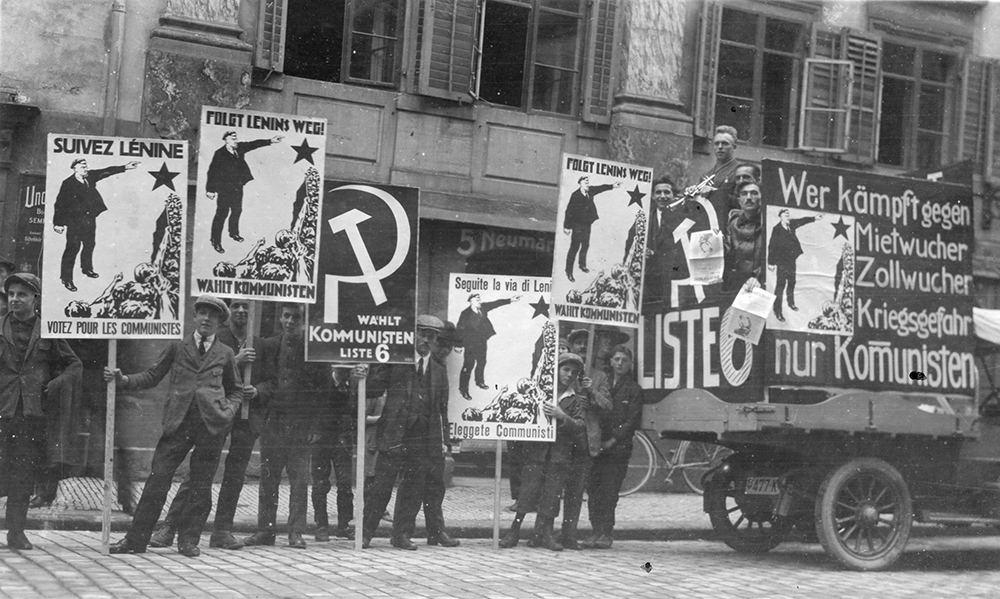
In all places there commenced acts of violence on the part of the fascists. Labour leaders were set upon. The editorial offices of revolutionary newspapers were set on fire. The Swiss fascists themselves prepared the ground for the murder of Vorovsky. The Swiss government held its protecting hand over Fascism. Thus it came that the murderer of Vorovsky was acquitted.
Fascism possesses special importance in Italian Switzerland, for the Italian fascists lay claim to Tessin, to the annexation of this canton to fascist Italy.
The C.P. of Switzerland is carrying on a constant fight against Fascism. Already in April 1923, in a open letter, it called upon the Social Democracy and the Trade Unions to form a united front and to take united action against Fascism, and demanded that a joint conference for this purpose be held. This proposal, however, was rejected by the other side. In spite of this, many workers’ organisations expressed their approval of the proposal. The C.P. of Switzerland is also participating in the work of the Anti-Fascist Committees.
In view of the fact that fascist Italy is a neighbouring country of Switzerland, that, there is active commercial intercourse between Switzerland and Italy, that the Fascists are aiming at the annexation of Tessin and are conducting a great anti-German campaign in this canton, and that they are also displaying great activity in the League of Nations and the International Labour Office, it is necessary that the C.P. of Switzerland conduct the anti-Fascist campaign much more energetically than hitherto. It has the greatest possibilities of helping in many respects the Communists in Italy, who are fighting under conditions of illegality.
In the discussion which followed on the report of Comrade Welti, Comrade Herzog (Zürich) pointed out the importance of creating workers’ defence corps.
A comrade from Geneva called attention to the deep-going fascist tendency of the Italian-Swiss bourgeois and student youth.
Comrade Bodemann read a telegram of greeting from the Communist Party of Italy, from which it was to be seen that our Italian brother Party is undauntedly continuing its work. Amidst great enthusiasm it was decided to send a telegram of greeting to the C.P. of Italy.
In the session of 18th April, Comrade Wieser reported on the Peasant Question and laid down the lines of an Agrarian Programme for the Communists which the Conference then adopted.
The Theses on the Economic Situation of Switzerland and the Political Tasks of the Communist Party, to which there were also added the proposals submitted to the Conference by the editorial commission, were likewise adopted. The report of Comrade Bodemann on the Directions regarding the next Organisatory Tasks of the Party, which had been worked out by the organisation committee, were approved unanimously.
The election of the Central Committee was carried out on the basis of the new Party Statute that had been adopted. The Central Committee consists of 23 members, of whom nine reside in Basle and form the inner Central, while the remaining members represent the most important parts of the country. Of the 23 members elected, 16 are workers from the factories. The Party Conference ended on the 18th April after a concluding speech by Comrade Wieser. It has accomplished serious and fruitful work.
Immediately following the close of the Conference, the Central Committee constituted itself and proceeded to elect the Political Bureau, which consists of Comrades Welti, Wieser and Bodemann.
International Press Correspondence, widely known as”Inprecorr” was published by the Executive Committee of the Communist International (ECCI) regularly in German and English, occasionally in many other languages, beginning in 1921 and lasting in English until 1938. Inprecorr’s role was to supply translated articles to the English-speaking press of the International from the Comintern’s different sections, as well as news and statements from the ECCI. Many ‘Daily Worker’ and ‘Communist’ articles originated in Inprecorr, and it also published articles by American comrades for use in other countries. It was published at least weekly, and often thrice weekly.
PDF of full issue 1: https://www.marxists.org/history/international/comintern/inprecor/1927/v07n27-apr-28-1927-inprecor-op.pdf
PDF of full issue 2: https://www.marxists.org/history/international/comintern/inprecor/1927/v07n28-may-05-1927-inprecor-op.pdf
PDF of full issue 3: https://www.marxists.org/history/international/comintern/inprecor/1927/v07n29-may-12-1927-inprecor-op.pdf

