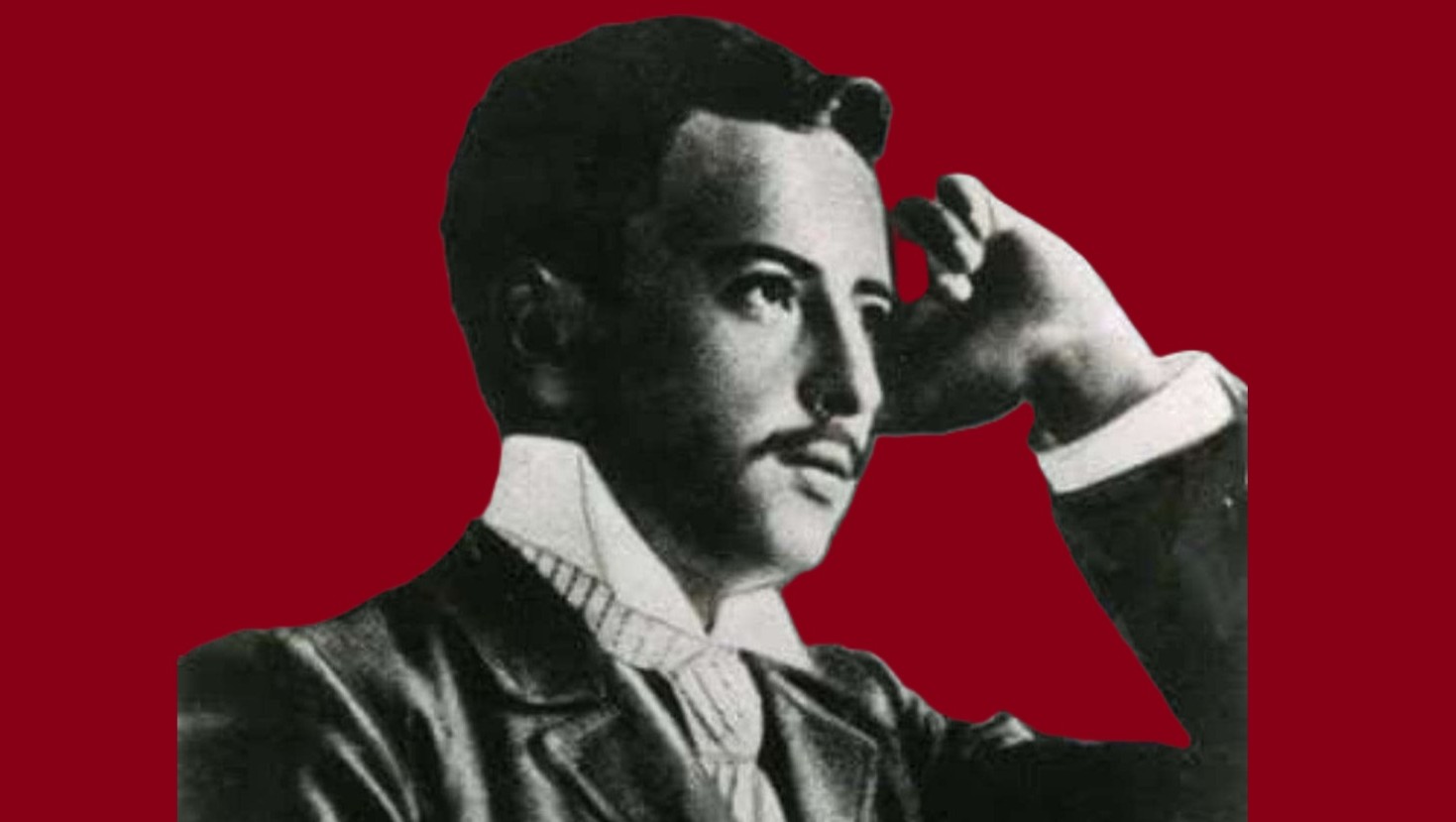
Remarkable words from ‘Land and Liberty’ guerilla and journalist Práxedis G. Guerrero of a brother-comrade of his, Francisco Manrique, who fell in the PLM insurgency in the town of Palmoas on July 1, 1908. Withing two months of this publication, Guerrero himself would die in revolutionary combat.
‘Episodes of the Revolution of 1908: Palomas’ by Práxedis G. Guerrero from Regeneración (Los Angeles). No. 5. October 1, 1910.
This chapter of the history of freedom should be called Francisco Manrique, it ought to bear the name of that noble youth who, almost a child yet, fell a victim to the bullets of tyranny on July 1 of 1908 in the border village of Palomas. From the blurred backgrounds of that half-unknown day in a gray desert I see penciled in clear outlines the happenings of those hours.
Just eleven fighters for liberty could come together when the persecution rained down like a hall of lead and steel upon the camp of the revolutionists. Eleven, and not one more, filled with the intention to try to save by an audacious move the revolution which seemed to be shipwrecked in the surf of treachery and cowardice.
The dawn of red of Las Vacas had already brilliantly illuminated the horizon of history, and Viesca, evacuated by the revolution was still echoing the calls of revolt of our “bandits” when this diminutive group was formed in the midst of the violence of oppression and, with few hands full of cartridges and some hurriedly manufactured bombs of mighty poor material, threw itself upon an enemy ready to meet them with uncountable elements of resistance, upon a tyranny supported by stupidity, fear and distrust, against a secular despotism that buries its heels in the infamous carpet formed by submissive, quiet shoulders known as our national passivism.
Palomas was situated on the road chosen by that group. Its capture was of no importance to the unfoldment of the adopted strategical plan. But it was appropriate to scare somewhat the rurales and the fiscal guards garrisoned in that locality in order to be able to cross the desert without being molested by their vigilance.
On their way the telegraph wires fell, destroyed at certain distances. The carbines in the hands ready for use, the sombreros shoved on the back of the heads, with cautious yet firm step, with an ear open to all sounds and the eyes fixed intent to see where light was battling with the darkness of the night, out eleven revolutionists came near the custom-house. Two bombs thrown against the building showed that the structure had been vacated. The rurales and the fiscal guards forcing the men of the little place to take arms had locked themselves in the military barracks. Before the attack the different houses were visited rapidly to see that there was no enemy in the back and to quiet down the women in explaining to them in a few words the object of the revolution.
Soon the barracks were within reach, and soon the flash of the guns firing from the flat roof and from the portholes revealed the number of the defenders. The men at the inside outnumbered those at the outside by over a dozen. The struggle was unequal from the start for the daring little band. The adobe walls formed splendid defense against the Winchester bullets, and the bombs which were to have decided the situation in a few minutes did only little damage.
Francisco Manrique, always the first in all exploits of danger, reached the door of the barracks, firing shot after shot and defying death in the open, and a few steps from the portholes spitting lead and steel he dropped mortally wounded. The struggle went on and back and forth whizzed the bullets. The pallor of the approaching sunrise dimly grew upon the horizon, and the pallor of approaching release through death lighted the features of the youth once so bold, so active, so noble minded. The day arose and its splendor diffused with that of a shining star of the revolution in its decline.
It became urgent necessity to march on rapidly to reach the heart of the mountains. It was urgently needed to carry the sparks of rebellion to all places possible. The last bomb broke down a door and thus procured some horses.
Pancho had lost consciousness and seemed dead.
The interest of the cause had sacrificed the life of a fighter of exceptional ability and the same interest cruelly dictated the abandonment of his body at the foot of the adobe walls spattered with his blood, watching his agony, witness to his last and beautiful action of sublime stoicism.
Shortly after his ten comrades had retired Pancho regained his consciousness. He was questioned and serenely answered all that was asked careful in his word to help his friends indirectly. He kept his incognito to his death, realizing full well that if his true name should become known the despotism might guess or trace the names of his associates and annihilate the victims after crushing the revolution. From his lips they could get neither plans nor names, not a single thing that could have helped the tyranny.
Pancho loved the truth above everything. Never in his life did he utter a lie to escape a responsibility or to gain an advantage. His word was always frank and loyal, at times even rude in its outspokenness, but always sincere. And yet he, who had disdained the life and the well-being bought at the price of a falsehood, died with a lie upon his lips–a sublime lie–wrapped in the anonymity of a conventional name, Otillo Madrld, in order to save the revolution and his comrades.
I knew Pancho from earliest childhood. We sat upon the same bench in school. Then in the years of youth we traveled together the road of exploitation and misery, and in later years our ideals, and hopes, and efforts centered upon the revolution. We were brothers as only few can be. No one could know him better than I do and fathom the beauties of his intimate life–he was a youth; of profound goodness in spite of a character rugged like a stormy sea.
Pancho gave up a salaried employment held in the land department of the state of Guanajuato to become a wage worker and later, by force of circumstances, a paladin of liberty upon the altar of which he sacrificed his life so full of intense storms and immense sufferings which he knew both to master with a will of adamant.
The two great loves of his life were a good mother of excellent heart, and liberty. He lived in poverty, suffering under the exploitation and injustices of the bourgeoisie, because he had made up his mind to become neither exploited nor bourgeois himself. When his father died he gave up the inheritance due him. Instead of living in a position at the hand of the government he became its outspoken enemy fighting his battles until the destiny of a high-minded and self-chosen odyssee for ideals was sadly fulfilled. He was a rebel of the moral type of a Bakounine: action and. idealism were harmoniously amalgamated in his brain. Wherever the revolution was in need of his activities he went unhaltingly, money or no money, because he knew that a way would be opened somehow by brain or brawn, and by sacrifice.
That was Otillo Madrid, called the chief of the bandits of Palomas. That was the man who lived for truth, and yet died with a sublime lie, and upon whose pallid lips vibrated in the last hour two names, that of his beloved mother, and that of me, his brother, who still lives to render justice to his memory and continues to stay in the fight in which he shed his blood, who lives now to appeal with the heroic, youthful silhouette of the sacrifice of Palomas against the passiveness of a people.
How many men fell in that fight, on the side of the government? The tyranny has concealed the fact. And nature joined hands with the despotism in power. The valiant group was ultimately overcome by the terrible Amazone of the desert: Thirst, that killing blade, that strangling serpent, that maddening anxiety, that voluptuous companion of the wandering and soft hills of fine sand. Neither the sword nor the gun, Thirst, the grim damsel overwhelmed them with her indescribable grimaces of caress, parched their lips with her kisses, dried up their tongues with her breath of fire, wildly choked their throats, blotted out those atoms of rebellion. And in the far distance the mirage of a crystal lake mocked the thirsty shadows of men creeping on painfully, dragging along a carbine powerless in the struggle with the fiery Amazone of the desert, and chewing in impotent rage the ash-colored grass that affords neither shade nor moisture.
PRAXEDOS G. GUERRERO.
Escrito Por Trabajadores Y Para Los Trabajadores. Regeneración is easily one of the most important, radical Spanish-language papers in U.S. history, and given its role in an actual revolution, one of the most important in any language. Regeneración was the official organ of the Mexican Liberal Party, an anarchist and later anarcho-syndicalist party. The paper was founded in 1900 by Flores Magón brothers; Jesús published the paper with his brothers Ricardo and Enrique writing, and Liberal Party leader Anselmo Figueroa editing. With imprisonment, illegality, revolution, exile, and war getting in the way of publishing, the paper went through several phases since its beginnings. In 1904, the paper moved its production to San Antonio, then St. Louis, and then Los Angeles where it would stay for nearly a decade. Jesús returned to Mexico City where he published a more moderate version of Regeneración, while Ricardo continued published the increasingly radical one in the U.S. Regeneración, expanded with the revolution, and in 1910, the paper added in English language section, edited by British anarchist William Charles Owen. With natural allies in the growing I.W.W., the paper served as an organizing tool in the Mexican Revolution and was instrumental in popularizing the struggle with U.S. audiences and workers. 20,000 copies were circulated weekly at its height. The paper ran afoul of the U.S. authorities well before the rest of the left did in World War One and ended printing for good in 1918. Ricardo Flores Magón was in constant legal battles until his final arrest in the 1918 Palmer Raids for violation of the Espionage Act, along with thousands of other radicals. He died, some say was murdered, in Leavenworth Prison on November 21, 1922.
PDF of full issue: https://www.marxists.org/history/usa/pubs/regeneracion/1910/n05-oct-01-1910-reg-eng.pdf

