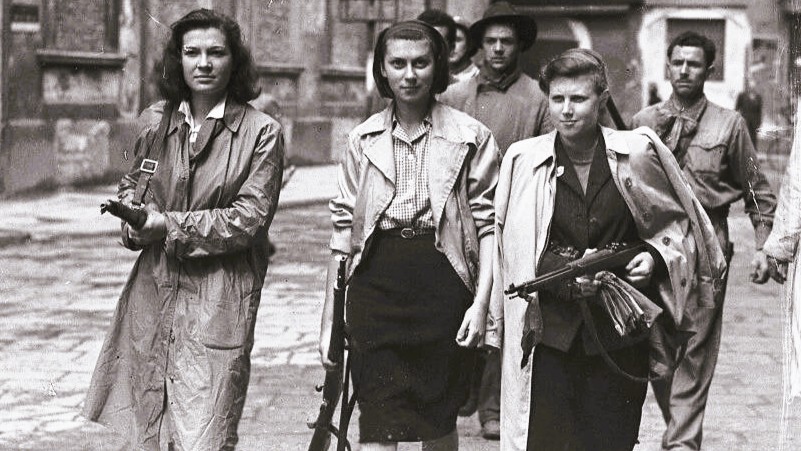
Fascist enslavement of women in Italy breeds resistance.
‘Intensified Exploitation of Female Labour under Fascism in Italy’ by G.S. from International Press Correspondence. Vol. 7 No. 69. December 8, 1927.
The Fascist Government of Italy boasts that it is one of the first capitalist governments to ratify the well known law of Washington for the protection of female labour and child labour. Fascism furthermore claims the merit of initiating the foundation of a “national campaign for the protection of motherhood and children”. In reality, however, there is no other capitalist country where female labour is so intensively exploited as in Italy; in no other capitalist country are children employed in such great numbers in industry and agriculture, and, moreover, without the slightest control. Just as Fascism has forced down to the lowest level the general standard of living of the working population, it has also intensified the exploitation of working women and made child labour still more inhuman. The intensified exploitation of the working women and of child labour is a direct consequence of the increasing deterioration in the strata of the working population and of the uncurbed arbitrary measures, which Fascism permits employers to take.
The latest wage agreements, signed by the Fascist trade unions in Verona, lay down for an experienced woman spinner 9.50 lire per day. When it is taken into consideration that a kilogramm of bread costs two lire in Italy it is immediately clear how far a wage of 9.50 lire falls short of the requirements of a working woman. But before a woman is treated as a competent spinner she must put in six years of apprenticeship. During this period the woman is treated as an apprentice and receives only 50% of the wage of a competent spinner, i.e. 4.75 lire a day. Fascism really understands how to protect the working woman in a proper manner! A further example: the same Fascist trade unions of Verona have established the following wages for women working in stocking-knitting shops: women of the first category two lire an hour; women of the second category 1.86 lire an hour; women of the third category 1.10 lire an hour; women of the fourth category 0.75 lire an hour. The majority of the women belong to the last two categories and have wages ranging from 6.0 to 8.80 lire per day (except when they are on short time, which is often the case). And in spite of such low wages, a cut of fifty per cent. was recently made under the pretext of an alleged improvement in the cost-of-living index.
Let us mention another agreement made by the Fascist trade unions, namely, the one concluded on behalf of the brickmakers of Macerata. For the earth-workers a wage of 1.50 lire per hour was established, for women 0.50 lire and for juvenile workers (from 15 to 18 years of age) 0.60 lire an hour. It will be seen that a girl’s wage does not exceed 5 lire a day. (and a kilogramme of bread costs 2 lire!). When we take the above rates in conjunction with an examination of the wage conditions of female labour and child labour in agriculture, the picture we get is a still gloomier one. We will only cite a few figures one might say official figures which we have taken from the working agreements concluded by the Fascist trade unions.
The agreement concerning agricultural work, made by the Agricultural Workers’ Association (dissolved by the Fascists like all the other class organisations) in 1921 for the district of Cremona, established the following wages: women 1 lira an hour, overtime 2.40 lire working day: 6 hours in winter and 8 hours from February 15th to November 15th. The wage limit for the woman’s wage was set at fifteen. When the Fascists captured the power, the wage per hour was reduced from 1 lira to 0.80 lire, with corresponding reductions for lower grades. The age limit for the woman’s wage was put up from 15 to 18. The women therefore had to work a further three years in agriculture before earning the wage which they had previously received at fifteen. And these wages have been still further reduced. The present wage agreed upon for the women amounts to only 60 centesimi up to the age of eighteen. In short, reduction of wages, raising of the age limit for the right to adults’ wages and extension of the working day (7-8) hours in winter and 9-10 hours in summer).
Female and child labour, paid for at the above starvation rates is employed extensively by the Fascist government in the manufacture of munitions of war. In spite of all the laws against the employment of juveniles on night work, many cases are reported of juveniles doing night shifts. The “protection of motherhood and of children” which was brought about by Fascism consists of intensified exploitation of female and juvenile labour. This is also the reason for the fact that the women and the juvenile workers are always prominent in the fight against Fascism.
The fighting spirit displayed by the women against Fascism in the general awakening of the working class is really remarkable. Let us recall some of the best-known events: During rice harvesting in Piedmont and in Lombardy, the women rice workers struck for three days against a cut in wages. This strike became very extensive; it was the biggest of the strikes in 1927 and was led by the Communist organisation and by the General Trade-Union Federation. In Turin, in Vicenza, in Biella, in Venice, in Bologna, in Trieste and in many towns of the province of Milan, such as Legnano, Gallarate. Caronno, the working women have defended their wages by strikes, interruption of work and other collective protest demonstrations. It may be said that the Fascist Government is obviously powerless in face of this resistance on the part of the women workers. In Caronno, where an effort was made to allocate to each woman a greater number of looms, the hands in the textile mills were out on strike for more than two weeks.
The Fascist Government is to-day afraid to proceed with the brutality which usually characterises it against women on strike and participating in street demonstrations. It is true that there is no lack of arrests and convictions even of women workers. The weapon which is most in use against working women is still dismissal. But it is certain that, in case the position becomes more critical and excitement and strikes increase, the Fascist Government will not hesitate to intervene with the iron heel they have used upon the workers, and indeed, with no less brutality towards the women. In connection with the tremendous increase of unemployment, the street demonstrations of the women and children of the unemployed demonstrations which have already taken place in various towns will become less avoidable and more frequent.
The Italian Trade-Union Federation is devoting great attention to the organisation of the working women, the women obey its appeals and they are rallying to the front in the fight which the working class constantly carries on against the employers and against Fascism.
International Press Correspondence, widely known as”Inprecorr” was published by the Executive Committee of the Communist International (ECCI) regularly in German and English, occasionally in many other languages, beginning in 1921 and lasting in English until 1938. Inprecorr’s role was to supply translated articles to the English-speaking press of the International from the Comintern’s different sections, as well as news and statements from the ECCI. Many ‘Daily Worker’ and ‘Communist’ articles originated in Inprecorr, and it also published articles by American comrades for use in other countries. It was published at least weekly, and often thrice weekly. Inprecorr is an invaluable English-language source on the history of the Communist International and its sections.
PDF of issue: https://www.marxists.org/history/international/comintern/inprecor/1927/v07n69-dec-08-1927-inprecor-op.pdf

