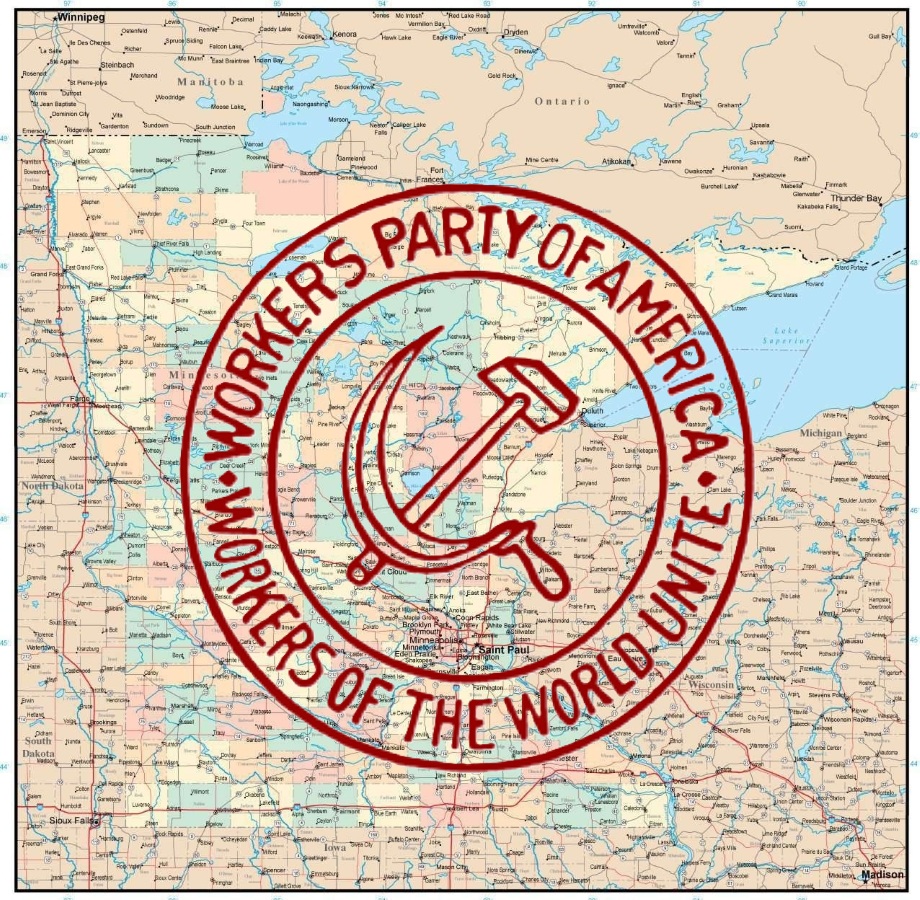
Then, as now, Minnesota had a progressive reputation of the Minneapolis electing a Socialist mayor in 1917 and having one of the few surviving Farmer-Labor Parties. Pat Devine surveys the state’s politics in the week before 1928’s election which saw the Minnesota Communist Party, with 950 members, run a slate as a educational and party-building exercise. Scottish-born Pat Devine was a key organizer in the C.P. and National Textile Workers Union before his deportation in 1931. In 1928, a time of powerful political reaction in the country, and right wing millionaire Herbert Hoover won the state handily with Norman Thomas as a Socialist and William Z. Foster as a Communist doing negligibly (6,774 0.70%–4,853 0.50%) in the ‘progressive’ state.
‘Class Struggle in Minnesota’ by Pat Devine from The Daily Worker. Vol. 5 No. 257. October 30, 1928.
Minnesota, home of the so-called progressives of the northwest, is the center of one of the most important political campaigns in the country. Conditions here bear out fully the indictment of capitalist society contained in the National Platform of the Workers (Communist) Party.
Boosted as the playground of the northwest with its 10,000 lakes, wonderful hunting preserves, a veritable paradise for the idle rich, we nevertheless find poverty and unemployment taking toll of the workers and poor farmers.
The speed-up of Ford, sweat shop conditions in packing plants, long hours in lumber camps, together with the exploitation of the poor farmers, make up a direct contrast to the ostentatious luxury of the hunting camps.
Steel Trust Domination.
Dominating governors, judges, legislatures–verily the whole life of the state, stands the anti-labor open shop steel trust. Feudal slavery, long claimed to have passed away, will be with us so long as the United States Steel controls as it does. Men are not their own masters. Communities are bent hither and thither as the will of all powerful Iron Ore dictates. Privacy of the home, freedom of speech and assemblage are myths with the efficient steel trust spy system feretting out one’s most inner thoughts. The post offices, and other government institutions, cannot be relied upon, as their most trusted employes have been shown as spies of the steel trust.
To talk organization, go to a radical meeting, or read a radical paper is sufficient to bring down the blacklist which means, in effect, to cut off from the working class families the right to live. The rich soil of the state, by right the property of all the people, is handed over to the trust by their agents in government positions. Whilst owning much land, the trust exploits the leased land first, being afraid a move might materialize for taking it away from them. They are supposed to pay taxes on this land but always are maneuvering, buying off politicians like Chauncey Paterson (farmer-labor legislator and steel trust spy) in order to circumvent such payment.
Towns are moved overnight to make way for the greedy maws of the steel trust shovel searching for rich ore deposits. When the workers attempt organization, the territory is turned into an armed camp. Injunctions, police, state troopers and “specials” ruthlessly club and kill the strikers. The trust sweeps aside or compels to do its bidding the straw men who officer the various legislatures. Only a powerful, well organized working class can meet and defeat the steel trust bosses.
Backus, Power Magnate.
Backus, the lumber magnate, is noted for his efficiency in corrupting legislatures and oppressing the masses of workers. Low wages, long hours and speed-up are features of his plants. As always, farmer-labor leaders are not beyond reach of this powerful influence.
Today we hear much talk about the raising of the water level on the border. This is just a conflict of interests between Backus and the steel trust. One wants the water raised to insure his industries a maximum of power and the others a minimum of power, and vice-versa. The corrupt trade union leadership of International Falls lines up with Backus, whilst that of Duluth lines up with the steel trust. The workers gain nothing either way. Whilst the country is supposed to be enjoying a great wave of prosperity, and the capitalists and bankers and railroad magnates are reaping millions of dollars in profits, the working farmers of the state are reaping poverty. Hundreds of them are driven off the land every year and forced to go to the big cities to join the already large army of unemployed. Mechanization is driving the small farmer off the land and making way for the “Industrialization or Efficiency Farmer.”
The International Harvester company and other big trusts dominate and practically own the small farmer. Mortgages and bank failures are a steady menace. The McNary-Haugen bills are red herrings thrown into the political arena to take the attention of the poor farmers away from the real problems. wealthy farmer is the only one who would benefit by such legislation. State and gasoline taxes imposed upon the farmer bring in enormous sums supposed to be used to improve country roads. Is this money so used? No, only the roads used by the rich are improved. Country roads are terrible, and in many instances impassable during the rainy and winter season.
The Three Capitalist Parties.
The republican party, virtual ruler of the state, has done nothing to help the workers and farmers. They are outspoken representatives of big business. Under their administration the workers and farmers have seen conditions becoming worse and worse. The democratic party, realizing the resentment against the republicans, feel they have a chance to capture the state. Records prove the democratic party is no better than the republican party. Both are direct representatives of the bosses.
The socialist party is a younger brother of the major parties and always betrays the workers. A strong political force in the days of Van Leer, the party very rapidly lost its influence as a result of betrayal after betrayal. The old Daily Star, once a labor newspaper and confiscated by Van Leer, became the outspoken champion of reaction. With one or two notable exceptions the socialist aldermen are indistinguishable from the republican and democratic aldermen. The once powerful socialist party is now a sore on the rising vitality and militancy of the working class, and must be kept in the scrapheap in which, by its reactionary treacherous policy, it places itself.
Farmer Labor Party.
The farmer-labor party, long looked upon as an instrument of revolt in the hands of the masses, has gone over to the side of reaction. Handicapped from its organization by the non-partisan policy of the A. F. of L. and the treachery of the local misleaders, it for some time nevertheless retained a semblance of working class policies. Mr. Shipstead, representative to the U.S. senate has been its most consistent enemy. He comes before us now with a record 100 per cent. It is 100 per cent, but not for the workers and farmers, as the fulsome praise of the most reactionary capitalist newspapers well show.
The final betrayal took place, however, at the last annual farmer-labor party convention where the Starkeys, Teighans, Cramers, Ewens and Mahoneys consummated their long record of vacillation and betrayal, Shipstead had been wavering between running as a republican or independent when the convention, in spite of the most flagrant insults on his part, offered him the F.L.P. nomination on a silver plate. This against the wishes of a militant opposition of one-third of the delegates present who supported William Watkins, Lundeen, who had been looked upon as a spokesman of the minority, entered the primary contest against the state committee nominee for governor, ostensibly to fight for a clean militant party. However, as soon as it became clear that he had a chance of nomination he trimmed his sails and compromised with Shipstead.
Sail Under False Colors.
Successful in the primaries, Lundeen openly ratted by coming out as a supporter of Shipstead in the general election. So complete has been the betrayal of Lundeen that the bureaucracy of the Railroad Brotherhoods (with Messrs. Royster and Tilquist leading the gang), who are against all things progressive, are now supporting both Shipstead and Lundeen. They do this, not because they believe these misleaders will help to build a genuine labor party, but because they know they will use all their power to thwart the desires of the masses for independent political action and attempt to lead it into the channels of class-collaboration.
Mr. Carrs, present U.S. congressman from the 8th district and erstwhile farmer laborite, known to all as a democrat, doesn’t even recognize the party at all. Today we can say the farmer-labor party is an instrument for holding back the militancy of the workers and farmers and not as it was intended, an instrument to help in the fight for better conditions. Standing as it does for a genuine farmer-labor party, the Workers (Communist) Party state this can only emerge from the breaking up of the present farmer-labor party and its corrupt aggregation of political and traitorous tricksters who are attempting to stifle the spirit of revolt.
Tasks of the Communist Party.
In spite of seemingly insurmountable difficulties, our Party set to work to put candidates on the ballot. One hundred thousand farmer-labor voters who voted in the primaries were ineligible for signing our petitions, which meant we had to strike out in new fields. This was done and we went on the ballot with 1,000 votes surplus for each candidate. However, the full membership was not mobilized. Many comrades did not realize the magnitude and importance of the job.
The election campaign nevertheless has acted as a tonic to the membership. From being apathetic they became energetic. Today we are mobilized better than ever before.
For the first time in the history of the state the Communist Party has come out four square against the misleaders and pseudo progressives, and is certain to more than double its 1924 presidential vote this year. To consolidate our influence we must not stop at the election campaign.
Industrial Work.
We must go into the unions, organize the unorganized and dig ourselves deep down in the masses. Already we have two shop nuclei where previously we had none. Factory papers are distributed in two Ford plants. Comrades are leaving non-basic industries to get into basic industries. Our orientation is definitely towards the factories where the masses are to be found. Anti-war work, usually carried on in company of preachers and pacifists, was definitely taken inside the army camps. We distributed hundreds of bulletins and leaflets to the Citizens’ Military Training Camps, some reaching the regulars. We raised the slogan, “Learn whom to fight when learning how to fight.” For the first time in the history of the district, departmentalization has been introduced. This is not functioning as it should, pt undoubtedly will make headway.
Election Campaign.
All the above activities are a direct result of the election campaign. This is the major campaign around which our other work has centered. All campaigns were definitely linked up with the election. The Party membership today is approximately 950 and will go over the 1,000 mark.
The election campaign period marks great progress in the life of our party. We are a party of the masses instead of a sect. We must buckle down to the task of greater and greater activity. The future is with our Party. Long live the Communist Parties of the world! Greetings to our presidential candidates! Forward to a Workers’ and Farmers’ Government.
The Daily Worker began in 1924 and was published in New York City by the Communist Party US and its predecessor organizations. Among the most long-lasting and important left publications in US history, it had a circulation of 35,000 at its peak. The Daily Worker came from The Ohio Socialist, published by the Left Wing-dominated Socialist Party of Ohio in Cleveland from 1917 to November 1919, when it became became The Toiler, paper of the Communist Labor Party. In December 1921 the above-ground Workers Party of America merged the Toiler with the paper Workers Council to found The Worker, which became The Daily Worker beginning January 13, 1924.
PDF of full issue: https://www.marxists.org/history/usa/pubs/dailyworker/1928/1928-ny/v05-n257-NY-oct-30-1928-DW-LOC.pdf

