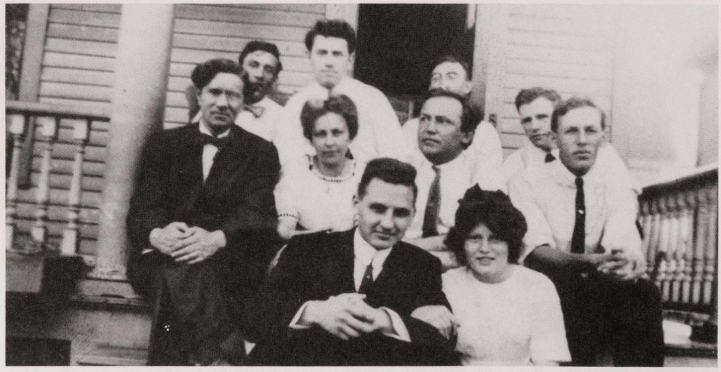
A look at the early work of the Intercollegiate Socialist Society at Ann Arbor’s University of Michigan which included national figures like Maurice Sugar and William E. Bohn.
‘Socialism at the University of Michigan’ from New York Call. Vol. 5 No. 225. August 12, 1912.
Hail to the students who are including humanity among the humanities” was the greeting that William Dean Howells gave to the second annual convention of the Intercollegiate Socialist Society, at which 325 men and women were present, representing twenty colleges, among them Michigan, which is officially stated to be the strongest in the league.”
No Socialist organization was in existence or even dreamed of in the university until 1907, but when in that year mix Michigan students drank from a loving cup at a midnight feed, and pledged themselves “round and round” to Socialism, it was like the leaven which the woman hid in three measures of meal, till the whole lump became leavened. This nucleus of Socialism in the university has acquired bone and sinew, and has achieved a strength which is virile and victorious among contemporary campus organizations.
This little society of six met very occasionally and irregularly, with a purpose nothing more than to find opportunity to discuss present day social problems, unhampered by class-room restrictions. Socialism entered into these discussions only as an academic question, but it entered, and the force of it has permeated through college and town, until the intercollegiate Socialist Society, locally represented, is a living factor in Ann Arbor and is officially announced as the strongest organization in the intercollegiate league.
And the Intercollegiate Socialist Society is a factor that is being reckoned with, for its growth has realized assertive rights, and it is aggressive sometimes almost beyond faculty restraint, and in instances has defied faculty caution, and individual members have paid the penalty for “free speech” by compulsory resignation from the university, which could not tolerate the views.
Some Professors In.
The faculty as a faculty does not give to this avowed group of Socialists its moral support. The organization is an alien to faculty kinship, although a few professors wink at it and a smaller number brazenly affiliate with it, laughing at the sovereign edict that free speech in colleges shall not be.
The Intercollegiate Socialist Society was organized in New York City on September 12, 1905, in response to a call issued by a group of well known writers, including Jack London, Upton Sinclair, Thomas Wentworth Higginson, J. G. Phelps Stokes, Charlotte Perkins Gilman, Clarence Darrow and others who felt that the subject of Socialism was one concerning which the educated men and women of the country could not afford to remain in ignorance. The expressed purpose, therefore, was “to promote an intelligent interest in Socialism among college men and women,” graduate and undergraduate. This was to be accomplished chiefly through the formation of study clubs in colleges and universities and alumni chapters among graduates the distribution of literature and through lectures and discussions
In 1908-1909 the increased activity) of the initial six at Michigan brought increased membership, and preparations were made to apply for a charter from the national organization. This was granted, and in 1909-1910 the organization was launched formally. Larger activities gave increase of meetings and the society became substantial and promising. The very active members were Marie Raney, Willlem Klare, J.R. Reekenstein, Peter Fagan, Claire Tinker. The faculty member who was the inspiration of the movement was Dr. William E. Bohn.
Up to the year of 1910-1911 what interest had been taken was largely such as students would show. They wanted to do, but did not know what to do. At this time, however, there happened something which gave to this group not only new impulse, but direction for further efforts.
Faculty Member Let Out.
Dr. William E. Bohn, a member of the university faculty of the rhetoric department, because of his alleged activity in political propaganda for Socialism, was dismissed from the faculty. Though his dismissal was a serious blow serious enough to check for a time all activity on the part of the student members, nevertheless the setback was only temporary, only a lull before the storm, The beginning of 1910 saw but little activity, except in the nature of preparation for the organization that was to come.
By the middle of the year the organization was running full blast. The Rev. Carl S. Patton, formerly of the Congregational Church, gave his advice and support, as did the members of the university faculty. A lecture on “Socialism and Art,” by Dr. R.W. Sellars, gave the members much encouragement. Dr. W.W. Florer, a member of the university faculty, who, it has been claimed by Socialists, has done more than any other one man in the State to advance Socialist propaganda with his anti-Socialist lecture. Another successful lecture was given by Alexander Irvine, once a famous pulpit orator, now Socialist agitator, whom the society gives the credit for the wonderful growth of the movement in the University of Michigan. This closed the year, but various and detailed plans were laid by a committee appointed to work during the summer months. Increased membership had become an assured thing. In addition to this, a problem of greater importance presented itself. The attention attracted by the heated discussion that had followed Dr. Florer’s lecture was more than any one had bargained for. Students and faculty and townspeople suddenly found themselves interested in Socialism to such an extent that the trustees of the Congregational Church decided that sanctity of the parlors of the church was seriously in danger, as long as they offered shelter to the Intercollegiate Socialist Society, and the society was asked to give up its privilege of meeting there.
Some Ups and Downs.
The University Young Men’s Christian Association then offered them the of one of the rooms in McMillan Hall, but before the end of the year was discovered that the University M.C. A. had in turn been crowded out of its quarters, and so it was said at the fact that it had given shelter the Intercollegiate Socialist Society was used as a slander against the Christian Association.
So once more the Socialists found themselves in the street. Then came the fall of 1911. There were thirty members at the beginning of the year. Meetings were held in the parlors of the Unitarian Church, secured largely through the efforts of the minister of that church. Dr. Percy M. Dawson. Officers were elected as follows: Executive committee, R.W. Sellars, Percy Dawson, W.M. Nelson; corresponding secretary, George H. Bishop; recording secretary, O.C. Marckwardt: treasurer, Salome T. Marckwardt.
An increasing membership made necessary and possible, a greater and greater activity, as well as a clearer idea as to the function of the society. And the function is “We recognize that because of its peculiar position in our social organism, no university as such, can be expected to approach our modern social problems with that sympathy necessary for any adequate solution of them. The class room should serve no other purpose than to offer opportunity for dispassionate study. The professor must not take sides.
“Therefore it is as students and future citizens that this group is handed together for the purpose of giving these problems not only intelligent but sympathetic interest. They are to form the nucleus of all activity to promote an intelligent discussion and understanding of all problems, social and political, that confront us today. We are in the business of making citizens.”
The society gets some of the best students on the campus, over one-fourth of its members belonging to honor societies in the university, a scholarship exceeding in proportion that of any other social organization at Michigan. It is interesting to know that no fraternity boy or no sorority girl was ever a member of the Intercollegiate Socialist Society.
Dr. Florer’s Compliment.
Dr. W.W. Florer, professor of German in the university, in a talk recently, said to the members: “They are the most active students on the campus; they read and think, and study: they are serious, all of them serious and alive.”
Wellington Tinker, assistant secretary of the University Y.M.C.A. said: “The boys and girls who compose that group represent the best brains on the campus. They get things done; they are bright and active boys and girls to work with; they could serve as examples for any one to follow in class and out of class.
The organization now numbers fifty members. The steady growth of it can best be comprehended by comparison with other campus organizations. Good government clubs have been started from time to time, having more or less the moral support of the university authorities, but they seldom lived longer than a year. A divinity club, founded simultaneously with the Intercollegiate Socialist Society, has long been defunct. Sporadic religious and political interests now and then evolved into groups or societies, found in the course of a year or two that the ties that bound them were gone. “But here we have a society,” said an enthusiastic member, “which, when not actually frowned upon by the faulty, has even been treated with indifference; and still, in spite of these obstacles, it has grown in its activities so that in the course of the past year it has distributed among the student body $500 worth of lectures and literature. In this respect this society passes unchallenged as the most active organization of its kind in this country.”
As illustration of one phase of its strength, when a straw vote was pulled off by the Michigan Daily, the students publication, balloting extended over a period of two weeks with little consequence, until it was learned that the Socialists had entered the field by nominating Debs. Then things began to happen.
The Roosevelt and Wilson and Taft clubs on the campus began to hustle. The last two days saw tremendous activity. The result was that a larger Socialist vote was polled here than at any other school in the country. The University of Michigan was the first to put up a Socialist ticket, with the result that when news of the returns began to appear in the daily metropolitan papers, other large schools followed suit.
None of them, however, not even Wisconsin University, an alleged Socialist stronghold, showed the number of votes polled here at Michigan.
Osborn’s Letter.
Governor Chase S, Osborn wrote to the Michigan Socialist Society in response to an invitation requesting him to address the club: “I hope the Socialist society will continue to be prosperous and to invoke the interest of all who are inclined toward Socialism. The right way of the future is to be discovered by those who are making earnest search for the truth, and I believe that you are doing that above all other considerations and before you take any thought of practical political profit. The truth is what we should all desire, and if it can come through the work of educated Socialism, it will be none the less welcome.” The activities of these student Socialists are varied. Anything that will further intelligent study and interest in Socialism and allied topics is their business. They organize study groups, meet bi-weekly and discuss. They have reports on new books and current events, interpreting the latter from the viewpoint of Socialism. They bring speakers to Ann Arbor, among whom have been Arthur Brooks Baker of Esperanto fame; A.W. Ricker of the Appeal to Reason: Frank Bohn, formerly of Columbia University, now associate editor of the International Socialist Review. The event of the year, however, was the last lecture, delivered June 6, by Alexander Irvine on “The Message of Victor Hugo to the Twentieth Century.” This was by far the largest meeting of the year, over 500 students, faculty and townspeople being present.
Go on Lecture Platform.
Though primarily given over to the study of Socialism rather than its propaganda, the Intercollegiate Socialist Society has of late branched out into an activity which makes it unique among organizations of its kind. They soon developed among its society members no little talent for lecturing. A very urgent demand from many cities in lower Michigan for speakers brought to fruition the idea of supplying these cities. Robert Hess, Peter Fagan, Maurice Beegar and Walter Nelson were the speakers on the Intercollegiate lecture course whose services were soon in great demand.
Plans for next year are already under way. Pledges for membership to the extent of 100 have already been secured. This increased membership makes possible a dream of two years’ standing. The S.L. A. course, the big lecture course, the official non-Socialist students’ lecture course, by reason of its constantly diminishing attendance caused, it is said, by booking each year a poorer and poorer grade of speakers, has become extinct. The Intercollegiate Socialist Society is now in correspondence with many of the country’s famous Socialist speakers, and will put on a lecture course for the coming year. Among the speakers that the society has secured are Morris Hillquit, a New York lawyer and writer; Eugene V. Debs, Presidential candidate: Victor Berger, Socialist member of Congress; Charles Edward Russell, magazine writer: Alexander Irvine, Dr. Frank Bohn and Prof. John Kennedy of Chicago University.
Sandwiched in between these speakers, student members of the organization will give talks and debates, and conduct quiz sections. In various groups of ten or twelve, different lines of activity will be taken up, such as a closer study of Marx, a review of the history of Socialism, the interpretation of current events, and various other lines. Unique among these will be a class for drill in public speaking.
Social Activities Also.
The social activities are not lost sight of. The dances given from time to time by this society are becoming more and more popular, and are more and more numerously attended. Social evenings indoors in the winter, and all-day outdoor picnics in the early fall and summer are a further part of the social life.
For next year three further lines of activity are planned, a singing club, consisting of a double quartet, plans for which are well under way; a debating team to contest with teams from the various literary societies; a drama study club under the direction of a member of the faculty, which will stage one of the modern plays.
Quarters for the coming year presented to the society a real problem. “We need a hall of our own, and we can get it, too,” said G.H. Bishop, secretary of the society; “a real auditorium, with a seating capacity of from four to five hundred, with parlors for our smaller meetings, and also for purposes of entertainment in a social way, and plans are almost mature for it. This would remove any restrictions that might arise from a relation of tenancy under the roof of the conservatively religious organizations. The society would be unhampered. Its great future purpose in the university is to present to Michigan students serious things to think about. “Membership in this society does not imply agreement with Socialist principles and doctrines, but merely indicates a willingness to have these principles carefully and seriously investigated, and makes an appeal to the college man and woman to study Socialism earnestly and candidly.”
The New York Call was the first English-language Socialist daily paper in New York City and the second in the US after the Chicago Daily Socialist. The paper was the center of the Socialist Party and under the influence of Morris Hillquit, Charles Ervin, Julius Gerber, and William Butscher. The paper was opposed to World War One, and, unsurprising given the era’s fluidity, ambivalent on the Russian Revolution even after the expulsion of the SP’s Left Wing. The paper is an invaluable resource for information on the city’s workers movement and history and one of the most important papers in the history of US socialism. The paper ran from 1908 until 1923.
PDF of full issue: https://www.marxists.org/history/usa/pubs/the-new-york-call/1912/120812-newyorkcall-v05n225.pdf

