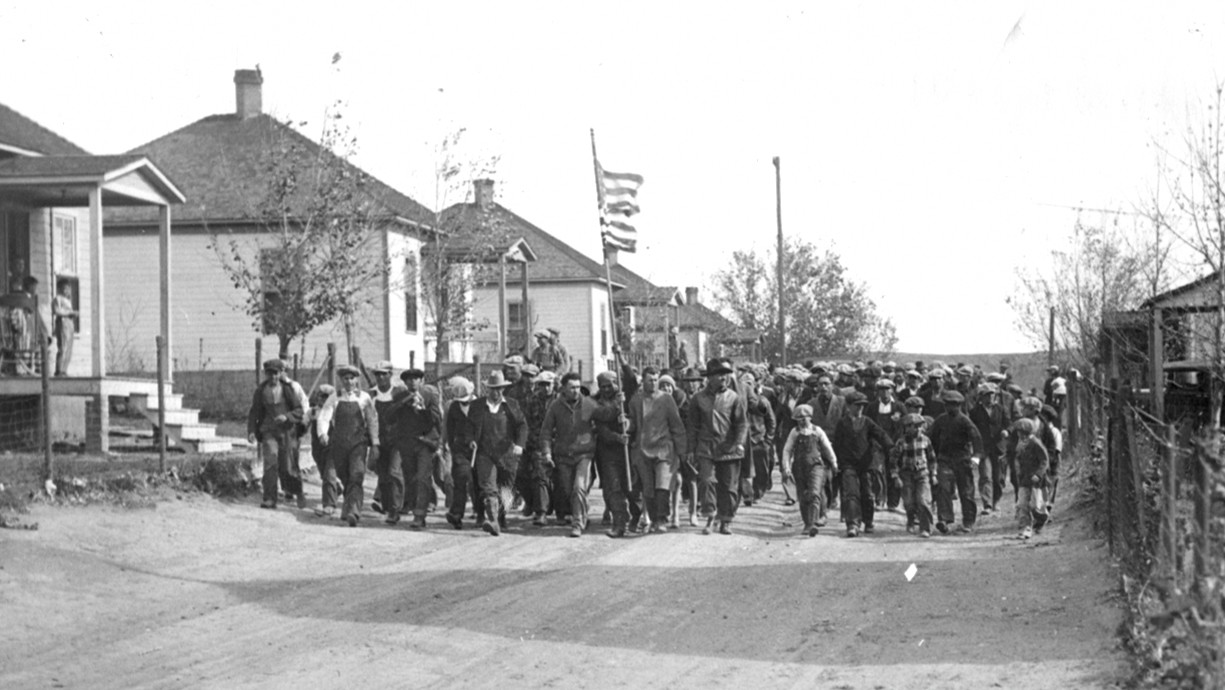
The third of Colorado great mine wars saw right dead, dozens wounded, and five workers hundred arrested in an epic 1927-8 confrontation of I.W.W.-led coal miners striking against Rockefeller’s Colorado Fuel & Iron Co.
‘A Blood-stained Throne’ by Frank Palmer from Labor Unity. Vol. 2 No. 2. March, 1928.
FRANK PALMER WRITES
WELD COUNTY JAIL, Greely, Colorado, Jan. 28. You will have to move fast to catch me between jails. However, I have written a little something for Labor Unity. This was a great strike. Fraternally, FRANK PALMER
JOHN D. Rockefeller, Jr. still rules Colorado, but again his henchmen have had to kill rebellious workers to hold his throne.
On the surface, Rockefeller was able to evade responsibility for the Columbine massacre on November 21, 1927, because his interests do not control the Columbine. And, despite all opinions, it has been impossible so far to tie the Rockefeller gang definitely to the frame-up now admitted to have preceded the massacre.
But on January 12, 1928, a striker and a boy were killed on the streets of Walsenburg, in the heart of Rockefellerdom. And this is going to be harder for the oily churchman to slip through.
On January 5, the City Council of Walsenburg passed a resolution at a special meeting, by quoting from a supposed proclamation of martial law, claimed to have been issued by Governor Adams, and making Mayor John J. Pritchard “dictator” of assemblages, parades and demonstrations until the martial law declaration should be withdrawn. This resolution was approved and countersigned by Lewis N. Scherf, personal representative of the governor, and head of the state police. Yet the fact is that the governor had never issued such a proclamation!
“THE FRIEND OF LABOR”
Governor Adams is a weak, frightened and puzzled old man, who squirms nervously, but never takes any direct action. He agrees with anyone to whom he may be talking and promises anything he is asked. But before he can keep his promise he is told something else. He denied to the newspapers that he had issued a proclamation of martial law in Huerfano County–but he couldn’t summon the courage to order Scherf to withdraw his approval of the statement that he had!

The day the resolution passed, 117 strikers were arrested as they marched toward Walsen (Rockefeller) mine at the edge of the town. The next night nineteen of these were taken in cars about one hundred miles from Walsenburg and dumped at midnight in the desert five miles from any town, food, money, sufficient clothing, or knowledge of their whereabouts,” and with the threat, “If you come back, we’ll kill you.” Sixteen came back.
Lewis N. Scherf was positively identified as the “chief” of kidnapping pirates, The kidnapping followed raids in which I.W.W. halls were smashed, mass arrests of strikers, violence by the K.K.K. the state police, and mine guards.
A PEACEFUL PARADE
On January 12, the campaign of terrorism apparently had failed. The Industrial Commission hearing began that afternoon in Walsenburg and the strikers were there, ready to testify.
They met as usual at 2 P.M., held a short meeting, and decided to march to the hearing at the courthouse. They formed, with the American flag at the head of the column, the women marching with their men, many of them with babies in their arms. As they started up Main Street, they were met by Scherf and Mayor Pritchard and ordered back. They turned back, although they knew Scherf’s order was based on the resolution, which in turn was based on fake proclamation of martial law. Backing Pritchard and Scherf were a dozen state police with riot guns and automatic pistols–and they were a nervous crew. One of them was Lee Lopez, a scab who three weeks before had been arrested for shooting Joe Martinez, a striker. Now he was with the state police!
It appeared that the police were to be disappointed, and that there was to be no opportunity for rough work.
A STRIKER KILLED
As the first of the marchers reached the hall, three state policemen left by the rear door Clemente Chavez walked to the door to close it after them, when he fell to the floor, killed by a policeman’s bullet, which also wounded another striker in the arm. A hail of bullets from the police in the rear of the hall whistled through the building, breaking the plate glass window in front and missing men and women by inches. Across the street a boy of 16, sole support of four brothers and sisters, a mother and grandmother, who had nothing to do with the parade, was mortally wounded, dying the next day.
The state police reported that Chavez had been sniping at them from the upper window, had been shot out of that window and had hit the telephone wires as he fell outside to the ground and so on in great detail. Unfortunately, they had done their bloody work too well for their own alibi. The brains and blood of Chavez were so spattered over the walls and floor of the lower hall as to make it perfectly obvious where he had been killed. Also, the windows upstairs had not been opened since the building had been painted; they were almost impossible to open, and the walls showed no return fire from the strikers had been directed against them.
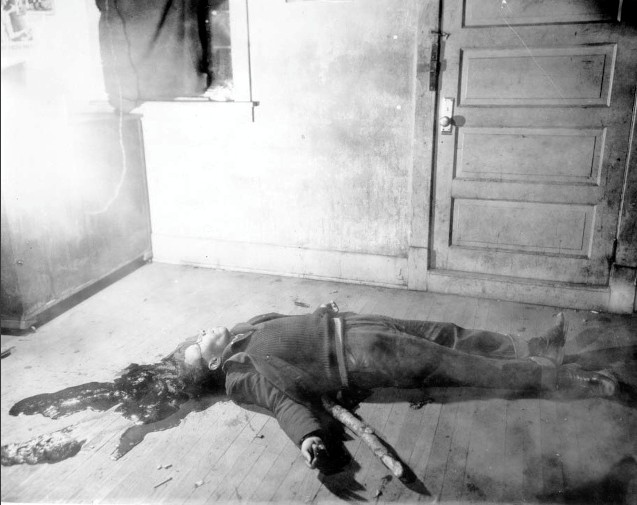
It was a bit too crude, and the coroner’s jury brought in a verdict of “unprovoked kil ling” saying “the state police showed a total disregard for human life.”
BOASTED OF BLOOD MONEY
Immediately stories began to fly that the Rockefeller interests were too obviously involved–that this time they might get caught. Overwhelmed apparently by the horror of the blood-spattered hall, the gunman who killed Chavez got drunk and bragged of the thousand dollars he got from the Rockefeller interests for the job. It developed that President Jesse F. Welborn of the Rockefeller Colorado Fuel & Iron Company had been in Walsenburg the night before the killing, presumably to attend the hearing of the commission, but that he had ducked out in the early morning! It was announced that he had been “inspecting the mines,” causing some question as to just how many mines the president had inspected in the middle of the night. The whole stoolpigeon system of the C. F. & I. has been crudely handled in this strike, and there is a good chance that this time the dirty work will be traced back to its source. The fineness of past years is missing, for some reason.
At any rate, the hearing has gone on and the strike has gone on. One of Colorado’s leading old party politicians was told by a C. F. & I. official, before the Walsenburg murders, “there will be about one more killing and all the strikers will go back to work.” He was dead wrong. Hundreds of those who had been imported as scabs walked out after the shooting. The fighting spirit of the strikers was renewed. They carried on with a new determination.
CONTINUED SOLIDARITY
Some 500 have been arrested; seven strikers and a boy have been killed; more than a score have been wounded; dozens have been held them have been beaten. But the wonderful without charges, bond or hearings; many of vitality and loyalty of the working class when aroused has been shown again and again.
Colorado is still a province in Rockefellerdom. But it is not always going to be. Another flag than his has already been raised over Smolny.
EDITOR’S NOTE: On Feb. 20 the strike committee in Colorado announced that the men should go back to the mines. Only a few were taken back. A left wing among the strikers opposed the return, which means surrender.
Labor Unity was the monthly journal of the Trade Union Educational League (TUEL), which sought to radically transform existing unions, and from 1929, the Trade Union Unity League which sought to challenge them with new “red unions.” The Leagues were industrial union organizations of the Communist Party of the United States (CPUSA) and the American affiliate to the Red International of Labor Unions. The TUUL was wound up with the Third Period and the beginning of the Popular Front era in 1935.
PDF of full issue: https://www.marxists.org/history/usa/pubs/labor-unity/v2n02-w21-mar-1928-TUUL-labor-unity.pdf

