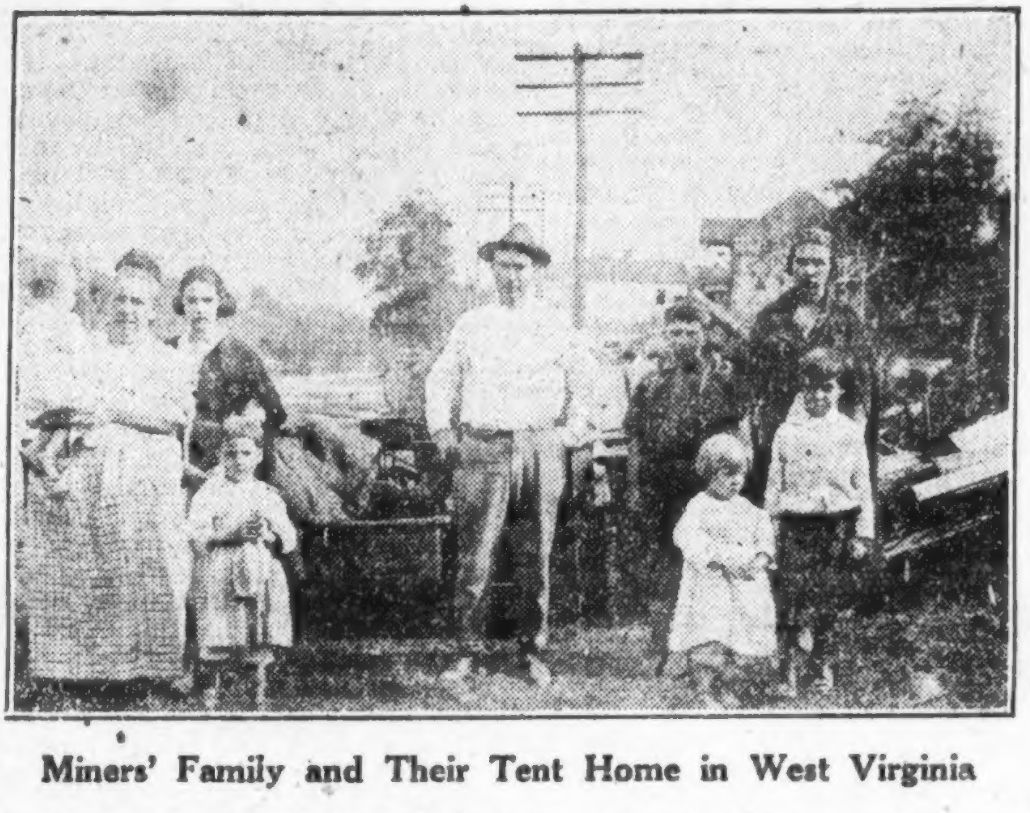
Often more a giant, armed and guarded labor camp than a state, the Federated Press’ McAlister Coleman spends a week in West Virginia in 1925.
‘A Week in West Virginia’ by McAlister Coleman from New Leader. Vol. 2 No. 10. March 7, 1925.
SATURDAY
PERCY TETLOW, who took over the presidency of District 17 United Mine Workers of America, when the old administration petitioned the International Union to carry on the organizing work in West Virginia last summer, is a lean man, quiet spoken, with a good business head on his shoulders and an air of convincing authority about him. I found him in the little two-story building that houses the union headquarters just around from the post-office at Charleston. I told him that I had been sent down by a joint committee of the League for Industrial Democracy and the American Civil Liberties Union to look into the need for relief for his striking miners and find out how it went with civil liberties in West Virginia. He smiled slightly when I mentioned “civil liberties.” When you have seen the local papers whose silence in regard to the industrial warfare that is raging on their doorsteps fairly thunders, when you hear of some of the things that happen to union organizers in their attempt to invade non-union fields, when you note the complete indifference of social and charitable agencies to the continuous abuse of constitutional rights and the consequent suffering among the families of evicted miners, you can’t blame Tetlow for smiling.
Will C. Thompson, secretary-treasurer of the district, fairly explodes with rage when you mention “civil liberties!” “Civil liberties in West Virginia! There ain’t no such animal.” That is expressive of the union attitude. The leaders have frankly given up all hope of presenting their case to the public through the medium of the local press. Organizers who have headquarters for non-union fields jest grimly about the probable fate that awaits them at the hands of deputy sheriffs. They tell you that it is as much as your life is worth to go into Logan, Mingo, or McDowell counties where Sheriff Don Chafin’s interdicts against public meetings still hold good.
Union officials tell you that they are providing relief to twenty thousand persons, evicted miners and their families. They are sending to the heads of local relief committees rations enough for bare existence and shelter in the shape of tents and lean-to’s. In some instances they have been doing this for almost three years, for you must understand that strikes and lock-outs in the West Virginia coal fields are overlapping. Some of the union men whose operators would not sign the contracts called for by the 1922 agreement are living out on wind-swept hills side by side with those who would not go back to work at a 38 per cent reduction last April and still others who joined the union when an organizing campaign got under way last November.
See Menace to Union
In all about 22,000 union miners are idle in West Virginia today, while some 50,000 to 60,000 non-union men are at work. In some instances operators are selling their coal at cost or less in order to keep their mines open. In other instances production and demand are normal. Much of this non-union coal comes from below the Ohio river through unionized territory to the north where it undersells coal mined under union conditions. Unemployment is rife in the central competitive fields, Illinois, Indiana, Ohio and Pennsylvania. Union operators who pay $7.50 a day for day men cannot complete with a scale of $3.50 or less. If organization work in West Virginia is checked, if the men are driven back to work at the 1918 scale, the future of the United Mine Workers, the strongest unit of organized Labor in the country, is menaced.
That is why union headquarters at Charleston is being watched by organized Labor the country over. That is why the International Union is pouring thousands of dollars every month into relief work in West Virginia. Labor’s fighting front in America today lies along the Kanawha Valley, in the camps on Cabin and Kelly Creek and on the mountains sides beyond Charleston where every day recruits are taking the union obligation and being promptly evicted from the company houses. Up and down the swollen creekbeds, trucks bearing tents and rations from headquarters race to provide food and shelter for these new converts to unionism. If they will stand fast in the valley as their fellow-workers to the north are standing, then the dangerous and difficult task of organizing Logan and the other non-union territories I can be undertaken from a strategic base. “Go to Eskdale on Cabin Creek tomorrow,” advises a union organizer, “there’ll be a parade and some talking and you can see what kind of folks are joining up.”
SUNDAY
Through long experience on these roads the automobile that takes you from Cabin Creek Junction up to Eskdale has acquired invaluable motor-boat characteristics. For a third of the way at least road-bed and creek-bed merge in a boiling yellow torrent whipped up by the steady downpour of rain, so that the front wheels throw off waves that would do credit to a racing craft.
At Eskdale, miners huddled under the eaves of the little store tell you that a parade of union men is coming down from Dakota six miles up the valley. You drive on to meet the marchers and presently hear the notes of a French horn gargling through the downpour. “It ain’t going to rain no moh.”
Lanky, broad-shouldered men in hip-boots are slipping and sliding along the road. Ahead is a huge man with an American flag furled limply around a six-foot pole. Back of him comes the man with the horn. He stops to unload cupfuls of water from the instrument and then continues his musical weather prediction. Then come men with rain-soaked signs stuck on poles, “We don’t like the American plan.” “We won’t work at a 38 per cent wage cut.”
On past the homes of non-union workers swings the little parade. The hills that hang sheer above the road echo the notes of the horn. Men shuffle curiously to the front porches of the company houses and survey the marchers with inscrutable eyes. An Italian cups his mouth and shouts with full-lunged enthusiasm, “Meeting today at Eskdale. All come. Good speaking. Black and white speakers.”
Six miles down to Eskdale through the rain and six miles back after standing in an abandoned store and listening to the speeches of the organizers from Charleston.
Evicted in Rain
“I was supposed to get $60 last pay,” says one of them, “and all I got was $11 in cash. The rest went to the company store, the company doctor and for ‘personal protection.” That means to pay these dicks that the company hires to keep out union organizers.”
A deep purple darkness has settled down as the homeward bound parade is organized. Off they go with the ironic horn still optimistic. Every Sunday you can see just such parades marching and counter-marching all through the valley. The rank and file love them and the leaders realize very well their enormous psychological value.
MONDAY
At six this morning a crash of broken glass and the whistle of a million fiends. Rain is whooping in through the smashed window of the hotel at Charleston. On the streets men are bending to the force of the storm. You get union headquarters on the phone.
“They wouldn’t evict anyone in weather like this, would they?”
“Just the weather they like best. We’re sending a truckload of tents up to Mammoth this morning. Want to go along?”
No matter what your economic opinions, Mammoth makes you mad.
Deputy sheriffs armed with eviction notices and revolvers have been “setting out” union miners and their families since dawn. Women and little children are wandering about in the mud seeking any sort of shelter. The men are trying to erect tents in the teeth of the gale. Wagons piled high with household goods slew about so that every now and then something precious to someone is knocked off into the creek, a child’s toy, a phonograph, an elaborately framed crayon. Over here next to the plot of ground owned by the union is the little Baptist church where the smallest children are being tucked away in cribs hastily constructed out of pews and mattresses. Some of the women are making dinner on a cook-stove brought in from the wet.
Others are quieting the frightened youngsters. Seventy-year-old Will Woodsum, who went to work at the face of the coal when he was ten years old and who was born within a stone’s throw of the Canadian army tent that has been assigned him by the union organizer, tells you that neither he nor his sons will ever go back to work at the 1918 scale. “Our women wouldn’t ever speak to us if we did,” says he with a grin. Everything that he has accumulated in the course of a long life is piled in the middle of the 14×8 foot tent. Through a bullet-hole in the side, shot into the tent by German machine gunners during the war, a trickle of rain is making a pool atop the Woodsum bureau. He stops the leak and shows you with pride the lines of the piece which he made himself.
TUESDAY
In the Supreme Court at Charleston they are wrangling over prohibiting the injunction which Attorney General England obtained last November against Don Chafin, sheriff of Logan, the county court of Logan and each member thereof, about two hundred deputy sheriffs and a number of coal companies. The object of the injunction is to prevent the appointment and ser vice of deputy sheriffs as private mine guards and to restrain the coal companies from paying them and Chafin “large sums of money for their appointment.”
When the Attorney General is through, his young assistant makes an eloquent plea for the upholding of constitutional liberties. The coal companies’ attorneys bring technical arguments against upholding the injunction and say that if the deputies are withdrawn there will be another “armed march” of the miners against Logan. The justices reserve decision, but listen with interest to these arguments not often heard in West Virginia courts. Behind the scenes political forces are moving. At the last election Attorney General England was warned not to come to Logan, his birthplace, to speak for the Republican ticket. He didn’t. His law partner ran on the Republican ticket against Don Chafin’s nominee for county prosecutor and is now contesting the election. Citizens of Logan have long petitioned state authorities to do something to curb the Don’s power and slowly the machinery is coming into action. All this is to the union’s good. It looks as though the union-baiting sheriff were finally on the run.
WEDNESDAY
Logan, a town of electrically-lighted, paved streets with modern stores, churches, some pretentious apartment houses and a court-house, and jail, lies at the bottom of a pocket between coal-fat hills. On the train coming down from Huntington all strangers are closely scrutinized by slant-eyed detectives on the lookout for union organizers At the hotel, curious heads bob over your shoulder as you register. When you go out after supper you are closely attended.
THURSDAY
Here are the non-union camps, frequently held up as model by writers for the operators’ press. Certainly the houses are as good as any I have seen in union fields. They have little garden plots about them and seem well-built. Furthermore, there has been some attempt at starting community life, dance-halls and even a tennis-court. Also the company stores are attractive. Physically, every prospect pleases. It’s when you come across a guard with a Winchester at his knee sunning himself in front of one of these stores; it’s when you make a hasty comparison of the prices charged the non-union workers there (in many cases 30 per cent higher than Charleston prices) that you are given to think.
Women Staunch as Men.
From such neutral sources a you can find you gather that the community as a whole is sick unto death of all this guard business, is willing to give union organizers a chance to see, if by peaceful persuasion they can add to their ranks in Logan.
FRIDAY
A clear, cold day with a chance to get some pictures at the Crown Hill colony near Charleston where they have been out in tents, some of them for three years. Here’s five-year-old Louise Bryant proudly holding up a wriggling puppy and eighty-year-old Luther Griggs who is going blind after seventy years of coal digging, both good union folks helping each other to bear the monotony of the years under canvas. Louise and most of her playmates are in sad need of shoes. Griggs could do with a stout coat.
“What do you women do?”
“Well, you see, we have to watch the kids more carefully living out like this; they’re liable to get wild and out of hand. And then there’s lots of figuring to be done to make the union rations last through the two weeks and by nighttime we’re all pretty well tuckered out. We get together sometimes and have quilting parties or someone reads out loud of one of these story book magazines. There’s movies down the road about five miles, but we ain’t got no money for such. Let me tell you, Mister, keeping house in an army tent ain’t no soft job.” “Do you want your husband to go back?”
“And go scabbing? Say, if I ever catched him doing that I’d stomp him clear through the floor of this tent.”

