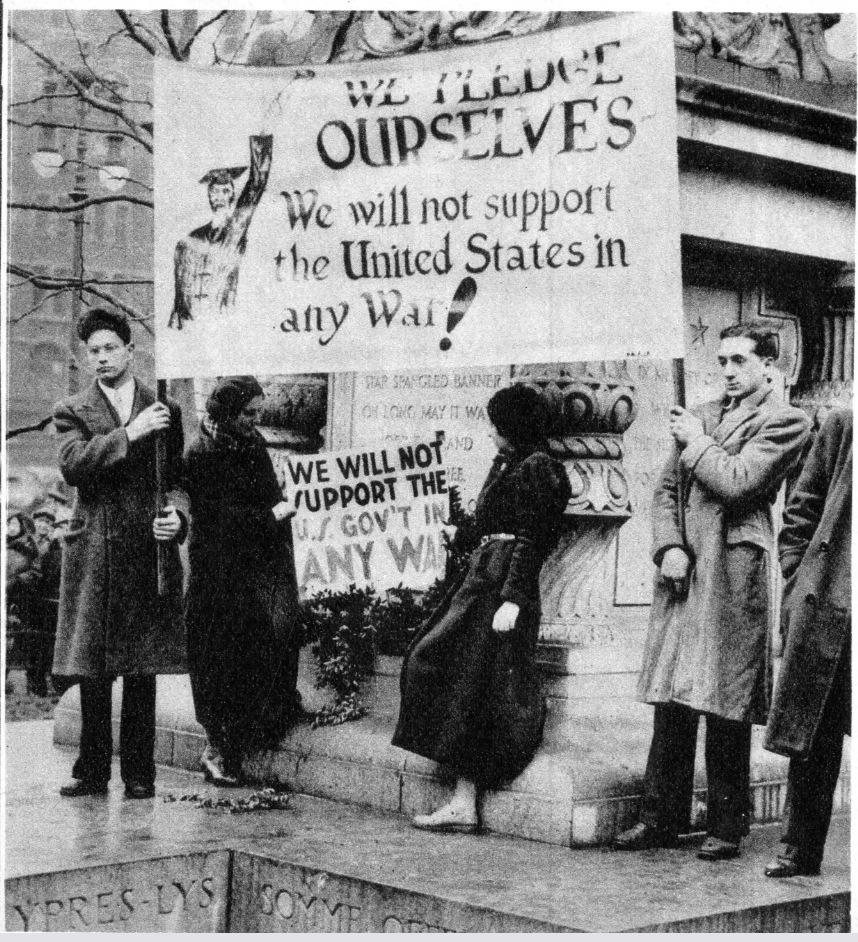
It was only well into the Depression that a significant national, progressive student movement in this country began. Both the Socialist and Communist Parties responded with student groups, eventually to unite in 1935 as the American Student Union. Along with academic freedom, issues included militarization and the R.O.T.C., fascism on campus, discrimination against Black students, and labor solidarity. Oakley Johnson speaks to the C.P.-allied National Student League’s December, 1933 Conference at Howard University.
‘American Students Becoming Politicalised’ by Oakley Johnson from International Press Correspondence. Vol. 14. No. 11. February 23, 1934.
During the final week of December, 1933, four national student conventions were held in Washington, D.C.
The convention of the National Student League was held at Howard University, the world’s largest Negro college.
The N.S.L., during four days of organisational and programmatic planning, had time to show in action the meaning and the resoluteness of its aims. The forbidden inter-racial dance was held in a hired hall off the Howard campus, and a considerable number of Negro students, both men and women, attended. The N.S.L. supported the League for Industrial Democracy in picketing a Washington store which refused to hire Negro help though its trade was largely with Negro customers. The N.S.L. held a demonstration jointly with the L.I.D., under the auspices of the Youth Section of the American League against War and Fascism, in protest against the R.O.T.C. (Reserve Officers’ Training Corps) and other measures of militarisation of the colleges. About 350 students (mostly N.S.L. members) marched through the streets, carrying placards, accompanied by a motor-cycle police escort, to the White House, where a delegation of five–two each from the N.S.L. and the L.I.D., and one Negro student interviewed President Roosevelt’s secretary, Colonel Louis Howe. At the same moment that these students were demonstrating in the streets, the reactionary National Student Federation was being entertained at lunch in the White House by Mrs. Roosevelt.
Though the police tried to prevent speaking, the delegates addressed the students when they returned to the street, two of them giving a report.
The N.S.L. has a five-point programme: (1) Against retrenchment in education; (2) against the R.O.T.C.; (3) against the discrimination directed toward Negro students; (4) against fascism; and (5) for academic freedom of students and teachers. Its history has been marked by an inter-collegiate students’ delegation to investigate mining conditions in Kentucky; by a student strike at Columbia University, which forced the reinstatement of Reed Harris, an expelled student; by militant demonstrations against the dismissal of two teachers, Oakley Johnson (City College of New York) and Donald Henderson (Columbia University); and by a struggle for the reinstatement of thirty-one students expelled from C.C.N.Y. It sent a delegate to the Amsterdam Congress against War, to the Latin-American Congress against War, to a congress of Latin-American students in Costa Rica, and to investigate conditions in Cuba.
For the coming year the N.S.L. has determined upon three points of concentration, each with its special task: (1) In New York, the fight against the R.O.T.C.; (2) in Chicago, the fight against retrenchment; and (3) in Washington, against discrimination and for equal rights to Negro students.
A total of 237 student delegates attended the convention, representing 44 colleges and 17 high schools.
The League for Industrial Democracy held a two-day convention in a Friends’ (Quaker) Meeting Place, with closed sessions. Some 50 or 60 delegates attended, representing about 25 colleges. Much of the time was devoted to the N.S.L. proposal for one united student organisation, which the leaders, Monroe Sweetland, William Gomberg, and others, were determined to reject, though nearly a quarter of the delegates were in favour of it. The proposal was voted down on the first day; it came up again the second day in the form of a proposal for a referendum, and despite efforts to rule it out of order it was again voted on, but voted down. The L.I.D. agreed to a united front with the N.S.L. on specific issues, such as the fight against the R.O.T.C.
The L.I.D. is not a purely student organisation. The college section is now called the Student League for Industrial Democracy, and has branches in 125 colleges. The Student Outlook, edited by Joseph Lash, is its organ.
The reformist character of the L.I.D. is shown both by the vague, formless “resolutions” which they adopt, and the hesitant “activities” which they engage in. For instance, in adopting a resolution condemning the discrimination against Negroes, the L.I.D. omitted the word “Negro” entirely, making it simply a general resolution against race-prejudice. A resolution against fascism, which included a pledge for help to the American League against War and Fascism, was on this account “referred back to the Committee” (although in some connections the L.I.D. declares support for the American League).
The National Student Federation of America was formed nine years ago by students who favoured American entrance into the World Court. It became a semi-official organisation of the Student Councils of 250 colleges, the Student Councils appointed in part by college deans and in part chosen at faculty-supervised elections, all removable at will by the college authorities. On the various campuses the Student Councils concern themselves with a showy student government,” occupied with enforcing “student traditions”–such as the wearing of “pots” (small round caps) by freshmen, smoothing out the relations between fraternities, promoting athletics, and advocating the “honour system.” Their national convention dealt with these same “problems,” and also announced an interest in public affairs.
The delegates had little chance to work out their own opinions. The speakers were politicians and professors. President Roosevelt sent the Convention a special greeting.
The sessions were held in the expensive Mayflower Hotel. Almost their first act was to dissociate themselves from the Conference on Students in Politics, to which they had at first agreed, because a Radical group (i.e., the N.S.L.) was taking part, and because Robert Minor, Communist leader, was on the programme.
The N.S.F.A. organ is the National Student Mirror, to which A.M. Bingham, editor of the demagogic Farmer-Labour weekly, Common Sense, contributed articles on “Revolution and the Student.” Material for a student-fascist movement undoubtedly lies ready to hand in the N.S.F.A.
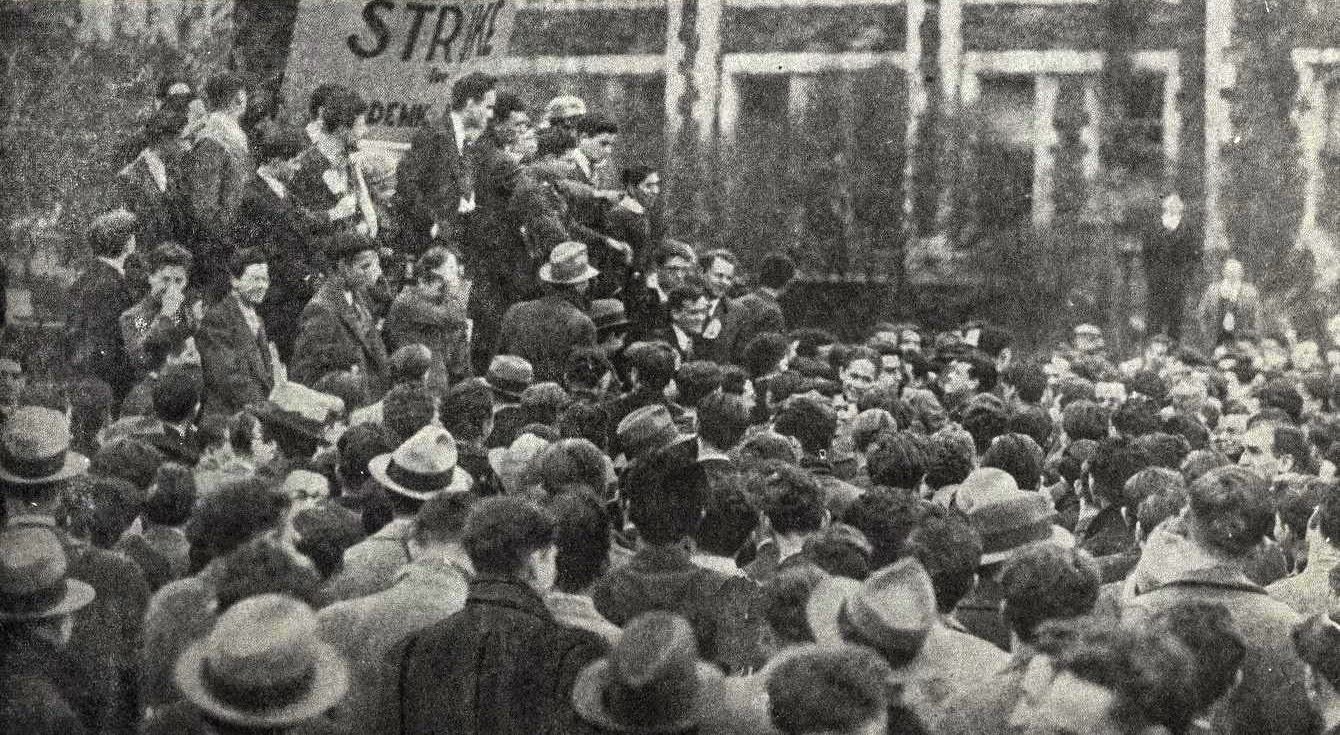
The ten participating organisations in the National Conference on Students in Politics were the N.S.L., the L.I.D., the League of Nations Association, the Student Christian Associations, the Y.M.C.A. (student section), the Y.W.C.A. (student section), the American Student Union (a part of “Young America,” promoted by Common Sense, the War Resisters’ League (student section), the International Student Service, the Committee on Militarism in Education, and the Inter-collegiate Council on International Co-operation. Not all of these have a mass membership, but about 500 delegates were at the Conference, representing thousands of students in these organisations. While the Conference was initiated by religio-reformist and social-fascist groups, it was none the less a most important affair.
The sessions were addressed by more than a dozen prominent speakers, including Norman Thomas, Socialist, and Robert Minor, Communist.
In the Saturday night session students were allowed to address the convention, but the U.S. Chamber of Commerce, in whose auditorium the Conference was held, had decreed, with the consent of the L.I.D. and the other non-revolutionary groups, that no resolutions should be adopted. The N.S.L., invited after the arrangements were made, discovered this only at the last minute. The first topic on the agenda was Organisation, and the second, Policy.
A few students dutifully discussed Organisation. Then Stevens, secretary of the N.S.L., declared that the convention was being straitjacketed. This broke the barrier of official rule. Student after student denounced the scheme to form an organisation before settling upon a policy; Finally the chairman, after a whispered conference, permitted discussion on Policy. J. Cohen presented the programme agreed upon by the N.S.L. and the L.I.D. The vote was overwhelmingly in favour of adopting “a policy.”
But what policy? Although he allowed a vote in favour of having a programme, the chairman refused to allow a vote on any specific programme. At this point the LI.D. wavered, breaking the united front. The drawing up of a programme was put into the hands of the Executive Committee, which had made the arrangements in the first place! But so clearly were the students shown to be in favour of the programme against retrenchment, R.O.T.C., fascism, and Negro discrimination, that a simulation of this programme was actually drawn up by the Executive Committee.
On the whole, the week was successful for the N.S.L. Its minimum programme–however weakened in form–will now go to colleges all over the country. N.S.L. prestige has gained. New members have signed up, new contacts been established. The L.I.D., by voting in the final meeting against student support of the American League against War and Fascism, and by repudiating even its own anti-N.R.A. plank, damaged itself before the revolutionary students in its own ranks.
However, the N.S.L. victory is largely formal and meaningless unless it is to be followed up by deepening student political understanding of the formulated issues; unless the students thus loosely organised can be involved in actual struggle in alliance with the working class. The N.S.F.A., whose defection from the Conference probably gave the N.S.L.-L.I.D. combination a chance to dominate the proceedings, was not touched by N.S.L. argument. The American Student Union group–the student branch of “Young America,” which is the Youth Section of “New America,” a newly-formed, extremely demagogic, semi-fascist organisation–tried, unsuccessfully, to get a following. Much work remains for the National Student League.
International Press Correspondence, widely known as”Inprecorr” was published by the Executive Committee of the Communist International (ECCI) regularly in German and English, occasionally in many other languages, beginning in 1921 and lasting in English until 1938. Inprecorr’s role was to supply translated articles to the English-speaking press of the International from the Comintern’s different sections, as well as news and statements from the ECCI. Many ‘Daily Worker’ and ‘Communist’ articles originated in Inprecorr, and it also published articles by American comrades for use in other countries. It was published at least weekly, and often thrice weekly. Inprecorr is an invaluable English-language source on the history of the Communist International and its sections.
PDF of full issue: https://www.marxists.org/history/international/comintern/inprecor/1934/v14n11-feb-23-1934-Inprecor-op.pdf

