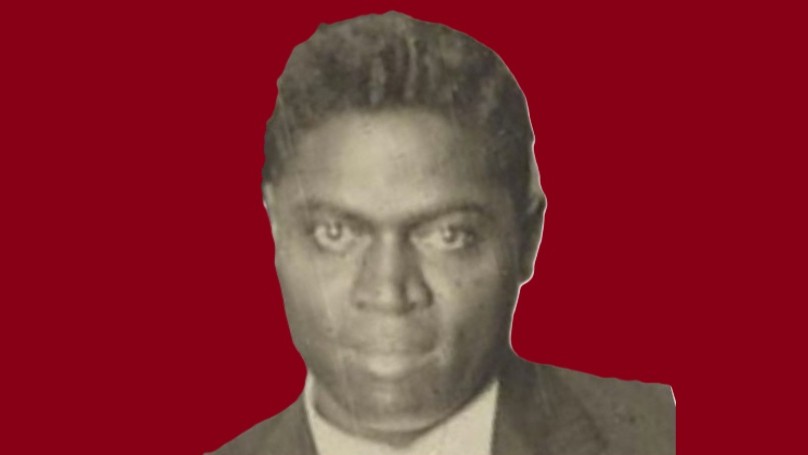
Domingo places the struggle for Black freedom as part of the worldwide struggle of oppressed peoples and the post-WWI revolutionary wave. The activism of Jamaica-born W.A. Domingo (Wilfred Adolphus Domingo) saw him participate in three of the main organizations of Black radicalism of the WWI-era writing for The Messenger, The Negro World, and The Crusader. First he joined the Socialist Party in the mid 1910s and worked in its Harlem Branch with Messenger editors A. Philip Randolph and Chandler Owen. In 1919 he became the first editor of fellow-Jamaican Marcus Garvey’s Negro World before political differences became insurmountable, whereby he joined the African Blood Brotherhood led by Cyril Briggs. Moving back and forth between the States and Jamaica over his life, his central commitment was to Jamaican independence.
‘A New Negro and a New Day’ by W.A. Domingo from The Messenger. Vol. 2 No. 10. November, 1920.
A NEW spirit is abroad in the world.
Ancient wrongs and oppressions are melting before the rising wrath of the masses of the entire world. This new spirit is a direct result of the war which destroyed millions of lives and enormous quantities of the products of labor, besides intensifying the sufferings of toilers everywhere. Just as the world war embraced all the races of mankind so have its consequences, typified by the new spirit, permeated all peoples. None is free from its influence; all are making demands for the democracy and justice that were eloquently mouthed by those who had and still have the power to make those words living realities. For the first time in human history have the lowly workers of the world asserted themselves and given intelligent expression to their needs. Subject races, small nationalities and oppressed workers are realizing their kinship. The white workers of Russia, the yellow coolies of Korea, the brown ryots of India and the black toilers of Africa, the West Indies and the United States are making similar demands upon their oppressors, although they and their masters in many instances are alike in race, color, language and religion. The former speak the language of the oppressed; the latter the language of the oppressor. Labor is the common denominator of the working class of the world. Exploitation is the common denominator of oppressors everywhere.
Many oppress because they profit from it, or think they do. There is a community of interests between oppressors. The real beneficiaries of exploitation are a small minority. They maintain their position because they control the machinery of government and the vehicles of public information–the school, church, stage, press and platform. These agencies support similar institutions. They defend present economic conditions, defame the working class, white and black, and abuse the Negro race as a whole.
As a considerable part of the American working class, Negroes have grievances against those who profit from the present system which operates against the interest of all workers. As Negroes they have specific reasons for desiring the downfall of those who manipulate public opinion for the creation of race prejudice which in turn divides the black and white workers of the country into warring camps. The workers of both races suffer from this vicious propaganda and it is to their interest to change conditions which make it possible. The reason for this propaganda and its resultant division of the working class is to rob them of the product of their labor. And the robbery of the workers of the product of their toil is sanctioned by our present system of government. Even if the black and white workers unite industrially, as they are slowly but surely doing, they will still be robbed of some of the product of their toil unless they unite for working-class political action. To stop present robbery and remove the cause of most of our racial friction it is necessary to change the system which legalizes the robbery.
In our present society most human being must work to live. They must have access to a job. The private owners of land, factories, railroads, mines and machinery have in their power to deny their fellows work. And without work a man and his family must suffer. Because of the developments brought about by inventions a man can produce more than is necessary for the consumption of himself and his family. But because the things produced do not belong to the producer but to the owner of his job the former finds wages, which represent a small portion of the things he has produced, insufficient to keep himself and his family in a reasonable degree of comfort. The owners of jobs have common interests and pay only as much wages as they are forced to pay. Their interests are opposed to those of their employees. And color or race makes no difference. Jews underpay Jews, and Negro employers rob their employees regardless of race or color. The interests of all workers are alike. Many workers do not realize this and work against their own interests. They refuse to join labor unions or exclude some workers because of their color. They also vote to strengthen the political chains which enslave them.
This is true of the Negro worker who votes for the Republican party which is frankly the party of Big Business. It is the party of the landlord and banker, black and white, Jew or Gentile. But most Negroes vote for the Republican party because it was the party of Lincoln and because he had freed their fathers. Whatever debt Negroes owed the Republican party has been paid long ago. Besides, it is the Republican party that delivered the Negro into the hands of the South in 1875 when Hayes was seated on condition that he withdraw federal troops from the South. For nearly fifty years the Republican party has been in power, controlling the Army, Navy and Supreme Court and during that period the oppression of Negroes has been cumulatively increased.
The only party that can make any appeal to Negroes that is based upon mutual interests is the Socialist Party. It is composed of enlightened workers who repudiate the DuBois-Gompers tactics of “rewarding friends and punishing enemies.” These workers realize that the chain of labor is as strong as its weakest link and from the standpoint of class consciousness Negroes are, through no fault of theirs, the weakest link.
li Negroes would be free then they must unite with others who are struggling for freedom. And it is the Socialists who are striving to free America from the throes of wage slavery. The slogan “those who would be free must themselves strike the first blow” gains added importance in the present political struggle. If Negroes think themselves freer than white workingmen then let them vote for Mr. Harding and the Republican party which represent the forces of reaction; if they feel themselves less free than white working men then let them vote with their fellow workers of all colors who repudiate both the Democratic and Republican tickets and vote for Eugene V. Debs, freedom and progress on November 2.
The Messenger was founded and published in New York City by A. Phillip Randolph and Chandler Owen in 1917 after they both joined the Socialist Party of America. The Messenger opposed World War I, conscription and supported the Bolshevik Revolution, though it remained loyal to the Socialist Party when the left split in 1919. It sought to promote a labor-orientated Black leadership, “New Crowd Negroes,” as explicitly opposed to the positions of both WEB DuBois and Booker T Washington at the time. Both Owen and Randolph were arrested under the Espionage Act in an attempt to disrupt The Messenger. Eventually, The Messenger became less political and more trade union focused. After the departure of and Owen, the focus again shifted to arts and culture. The Messenger ceased publishing in 1928. Its early issues contain invaluable articles on the early Black left.
PDF of full issue: https://www.marxists.org/history/usa/pubs/messenger/v2nRN-10-nov-1920-Messenger.pdf

