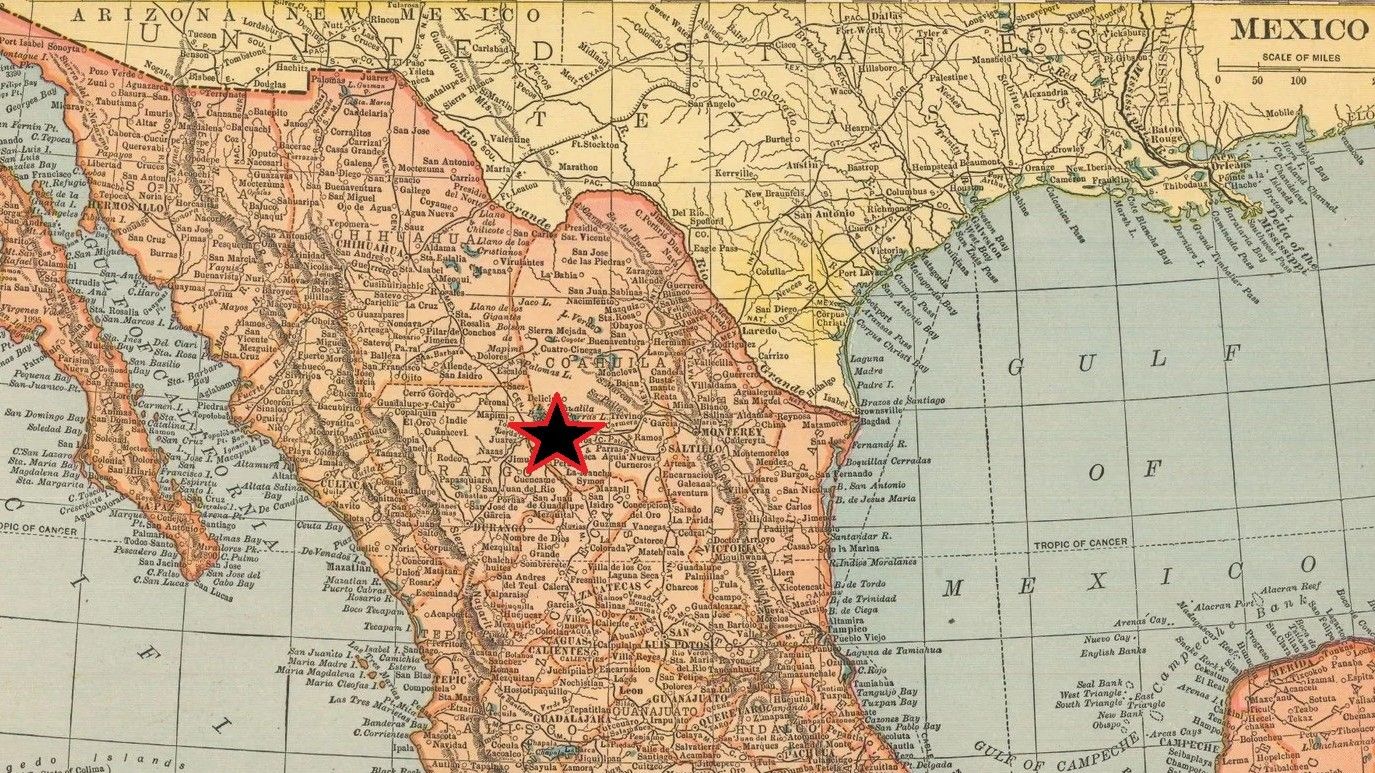
In another look back at the events of the Liberal insurgency in Mexico, Guerrero remembers the revolutionaries who took the town of Viesca in Coahuila on the night of June 24, 1908.
‘Episodes of the Revolution of 1908: Viesca’ by Práxedis G. Guerrero from Regeneración (Los Angeles). No. 4. September 24, 1910.
The organization had been a laborious task executed in the midst of great difficulties and dangers. The indiscretion and the faint-heartedness of the masses, the vigilance of the authorities supported in their dirty work by spies and informers, the lack of financial support, all this was being overcome, victoriously by the revolutionists of the group of Viesca. Their organization acquired strength and consistency under the continuous impulse emanating from those few toilers for liberty. In tiny installments, one by one, weapons were gathered by the group: today a pistol, some other day a carbine, and in quantities ever so small, gradually the ammunition was provided. Double privation had to be undergone, and three-fold they had to toil to earn a little bit of money over and above the merest necessities of life indispensable to pay for the right to live. But in the end; when the appointed time for the insurrection came, history could count with some elements of the finest caliber if we take in consideration the miserable conditions encompassing all the fighters for higher principles.
The revolution has never possessed any large capital. The rich who possess things hardly ever enroll for militant activity in the struggles for the emancipation of mankind, and still less are they disposed to risk some of their things, a part of their capital, in political games of any kind. They are egotists of the suicidal type: they claim, for themselves even the useless things they do not need, though they are almost ready to burst from stuffed overconsumption. For that reason a Tolstoy and a Kropotkine are exceptional types in our times.
The night of June 24 to 25th, the anniversary of the assassination of Veracruz, assassination in obedience to the historic infamous telegram of Diaz: “Matalos in callente”–“kill them quick,” had been set as the date for the rebellion to break out in different parts of the country. The group of Viesca enlisted in the greatest secrecy. The most minute precautions had been taken. But all this could not avoid their work from becoming so manifestly clear and threatening in appearance that the chief authorities of the locality, shaking of fear, fled on the eve of the uprising. Moreover the treachery of Casas Grandes had revealed to the government the existence of a vast conspiracy, and, what was of greater importance for the outcome of their plans, also the date set for the attack on the part of the rebels. The telegraph had wired urgent orders to all the villages and cities impressing upon the civil and military authorities to do all in their power to suffocate the revolution, whilst an ambassador made ready to present himself in Washington to demand for the most shameful assistance possible in favor of the Mexican tyranny. At midnight the comrades came together. To each one his place was assigned and the work begun. The police made a pretence at resistance. A few shots were exchanged resulting in one of the gendarmes being killed, and one on each side wounded. The jail was opened wide and no one remained there. The liberal program was proclaimed and the power of the usurper and dictator declared null and void. Horses were requisitioned and the scarce funds in the public offices were taken possession of The revolution took full hold of the village without a single case of violence or outrage to the resident families or neutral persons.
Jose Lugo, who had taken no part in the preparations became very active when the time had come to do things.
Denunciation paralyzed the activities of a good many groups. Others who had chances for effective rising failed to live up to their duty of solidarity holding back in a silence of shame.
The government began to dispatch troops over the Laguna region. And to all this came also over the valiant insurgents of Viesca the inundation of calumny and insult.
Penny-a-liners assuming the fictitious garb of liberals and of friends of the proletariat took upon themselves the task of arousing against the rebels the blind hatred of, we might call it, Mexican jingoism, a patriotism made to order to cover up unworthy motives. So they insinuated now, and asserted then, that the arms of the revolutionists had been helped over the border by the United States which, eager to get the mastery of Mexico, had incited to mutiny some bad Mexicans, or misguided persons, bought creatures like those of the mock-republic of Panama, bandits and highwaymen. The kindest epithet applied to us was “mitoleros,” Indian dancers.
In that way the “friends of the people” showed their worth and value. With their poor declamations they desired to assist in the crushing of the manly and worthy by the mercenaries of the powers that be and by the ignorant pseudo patriotism of the masses. As far as they were concerned the brutality of the repression could be used against the victims of their insidious attacks to all the extent cherished by the despotism. Even amongst the liberals themselves voices became loud condemning the few who ashamed of being mere cattle led to slaughter had broken with their passive attitude of meek submission. But those voices with all the earmarks of the lowest passions, those murmurs which were but the grunts of impotent envy, died and had no effect when they reached the ears of the pariahs, of the brethren of the unsubdued bandits. In spite of the cowardly fear, in spite of the dejection and degradation depressing the character of the masses, they did not entirely give credit to the calumnies of the “friends of the people.” As a whole and in general they thought with love and with admiration of the daring ones who knew how to stand up resolutely in a power that filled the faint-hearted and the vile with fear.
The evacuation of Viesca became unavoidable. The volunteers of liberty came forth from their appointed stations and left, followed by the looks of love and of hope of the proletarian women whose sympathies had been enlivened by the actions of the true conservers of peace and order, who had voluntarily taken upon their indomitable shoulders the appellation of bandits as in past history was done by the beginners of all reforms, the badge of contempt and promise of ultimate victory worn by the liberators of all ages.
To the hills, to the friendly mountains they direct their steps. And once there the nucleus dissolved in obedience to new plans. The body dissolved into particles, projected in all directions, there to create and form new rebel organizations, repeating the biological phenomenon of certain zoological species which reproduce themselves from their fragments.
Viesca brought forth to light characters like Lugo, and others whose names cannot yet be mentioned.
Viesca unmasked the liberals of convenience and excluded from the revolution elements tainted with fear or incompetency.
In 1908 the soldiers of the tyranny have in no place won victories. Only treason crushed the triumph of the revolution, and that is all there is to be said.
PRAXEDIS G. GUERRERO.
Escrito Por Trabajadores Y Para Los Trabajadores. Regeneración is easily one of the most important, radical Spanish-language papers in U.S. history, and given its role in an actual revolution, one of the most important in any language. Regeneración was the official organ of the Mexican Liberal Party, an anarchist and later anarcho-syndicalist party. The paper was founded in 1900 by Flores Magón brothers; Jesús published the paper with his brothers Ricardo and Enrique writing, and Liberal Party leader Anselmo Figueroa editing. With imprisonment, illegality, revolution, exile, and war getting in the way of publishing, the paper went through several phases since its beginnings. In 1904, the paper moved its production to San Antonio, then St. Louis, and then Los Angeles where it would stay for nearly a decade. Jesús returned to Mexico City where he published a more moderate version of Regeneración, while Ricardo continued published the increasingly radical one in the U.S. Regeneración, expanded with the revolution, and in 1910, the paper added in English language section, edited by British anarchist William Charles Owen. With natural allies in the growing I.W.W., the paper served as an organizing tool in the Mexican Revolution and was instrumental in popularizing the struggle with U.S. audiences and workers. 20,000 copies were circulated weekly at its height. The paper ran afoul of the U.S. authorities well before the rest of the left did in World War One and ended printing for good in 1918. Ricardo Flores Magón was in constant legal battles until his final arrest in the 1918 Palmer Raids for violation of the Espionage Act, along with thousands of other radicals. He died, some say was murdered, in Leavenworth Prison on November 21, 1922.
PDF of full issue: https://www.marxists.org/history/usa/pubs/regeneracion/1910/n04-sep-24-1910-reg-eng.pdf

