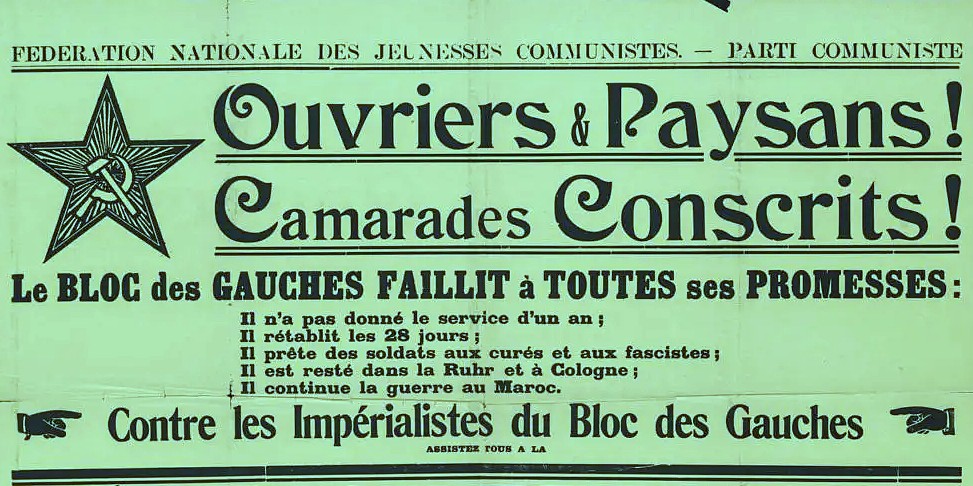
Rejecting the 1920s version of the Popular Front on the basis of tactics and principles, the Communist Party of France proposes not a ‘Left Block’ with bourgeois forces, but a block of workers and peasant forces in he 1924 elections.
‘Before the Parliamentary Elections in France’ by the Communist Party of France from International Press Correspondence. Vol. 4 No. 2. January 10, 1924.
Against the bourgeoisie Block, for the Block of the Workers and Peasants.
The majority of the Parliament has rejected the principle of proportional representation, as it would have made all parties in the electoral contest in the Spring, appear under their proper colours. It has retained an election procedure, that falsifies the representation of the parties, and compels them to form coalitions, that is, to an inevitable confusion of programmes.
The Communist Party is of opinion, that the elections of 1924 have a significance far surpassing all previous elections.
The country will be able to judge even better than in 1919 the policy of the war, and of those who brought it about. The Peace of Versailles marked the triumph of French imperialism, whose policy, since the end of the war, has led the world to destruction, France to bankruptcy, and has created prospects of a new war.
Within the country itself, this imperialist policy of the bourgeoisie is essentially anti-labour.
The electoral contest must bring into the field against those responsible for this policy, the mass of their victims–workers, officials and small peasants, tenants and consumers with small incomes. The country must sweep away those responsible for this policy of bankruptcy, famine and war.
The party alignments are already becoming apparent. The block of the left is setting itself in opposition to the National Block which since 1919 was the support of French imperialism and which is directly responsible for the present state of affairs. The Left, if not yet officially, contains the leaders of the so-called Left-bourgeoisie and the leaders of the Socialist and Socialist-Communist Parties.
The Communist Pary has refused to enter into such a block, and has persistently warned the workers and peasants against such a trap…The division of the bourgeoisie into a “Right” bourgeoisie and a “Left” bourgeoisie is but a superficial one. In reality, all the capitalists have common class interests. The employers of the Right and of the Left have the same interest in exploiting their workers, the property-owners of the Left and of the Right have the same intention of plundering their demands, the dealers and speculators of the Left bring about increase of prices in the same way as those of the Right.
This struggle between the Left and Right bourgeoisie, is simply a superficial political struggle for the privileges of power. At bottom the bourgeoisie class is always prepared to defend its prerogatives against the worker and peasant classes whom it exploits. This superficial division was only set up in order to conceal the real class division, and to prevent the struggle next Spring from assuming its true character, the character of a class struggle between all the exploited and their exploiters.
Great masses of workers, employers, peasants, clerks and small men are dissatisfied with the regime that continually renders their lives more insecure, and are prepared to resist, not only the national block, but the very capitalist regime the thing which is really responsible.
The Block of the Left.
The block of the “Left” is only a manoeuvre of one section of the bourgeoisie to prevent the expression of this justifiable discontent from injuring the vital interests of the bourgeoisie, and under the mask of the “Left”, still to keep the discontented to serve the profit of the capitalist system, as dividend earners and cannon-fodder. The proletarian parties which join in this movement, hand over a section of the proletariat to the capitalist class, and betray the working class.
It is an absolute fact, that the bourgeoisie of the “Left” does not differ from the government of the National block, that it has not ceased to support the imperialist foreign policy of Poincaré, that, immediately after the strike of 1920, it concurred in the anti-labour policy of the National Block, and that it still today helps to support the ministry by means of three radical members. The Senate, which has a left majority, has recently agreed to a scandalous increase in Rents of 104%. Renauld Jean has exposed the details of this out and out capitalistic and anti-labour policy from the tribune of the Chamber.
The antagonism between the Right and the Left is so artificial, that their dividing lines are still very indefinite and they move more to the right every day. This goes so far, that finally even Poincaré will be regarded as an element of the “Left”. An editorial note, which the Ere Nouvelle recently made on the occasion of a speech by M. Chaumet, contained the following significant lines, “As soon as Poincaré places himself on the side of the Republic against reaction, he will meet with no more opposition from us”.
And that is the extreme “Left” of the Radical-Socialist Party, the “socialist” wing, which issues such declarations! It is not the block of the “Left”, which will defend the interests of the workers in town and country against those who enslave them.
The Workers and Peasants have their own demands.
The workers and the peasants have their own demands for which they can unite on the firm ground of the class war against the whole bourgeoisie.
Together they must:
1. Set themselves against an adventurous foreign policy, which brings destruction in the world, and bankruptcy in public finances.
2. Fight for the annulment of the Treaty of Versailles and its disastrous results.
3. Strengthen the solidarity and the will to peace of the workers.
4. Demand the official recognition of the Soviet Republic.
5. Defend the working class, officials, clerks and small farmers against speculation, increase of prices, high rents, and against attacks upon the eight-hour day.
6. Demand for civil servants freedom of opinion and right of combination, and the 1800 francs bonus.
7. Demand a system of social insurance, under which there can be no fraud or theft.
8. Demand a financial policy which abolishes wage taxes and indirect taxation, and which takes from the huge capital of the war-profiteers, dealers and speculators.
9. Strive for equality of political and economic rights for working men and women.
The Workers’ and Peasants’ Block.
As against the formation of a block of the Left, the Communist Party is setting up the idea of the creation of at workers’ and peasants’ block. The block of the Left necessarily signifies the collaboration and blending of classes, the workers’ and peasants’ block, on the contrary, means the clear and irreconcilable class war.
The Communist Party demands from the other two proletarian parties, the setting up of a united front of all workers against the bourgeoisie, which is artificially divided into a Right and a Left.
Profound differences of opinion divide us on the questions of defense of native country, the Dictatorship of the Proletariat, and revolutionary methods. They render a unity of organization of the political parties of the proletariat impossible. But for a definitely circumscribed and important action, in which it is a question of bringing the whole of the proletariat into the struggle against the bourgeoisie, the Communist Party is ready to set aside the questions which divide us, to set up the unity of the proletarian forces for a minimal program of struggle. In making this sacrifice, it proves its will to see the unity of the forces of labour realized on the solid foundation of the class-war.
The Communist Party therefore suggests to all proletarian organizations, a General Conference, to examine the platform to be set up and the practical problems which will arise in the formation of a workers’ and peasants’ block.
This general discussion, and the formation of a class block of the workers and the peasants, necessarily presumes two elementary conditions:
1. United tactics throughout the country. It would be making a farce of the working class block, if it were only partly carried through in certain localities, while in others the Block of the “Left”, was formed. The workers’ and peasants’ Block must at the next election evoke the class war on a national scale.
2. A practice of real class war involving the absolute break with the bourgeois Left parties. A certain number of socialist and socialist-communist Federations have already created, with the radical party, the block of the Left in their districts. Although the two parties have not officially defined their attitude their most eminent leaders are daily working at the creation of the Block of the Left, together with the leaders of the radicals, both in meetings and at public demonstrations, as well as in the special press of the “Left” Block Ere Nouvelle, Quotidien, Paris Soir etc.
One cannot maintain at one and the same time, the Left Block, and the workers’ and peasants’ Block, the collaboration of and the struggle between the classes. Therefore, the Communist Party by suggesting to the other proletarian parties the formation of the Workers’ and Peasants’ Block, places before these parties the unavoidable alternatives: with the Communist Party, to create the Unity of the struggle of the working class against the bourgeoisie of the Left and of the Right; or, with the Radical Party against the Communist Party, which latter absolutely refuses to take part in the collaboration of the classes.
The Communist Party is prepared to make the necessary sacrifice for the formation of the Workers’ and Peasants’ Block, whose task it will be, to arraign the whole capitalist regime.
International Press Correspondence, widely known as”Inprecorr” was published by the Executive Committee of the Communist International (ECCI) regularly in German and English, occasionally in many other languages, beginning in 1921 and lasting in English until 1938. Inprecorr’s role was to supply translated articles to the English-speaking press of the International from the Comintern’s different sections, as well as news and statements from the ECCI. Many ‘Daily Worker’ and ‘Communist’ articles originated in Inprecorr, and it also published articles by American comrades for use in other countries. It was published at least weekly, and often thrice weekly. Inprecorr is an invaluable English-language source on the history of the Communist International and its sections.
PDF of full issue: https://www.marxists.org/history/international/comintern/inprecor/1924/v04n02-jan-10-1924-inprecor.pdf

