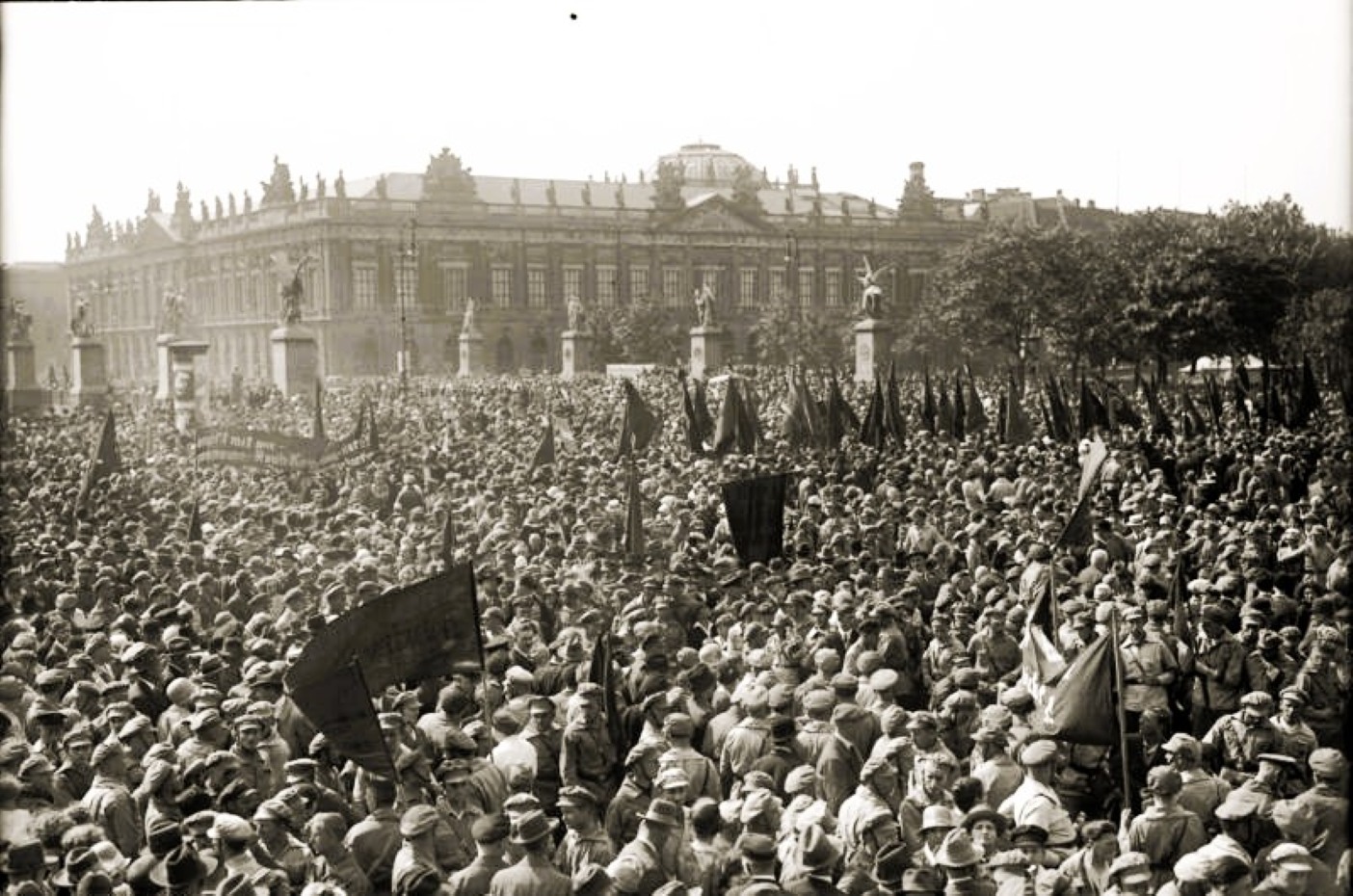
As we enter a new season of street mobilizations, a concrete look at the political and practical considerations of mass, militant demonstrations in the face of state repression with a critique of the actions of several large European Comintern sections.
‘Mass Demonstrations’ by B.V. from Communist International. Vol. 6 No. 1. December 1, 1928.
THE resolution on the report of the Executive Committee of the Communist International at the Sixth Congress of the Comintern obliged all Communist Parties to develop to the utmost the work of organising mass revolutionary demonstrations, giving particular attention to the carrying through of these demonstrations during great political campaigns of an international character.
This resolution applies chiefly to the European Communist Parties, which of recent times have not adequately succeeded in carrying out a single great international political campaign, and which in a number of cases have shown themselves unequal to the situation when attempting to call the proletarian masses on to the street in connection with internal questions of the political life of their country.
During the miners’ lock-out of 1926 the attempts of the E.C.C.I. to arouse an extensive movement of sympathy and support did not yield the desired results. Only the proletariat of the U.S.S.R. fulfilled its international task. As a result, while the basic causes of the defeat are the betrayal of the trade union leaders and the weakness of the British Communist Party, that defeat was also contributed to by the fact that the international proletariat did not come to their help with material and political assistance in time. The same has to be said of the campaign in aid of the Chinese revolution. In the U.S.S.R., that campaign was carried out with great success, it embraced the widest sections of the proletariat, and met with the great sympathy of the peasant masses. In the capitalist countries the campaign for assistance to the Chinese revolution was a poor one. But the failure of the “Red Day” in Czecho-Slovakia and of the demonstration at Ivry (France) particularly called for the attention of the Comintern.
THE FAILURE IN CZECHO-SLOVAKIA
In Czecho-Slovakia, in connection with the interdiction of the Spartakiade hv the Government, the C.P. decided to carry out simultaneous powerful demonstrations of protest throughout the country. The Government banned these demonstrations. The C.P. of Czecho-Slovakia called upon the Czech proletariat to demonstrate despite the Government ban. In order to prevent the demonstrations the Czech Government not only published prohibitive orders, but also mobilised large forces of police and military. As a result, in Prague not even the members of the party demonstrated, and the result of the demonstrations was not an energetic protest against the Government’s reactionary measures but the discrediting of the C.P. and a great moral and political consolidation of the reactionary forces. The Czecho-Slovakian and foreign reactionary and social-democratic press shrieked that the Czecho-Slovakian C.P. had demonstrated its practical impotence, that there was nothing more revolutionary than its phraseology in the Czecho-Slovakian C.P., and that, in a word, the Czecho-Slovakian Communist devil is not as frightful as it paints itself.
THE FRENCH FAILURE
There was a somewhat similar result to the Ivry demonstration. This demonstration was organised on the proposal of the Central Committee of the French Communist Party for the anniversary of the imperialist war, and was intended to demonstrate the unswerving will of the French proletariat not to allow a repetition of slaughter. Naturally the Government banned the demonstration. The central organ of the French C.P. “Humanité,” declared in the name of the Party that the demonstration must take place at all costs, despite all the measures taken by the Government. This declaration was repeated several times by the Party in the most categorical manner. Nonetheless, at the very last moment the Party announced that the demonstration would be replaced by three great meetings. In the end there were several small clashes with the police at Ivry, and more than a thousand persons were arrested in ones and twos. The demonstration was a failure, and once more the reactionary and social-democratic press were jubilant. The following excerpt from the leading organ of the French reformists, “Le Peuple,” is significant. On August 15th “Le Peuple” says: “We look through ‘Humanité.’ On Friday, 3rd August: ‘We shall demonstrate against war’; and in great capitals; ‘The C.P. and Young Communist League will not yield to the demands of the Government.’ Saturday 4th: ‘This evening in the Paris circus, tomorrow at Ivry!’ And in heavy type. ‘The demonstration will take place at all costs.’ Sunday 5th: ‘To Ivry at all costs,’…‘Workers, the demonstration of August 5th will play an extraordinarily important role. Not one of you must desert his militant post on this day!’ And right next to this thunderous sentence is the soothing phrase: ‘The Party and the Y.C.L. have decided that the demonstration which has to take place at Ivry to-day is to be organised in the form of three great meetings, which will be held in the hall of Merni, in the Conference Hall and in the public baths.’ Baths! A pleasant prospect! A pleasing picture! A soothing symbol! M. Vaillant-Couturier himself adds the soothing programme: ‘In connection with Ivry we are not raising the issue of revolution or revolt, it is a question of a demonstration of cold blood and revolutionary order…We wish to avoid our Party taking a further step towards illegality…We, a legal Party, desire only to gather under conditions of order.’ We shall see, we shall see,” the “Peuple’s” leading article continues, “On the one hand they talk of a militant post, on the other of a legal demonstration. Whom are they fooling, and who is doing the fooling? If we have understood M. Vaillant-Couturier aright, the Party wishes to remain a legal one. The Party entreats the bourgeois Government to let the cup of illegality pass from it… It is good that Vaillant-Couturier is a law-abiding person. He washes his hands of all the illegalities which might be committed under the Government ban by the lads paying membership contributions or in sympathy.”
POSSIBILITIES OF DEMONSTRATING
Failures of mass revolutionary action undertaken by the European C.P.’s recently raise the question of the extent to which those Parties will be equal to developing a series of mass actions of increasing pressure on the ruling classes in the struggle against war, in fulfilment of the decisions of the Comintern Sixth Congress. On their part the ruling class will undoubtedly exploit all the forces and resources for direct suppression, and will have the help of the social-democrat and trade union reformists to smash the class revolutionary demonstrations organised by the C.P.’s. That means that while it is already difficult to organise and carry through such demonstrations, in the future it will be still more difficult. Meantime the whole situation at the moment imperatively demands the strengthening of the mass revolutionary movements of the masses. Otherwise the whole struggle with the dangers of imperialist war will be mere idle talk, and in essence will lead to the previous empty social-democratic babblings anent the criminality of the bourgeoisie and so on.
At the moment when these lines are being written, information arrived of a fresh failure of the French Communist Party. This time the failure has been in the Youth Day organised by the French Young Communist League. The French Y.C.L. decided to organise a demonstration in Saint Denis. The Government flooded Saint Denis with military and police forces, and the demonstration was smashed. It is true that in certain of the suburbs of outlying Paris there were youth demonstrations, but they were not held everywhere, they were of a partial nature, and Paris proved to be quite free of the Communist infection. Obviously the lessons of Ivry have passed without practical results for the French C.P.
Can the French C.P. be regarded as an exception by comparison with the other European C.P.’s in their inability to organise mass revolutionary demonstrations? Obviously not. Can one accept the argument that the mobilisation of large forces of military and police was sufficient justification for abandoning the demonstrations and other mass revolutionary activities? Again obviously not. Consequently the European C.P.’s must make the maximum exertions in order to overcome their present weakness in regard to mass revolutionary activities, and that as swiftly and radically as possible.
PRACTICAL PROPOSALS
What practical proposals can be put forward? In the first place, the C.P.’s must cease to be afraid of action which may appear to break through the frame of bourgeois legality. The ruling classes are driving the C.P.’s underground. The C.P.’s must struggle for the retention of their legal position. On the contrary, that action will the quicker lead to positive results the more swiftly and strongly the C.P.’s oppose bourgeois reactionary measures.
For example, the Czecho-Slovakian C.P. has recently been unable to explain its political line and the tasks of the Party in the pages of its journals. The Governmental censor strikes out all that has even indirect reference to the discrediting of the Czech authorities. The Party newspapers are published with great white blank spaces, and the censor even strikes out the title of the article, evidently so that it should not be possible to guess even what the forbidden articles are about. It is obvious that if the Czech C.P. took the line of passive submission to the censor it would simply be necessary to stop the publication of the Communist press until the organisation of a Soviet Republic in Czecho-Slovakia, which in its turn will remit the present Czech censorship to a museum for antiquities. Nor could the Czecho-Slovakian C.P. count on much more from the “democratic” parliament of its country. The sole practical answer to the activities of the censor is that together with a general intensified struggle for a workers’ and peasants’ government the Czecho-Slovakian C.P. must obviously develop the most intensive work on the publication of uncensored literature, with the aid of which it will be possible to fill out the gaps in the legal press. And that would be a real struggle for the legality of the Communist press. A secret press would stultify the censorship of the Government, demonstrating their complete impotence and ignorance, and simultaneously demonstrating the helplessness of the Government in the face of the will of the revolutionary proletariat.
If this example be applied to the sphere of mass activities, to the sphere of revolutionary demonstrations, the question has to be raised in an analogical fashion. A bourgeois Czecho-Slovakian Government bans a demonstration, the C.P. must organise it without the permission of the Government, demonstrating the impotence of the Government to restrain the revolutionary demonstrations of the proletariat.
That this is possible is demonstrated by the fact of the mass revolutionary demonstrations organised, and still being organised, by the C.P.’s of certain countries—China, Poland and elsewhere. The question consists in knowing how to organise demonstrations, in the necessity of learning how to organise them. There is a large international experience to be drawn upon in this question.
PREPARATORY MEASURES
It is absolutely necessary that the preparation of the demonstration should be done from below, in the factories. Needless to say, the directing organs of the Party must carry on general agitation, must with the aid of the press, and through meetings, etc., call the workers to the support of the revolutionary proposals of the Party. But together with the general press and oral agitation there must necessarily be carried out corresponding preparatory work in the factories, and it is on this work in the factories that the attention and finest forces of the Party must be concentrated.
How is this work to be carried on? Quietly, and as far as possible imperceptibly. The work must be carried on with the aid of the factory newspapers, and in particular with the aid of the personal agitation of the members of the factory nuclei and the sympathisers working in the factories. The basic task of this work is the grouping of the maximum number of the workers in the factories under the slogans of the Party for a demonstrative movement, organising them in such a way that the demonstration takes place directly from the factory during the dinner hour or at the close of the working day. In order to prepare the working masses and the party organisations for joint mass activities, the Party must at first begin with the organisation of small demonstrations, adapting them to the conflicts in the enterprises (strikes, etc.). While preparing strikes and other forms of bringing the workers to defence of their immediate demands, the Parties must include among the measures for this struggle demonstrations of workers in the factories. The slogans must include not only a simple specification of the demands for which the workers are struggling. They must also include appeals to the workers of other enterprises to support those demands, appeals to the unemployed not to break the struggle by strike-breaking, appeals to all workers supporting the bourgeoisie, and appeals of a like kind. In order to give these appeals the greater force, as soon as a conflict develops with the employers in any given enterprise the Party must set itself the task of calling on the workers to resist the bourgeoisie, or proposing that they should immediately select delegates to send to other works and to the unemployed with requests for support; and also of establishing fraternal relations with the military. These very revolutionary demonstrations of which we have spoken above have also to be organised in such a manner as to make it possible for the workers of other enterprises, the unemployed, and so on to ally themselves. Consequently in arranging a demonstration it is extremely important to give a correct indication of the hour and the place, and also to give early notice to the workers who can ally themselves with the demonstration and prepare and organise the alliance of several detachments.
OBSTACLES TO BE MET
Needless to say, obstacles will be put in the way of such demonstrations also. But that will only testify to the necessity that together with the widest general agitation the concrete forms of such demonstrations have to be prepared as far as possible with a careful estimation of all possible obstacles and difficulties. It is especially important to make a correct estimate of the attitude of the masses, the extent to which the slogans put forward by the Party satisfy them and so on. In order to circumvent opposition it is also important that such demonstrations should be organised as lightning demonstrations, but frequently also with such alternations of time and space as to make interference difficult. Although the forces of the bourgeoisie have swift methods of transport at their disposal these methods do not work with the speed of thought, and fifteen to thirty minutes is adequate time in which to carry through a short demonstration before the gates of a factory and in the workers’ quarters close to the enterprise. When the demonstration takes on enormous dimensions it will not be so easy to oppose it.
METHODS OF ORGANISATION
In preparing a large general demonstration the Party must necessarily, firstly, carefully select their slogans. For instance, it is quite obvious that it is definitely impossible to arouse the great masses of workers with a slogan of struggle over the prohibition of the Spartakiade. Secondly, through its factory groups it must diligently check the extent to which the slogans put forward are really able to attract the masses. The general slogans must necessarily be supplemented by slogans particularly comprehensible to the most backward sections of the proletariat. Thirdly, as a rule the place and time of the demonstration must not be published. The place and time must be fixed at conferences of the organisers of the demonstration, and in doing so they must fix them so that (a) the workers of the largest enterprises can participate in the demonstration at the end of their work or during the dinner hour, and (b) in order to unite the various columns of the demonstration several variants of route should be planned. In addition, the following measures have to be given previous consideration: a special liaison service must incessantly keep the leaders of the demonstration informed of the movements of the various columns of demonstrators and: of the movements of opposition forces, so that timely alterations in the routes can be effected. (c) In order to ensure the demonstration the greatest possible success it is of extreme importance that there should be previous knowledge of the plans of opposing forces, their strength and so on. (d) In order to carry out all these measures it is necessary to have a good, strong leadership, basing itself on defence corps to maintain order, the members of which are selected by the factories and trade unions. Non-party workers, especially young workers, must be drawn into this work in the most extensive fashion.
Certain C.P.’s organise demonstrations at a time when the workers are at home indoors. This is unsound. It is more difficult to get the workers onto the street out of their homes. Besides, it is impossible to check the extent to which those are drawn into the movement whom it is of particular importance to attract —the workers of the large enterprises in the basic industries.
ANTI-WAR ACTION
The Sixth Congress of the Comintern decided that one of the methods of struggle with the dangers of imperialist war was the immediate beginning of preparations for carrying out a “Red Day” simultaneously in all countries in the form of simultaneous mass revolutionary demonstrations. The date and the concrete forms of this international “Red Day” will be indicated by the E.C.C.I. These preparations must begin with the organisation and carrying out of individual partial revolutionary demonstrations, and in doing this the C.P.’s must always (1) associate these attacks with the tasks of the struggle against the war danger; (2) endeavour to extend each partial demonstration to cover a number of enterprises, an entire town, district and so on; (3) concentrate attention on the organisation of revolutionary mass demonstrations of the workers of the largest enterprises in the most important spheres of industry (especially those which play a part in the preparation of imperialist wars).
By steeling and tempering separate divisions of the proletariat such partial demonstrations will conduce to the growth and strengthening of the C.P., and at a definite moment will create an adequate or organisational basis in order that against the whole capitalist world may be organised one international “Red Day” as the first powerful blow in the approaching struggles for the rule of the working class.
The ECCI published the magazine ‘Communist International’ edited by Zinoviev and Karl Radek from 1919 until 1926 irregularly in German, French, Russian, and English. Restarting in 1927 until 1934. Unlike, Inprecorr, CI contained long-form articles by the leading figures of the International as well as proceedings, statements, and notices of the Comintern. No complete run of Communist International is available in English. Both were largely published outside of Soviet territory, with Communist International printed in London, to facilitate distribution and both were major contributors to the Communist press in the U.S. Communist International and Inprecorr are an invaluable English-language source on the history of the Communist International and its sections.
PDF of full issue: https://www.marxists.org/history/international/comintern/ci/vol-5/v06-n01-dec-01-1928-CI-grn-riaz.pdf

