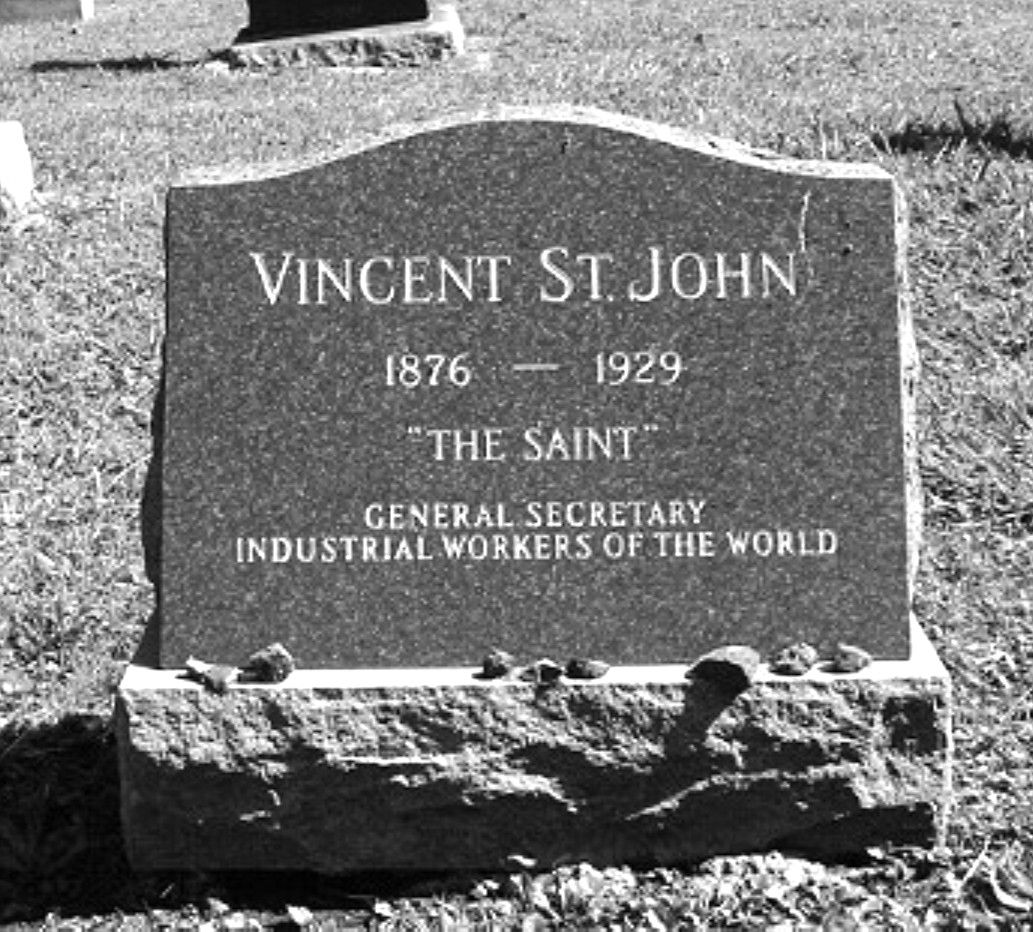
What was long a hot debate engaged in by partisans of the I.W.W. like St. John, not only with Socialist Party activists, but also revolutionary syndicalists like William Z. Foster, over the possibility of ‘boring from withing’ to break the American Federation of Labor from its craft union conservatism and win it to industrial unionism. In the end, the Congress of Industrial Unions was largely founded a generation later by insurgent movements from within the old unions getting expelled, linking up with the smaller, but fundamentally more active ‘new unions’ that emerged in the early 1930s, many of them Communist-initiated.
‘Why the A.F.L. Can Not Evolve into an Industrial Union’ by Vincent St. John from Solidarity. Vol. 1 No. 16. April 2, 1910.
Will the American Federation of Labor become a revolutionary industrial union? Can the American Federation of Labor become a revolutionary industrial union?
It is the purpose of this article to prove that the answer to both of the above questions is NO!!!
Let us consider the reasons advanced by those who argue that the A. F. of L. will evolve into an industrial union on a revolutionary base. They hold:
1. That economic pressure will force the members of the craft unions to see the weakness of the craft plan of organization. Economic pressure has been pointing out the weakness of craft unionism in every struggle of any size for the past 20 years; Homestead in 1892, McKeesport in 1902, Stock Yards in 1904, Garment Workers and Teamsters in 1905, Telegraphers and Machinists in Portland and San Francisco in 1907, Commercial Telegraphers in 1907, Coast Seamen in 1906 and the Lake Seamen in 1907. The fact remains that none of the above parts of the A. F. of L. have, as an organization, given any evidence of profiting by the lessons taught in the struggles mentioned. Nor has the A. F. of L. paid any attention to the lesson or made any attempt to remove the causes for these defeats. These are but a few of the cases in point that could be cited. So much for what the A. F. of L. or its constituent parts are learning from economic development.
2. “The material interest of the craft union members will force them to align their organization to overcome its weakness and make it capable of coping with present day conditions in industry.”
“Will material interest compel members of the A. F. of L. to pay dues into an organization that denies them the right to organize on proper lines to protect their interests? Or will that material interest compel organization on right lines regardless of any affiliation with the A. F. of L.”
In determining the policy of the A. F. of L. or any of its constituent bodies the interest of the membership cuts very little figure. For proof of this statement study the internal struggle that is going on at this time in the International Brotherhood of Electrical Workers and the official attitude and actions of the A. F. of L.
3. Within the A. F. of L. today there is more than one organization that is industrial in form and revolutionary in aim, to-wit: Bakery Workers, United Mine Workers, the Boot and Shoe Workers and the United Brewery Workers, etc.
The claim that there are already in the A. F. of L. organizations that are industrial in form and revolutionary in aim is but half true, to say the most we can for the organizations referred to. As a matter of fact, the craft lines are drawn more strictly now than they were twenty years ago, and all of the developments in the A. F. of L. is in that direction. Such industrial jurisdiction as any organization has that is a part of the A. F. of L. is in all cases in spite of the A. F. of L. and is gradually being lessened; the Brewery Workers are being compelled to give up engineers and teamsters, and the Bakery Workers do not include clerks and drivers of the bakeshops. The United Mine Workers in their last agreement with the coal operators of Illinois gave up jurisdiction over the electricians. These are a few cases in point.
The development in the A. F. of L has been from the mass organization of the K. of L. to the craft form following an ever-narrowing line of organization on the trade or craft plan. The only effect that the development in industry has had in the A. F. of L. is to precipitate jurisdictional fights, not for the purpose of obtaining industrial control in order to better fight the employer, but to get jurisdiction over certain work so as to limit the right of doing the work in question to the membership of one or the other of the organizations involved.
4. That development is along the line of industrial unionism is proven by the recently formed “Departments” in the A. F. of L.–Metal Trades, Building Trades and Railroad Department.”
The “Trades Departments” recently organized by the A. F. of L. is NOT an evolution to industrial organization. This is proven in the recent tin workers’ strike at New Castle, Pa. The A. F. of L. that is involved in the strike a part of the Metal Trades Department, yet we see in the plants that are struck the engineers, blacksmiths, and machinists, are at work, helping to operate the plants for the employers. The constituent parts of all these so-called departments have full craft autonomy, fight the employer in detail as before, and uphold the sacredness of the contract with the employers that forces one craft to scab upon another in the same industry. Any attempt on the part of these departments to violate the rule of craft autonomy will be met by the A. F. of L., compelling them to adhere to the principle. To one familiar with the tactics of the A. F. of L. the only reasons for the formation of these departments are, i.e., to create more officials and therefore strengthen the present machine in control, and to stave off the sentiment that is growing amongst the members for Revolutionary aur Organization.
5. “The revolutionary development within the A. F. of L. is proven by the passage of “Socialist Resolutions” by several constituent bodies of the A. F. of L.”
The passage of “Socialist” resolutions by constituent parts of the, A. F. of L. means nothing, even were they not so worded, as they always are, to make them acceptable to anti-Socialists as well as “Socialists.” The recognition of the class struggle on the part of the A. F. of L. or any of its constituent bodies is mostly Lip Service.
6. “Craft organization working in the same industries are entering into agreements with each other for mutual support in the struggles against the common employer.”
Working agreements are always local and are always set aside by the International officials whenever the “interest of the craft” is endangered, i.e., whenever the employer offers concessions to one craft involved, in order to get them back in the shop to help defeat the balance of the workers on strike. The strike of the coal miners in Colorado in 1904-1905, where the miners in the northern fields were forced back to work by the general officers of their own union. Forced back to work to dig the coal that the mine operators had to have in order to defeat the workers in the Southern fields and, in the end, the Northern fields also.
So much for the hopes of the “Revolutionists” and, what they base those hopes upon.
From the standpoint of the industrial unionist it can be said:
1. The fundamental basis of the A. F. of L. absolutely does away with any probability of the transformation being accomplished.
The basis of the A. F. or L. is craft autonomy. Harmony of interest and arbitration and conciliation with the employers.
Any part of the organization that attempts to change this basis will be immediately expelled from the organization Harmony of interest officials will always have the support of the employers in keeping control of the machinery of the organization, and they will work together to victimize and make tramps out of any members that try to revolutionize the A. F. of L. A jobless worker cannot help the cause of evolution in an organization in which his membership depends on his having a job at his craft. Any time a majority of a local union become real industrialists and attempt to expand on those lines they will be expelled from the International as disrupters, etc. If it did so happen that a majority of the locals in an International becomes industrialists the International would be forced out of the A. F. of L. as disrupters, etc.
This is demonstrated by the actions of the old officials in the I.B.E.W. and the support they are getting from the A. F. of L. official family. In the present case nothing is involved except the handling of funds of the organization. The difficulties would be multiplied were it a question of revolutionizing the organization. Having the funds and the machinery in their control, the officials can always compel the evolutionist to
1. Apply to the courts. (The bosses own the courts and the harmony of interest officials as well.)
2. Form a new organization.
There is no case in history where any society has ever been changed by the adherents of the old system. There is no case in the history of by-gone organization in the labor movement where existing organizations have changed to meet new conditions.
The above points cover the main ground upon which is based upon the idea that the A. F. of L. will evolve into a Revolutionary Industrial Union. If they will not stand the test of investigation we will be safe in concluding that the evolution of the A. F. of L. into a Revolutionary Industrial organization is not possible.
V. ST. JOHN.
The most widely read of I.W.W. newspapers, Solidarity was published by the Industrial Workers of the World from 1909 until 1917. First produced in New Castle, Pennsylvania, and born during the McKees Rocks strike, Solidarity later moved to Cleveland, Ohio until 1917 then spent its last months in Chicago. With a circulation of around 12,000 and a readership many times that, Solidarity was instrumental in defining the Wobbly world-view at the height of their influence in the working class. It was edited over its life by A.M. Stirton, H.A. Goff, Ben H. Williams, Ralph Chaplin who also provided much of the paper’s color, and others. Like nearly all the left press it fell victim to federal repression in 1917.
PDF of full issue: https://www.marxists.org/history/usa/pubs/solidarity-iww/1909-1910/v01n16-apr-02-1910-Solidarity.pdf

