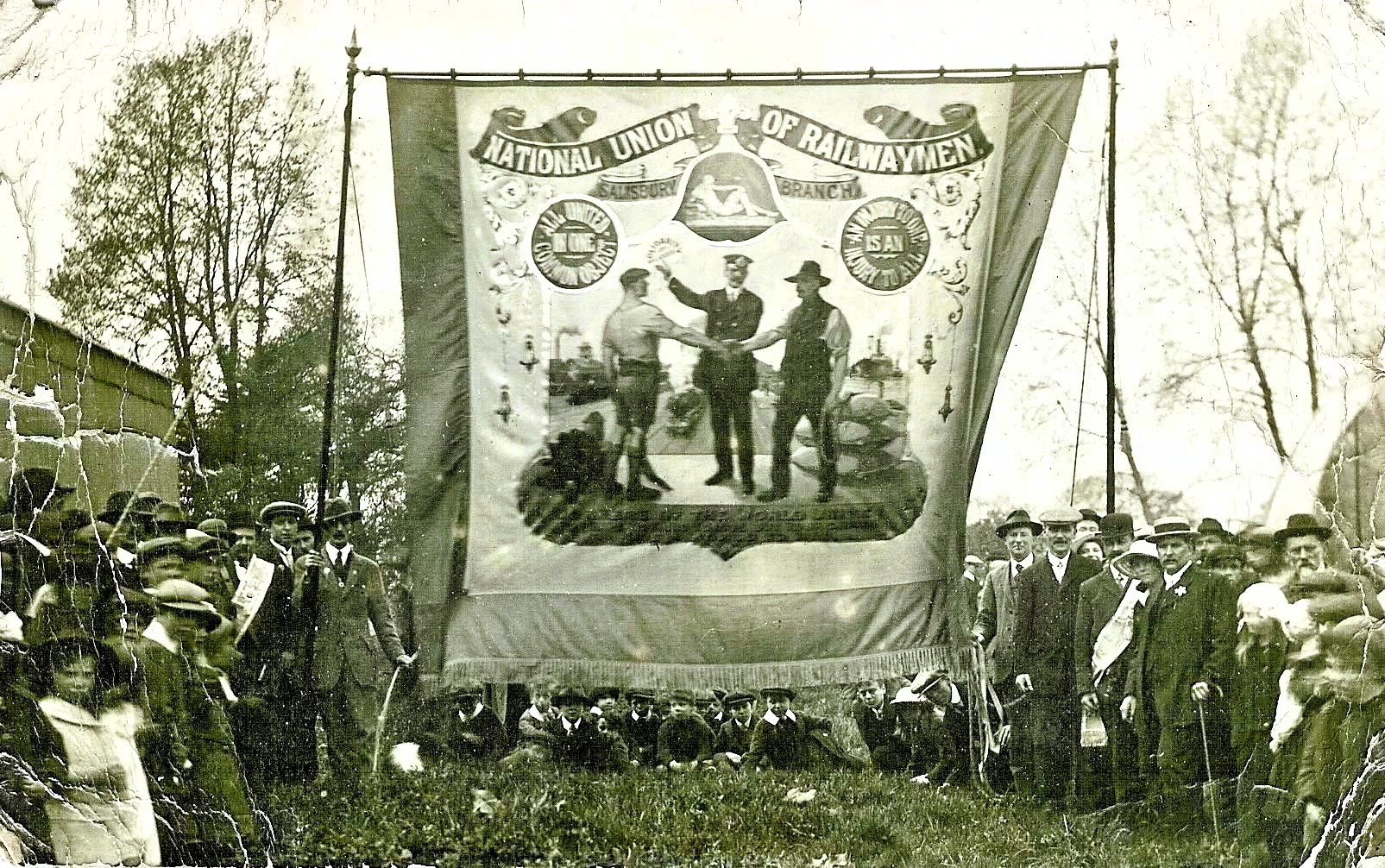
The origins of one of Britain’s leading unions. A constituent, with leaders like Bob Crow, in 1990’s merger that created today’s R.M.T. The National Union of Railwayman, founded in 1913, was an industrial union open to nearly every worker in rail, growing to over 400,000 members by the 1940s. A pioneering British labor union, it was originally the product of progressive trade unionists confronting a dramatically changed technological and productive process with a new type of organizing and organization. Below is a fine exposition of that new type, industrial union, from a leader of the Workers’ Education movement.
‘The Railway Workers Power’ by W.W. Craik from International Socialist Review. Vol. 16 No. 10. April, 1916.
Of the Central Labour College, England
The Need for Power
It should now be a self-evident truth that the workers of all branches of our industrial system require organization because they need power. They need power in order to resist and remove the yoke of capitalist oppression. The isolated individual is powerless. He can find power only as an associated individual. He can become strong only in and through powerful organizations.
The Need of Increasing Power
Capital grows in magnitude. As it becomes bigger it presses more heavily upon the workers. In the railway industry this process of growth is well marked. The many small railway companies that once existed have become absorbed in a few large concerns. The system of railway working has become so perfected, by means of machinery and science, that the railway workers can be exploited much more intensely. Wages have fallen, on the one hand, in relation to the prices of food, clothing and shelter, while, on the other hand, they have fallen in relation to the greater expenditure of energy through speeding up. It follows, therefore, that the workers employed in the railway industry require increasing power in order to effectively meet the increasing pressure.
The Road to Power
Organizations are not ends in themselves. They are means to the end of a fuller and freer life. The mere existence of a certain kind of organization does not justify its existence. The test of justification is: How far can that form of organization meet the needs of men? If this test is not fulfilled, then, no matter how hoary the structure may be, no matter what may have been its merits in the past, the hour of its dissolution has sounded.
The National Union of Railwaymen is a modern form of industrial organization. It marks a departure from the old and still existing type. It is an advance upon that type. It was not created out of the brain of any single individual, but has been begotten by the conditions of modern industrial development. The logic of the N.U.R. is the logic of the industrial process.
So long as men are blind to the realities of their experience in the present, just so long do they oppose the old to the new: things as they have been to things that begin to be. Sooner or later, they are compelled to awaken to the necessity which is no respecter of human prejudices or ancient institutions, and to adopt that which they previously despised and rejected. These delays are wasteful. Working-class education shortens the process of transition.
Craft Unionism Examined
At the present time the dispute has developed between the old order of organization and the new; between organization upon the basis of ‘craft and organization upon the basis of industry. Apart from the miners, who stand pledged to the new policy, the conflict has become acute between the craft unions and the National Union of Railwaymen. The N.U.R. is an organization based upon the principle of one union for all workers engaged in the railway industry. The craft unions, on the other hand, are based upon the principle of separate organizations according to the special detail operations in which the men are exclusively engaged, and regardless of the other detail operations with which they are directly connected. That is to say—whether masons work without or within the railway industry, they shall all be organized in the masons’ union; whether coachmakers work without or within the railway industry, they shall only be eligible for the coachmakers’ union; and so on.
An industry is distinguished by the fact that it turns out a particular product, which is sold by the owners of that industry, and from the sale of which the profits are derived. Each industry embraces a greater or lesser number of processes, all of which represent successive stages in the production of the finished commodity. The latter, then, is the final result of a whole series of connected operations. It is a common product, the product of the common labor of all workers within the industry.
The lines of craft run thru an industry, cross its boundaries and extend into other industries. On the other hand, the new principle of organization describes a circle, identical with that described by the single industry which turns out a single commodity.
For example: A bricklayer building the walls of a workman’s dwelling is engaged with carpenters and others in the Building Industry in turning out a saleable product—a house. A carpenter, engaged upon the Railway, works in co-operation with bricklayers, blacksmiths, platelayers, drivers, guards, and others in the Railway Industry, to produce the saleable finished article—Railway Transport.
So much for the productive side of the process. Organization upon the basis of industry harmonizes with the groupings of production. It organizes men as they work. It combines in organization those workers who directly combine in production. Organization upon the basis of craft, however, splits up into independent sections the directly cooperating producers. It takes to pieces that which, in production, is an organic whole.
How Workers Are Exploited
There is, however, another side of capitalism to be considered. Under this system, the producer is exploited. He must not only expend labour for the production of some service or article. He must, at the same time, allow the owners of capital to appropriate the greater part of the value which he produces, without return. He is an unpaid worker to that extent. This unpaid labour of railway workers, for example, is the source of the railway companies’ profits.
Now, just as the commodity is the result of the common labour of all sections of workmen in the same industry, so are the profits realized in money thru the sale of that commodity, extracted from the common unpaid labour of all the directly combining sections. It is not the capitalists of the building industry who directly exploit the masons, carpenters, plumbers, etc., working in the railway industry. It is not the capitalists in the industry producing coaches or other vehicles directly for sale, who exploit the workmen making coaches for railway companies. If the railway companies bought their coaches from the concerns in the coach-building industry, then certainly the workmen building these coaches should belong to the single union organizing that industry. Where, however, they are employed in the railway industry, they should belong to the N.U.R.
Organization upon the basis of industry not only organizes men as they work, but organizes them also as they are immediately exploited. It adapts itself to modern capitalism in two ways: to the collective production, and to the collective exploitation. It is the economic fact of exploitation that compels men to organize at all. Organization upon the basis of craft, however, dismembers the collectively exploited whole. It cuts in pieces the various members, tears sections of workmen out of their industrial context, and destroys the force of the totality. By dividing men in that way, it weakens their resisting power.
Craft Union Anarchy
The president of the N.U.R. cited the case, at the Trade Union Congress (1915} at Bristol, of a certain railway shop where 216 grades were employed by a single railway company, and for which 82 craft unions catered. That is craft unionism in all its anarchy! Is such a state of affairs worthy of preservation? Is it a condition of organization that is likely to secure the best for every one of those 216 grades?
The only people that are served by this senseless situation are the railway companies who realize that so long as we are divided, the more easy it is to defraud us. When the N.U.R. has sought to raise the status of shopmen upon the railways, in the course of negotiations, it is the representatives of railway capital who at once point out such cases as the one referred to above, and who give it as a reason why they cannot negotiate shopmen’s conditions with the N.U.R. It is for the shopmen to make such a reason impossible.
The craft union representatives, in opposing the policy of the N.U.R., have urged as a reason for that opposition the low rates paid to artisans upon the railway as compared to the rates prevailing for the same class of work outside the railway. That is true, but what does it prove? It proves that there has been something wrong with the craft unions that now claim these men. It is only the existence of the N.U.R., and the fact that the N.U.R. has begun to organize these men, that makes it possible even for these craft unions to bring forward the claim. If shopmen are wise, they will join the organization that can give them the greatest power, and, as a consequence, the greatest results.
Scientific Organization
It has been urged by certain craft union leaders that the N.U.R. policy will split the workers into small groups. What is that policy? The substitution of one single union in place of the 82 unions in the illustration given. Is that splitting into small groups, or is it not precisely the opposite?
Railway companies do not run their business on craft union lines. They each have one single composite control over the whole industry. They unite all their departments on the basis of industry. The organization of workmen which is to be systematic and successful is the one that embraces the workers of all departments under one single control.
The craft union representatives say “Let us federate!” But why, if craft unions are all powerful, should there be any need for federation? Either the craft union is powerful enough, in which case federation is not required, or federation is required because the craft union is not powerful enough. This plea of federation proves the weakness of craft unionism. As for federation, it is only a half-hearted attempt at unity, and gives no guarantee of united action, for the reason that it leaves the craft autonomy of each union undisturbed. Federation, time and again, has broken down because one or two craft unions backed out. It allows a minority to frustrate the aims of the majority. There is only one way to permanently unite, and that is—to act as one.
That way is the way of organisation by industry. Instead of fostering a state of things which allows one section to be pitted against another section in the same industry, either in the process of negotiations, or in a strike, it gives to each section the united support of every other section.
Get Together
We invite our fellow-railwaymen employed in the shops, and in other branches of the railway industry, to consider this question: Which is the most powerful union? The craft union catering for only one department in the railway industry, or is it the N.U.R. catering for every department, and capable of paralyzing every department of that industry? Which is the most effective in negotiating your claims? Is it by means of 82 different craft unions negotiating separately with a single railway company, or is it by the single union representing every grade of worker in the employ of that railway company? There can only be one reasonable answer: the answer, that all those who in common are subject to the oppression of railway capital, should, in common, resist that oppression.
The times are troubulous, and the future is full of momentous issues for the workers in general. In the battles that will be fought, the victory can alone be to the scientifically organized unions; to the organizations founded upon an industrial basis. Let not the fog of prejudice bedim our eyes, but let us now marshal together, and stand together as railway workers, ready to fight with modern equipment against a common enemy and in a common cause—One in production!—One in exploitation!!—One in organization!!!
The International Socialist Review (ISR) was published monthly in Chicago from 1900 until 1918 by Charles H. Kerr and critically loyal to the Socialist Party of America. It is one of the essential publications in U.S. left history. During the editorship of A.M. Simons it was largely theoretical and moderate. In 1908, Charles H. Kerr took over as editor with strong influence from Mary E Marcy. The magazine became the foremost proponent of the SP’s left wing growing to tens of thousands of subscribers. It remained revolutionary in outlook and anti-militarist during World War One. It liberally used photographs and images, with news, theory, arts and organizing in its pages. It articles, reports and essays are an invaluable record of the U.S. class struggle and the development of Marxism in the decades before the Soviet experience. It was closed down in government repression in 1918.
PDF of full issue: https://www.marxists.org/history/usa/pubs/isr/v16n10-apr-1916-ISR-riaz-ocr.pdf

