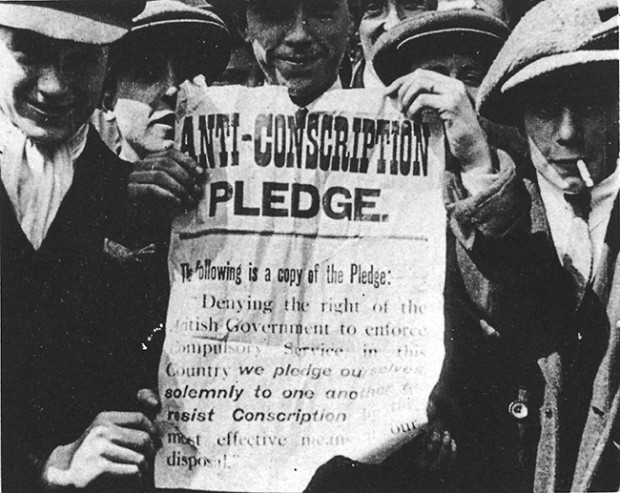
During all of World War One the British government dare not invoke conscription in Ireland, though it was a constituent part of the United Kingdom, until April, 1918. Two years after the Easter Rising–it too in large part meant to prevent the conscription of Irish people into the Empire’s army–and sentiment had turned markedly toward Republicans, and independence. The 1918 attempt was met with mass resistance and helped radicalize the national mood. The Irish labor movement was also in motion, and would respond to the new draft law with a general strike on April 23, 1918–the week following this article–shutting down much of the country. Irish-born Jack Carney, who worked closely with Jim Larkin in Ireland and would follow him to the U.S., was editor of Duluth, Minnesota’s Truth newspaper when he authored this knowing article. Ireland would never see the draft. Soon, though, and the Ireland’s own War of Independence would begin. Spurred on by Lloyd George’s attempt in April, 1918.
‘Can Britain Conscript the Irish?’ by Jack Carney from Truth (Duluth). Vol. 2 No. 16. April 19, 1918.
Lloyd George, prime minister of) England, has proven to the world, that he is not fitted to be the guider of the destinies of a nation. Any man who would dare to suggest that the Irish be conscripted, is either a poor ignorant fool or a vain politician. The reply to conscription in Ireland will be open rebellion and civil war.
The Lord Mayor of Dublin has called together a meeting of the Nationalist party, trade unions and the Sinn Fein leaders to discuss ways and means to oppose conscription.
Two years ago the streets of Dublin were wet with the blood of the Irish. They had gone out to sacrifice their lives, rather than allow their sons and brothers to be conscripted. At that time the people were not united on the question of armed resistance, but there is no doubt today, that they are united and will be more prepared to shed their blood than they were two years ago.
At the present moment there are two hundred thousand soldiers in Ireland. It is another example of the stupidity of the British Government. They will not trust the Irish, but they want the Irish to do their fighting. Now if it requires two hundred thousand soldiers to look after the Irish, when they are at peace, how many soldiers will they require to look after Irish when the fight to force conscription commences?
But why do the Irish object to fighting for England, we are asked. The answer to that question will be found in the conditions under which the Irish people live. London is considered to have more poverty than any other city of its size. But in London the number of people who live in slum tenements is only 59 per thousand, whilst in Dublin it is 229 per thousand. We can show you many families in Dublin who eat and sleep in the same room. As many as ten people, eating, living and sleeping in the same room. As a result of the strike that took place in Dublin in 1913, due to the work of Jim Larkin, a searchlight was thrown upon the living conditions of the workers of Dublin, and as a result a commission sat, and in their report they stated that—
The earnings of the heads of the families occupying first class tenements was:
1385 earning not more than $3.75 per week.
2265 earning not more than $5.00 per week.
Second class tenements:
3918 earning not more than $3.75 per week.
5856 earning not more than $5.00 per week.
Try and imagine if you can, when you know the average family is six persons, how the workers of Dublin live on such wages. Let us analyse this princely wage–Rent, $1.00 per week; three meals per day, for six persons for seven days per week is 126 meals, which means 31⁄2 cents per meal. No amusement, no clothes, no shoes, no doctor and no holidays. Such is the life of an Irish worker on five dollars per week. CAN YOU WONDER THAT THEY OPPOSE CONSCRIPTION?
In Jacobs’ Biscuit factory girls are employed for 50 hours per week, and all they receive for such work is SIXTY CENTS PER WEK. Can you still wonder why the Irish oppose conscription?
But there are other reasons why Ireland is opposed to conscription, reasons as justifiable as the above, and they are contained in a perusal of Irish history for the last seven hundred years. If you want to know what the Irish have suffered, just take a trip through Ireland. Count if you can the bones that have bleached the green hills of Erin; measure the blood that has been shed, and made Ireland, not the green Isle, but the scarlet Isle, scarlet with the blood of the Irish race. Listen to the woes of the widows and orphans of the many Irishmen who were shot in cold blood, because they refused to bow the knee to a foreign tyrant. When you have focalized these enormities, the blood that has been shed, the havoc that has been wrought, the homes that have been ruined, the cities that have been destroyed, the outrages upon the young women and girls of Ireland, the hearts that have been broken, you will then have some idea of what Ireland has gone through. You will then understand why the IRISH WILL NOT BE CONSCRIPTED. The wrongs of Belgium are nothing compared to the wrongs of Ireland. Belgium has suffered for three years, Ireland for seven hundred. So we say, without boasting in any way, that the IRISH WILL DIE IN THE STREETS OF THE TOWNS AND CITIES OF IRELAND BEFORE THEY WILL EVER THINK OF DEPARTING TO SHED THEIR BLOOD IN A FOREIGN COUNTRY.
The Irish-American politician in this country is no standard to go by, to judge the feeling and the temper of the Irish race. He is like a weather-vane, the way the wind blows, the way he goes. Coming to this country a lover of freedom, he eventually becomes a political autocrat, neither good for man nor beast. The curse of the cause of Irish freedom has been the Irish-American politician, who has used the misfortunes of his countrymen and women to further his own dirty ends. So we warn our American friends not to be fooled by these politicians here, the Irish in Ireland will fight and decide their own destiny. They care neither for politics or the politicians, they are resolved in one thing, and that one thing is, SO LONG AS IRELAND IS UNDER THE CONTROL OF ENGLAND, SO LONG WILL ENGLAND APPEAL TO IRELAND IN VAIN.
If you want to understand the sincerity and the fighting qualities of the Irish workers, read the history of the Dublin strike. Jim Larkin is a typical Irish fighter for freedom. Anyone who knows Larkin, knows perfectly well enough, that no one can conscript him. Larkin went into the city of Dublin and by his vigorous personality and his marvellous powers as an organizer, he aroused the workers of that city to such a pitch of class consciousness, that no other organizer ever did before or has done since. The work of Larkin will never die, its effect will be permanent, and so the workers of Ireland will show to the whole world, that once they agree on a certain idea, neither man nor devil will stop them from carrying it out.
We are of that race, we have lived with them, worked with them and we know the temper of the people we write about. Lloyd George in insisting on conscription of Ireland is digging his political grave. During the Dublin strike, when all England stood amazed at the marvellous personality of Larkin, Lloyd George was struck with the fortitude of the Dublin workers. For forty-two weeks they stood out against the combined associations of Irish and English employers. Knowing the Irish worker, as Lloyd George learned to know them at that time, we are surprised that he should be so foolish as to introduce conscription. Lloyd George is like a gambler who risks his all, in one last throw of the dice. Carried into political power on a wave of emotion, Lloyd George has failed in the hour that practical results are required, when emotion fails. Having in his control the political power of the British Empire, flushed with childish excitement, unable to do that, which in his conceit he thought was simple, he today attempts to justify himself. Conscription of the Irish means the political death of Lloyd George. With his political demise, the radical element in England will again control, and with their taking over the administration, PEACE WILL BE NEARER.
Lloyd George is a typical example of the reform politician. He promised the workers all the reforms that one could think of, and today he is the biggest tyrant in England. The workers would be wise to learn a lesson from the career of Lloyd George. They should learn the one great lesson, never trust the politician, but organize on the job and in your own power place your trust, then no one can deceive you. The Irish men and women were taught that lesson by Jim Larkin, they are slow to learn, but once they begin to act, then GOOD NIGHT.
Truth emerged from the The Duluth Labor Leader, a weekly English language publication of the Scandinavian local of the Socialist Party in Duluth, Minnesota and began on May Day, 1917 as a Left Wing alternative to the Duluth Labor World. The paper was aligned to both the SP and the I.W.W. leading to the paper being closed down in the first big anti-I.W.W. raids in September, 1917. The paper was reborn as Truth, with the Duluth Scandinavian Socialists joining the Communist Labor Party of America in 1919. Shortly after the editor, Jack Carney, was arrested and convicted of espionage in 1920. Truth continued to publish with a new editor J.O. Bentall until 1923 as an unofficial paper of the C.P.
PDF of full issue: https://www.marxists.org/history/usa/pubs/truth/1918/v02n16-apr-19-1918-truth.pdf

