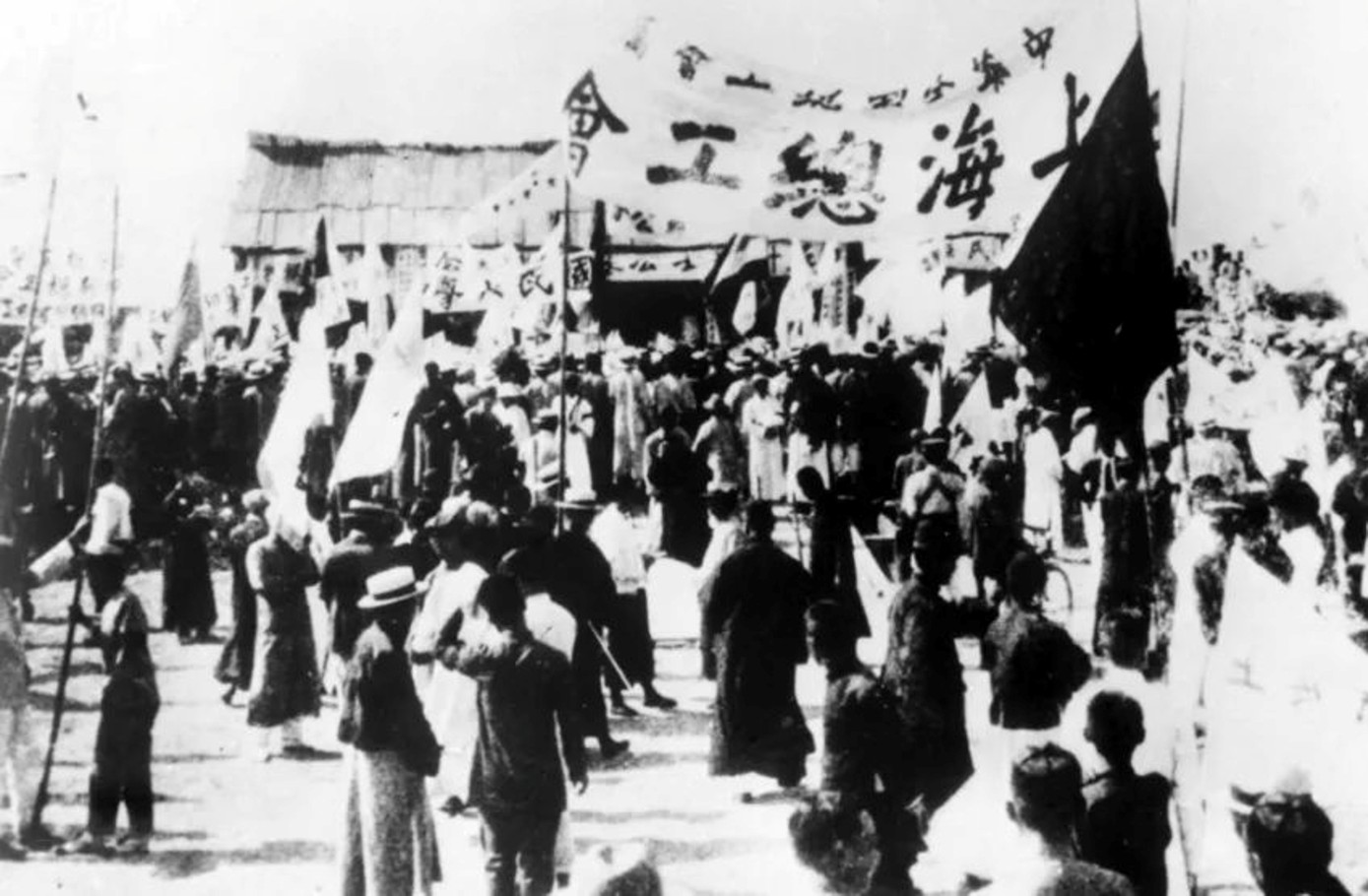
A contemporary Comintern review and analysis of China’s May 30th Movement, earth-shaking events which saw a wave of strikes in reaction to the massacre of student demonstrators against imperialist occupation in Shanghai on May 30, 1925. In the process that followed China’s relatively small Communist Party would grow into a significant force, especially among workers and students in the south’s coastal industrial and trading cities. I am unsure who from the Comintern ‘F.R.’ would be.
‘China Awakened’ by F.R. from Communist International. Vol. 2 No. 13. August, 1925.
HE tide of events in China has overflowed the precincts of an ordinary political strike; but the flow of national revolutionary elements is not yet sufficiently great to permit of it being described as a revolution. The first spark in the powder magazine, that in the final analysis caused the present explosion, was the killing of two Chinese workers by Japanese factory superintendents in Shanghai. The Shanghai newspaper, Ming-Ho-Ji-Bao, describes what happened on that occasion in the following manner:
“On the 15th of May, the workers employed in Mill No. 7, belonging to the Kagai Wata Kaisha, a Japanese textile company in Shanghai, turned up for work as usual, but found the gates of the factory closed. The Japanese super- intendents, without giving any reason, declared that work at the factory had stopped. Meanwhile crowds of workers began to gather around the factory gates. On learning that work at the factory had stopped, the workers, in view of the nearness of pay day, demanded payment of the wages due to them. Instead of meeting the just demands of the workers, the Japanese superintendents began to disperse the crowd, employing iron rods with which they beat the workers. When the workers tore these iron rods out of the hands of the superintendents the latter opened fire upon the crowd from revolvers as a result of which two workers were killed and many were wounded. On hearing the firing the workers employed in the other sheds situated in the same courtyard, came out and joined their fellow workers. The officials of the mills called out a detachment of police, which together with the superintendents opened fire upon the workers. As a result of the shooting, a score or so of workers were wounded. Picking up their killed and wounded the workers in a large crowd went to the offices of their trade unions where they were advised to take their killed and wounded comrades to the police. The crowd went from place to place appealing now to the mixed court, now to the police station. Finally, the police took charge of the bodies of the killed workers and sent the wounded to the hospital.”
On the same day, at a general meeting of textile workers it was resolved to declare a strike and to put forward the following demands:
1. The dismissal and prosecution of the two Japanese superintendents responsible for the shooting.
2. Compensation to the wounded workers and to the families of the workers who were killed.
3. The Japanese factory superintendents be prohibited from carrying arms.
4. The re-instatement of all workers previously dismissed.
5. Recognition of the Labour Union.
6. Payment for the period of the strike.
7. The restoration of the payment of supplementary pay abolished by the mill management after the February strike.
8. Wages to be paid in full value dollars, and not in small silver.
Next day, the 16th of May, a joint meeting of public organisations in Shanghai including trade unions, student leagues, the Shop Assistants’ Union, and the Street Traders’ Union, was held, at which a committee to combat the Japanese assassins was formed and a telegram was despatched to Peking demanding that a protest be sent to the Japanese Government against the shooting down of workers in Shanghai. Another telegram was sent to the Chinese Trade Union Congress proceeding at the time in Canton, asking for aid.
The character of the demands enumerated above clearly shows that in its first stages the movement did not extend beyond the limits of an economic struggle. On the r5th of May, the Shanghai workers did not put forward any political slogans. Even the murder of two Chinese workers by the hirelings of Japanese capital, did not induce them to take up the fight against imperialism; the Shanghai workers considered that this bloody conflict could be settled by the Japanese employers agreeing to some improvement in the conditions of the workers.
Generally speaking, the Chinese workers are in the position of slaves. This is not denied even by partial English authorities. For example, a “Blue Book” was published in England recently containing official documents concerning the position of the working class in China. The interest revealed by the British Government in the labour question in China, originates from the time of the MacDonald Ministry which, in April, 1924, ordered the British Ambassador in Peking, Ronald Macleay, to collect from the consular offcials material concerning labour legislation and the conditions of labour in China. The picture of the conditions prevailing as painted in the “Blue Book” is indeed a depressing one. There is practically no civil code, no protection of labour, no system of factory inspection in China. The Chinese worker is a creature without rights, totally unprotected from unlimited exploitation, and completely dependent upon and at the mercy of his employer. The working day is not less than 14 to 15 hours. The sanitary conditions of the factory is beneath all criticism. The British consul, Cheffo, J.W. Nipps; in his report. says:
“The sanitary conditions in silk factories are extremely bad. In order to protect the silk, the atmosphere must be kept warm and moist. Windows and doors are, therefore, continually closed, and the air is constantly loaded with odorous dust and germs. The workers almost universally wear no clothing above the waist. They can readily be recognised in any crowd by their sallow complexion. All workers must live in the factories. Those completing their work before night are free to go where they please, but they must return by dark. This means that only a few men get out of the factories except on special occasions. When they finish their work at night, they pull out their roll of bedding and sleep on the floors, on stray boards laid across benches, or on the ground in the courtyard. They rise at the break of day, roll up their blankets, and stack them in some corner until night. Thus they work, eat, and sleep in the same quarters.”
“However industrious he may be he has no assurance of keeping the earnings of his toil or even of preserving his personal safety.”—writes Mr. Clenall, Consul of Foochow, in his report.
Frequently, compulsory labour is employed. pa or example, Mr. Archer, the British Consul at Chunking, in his report, writes:
“Almost every day, even in the Treaty Port of Chunking, gangs of men may be seen roped together with cords around their wrists, being carried off by soldiers to act as transport coolies, and no soldier in Szeschuan ever carries his own baggage on a march, and sometimes not even his rifle. These commandeered baggage coolies receive no pay but sometimes are given a kind of certificate for labour done which entitles them to preferential treatment when the next commandeering takes place.”
From other sources we know that the wages of the Chinese workers are extremely low. For example, the average wage of a worker in Shanghai ranges from 24 to 28 shillings a month, and such categories of labour as porters, stevedores, and rickshaw coolies earn not more than 12 to 14 shillings a month.
Recent returns show that the number of children employed in industry in Shanghai is 173,272, of whom 150,662 are below 12 years of age (44,741 boys, and 105,92 girls) Thus, the majority of child workers (about 85 per cent.) comprise children of below 12 years of age, and of these 75 per cent. are girls. The wages of children usually do not exceed to shillings a month. Apprenticeship usually extends to four or five years, during which period the apprentices receive extremely low pay or no pay at all. In most of the factories work is conducted in two 12 hour shifts, sometimes in one shift of 14 or 15 hours with a brief interval for dinner. The factory children are treated in a barbarous manner. Beating is an ordinary phenomenon. Many children are ruthlessly exploited by agents who trade in these children like slave traders, and who take from the children half the wages they earn.
“A Shanghai factory, while the night shift is at work, presents a horrible spectacle,” writes the Shanghai Guide Weekly, in an article entitled, “The Little Slaves of Capitalism in China,” “In close, semi-dark premises filled with dust and vapour, half naked figures of men, women and children can be barely discerned standing at their work. Frequently the children, unable to bear the strain of continuous toil, fall as they stand, and sleep the sleep of exhaustion on the dirty floor, or on a heap of raw cotton. They are brought back to consciousness by a kick from the brutal superintendent. Right next to the rattling machinery, in the midst of the filth of the factory, are rows of baskets containing infants which the mothers feed during intervals.”
Injury from machinery and poisonous gases, particularly in match factories, under such conditions, assumes a mass character.
And yet, in “civilized” England are to be found learned publicists likes the Times Peking correspondent, who wrote literarily the following:
“It has caused some surprise that Mr. Chamberlain dwelt so much on labour conditions, presumably meaning labour in foreign owned mills. No such questions exist here.
“…The question of child labour has arisen at Shanghai and all foreign mills are prepared to adopt restrictive regulations whether the Chinese do likewise or not. But the truth is that child labour is universal in China. As soon as they are able to walk, children are expected to share all the tasks with their elders. The hours are long, but the work is light, and any sweeping changes will merely complicate domestic arrangements and cause overwhelming hardship to parents. In the small Chinese factories throughout the country, conditions for children are usually highly detrimental to child life, but there is no demand for legislation on the subject.” (Times, June 22nd, 1925, p. 14, under heading “The Situation in China.”)
The Times ably defends the interests of the big British capitalists. In spite of its halting excuses, it actually stands for the unlimited exploitation of child labour.
The movement of the Shanghai workers which arose on an economic basis would not have reached its present enormous dimensions if the subsequent events in Tsingtao had not served as an additional cause for this.
In Tsingtao, where the factories are concentrated almost exclusively in the hands of the Japanese, a strike affecting ten thousand workers had been going on since the middle of April. The demands put forward by the strikers were as follows:
1. Abolition of corporal punishment, 2. Increase of wages, 3. One day’s rest in seven, 4. An eight hour day for children and young persons.
It will be seen, therefore, that the textile workers put forward demands of a most moderate character. This platform of the economic struggle in itself reveals the low standard of existence of the Chinese workers. These demands are considerably lower in scale than the demands put forward by the Russian workers 20 years ago, in the period of our first revolution.
On the 9th of May, the Tsingtao capitalists were compelled to make certain concessions, but after the formal agreement had been reached it became clear that the Japanese employers were sabotaging the fulfilment of the agreement. This breach of agreement must be regarded as part of the policy of the Japanese Government, which gave its agents and consuls instructions to take measures against the strikers and to establish contact with other states in the event of the strike spreading to the factories of other nationals. The failure on the part of the capitalists to carry out the agreement roused considerable indignation among the textile workers of Tsingtao. The tense atmosphere reached white heat after the 25th of May, when the managers of the three factories most affected—the Dai Nippon, the Taikana and the Nishin—introduced 300 police officers into their factories. The workers responded to this by again coming out on strike. Upon this the Japanese imperialists declared a lockout of 7,000 workers and called two destroyers and one cruiser from Port Arthur. The workers in two factories were prepared to capitulate to the employers, but the workers of the third factory did not follow the example of their fellow workers and categorically refused to cease the fight. In order to compel these workers to go back to work the Japanese police resorted to arms, as a result of which two Chinese workers were killed and. 30 injured, and 30 workers arrested. The news of the savage attack of the Japanese exploiters upon the peaceful and unarmed strikers in this town of two million population, already incensed by the events of the 15th of May, roused them to give expression to their class solidarity by organising, in conjunction with the students of 23 educational institutions, a demonstration of protest against these fresh Japanese massacres. Hardly had the demonstration reached Nanking Street in the centre of the town, when they were met by a detachment of British police, who fired a hail of bullets into the crowd. 15 persons were killed on the spot and 30 were severely wounded. This senseless shooting down of workers and representatives of labour students roused a wave of general indignation throughout China. As has been correctly stated in the Manifesto issued by the Executive Committee of the Communist International, the political significance of these shootings is equal to that of the shootings which took place on the 9th of January, 1905, in Russia. The subsequent shootings in Hankow and Canton added oil to the flames. The cynicism of the foreign plunderers was suffciently revealed in the statement made at the mixed court by the British chief of police in Shanghai, Everson. He said: “I was instructed to employ arms as a last resort, and when I did I was to shoot to kill.”
The fact that the Chinese workers, with their own eyes, saw the true attitude of the imperialists towards the masses of the workers in their country helped to a considerable degree to awaken their revolutionary consciousness. By their volleys the British and Japanese imperialists roused and set into motion the vast masses of the people in China much more effectively than could be done by the most eloquent agitators of the Comintern. As a result, the movement which commenced as a simple economic strike, flowed into the broad arena of political struggle and came face to face with the cruel oppressors of the Chinese people—international imperialism. Already, on the 31st of May, at a large mass meeting held near the premises of the Shanghai Chamber of Commerce, attended by large numbers of workers and students, the following political demands were drawn up, which served as the slogan of the movement in the first stage of its development:
1. The annulment of the unequal treaties.
2. The return to China of all foreign concessions.
3. The dismissal of all foreign police and their substitution by Chinese police.
4. The transference of the municipality of Shanghai to China.
5. Release of those arrested.
Thus, on the 31st of May, the Chinese movement very definitely assumed the character of a political struggle striving towards the national liberation of China from the yoke of imperialist oppression. Recent events give us a clear reply to the question as to who will be the guiding force of the Chinese national liberation movement. In the light of recent events it becomes clear that the hegemony in the unfolding movement is being assumed more and more by the working class. The Chinese proletariat is conducting the fight not isolated from other sections of the population, but on the contrary, in conjunction with them and relying upon them. The feature which distinguishes the Chinese liberation movement from the revolutionary movement in Russia: and in other European countries is that the struggle is directed not against the home government, but against international imperialism. Consequently, in the fight for the overthrow of foreign oppression are united not only the workers: and peasants, not only labour intelligentsia, but also various categories of the petty and middle bourgeoisie. Already: there have been drawn into the movement universities, Chambers of Commerce, and Chinese banks. During the great French Revolution, Abbot Siess solemnly declared: “The Third Estate is the whole nation.” It may be said that the national liberation movement in China now practically embraces the whole nation, with the exception of a clique of militarists, compradores, and rich merchants closely bound! by economic ties with foreign capital. Even the Peking Government of Tuan Chi Jui, which is under the direct influence of the imperialist diplomats, is demanding the annulment of the unequal treaties. The unequal treaties are the chains by means of which the foreign capitalists keep the toilers of China bound in slavery.
The sweep of the movement at the present time is so: great that even the Chinese Government does not dare go against it. In order not to lose the last remnants of its prestige, it is compelled to swim with the tide. The government of Tuan Chi Jui is performing this anti-imperialistic gesture with the same inimitable grace with which the Provisional Duma Committee fulfilled its unaccustomed role in the beginning of the February revolution in Russia. At that time Rodzianko, the convinced monarchist, landlord, aristocrat to the marrow of his bones, chairman of the Fourth Duma, was compelled by the development of events, in spite of the fact that it went entirely against his grain, to greet the revolutionary troops which had overthrown Russia Tsarism. Another not less convinced monarchist, Schilgin, submitted to his “August Majesty,” the declaration of abdication for signature. The Chinese Government is acting in the same role at the present time and the more powerfully the movement in China will develop the less significant will be the role which the government of Tuan Chi Jui will play in the political fate of the country.
What is taking place at the present time in China finds expression in the movement combining the forms of boycott and strike. By what methods is the boycott conducted? A complete reply is given to this question in a Manifesto issued in Shanghai. This manifesto contains a list of eight measures to be adopted in the fight against British imperialism. These are:
1. Do not serve in English homes, shops and factories.
2. Do not employ the bank notes of British banks; do not put your money into and do not transfer money through British banks.
3. Do not buy British goods. Do not transport Chinese goods in British ships, do not insure in British companies.
4. Do not work on British steamers as engineers, seamen, etc.
5. Do not employ British steamers, automobiles, tramways.
6. Do not attend schools founded by Englishmen.
7. Do not employ British lawyers, doctors, engineers, cashiers, etc.
8. Do not sell Chinese goods to Englishmen.
Note–Behave very carefully in the English settlement. Do not assault or abuse Englishmen in the Settlement at the present time.
The boycott expresses the indignation of the Chinese people against the foreign oppressors, at the same time it palpably hits the pockets of the foreign capitalists. The imperialists suffer greatest damage from the goods and financial boycott. Chinese depositors who have their money on current account in foreign banks are now demanding their money. History is repeating itself. In China at the present time the same scenes are being witnessed as were witnessed In Russia in 1905, when the Council of Workers’ Deputies, in order to strike at the Tsarist autocracy through its treasury, called upon depositors to demand the return of their money deposited in banks and savings banks. In the same way as the Russian depositors in 1905 demanded payment in coin, so to-day, the Chinese depositors express their boycotting mood by refusing to accept paper dollars, pounds and yen, and are demanding coin and full weight silver. But there is extremely little silver in the banks and already there is not enough to meet the demands. Judging from reports in the British newspapers, certain foreign banks in China have already expended all their silver. This means that these banks are on the brink of ruin.
The material damage suffered by imperialists as a consequence of the strike movement is incalculable. The whole of the port and commercial and industrial life of Shanghai has come to a standstill. During the month of June the number of enterprises affected by the strike in this important port was 115, of which 89 were Japanese (63,000 workers), 26 British (36,000 workers), 35 belonging to other nations (27,000 workers), 8 municipal (4,000 workers), and 11 Chinese (26,000 workers). Furthermore 42 steamers were lying idle in the port. In addition to the factory workers there were also on strike numerous artisans, masons, painters, municipal workers, book-binders, etc., employed in foreign enterprises. Even the unorganised and despised coolies and rickshaw boys were drawn into this gigantic fight. In Shanghai alone 250,000 workers are affected.
In Hong Kong, this British fortified citadel in the Pacific Ocean, all commercial life, practically, has come to a standstill. The seamen’s strike has paralysed the maritime trade of the Pacific Ocean. The strike has affected tramway workers and hotel employees. British officers and high officials are acting as strike breakers and are fulfilling the duties of butchers and bakers. Refined aristocratic ladies, who all their lives have never been compelled to do a stroke of physical work, are acting as cooks and scullery maids. Two hundred and thirty four Russian White Guards were called from Shanghai to make up crews for the British and American ships standing idly in Hong Kong. Even boy scouts of bourgeois families were recruited to act as telegram and messenger boys. In the same way as the Russian aristocracy, during the strikes in Russia in 1905, went to the Post Office to take the place of the striking post and telegraph workers, so the British aristocrats, by their blacklegging, are vainly striving to break the Chinese strike. In Hong Kong the British feel as if they are in a besieged fortress, for the slaves, upon the labour of whom all their wealth and their material prosperity depends, have revolted.
The strike movement is developing without restraint. At first the strike affected only Tsingtao and Shanghai, but now it has spread to other industrial centres. There is hardly an industrial city in China in which a strike is not proceeding in one form or another. In this national strike, in addition to the proletariat, students, merchants, and office employees in various enterprises, are taking part, and the petty and middle bourgeois elements recognise the leadership of the working class. This fact is sufficiently proved by the following:
After a series of discussions, the Shanghai revolutionary organisations, on 26th of June, gave permission to the Chinese merchants to open their stores and banks if they held to the following conditions:
1. The cessation of the strike of the merchants in no way affects the strike of the workers. The Chamber of Commerce undertakes to render material aid to the workers on strike.
2.The merchants must hang up outside their shops white flags of mourning bearing anti-imperialist inscriptions.
3. They must give a pledge to boycott British and Japanese warehouses.
The leadership of the strike movement is in the reliable hands of the proletarian organisations, and although the merchants have dropped out of the strike since the 26th of June, their release from the fulfilment of their civic duty was arranged in an organised manner with the knowledge and con- sent of the workers, on strictly definite terms. The Shanghai Chamber of Commerce has already guaranteed aid to the strikers to the amount of 800,000 dollars per month. Thus, the petty and middle bourgeoisie, marching side by side with the proletariat, submits to the orders of the latter, and recognises its hegemony in the great struggle of liberation.
In the process of the growth of the strike movement arose the Trade Union Council in Shanghai. This Council practically has undertaken the duty of a strike committee, but in addition it has assumed functions, which in Russian conditions, were performed by the Council of Workers’ Deputies. At one of the delegate meetings of the Shanghai Trade Union Council the following decisions were made:
1. To appoint representatives of the labour unions to control the activities of the Chinese textile mills, which will be reopened as a result of the agreement arrived at.
2. To prohibit Chinese mills, which will resume work from fulfilling orders for foreigners.
3. To call upon the workers employed in Chinese enterprises in which work will be resumed, to make a monthly contribution from their wages towards the strike fund.
The first point in this resolution practically means that the Chinese Trade Union Council in Shanghai is taking upon Feo the responsibility for the Workers’ Control of Industry, i.e., is carrying out a slogan which our Party put forward in 1917. The establishment of control of industry is nothing more nor less than an attempt to regulate economic life, the manifestation of power in a sphere of economics, the introduction of conscious, planned guidance in the anarchy of capitalist production. This circumstance clearly shows that the Shanghai Trade Union Council reveals a tendency towards becoming a Council of Workers’ Deputies to lead the economic and political struggle. True, it has not yet revealed a striving towards the seizure of political power, it is not yet conducting a struggle for power, but it has already ceased to be a purely trade union organisation, and has even emerged from the character of a strike committee and is gradually becoming an organ actually fulfilling the functions of a government. The Shanghai Trade Union Council is on the way to becoming the Council of Workers’ Deputies, and for this, of course, it has every foundation.
In China, as in all predominantly agrarian countries, an enormous role will be played by the peasantry. The peasantry in China is now beginning to be drawn into the struggle for national liberation. The late Sun-Yat-Sem succeeded in the South of China, in uniting nearly 200,000 peasants under the banner of the Kuomintang. This army of 200,000 peasants recently affiliated en masse to the Peasant International.
The Canton correspondent of the Ming-Ho-Ji-Bao, of Shanghai, reported that the following extremely important resolution was passed by the Congress of Peasant Unions of Kwantung Province, held at the beginning of May. On the report on the political situation in China, the peasant congress resolved:
1. To issue the slogan of “Fight against international imperialism and Chinese militarism and also against the usurers and bureaucrats in the rural districts as enemies of the people.”
2. To issue a manifesto to all the peasants of China, calling upon them to organise in unions and to support the national revolution.
3. To call upon the peasantry to establish unity with the workers and revolutionary soldiers and to remind them that the emancipation of the peasantry depends upon the success of the revolutionary struggle of the working class against the enemies of the people.
4. Recognising that the peasant movement in China represents part of the international peasant movement, to affiliate to the Peasant International.
5. The Peasant Congress accepts the revolutionary platform of the Kuomintang, but bearing in mind that the Kuomintang has in its membership comprador counter-revolutionary elements, it calls upon the Central Committee of the Kuomintang to purge the Party of the undesirable elements hostile to revolution.
6. For the purpose of protecting the interests of the peasantry to strive to secure the participation of peasant unions in the work of State institutions and to demand that the unions have their representatives in all the provincial, country and rural representative organs, both legislative and administrative.
7. To organise a peasant army by establishing armed detachments of the unions.
At this Congress of Peasant Unions, there were present 150 delegates representing 22 unions.
The above quoted resolution marks an important change in the peasant movement of China. The peasantry is openly opposing imperialism, and is beginning to realise the enormous political importance of unity with the workers and revolutionary soldiers, and for the first time regards itself as part of the international peasantry fighting for their peasant interests. The peasantry openly expressed itself in favour of the Left Wing of the Kuomintang. Special importance must be attached to points 6 and 7 of the resolution. Point 6 says, practically, that the Chinese peasants are demanding something more than mere public activity, and that for the purpose of protecting their interests they are striving to secure a place in the organs of authority of the revolutionary government of Canton.
Point 7 bluntly raises the question of the armed peasantry—of the formation of a peasant army for the protection of their gains from attack by the militarists. All these facts. reveal the enormous growth of the political consciousness of the Chinese peasantry. True, this resolution was passed at a congress of peasants of the most progressive and revolutionary province of China, which is the base of Kuomintang influence. Nevertheless, it is extremely symptomatic. Furthermore, in other parts of China the mass peasant movement is markedly developing.
Like France on the eve of the great revolution, present. day China is cut up by provincial customs barriers. The peasant who desires to transfer his surplus crops for exchange to some other province must pay customs duties. The salt monopoly, which exists in China, imposes a heavy burden upon the Chinese peasants. The insufficiency of land, high rents, the concentration of the best irrigation canals, upon which the agriculture of China depends, in the hands. of the large landowners, all this rouses great discontent among the Chinese peasants and stimulates the peasant movement.
A considerable burden is imposed upon the peasant economy of China by the interminable internecine wars of the Chinese militarists. The rival Chinese generals, by their repeated mobilisations, absorb the labour power of the peasantry into the ranks of their armies, impose heavy contributions upon the peasants and ruthlessly destroy their meagre resources.
The most dangerous enemy of the movement of the national liberation of China at the present time is the Manchurian war lord, Marshal Chang Tso Lin, because through him the imperialists will strive to crush the Chinese workers, peasants and students. For a long time Chang Tso Lin served as the mercenary of Japanese imperialism; now he is being supported not only by the Japanese but also by the British. In the face of the powerful tide of the national movement against the British and Japanese imperialists, in spite of the profound economic antagonisms which divide them, they are uniting against the working class of China. England and Japan are supporting Chang Tso Lin, who is preparing for a military dictatorship. Chang Tso Lin is definitely becoming a reactionary force. In Manchuria, where he has uncontrolled dictatorship, he has even prohibited the collection of money on behalf of the workers on strike on the pretext that this will create a bad impression upon the British and Japanese Consuls. On the same grounds he has prohibited the Russian and Chinese workers from holding meetings in the special area of the Chinese Eastern Railway. He is clearly taking the path of counter-revolutionary struggle. Chang Tso Lin sent his son Chang Tso Liang to Shanghai with 4,000 Mukden soldiers. A series of meetings had been arranged in Shanghai on the 2sth of May, but all the places at which the meetings were to be held were occupied by troops. Chang Tso Liang has closed all the workers’ clubs in Shanghai and has prohibited the holding of meetings and demonstrations. Chang Tso Lin and his clique are becoming the suppressors of the movement.
In the quest of a firm government the Anglo-Japanese imperialists have turned their gaze towards Chang Tso Lin. They are merely waiting for a convenient moment to invite him to Peking. The policy of Tuang Chi Jui, who is swimming with the stream, certainly does not satisfy the imperialists. The notes he has sent demanding the annulment of the unequal treaties disturbs and irritates them. At the same time these notes are causing the relations between Chang Tso Lin and Tuan Chi Jui to become more acute. In all probability Chang Tso Lin will make preparations to overthrow the present government.
The arrival of Chang Tso Lin in the capital of China would mean the beginning of a bloody reaction and the establishment of the reign of white terror. At the same time Chang Tso Lin’s arrival in Peking would bring him face to face with his principal antagonist, General Feng-Yu-Hsiang, whose headquarters are at Kelgan, a few hours journey from Peking. This will inevitably be the signal for a conflict between the armies of the rival generals.
In opposition to the counter-revolutionary position taken up by Chang, Feng-Yu-Hsiang, in the article he wrote for the Workers’ Weekly, openly attacks the imperialists. Feng- Yu-Hsiang is as popular with the masses as Chang Tso Lin is hated by them. In the forthcoming armed conflict between these two generals, ultimate success will be determined not so much by the arithmetical relations of military forces as by another fundamental factor, viz., the support of the masses. Hence, in spite of the relatively superior forces of Chang Tso Lin, Feng-Yu-Hsiang has very good chances of emerging victorious from the struggle.
Moreover, Feng-Yu-Hsiang does not stand alone. He will be supported by the Kuomintang armies of Sun-Yo and Yu-Wey-Hsun.
While Chang Tso Lin is carrying on his infamous work in Mukden and Shanghai in preparation for his assumption of the dictatorship of Peking, the commander of the Huley province, General Sayo-Yao-Nan, a warm adherent of the overthrown general, Wu-Pei-Fu, is also beginning to reveal his counter-revolutionary character, On the insistence of the British, he executed eight leaders of the anti-imperialist movement and arrested the Committee for the Protection of the Rights of Man, and shot its leader, Sayo-In. At the same time he issued an order for the arrest of the leaders of the railway strike of 1923. No doubt by this means Sayo-Yao-Nin hopes to rehabilitate the credit of the Chihli clique in the eyes of the British.
The international imperialists, for reasons that may be understood, in their press, strive to make it appear that the events in China are a movement directed against foreigners as such and to compare it with the Boxer Rising of 1900. In this manner they hope to discredit the peasant movement. They tried to prove this charge by quoting the fact that in certain public places in China where formerly notices were exhibited stating that “Dogs and Chinese prohibited” notices are now exhibited bearing the inscription “Dogs and Englishmen prohibited.” However, everybody understands that when a Chinese worker speaks of Englishmen in this connection he means British imperialists and only such. A clear refutation of the legend concerning the alleged anti-alien sentiments of the Chinese is the fraternal invitation sent by the Chinese Railwaymen to the General Council of the British Trades Union Congress to send a delegation to China in order that they may see for themselves the outrages committed by the British imperialists in China.
The proclamation of the boycott quoted above, as the reader observed, contained a note calling for careful behaviour in the foreign settlement, and a caution against assaulting and abusing Englishmen. This clearly shows the serious attitude towards affairs adopted by the Chinese workers. Indeed, any act of violence directed against foreigners at the present moment would merely play into the hands of the imperialists. It would provide them with a very convenient excuse to land troops for fresh shootings and for intervention. For that reason the Chinese workers are a thousand times right when they call upon their fellow citizens to exhibit extreme caution in their attitude towards foreigners.
One must not think that the dimensions assumed by the movement is entirely spontaneous. The struggle of the Chinese workers bears an astonishingly stubborn character to a considerable degree owing to the organised leadership exercised over the masses which have been drawn into the movement.
We have already referred to the Shanghai Trade Union Council, which is excellently managing its duties as a strike committee and even partly that of a Council of Workers’ Deputies. But the principal role in the leadership of the movement is played by the political parties: the Kuomintang and the Communist Party of China.
The Kuomintang is a national-revolutionary party founded by the late Sun-Yat-Sen as far back as 1911. Only in January, 1924, however, did it take up a definitely militant anti-imperialist position.
The principal base of Kuomintang influence is the South of China: the province of Kwantung, with its capital Canton. During the last few months, however, the Party has managed to extent its influence to Central and Northern China. Chinese Communists belong to the Kuomintang and work in its ranks. Consequently the Kuomintang is not a Party in our understanding of the term, but is a national-revolutionary bloc. The Communists, however, do not lose their identity in the Kuomintang, but act as a compact group with definitely Communistic views, which they do not conceal. As a matter of fact the Communist group has predominant influence in the Party.
Sometimes it is endeavoured to present the Communists as the Left Wing of the Kuomintang. This, of course, does not stand criticism. Communists can no more be a fraction even the most revolutionary, of a petty bourgeois Party, than the working class can be a Left Wing of the bourgeoisie.
The Chinese Communists are the vanguard of the working class, which for tactical considerations, enters into a bloc with the radical, anti-imperialist, petty-bourgeoisie. But this does not make it a “left wing” of a petty-bourgeois Party.
The Kuomintang, however, has its left and right wings. The left wing represents the orthodox adherents of the policy of the late Sun-Yat-Sen. They fully realise the necessity of fighting against the imperialists and the expediency of allying themselves with the Communists, and also the enormous political significance of the alliance of the masses of the toilers of China with the world proletariat. On the other hand, the right wing of the Kuomintang advocates “compromise” with the imperialists and stands for a break with the Communists—for the expulsion of the Communists from the Kuomintang.
The left wing of the Kuomintang call for the convening of the next Party Congress in Canton—the old fundamental base from which the revolutionary movement originated, while the right wing proposes that the Congress be held in Peking, where the influence of the imperialists is strongly felt.
Be it as it may, a split in the Kuomintang, or speaking more correctly, the break off of the right wing, is absolutely inevitable. The possibility is not excluded of two congresses being held simultaneously—that of the left wing in Canton and that of the right wing in Peking.
The task of the young Communist Party of China is not to force the split, but to endeavour to hold it off for as long as possible and to retain its influence over the majority of the Kuomintang.
The Communist Party of China is still numerically weak and is not yet sufficiently hardened in the struggle. Yet a difficult and responsible duty has fallen to it, namely, to lead the enormous mass movement. But this is the best method of Bolshevising a Party, and indeed, our Chinese Party is fulfilling its duty most excellently. It is closely linked up with the masses. It leads them in fact, both directly and through the Kuomintang. All the manifestoes and appeals issued by the Communist Party and the Kuomintang are impregnated with the consciousness of the seriousness of the present situation and wholly meet with the requirements of the movement. One cannot but express astonishment at the fact that this young party, with its little experience, puts forward absolutely correct slogans, really capable of rousing the masses and raising the movement to a high level.
The Communist Party is fully aware that the base of its influence and its reserve must be the trade unions. In the beginning of May, in Canton, was held the Second Trade Union Congress of China, at which, among other politically important resolutions, a resolution was passed in favour of affiliation to the R.I.L.U.
At all events the present movement facilitates the organisational growth and consolidation of the trade unions and the Party to the fullest degree.
Whichever way the present movement may end, the Party and the trade unions will emerge from it stronger, more organised and more compact. Amidst the progress of events, the working class of China is beginning to understand the importance of the Party and the trade unions. It is self-understood that it can exercise its hegemony only through the Party of its class—the Communist Party.
F.R.
The ECCI published the magazine ‘Communist International’ edited by Zinoviev and Karl Radek from 1919 until 1926 irregularly in German, French, Russian, and English. Restarting in 1927 until 1934. Unlike, Inprecorr, CI contained long-form articles by the leading figures of the International as well as proceedings, statements, and notices of the Comintern. No complete run of Communist International is available in English. Both were largely published outside of Soviet territory, with Communist International printed in London, to facilitate distribution and both were major contributors to the Communist press in the U.S. Communist International and Inprecorr are an invaluable English-language source on the history of the Communist International and its sections.
PDF of full issue: https://www.marxists.org/history/international/comintern/ci/new_series/v02-n13-1925-new-series-CI-grn-riaz.pdf

