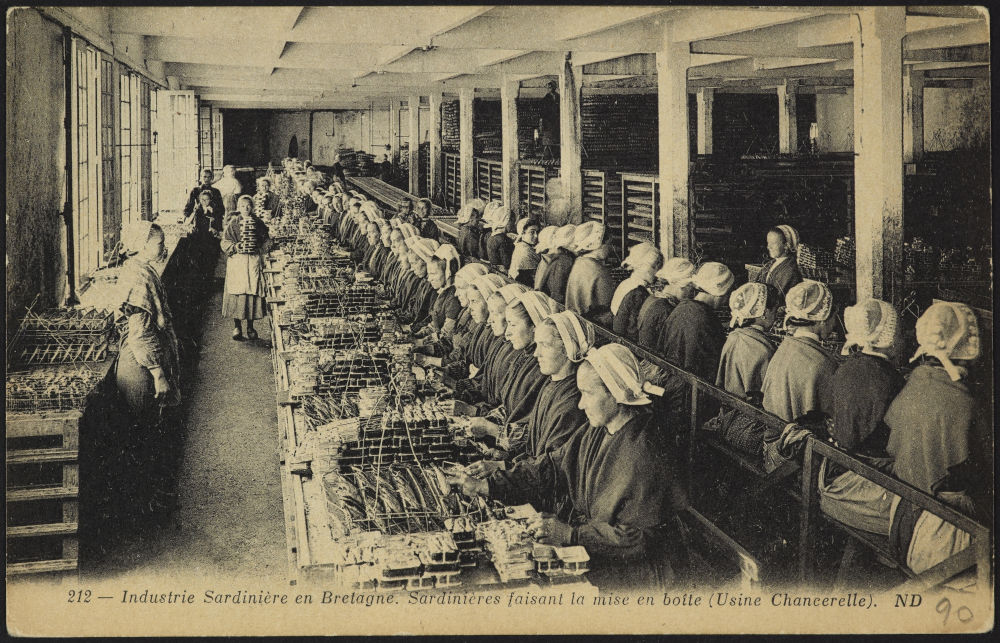
As part of the general reorganization that developed in the Comintern and its sections after the Fifth World Congress in 1924, an Organizational Conference was held in June, 1925 to discuss progress. As part of that process, Hertha Sturm, head of of the Comintern’s West European Women’s Department, gave this valuable report for history on organizing women factory workers, and some of the obstacles to further recruitment of women proletarians into the Communist movement.
‘Capturing Factory Women Through Factory Nuclei’ by Hertha Sturm from International Press Correspondence. Vol. 5 No. 63. August 6, 1925.
The Third International Conference of Women Communists decided that one of the main tasks of Communist work among women consists in capturing large sections of working women employed in industry in connection with the reorganisation of the Party on a factory nucleus basis. The policy decided upon at that time was supplemented and made more concrete by the May resolution of the OrgBureau on work among women after the last session of the Enlarged Executive.
Generally speaking the Sections have as yet done very little on this field. The reasons for it can be easily ascertained by a perusal of the reports of the Women’s Sections (Women’s Secretariat) of the various Parties. Apart from such abnormal cases as for instance, Belgium and the USA where, in spite of the existence of a large female industrial proletariat, the Communist Parties have as yet not organised work among women from the centre, three specific reasons predominate for the as yet small activity of factory nuclei among working women:
1. Ideologically, some of the Parties still cling too much to the traditional organisational forms of Party work. In most cases the Party apparatus for work among women is on a wrong organisational basis, it is a slave to old traditions and cannot therefore be easily reorganised for the different aims, which we pursue. This refers particularly to Czechoslovakia and Norway where alongside of the general Party work, work among women was conducted on a fairly independent basis.
2. In most Parties work among women is, politically and organisationally, not yet sufficiently part and parcel of the general work for the general Party organs and especially Factory Nuclei to initiate themselves the capture of working women.
3. In all Parties the percentage of women members is on the whole small (maximum 25% down to 6% and 2% even in important Parties). Among these women members only a minority are working women (the majority are working-class housewives), and even these few working women have had but little political training or systematic preparation for their tasks. Thus there are only small cadres at our disposal for the initiation of this work.
In view of these objectively unfavourable premises, and the general rather slow process of the construction of factory nuclei, it is all the more important to study very carefully the few beginnings which have been made for the capture of working women by means of the factory nuclei, and also the methods applied in this process and the successes which have thereby been achieved.
Certain reports and material are available from Germany, France, Czechoslovakia and Poland. But actual results of the work have only been obtained from Germany.
We will proceed now to deal with a few facts:
1. Germany. Although the Women’s Secretariat of the CPG (subsequently the “Women’s Section”), had already at the Women’s Conference in May 1924 issued a slogan that the chief activity for work among working women be transferred to the factories, no positive results could be recorded until the late summer. The Women’s Section therefore decided to concentrate the work on certain districts of the Reich, in order to gain experience and to form a basis for the extension of the work.
Three districts were selected, where large numbers of women are employed in industry, and where there is at the same time a good Party organisation or a capable cadre of officials, Erzgebirge-Vogtland (Chemnitz), West Saxony (Leipzig) and Thuringia (Erfurt-Gera). To every one of these districts we sent for a short time (one to three weeks) an experienced woman comrade, who in close collaboration and agreement with the district executive established a connection with the large industries where women are employed, and initiated the work there.
The woman organiser discussed matters with the District Executive, and the latter organised in the most important localities meetings of Factory Nuclei Chairmen and Trade Union Officials, at times also general members’ meetings and in some cases meetings of women Party members, at which the tasks and the organisation for winning over working women in the industries were discussed. In this way it was ascertained with what factories employing women the Party had personal connection, in which factories Communist women were employed, and where organised nucleus work is already being done. All this material was partly supplemented by a perusal of the written monthly reports of the factory nuclei to the district executive and of the register of Party members.
In Leipzig, one of the main centres of the textile industry, we succeeded in getting into contact with a number of big industrial enterprises through the Trade Union Fraction of the opposition textile workers. These enterprises employ about 3.000 women including 20 women comrades, who had not yet joined their Nucleus and were not systematically organised for work. All these data were very helpful as they gave valuable hints to men and women comrades for their activity in the enterprise. This encouraged the formation of new factory nuclei there are in Saxony a number of textile factories where, because of lack of male Communist workers, the entire factory nucleus consists of Communist women. Moreover, active women comrades were sent into already existing nuclei, or nuclei in factories employing women where there were as vet not working women among their members, and were mobilised for work among the women employed in the factory.
Two tasks were placed before the factory nuclei and the liaison officials in as far as working women were concerned. One of the tasks was to circulate Party newspapers in the factory, the “Arbeiterinnen-Zeitung” being given a special place. It should be stated that in the three above-mentioned districts there is now a revolutionary working women’s newspaper. These papers are published on the model of the Berlin “Arbeiterin” and two of them came already into being during the May Reichstag election. Through the activisation of women comrades and subsequently also of considerable circles of working women, the make-up and tone of these newspapers were considerably improved, one of their features being contributions by the factory women themselves. It also became possible for this same reason to organise from within the circulation of these papers in a considerable number of enterprises.
This “Arbeiterinnen-Zeitung” forms, so to speak, a nucleus for work in the factories, and is the precursor of proper factory nucleus newspapers. In the course of the work, the working women were drawn into the work of the already existing factory nuclei, whilst on the other hand nucleus newspapers came into being to which only working women contributed and which are entirely edited by women. There was a very characteristic case in Chemnitz where the first number of a nucleus newspaper was published in two to three hundred copies. This was in connection with a very high-handed action of the employer towards the women employed in the factory. The case was at first discussed in the daily press of the Party and thus circulated in the factory. The second task consisted in utilising general factory meetings by bringing forward at them the demands and needs of the women, and by announcing at them special factory meetings for women.
This method was particularly was particularly successful in Thuringia, where one factory set the example for a big campaign among the working women of the whole district. In Gera where the Party had at that time (September 1924) 7 women factory nucleus organisers, a number of women’s Factory Councillors, and a considerable number of other active women nucleus members, the working women of one factory were met as they were coming out from work and were taken along to a meeting on wage questions. The working women were interested and decided to convene a factory meeting to which the working women of the other Gera factories should be invited.
Prior to this meeting the nuclei and representatives of various other local factories held meetings for the working women. After this preparation, a plenary meeting of working women was held in Gera in October. At this meeting 23 factories were represented by working women. The meeting dealt with questions of wages and working hours and adopted a programme of action similar to the Gotha fighting programme, which was then the subject of a big campaign not only in Thuringia but throughout the Reich. The meeting issued a proclamation to all the working women of Thuringia inviting them to take part in this action. It also elected a Working Women’s Committee for the conduct of the action, and this committee got into touch with the Textile Workers’ 13th committee of action. This proclamation was taken up and discussed also in the Gotha, Erfurt and Jena factories, where women are employed.
But Gera was the only place where a working women’s plenary meetings was held and a Working Women’s Committee was elected. Subsequently, the action died down, partly because of the lull in the general movement and partly be cause of lack of continuous personal initiative by some stronger motive force. Later on, the Working Women’s Committee devoted its energies to the establishment of educational courses for working women. The Berlin organisation had already done energetic work as far back as the winter of 1923-24 in a similar manner as to how it was done in Saxony and Thuringia. Particulars about this were already given at the Third International Conference of Communist Women. (See Special Number of the “Inprecorr” of October 6th, 1924.)
A conference of Communist working women was also held in February 1925 in Stuttgart (Württemberg) which was attended by 21 working women from 16 factories in Stuttgart and the neighbouring Districts. This conference dealt with the formation and organisation of factory nuclei for the capture of working women. It heard reports from the factories, and on this basis decided what our tasks in the factories should be.
The experiences of the factory nucleus work from the various districts were utilised in the CPG at the sessions of the women collaborators of the Women’s Section attached to the Central Committee, and also in written reports to the Central Committee of the Party in circular letters of instructions addressed to District Executives and District Women’s Committees as well as in the “Kommunistin” and the working women’s newspapers of the district. Moreover, the women’s section works systematically for the inclusion of the question of factory nucleus work among women into the so-called “Women’s Conferences” of the Party.
In addition to the Women Organisers of Work among in the Districts (28), working women from the big factories of the most important Industrial Districts were invited to the last Reich Conference held in January. 15 working women attended and took an active and able part in the discussion of the special item on the agenda: “Work in the Factories and Trade Unions?” The forthcoming Women’s Conference in connection with the Party Congress, will this time stipulate that every district should send in addition to the woman organiser of the work a working woman from some big enterprise to the conference. The last circular letter of instructions of the Pol-bureau of the Central Committee enjoins all Party organisations to invite especially working women to Women’s District Conferences.
2. France. The Paris section of the Party decided at the end of 1924 on a plan of work for agitation among women, the main part of which deals with the work of the factory nuclei. The most interesting part of this plan, the main features of which are in keeping with the international decisions, is the very practical concretisation of the immediate tasks and the fixture of definite dates.
1. The nucleus of every factory where more than 20 women are employed, should appoint within a week a woman or man comrade as organiser for working women. This organiser should be a member of the nucleus bureau.
2. The first tasks of the working women’s organiser are:
a) Within two weeks of his appointment he should present a report on the number, position and demands of the working women in the factory.
b) He must find a woman correspondent for “L’Ouvrière” (working women’s weekly organ of the CPF), and act as a correspondent in the meantime.
c) He should collaborate in the editorial board of the factory nucleus newspaper and should encourage working women to become regular contributors.
d) He should do his utmost to organise with the help of the nucleus bureau a working women’s factory meeting, and should bring up at these factory meetings questions of interest to working women.
e) He should find a suitable woman comrade in his factory for the Paris educational course for Communist working women.
f) He should carry on individual propaganda among the most intelligent and active working women of his factory in order to bring them into the Communist Party.
g) He should supervise the circulation of the “L’Ouvrière” in the factory, this circulation to be at least 10 per cent of the number of women employed in the factory.
h) He should try to ascertain what impression the “L’Ouvrière” is making, communicating to the editorial board the criticisms of the working women. He should also urge at Party meetings that work among women should be extended and intensified.
3. Factory organisers are convened twice a month by the women’s commission of the district (Región) according to town districts (Rayon) or groups of town districts, for the purpose of reporting on their work, exchanging experiences and receiving instructions.
No reports have as yet been received on the results of this work. However, progress has already been made during the last months there have been already letters from working women in the factories in “L’Ouvrière” whilst formerly they were conspicuous by their absence.
The plan of work of the Paris Section was sent to the other districts as a model. In North France and in Lyons, which are both big centres of the textile industry, employing large numbers of women, Party Conferences for the organisation of work among women factory workers have been held. In these conferences representatives of political leading organs and of factory nuclei and also trade union officials and women employed in the factories took an active part. On this too, no full reports have yet been received. But through this mobilisation of the factory the factory nuclei the circulation of the “L’Ouvrière” which was hitherto almost entirely limited to Paris, has been extended to the provinces where it has been brought to the notice of large sections of working women. The circulation increased from 3 to 4,000 in January and to 7,500 in April 1925.
3. Poland. Here the Party already had before the Fifth World Congress a fairly well-established connection with women factory workers, which, however, lacked systematic organisation. During the past year Nuclei of communist working women and also women’s circles into which working women sympathisers were drawn, were created in various districts with big factories employing women; these nuclei and circles had to work illegally. The reports show that there are in some cases in Warsaw two Communist nuclei in one and the same enterprise, one consisting of women and the other of men workers. This practice of forming separate Party nuclei for working women was strongly condemned by a Women’s Conference of the CP of White Russia. In its resolution on questions of organisation, this conference decided among other things:
To appoint responsible leaders for the work among women in every Party Nucleus in whose district women factory workers are to be found.
To establish close collaboration with the Youth League which in view of the lack of party women comrades should assign its nucleus members for work among women,
To organise so-called Free Women’s Circles, into which average working women whose class consciousness is not yet developed, should be drawn. These circles should gradually educate their members in a Communist spirit.
To utilise Trade Unions, Co-operatives and schools for the mobilisation of the working women.
As a means for the political class education of working women, the resolution recommended the organisation of economic actions for higher wages and better working women’s protection laws, as well as for bringing forward working women’s demands at elections of all kinds to sickness funds, administrations, to organs of self-government, etc.
In support of this agitation it was recommended: to elaborate a plan for talks and reports among working women, for the establishment of small libraries, and collection of material on the women’s question.
4. Czechoslovakia. The Women’s Secretariat of the Party has published a pamphlet on nucleus work and has compiled an informative pamphlet on work among women in Czechia. It sent an instruction on factory nucleus work among working women to the district organisations of the Party and has compiled statistics on factories and the number of women employed in industry throughout the country. Reports on practical results have not yet been received.
And now we come to the deductions from these facts. Although we must be very cautious because of the scanty material at our disposal, we can draw some conclusions which may to a certain extent be considered as a guide for successful work.
1. The necessary premise for the Party’s concentration on the tasks which factory nuclei have to fulfil among working women, is a thorough and practical study of the principle of the question by the women’s sections in close collaboration with the Party executives and with the special organisers of Party work in factories, and trade unions.
2. The work should not be allowed to depend on the presence of communist working women in the factory, as this cadre is for the time being decidedly too weak. In the beginning the work must rather rest on the factory nuclei as a whole, that is to say, also on the men comrades,
3. The women’s sections (Women’s Committees) of the Party should not passively wait for the “Party as a whole” to take the initiative for the organisation of planned-out systematic work. It is rather the duty of the women’s sections to focus the attention of the Pary as a whole on this task by their own initiative and activity, and to make sure that justice be done to it, especially in such cases when the Party does not go about this work in a sufficiently energetic manner.
4. In connection with certain enterprises, localities and districts it would seem expedient to create first of all favourable conditions for the work, and to concentrate on this all efforts in order to gain the first practical experience. Such practical attempts can and should be made everywhere without any further delay, without waiting for the results of detailed statistics, the usefulness of which cannot be disputed.
5. The factory nuclei should be given definite tasks to fulfil. The circulation of the Communist women’s press in the factory, the number of working women secured for trade unions and the Party, the number of working women’s letters in the press, all this is an absolute criterion for the activity and success of nucleus work.
6. The cadres of the Communist working women in the factories should be systematically registered, organised, instructed and trained.
7. The special women’s propaganda material of the Party should be adapted to the requirements of work in the factory. This applies to report material as well as to periodicals, pamphlets, leaflets, etc. used for recruiting purposes among the masses.
8. The Communist Youth should be encouraged to support this work especially among the young working women.
9. The experiences of this work should be carefully collected and utilised. This necessitates: regular reporting by the nuclei to the higher Party organs and regular reports and instructions of the higher Party organs to the nuclei, preparation of all kinds of questions for mutual discussion at Party meetings and conferences as well as exhaustive reporting and discussion in the press: political daily press, bulletins on questions of organisation, and International Press.
International Press Correspondence, widely known as”Inprecorr” was published by the Executive Committee of the Communist International (ECCI) regularly in German and English, occasionally in many other languages, beginning in 1921 and lasting in English until 1938. Inprecorr’s role was to supply translated articles to the English-speaking press of the International from the Comintern’s different sections, as well as news and statements from the ECCI. Many ‘Daily Worker’ and ‘Communist’ articles originated in Inprecorr, and it also published articles by American comrades for use in other countries. It was published at least weekly, and often thrice weekly. Inprecorr is an invaluable English-language source on the history of the Communist International and its sections.
PDF of full issue: https://www.marxists.org/history/international/comintern/inprecor/1925/v05n47-jun-04-1925-inprecor.pdf

