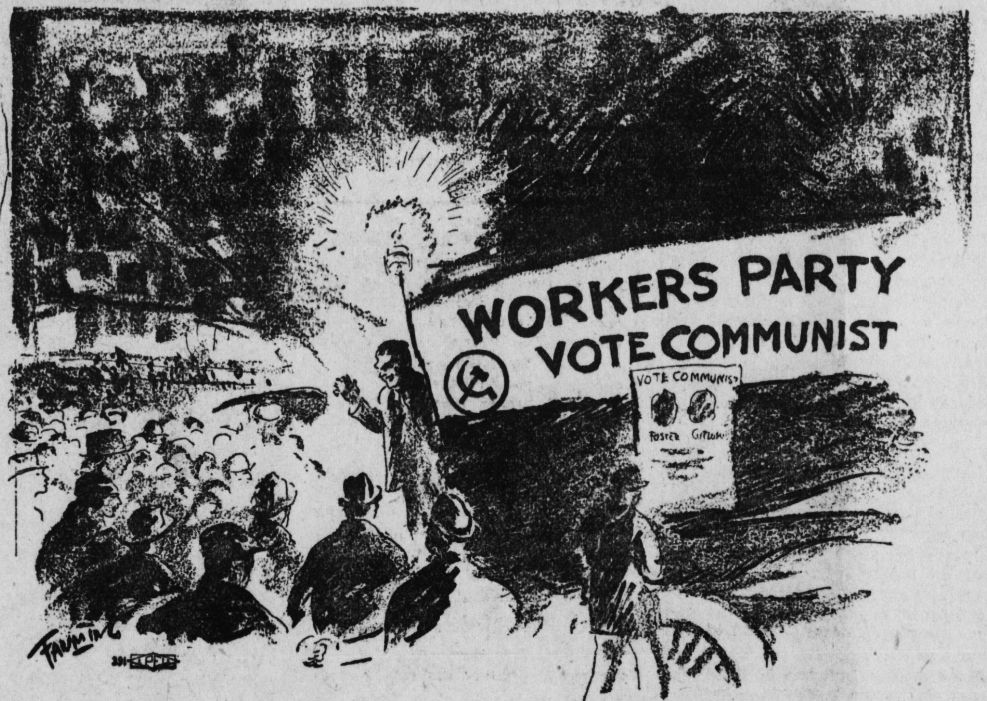
One day of Daily Worker reports from the election fight in 1924 sees rallies for Communist candidates in Chicago, Milwaukee, Detroit, New York, Boston, New Haven, and more. The 1924 Workers (Communist) Party presidential campaign of William Z. Foster was the first national electoral Communist campaign in the United States. Starting late, and controversial in a deeply divided party, the Party got ballot access in only 14 states. In addition to running against the Democratic and Republican Parties, the main competitor was the Progressive campaign of Robert LaFollette, supported by the Socialist Party.
‘A Day in the Communist Election Struggle Against U.S. Capitalism’ from The Daily Worker. Vol. 2 No. 189. October 29, 1924.
BIGGEST BOSTON MEETING HEARS FOSTER SPEECH
Communist Carries His Campaign to Boston
(Special to the Daily Worker) BOSTON, Mass., Oct. 28. More than a thousand workers filled Scenic Auditorium to capacity in Boston and listened to the Communist candidate for president, William Z. Foster, on the Workers Party ticket.
The meeting was the most successful ever held in Boston by the Workers Party from every point of view.
Analyzes LaFollette Movement.
Comrade Foster held the attention of his audience from start to finish with the clearest and most direct Communist message delivered in this city for a long time.
LaFollette buttons were very much in evidence on the coats of union men and women who had been swept off their feet by the LaFollette illusion. Comrade Foster’s handling of the LaFollette movement was masterful in its clear and concise analysis. Foster in Boston explained the class basis of the LaFollette movement so convincingly and so clearly that it made a lasting impression upon every worker present.
Without one unnecessary word or phrase, Comrade Foster laid bare the basis of capitalist society and the capitalist state; with simple illustrations drawn from the daily lives of the workers, Foster sent home the Communist message. The capitalist dictatorship was exposed by citing the actual experiences of the workers in the coal, steel and railroad strikes while the grip of the capitalist class upon all existing institution was shown by a simple examination of the function of school, church and press. Unemployment, the menace of imperialistic war and capitalist exploitation was stressed as the real issues in this campaign.
The role of the Workers Party and the Communist International in the proletarian revolution was simply and plainly told by Comrade Foster and the necessity for the dictatorship of the proletariat in the place of the capitalist dictatorship was brought out so clearly that on one present could mistake the aims of the Communist movement.
LaFolletteite Disillusioned.
As one disillusioned LaFollette trade unionist who joined the party said: “I have waited to hear Foster before finally making up my mind on these issues. To hear Foster is to be convinced.”
And that about sums up the attitude of the great majority of those present.
Comrade Foster made the collection appeal and a total of nearly $350 was taken up.
Comrade Harry J. Canter presided and Comrade John J. Ballam, Communist candidate for governor of Massachusetts, made a brief introductory speech.
Meeting Splendidly Arranged.
The meeting was splendidly arranged and managed under the direction of Comrade Robert Zelms, secretary of the Boston City Central Committee, and the effect of the meeting will be to stir up greater enthusiasm and spur our comrades on to more tireless efforts for our party in Boston.
***
COMMUNISTS IN CHICAGO IN BIG MEETING DRIVE
Thousands of thinking Chicago workers are signifying in no uncertain manner that they are thru with the elephant, the jackass and the bobcat, and the rest of the capitalist political zoo.

In the last week of the campaign a storm of carefully planned and faithfully executed meetings, indoors and open-air, are being held all over Chicago. Monday night a special drive of many street meetings were held in the first congressional district for Gordon W. Owens, our colored comrade and candidate. Tuesday, in the sixth district, six meetings were arranged.
But this is not all. The meetings are only the opening gun in a rapid-fire attack of street corner appeals, mass meetings, factory gate and house-to-house distribution of Communist literature which will mark the final week of the campaign in Chicago. All workers must watch the dates and places below and turn out strong!
Wednesday, Oct. 29.
Foster-Gitlow Conference–Big mass meeting, Liberty Club House, 3420 Roosevelt Road. Speakers: J. Louis Engdahl, Arne Swabeck, Frank Pellegrino, N. Shaffer, in Jewish, and S. Lifshitz, for the Left Paola Zion.
Open Air Meetings–32nd and Halsted, 32nd and Morgan, 23rd and Leavitt, and 47th and Ashland. Speakers: Shachtman, Schapp, Herd, Zokaitis, Harvey, George, Cline and Maurer.
Thursday, Oct. 30.
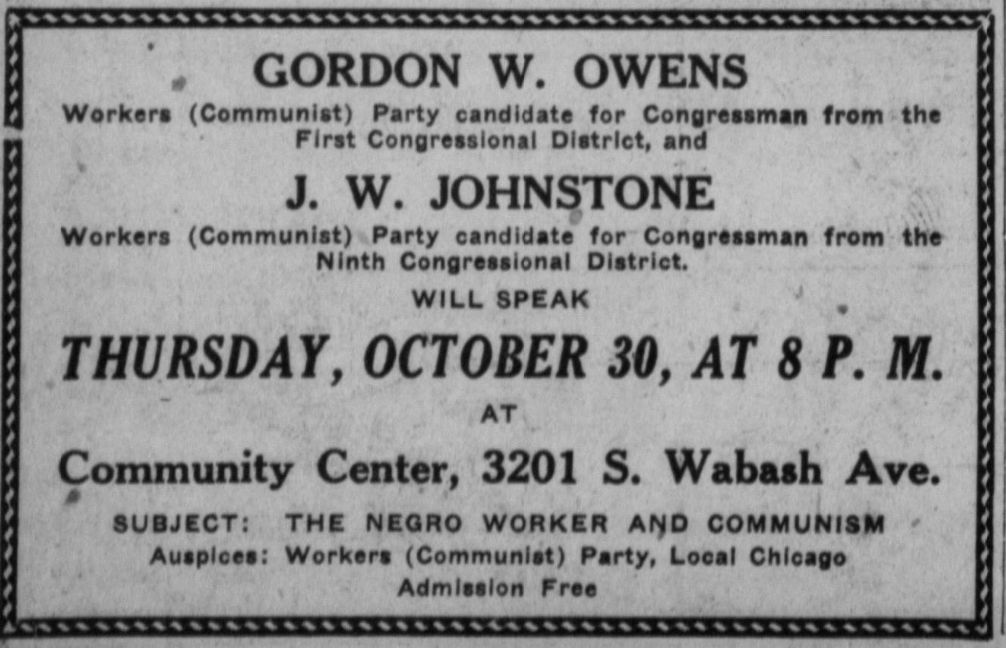
3201 South Wabash–Hall meeting, at Community Center. Subject: “The Negro Worker and Communism.” Speakers: Gordon W. Owens and J.W. Johnstone.
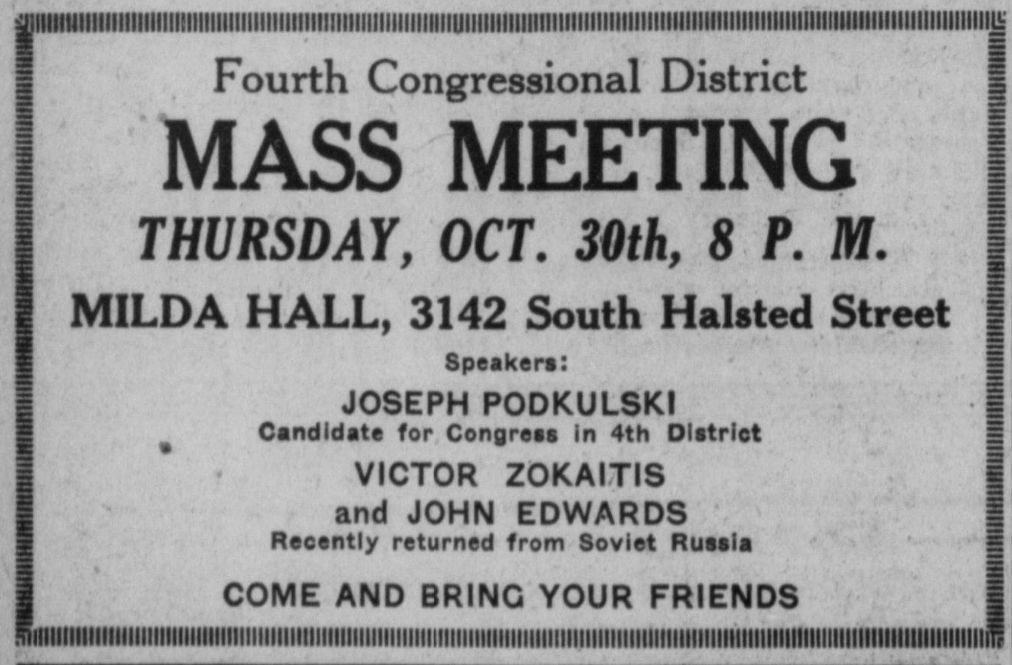
3142 South Halsted–Hall meeting, at Milda Hall. Speakers: Zokaitis, candidate Podkulski and John Edwards.
Open Air Meetings–Start from Workers Lyceum, 2733 Hirsch Blvd. Autos wanted, lots of them, to take speakers out. Report not later than 7:15 p.m. Speakers will be: Bittelman, Cannon, Shachtman, Hammersmark, candidate for the 7th district, Earley and Williamson.
Friday, Oct. 31.
Workers Lyceum, 2733 Hirsch Blvd.–Mass meeting, Foster-Gitlow Conference. Speakers: M. Loonin, M. Schuchter for the Left Paola Zion, and Hammersmark.
2517 Fullerton Ave.–Hall meeting. Sam Hammersmark and others.
722 Blue Island Ave.–Hall meeting. George Maurer, candidate of the 8th district, and others.
722 Blue Island Ave.–Y.W.L. hall meeting. Subject: “The Voteless Young Workers and the Elections.” Speaker: John Williamson.
3322 Douglas Blvd.–Y.W.L. hall meeting. Subject: “The Voteless Young Workers and the Elections.” Speaker: Oliver Carlson.
3142 South Halsted–Y.W.L. hall meeting. Subject: “The Voteless Young Workers and the Elections.” Speaker: John Edwards.
180 West Washington St., second floor—Y.W.L. hall meeting. Subject: “The Voteless Young Workers and the Elections.” Speaker: Barney Mass.
Open Air Meetings, North and N.W. Side; North Ave. and Fairfield by the Northwest English branch; Division and Washtenaw by the N.W. Jewish branch; Division and Hoyne by the N.W. Jewish branch; Fullerton and Western by the Karl Marx Scandinavian branch; North Ave. and Orchard by the Hungarian and German branches. Many well-known speakers. All in the 7th congressional district. 947 Grand–Hall meeting by branch 5 of the Young Workers League. Speaker: Tom Bell.
2613 Hirsch Blvd.–Hall meeting by branch 6, Y.W.L. Speaker: Max Shachtman.
***
NEW YORK’S EAST SIDE RALLYING TO COMMUNISM
(Special to the Daily Worker) NEW YORK CITY, Oct. 28. The Communists en masse invaded the former stronghold of the socialist party, Abe Cahan, editor of the Jewish Daily Forward, and the labor fakers on the lower east side.
The Red Night there not only resulted in the complete rout of the socialist forces, but it brought a wonderful response from the Jewish workers, now becoming disgusted with the yellows.
Socialists Get Busy.
As soon as the socialists heard of the proposed Red Night in this district, they decided to prevent the Communists from reaching the workers at all costs. Therefore they sent a squad of socialists to Rutgers’ Square with instructions to camp there from noon hour in order to hold the meeting place. In spite of all their efforts, however, the series of meetings arranged by the Workers Party on the lower East Side was in every respect among the most successful ever arranged in New York City.
On no less than eight crowded corners various well-known Communists of New York exposed the role of the yellow socialists as allies of capitalism, and pointed out the necessity for a working class revolution. These meetings were followed by the grand wind-up meeting at Rutgers’ and East Broadway.
Here an enormous crowd gathered. Speaking a few doors away from the Forward building, Comrade Ravitch told of the betrayal of the working class by the so-called labor paper, the Jewish Daily Forward. He gave numerous examples of how this sheet had served the interests of the capitalist class against the workers. Numerous other speakers held the crowd until midnight as they explained what the socialist party was doing to their unions and to their political movement. Comrade Poyntz in a scathing attack on the paper she called “The Jewish Daily Backward,” pointed out that this organ of the socialist party was but another proof of the fact that the Workers Party was now the only party which represented the workers. New York comrades, watch for your meetings, below, and all workers of New York, turn out! Turn out!
***
FOSTER SPEAKS TO BIGGEST NEW HAVEN AUDIENCE
Receives Hearty Ovation From Workers
(Special to the Daily Worker) NEW HAVEN, Conn., Oct. 28. Foster’s campaign speech in Music Hall, New Haven, Conn., will remain the talk of the class conscious workers for some time to come. He won his audience and held them for two hours while he preached the message of Communism.
Music Hall, the largest in town, is used by all political parties for their rallies. The Communists succeeded in attracting a larger crowd than any other party, even though they charged an admission fee. The democrats with all their candidates, with an outside state governor and a band of music, could not muster as many as the seven hundred who came last night.
The attendance far overshadowed that at the two previous political meetings run by Local New Haven.
A Different Speech
How different from the spread eagle type of political oratory indulged in by capitalist politicians! Foster gave a masterful presentation of the underlying facts of modern civilization, of the capitalist system of wage slavery. He was not concerned with a discussion of personalities, but with the necessity for a change to a new system, the Communist order. A student of economics and politics, he explained not only conditions in America, but throughout the entire world, with an intimate grasp of his subject. The Communist campaign was again shown to be a means of education, and not a vote catching device. The main part of the talk dealt with the evils of modern society, and with the cure. Unemployment, poverty, misery, and war were laid at the door of the capitalist system, which gave them birth.
Another War Coming.
The economic nature of the last war, and the inevitable trend toward the next one, were clearly demonstrated. The growing antagonism between Japan and the United States over control of the East meant war. Foster then showed how the capitalists mould public opinion, so as to draw the workers into war, even as in the last. As against the silly proposal of LaFollette to have a referendum on war, Foster urged the substitution of the class war for imperialist war, and pointed to the Communist International as the body that would lead the working masses in their effort to bring about the world revolution.
Whose Dictatorship?
For the benefit of those in the audience who knew little of communism, Foster, by examples drawn from his own experience in the steel strike of 1919, showed how the capitalists used the courts and the police to crush the strike. He pictured the sinister influence of the masters, who controlled the schools, the newspapers, the factories, and the churches. The destruction of the Inter-World Church Federation was laid to the Steel Trust, because the former dared to investigate and tell the truth about the brutal Empire of Steel.
The dictatorship of the proletariat was explained as the rule of the workers and farmers; while the slogan “He that does not work, neither shall he eat” was met with thunderous applause
Foster exploded the social democratic notion of buying the industries. He showed that every decaying class, even as the slave owning aristocracy of the South, fought to retain its special interests. He showed that every rising class confiscated the property of the previous ruling class.
Social Democratic Traitors
The role of the social democrats in the various European countries, being the last bulwark of capitalism, when the reactionary parties could no longer dominate the minds of the working class, was likened to the role which the LaFollette movement will play in this country, under similar circumstances.
The middle class was termed a doomed social class, and no amount of political bellowing could bring back competition, and the comparatively primitive days of 1776. LaFollette and his movement, charged Foster, would do nothing for the middle class, but would act as the defender of the interests of big capital.
Industry For Use
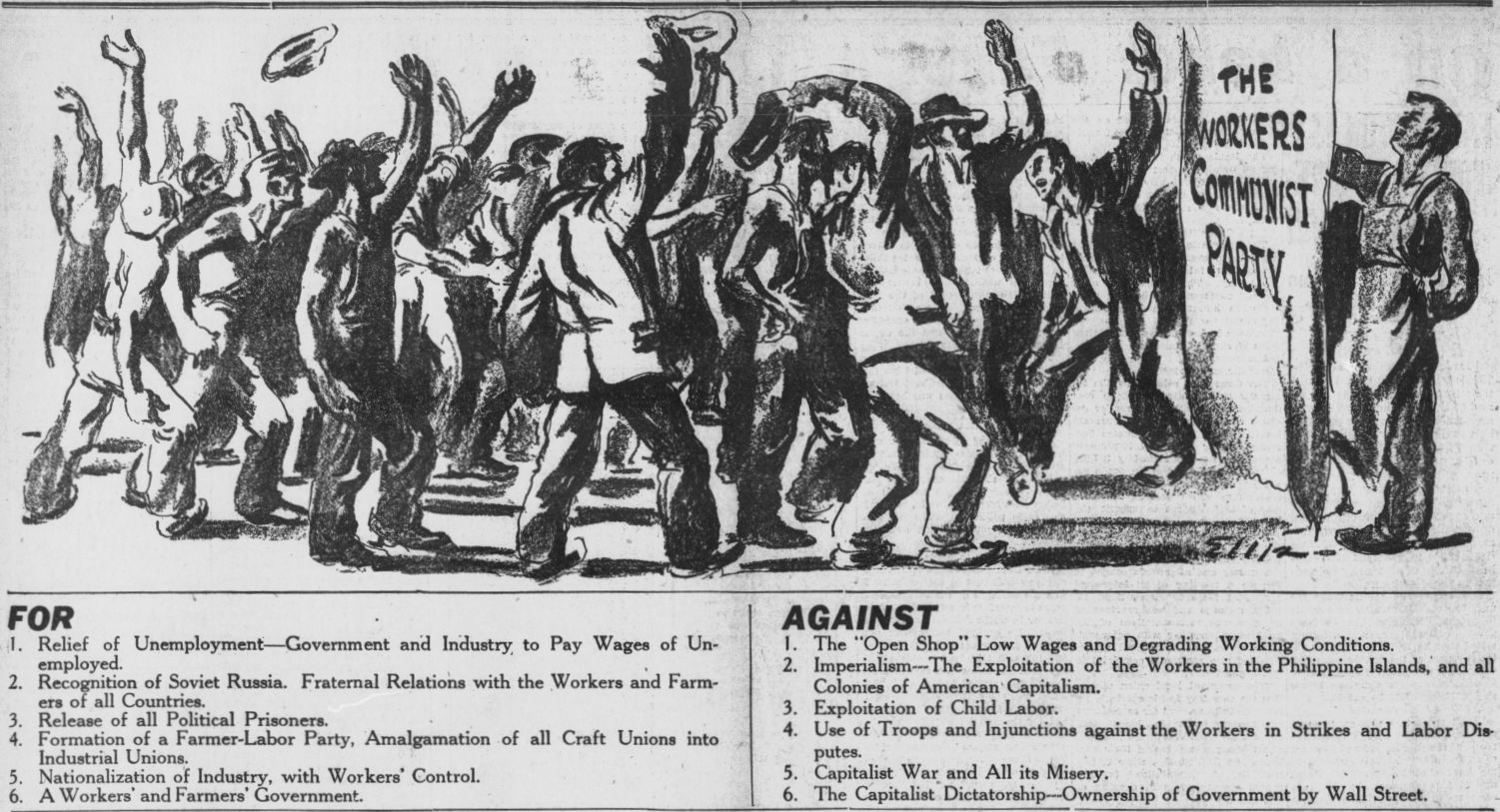
After showing that unemployment was inevitable under capitalism, Foster urged the working class to form industrial unions, so as to present a strong fighting front on the economic field, and to band together with the poor farmers on the political field, in, order to take over the reins of government, and to take possession of the industries. Industry for use, as opposed to industry for private profit, was the cry.
When the name of LaFollette was first mentioned by Foster, a few of his followers applauded, but they shriveled up, as Foster fired shot after shot into the record of this false leader. This was too much for a local socialist, who is one of the prominent speakers in the LaFollette movement; in a little while he left the hall.
District Organizer Simons appealed for support of the state ticket of the Workers Party. He took up the record of the candidates on the other tickets, showing their connection with business corporations and banks.
***
BIG JOHNSTONE RALLY IS GOOD START FOR FINAL CAMPAIGN WEEK
The successful mass meeting at Imperial Hall, when J.W. Johnstone, candidate for congress, addressed a filled hall of workers and pointed out the necessity of a Soviet Republic of workers and poor farmers, marked a good beginning of the final campaign week in Chicago.
Red Lights Announce Meeting.
The north side of Chicago in the vicinity of Lincoln, Fullerton and Halsted streets was lit up by blazing red lights and announcements telling of the Workers Party campaign rally at Imperial Hall, 2409 N. Halsted street, were so thoroughly distributed that no worker living in that district failed to know of the meeting.
As a result the Imperial Hall was well filled with an interested audience of workers who came to hear the Workers Party candidate in the ninth congressional district.
Speaks to Workers.
Johnstone, member of the Painters’ Union, has been active in the labor movement of this country all his life. When he speaks of the labor movement and its leadership, he knows what he is talking about and it does not take any audience of workers very long to appreciate that fact.
When he showed that the trouble with the labor movement today was not with the trade unions but with the class collaborating leaders and that the Workers Party was for making the unions truly representative of the workers’ needs by ridding It of false leaders and replacing them with men who truly represent the workers, the audience understood and agreed, judging from the applause. Many workers came up after the meeting to ask questions about the north side branch, about Workers Party literature and a few of them signed up for membership.
Street Meetings.
At several corners in the first congressional district, where the colored Communist, Gordon W. Owens, is the candidate, big crowds were held by several speakers. On the near west side, at Madison and Green streets, one of the best meetings of the night took place, a large crowd gathering, and over 100 DAILY WORKERS were sold.
***
ENGDAHL SPEAKS AT FINAL RALLY IN DETROIT, MICH.
Wind Up Campaign at Finnish Hall, Friday
DETROIT, Mich., Oct. 28. The Workers Party of Detroit will hold its final mass meeting of the election campaign Friday evening, Oct. 31 at Finnish Hall, 5963 Fourteenth St. J. Louis Engdahl, editor of the DAILY WORKER, and candidate for senator on the Workers Party ticket in Illinois, will be the principal speaker.
The recent ruling of the officials of Michigan barring the Workers Party from the ballot was one of the most brazen pieces of Newberryism.
The Workers Party and the LaFollette forces both following identically the same procedure in the holding of county and state conventions, selecting presidential electors and certifying them to the secretary of state and the 83 County Board of Election Commissioners. But while the Workers Party was barred from the ballot, these same officials ruled that the LaFollette ticket should not be molested.
The party brought suit in the circuit court of the County of Wayne (Detroit) to place the party candidates on the ballot.
The Workers’ Party is meeting this political trick by instituting a campaign to get the class conscious wor ers and farmers of Michigan to go to the polls on November 4, and write in the names of Foster and Gitlow, the Workers Party (Communist) candidates for president and vice president. This tactic will be fully explained at the meeting Friday night. Every effort is being made to bring out a big attendance.
***
RED NIGHT ON RED EAST SIDE MAKES BIG HIT
By MARY RUBIN.
Tremendous Crowds at Each Meeting
NEW YORK, Oct. 28. New York’s east side witnessed one of the most stirring series of meetings in the history of that wide-awake part of New York City. Accompanied by flaming torches, tons of red literature, speeding automobiles, streaming banners and squads of party members, the Red Night was celebrated in the heart of the former socialist territory.
Carl Brodsky, Ludwig Lore, Sadi Amter, George Siskind, J. Brahdy, C. Mitchell, M. Hartmann, B. Sparer, Juliet Stuart Poyntz, J.C. Oblans, N.B. Sparer, M. Kordon and a number of others spoke at the eleven meetings.
On the 7th Street and Avenue A, the meeting was carried on in Russian with a number of fine Russian speakers. In spite of an attempt by a Russian, white guard reactionary to disturb the stirring account of conditions in Soviet Russia, the gathering continued and developed the greatest enthusiasm among the workers.
On 2nd Street and Second Avenue, C. Mitchel gave a most interesting talk on conditions in Soviet Russia. D. Benjamin showed up the utter futility of placing any faith in the election of either Coolidge, Davis and LaFollette and made a stirring appeal for the support of Foster and Gitlow.
At 7th Street and Second Avenue, Juliet Stuart Poyntz shattered the meeting of a young misguided East Side lawyer, who from the end of a large expensive moving van, tried to advertise the virtues of Louis D. Gibbs, democratic candidate for supreme court judge. Poyntz ridiculed him effectively, pointing out while Gibbs and his crowd come before the workers only before election day, the Workers Party is working every day in the year in the interests of the toiling masses. It was not very long before the Gibbs outfit moved out for a better location.
At Tenth street and Second avenue, the Workers Party meeting competed with that of the socialists-LaFollette combination, who had hugged this corner from four in the afternoon in great fear of terrible Communists. In spite of the demagogic antics of their best and leading headlines, and in spite of the efforts of the socialist-LaFollette clique, who made strenuous efforts to swell the crowd and made ineffectual efforts at stirring up a semblance of applause–in spite of all this machinery, the Workers Party meeting, slowly but surely drew the crowd to its platform.
Ludwig Lore, local candidate for congress spoke on the rule of capitalism and the lot of the workers in America. Ford he said, paid an income tax of $9,000,000 while the workers in his factory, who made the automobiles, made only about $1,600 all year. He attacked LaFollette as a misleader of the workers.
Sadi Amter, just returned from Soviet Russia, the First Workers’ Republic, gave a vivid description of her experiences and appealed to the workers to establish a workers’ and farmers’ republic in the United States.
Charles Krumbein pointed out the futility of the LaFollette movement and told of his own experiences in Wisconsin as a worker in the state of which LaFollette is boss. The injunction and the state machinery is used against the workers as effectively in that state as it is elsewhere.
The meetings lasted until after mid-night and occasioned much discussion at the close. The response in the sale of literature, collections and enthusiasm developed, was far beyond. the expectations of even the most optimistic. The Workers Party is planning a series of meetings for the final wind up the campaign.
***
Straw Vote at Factory
Foster Runs Ahead of Coolidge and Davis
By G.S. SHKLAR.
MILWAUKEE, Wis., Oct. 28. A presidential straw vote taken by the DAILY WORKER at the International Harvester company here gave the following result: LaFollette, 167; Foster, 24; Coolidge, 5; Davis, 1.
The result of the straw vote is very significant. It indicates that the working masses are leaving in mass the leadership of the old capitalist parties.
Also Hold Big Meeting.
While it is of great historical significance that the workers are finally breaking away from the influence of the old parties, nevertheless, the revolutionary movement should not overlook the danger of this dissatisfaction being utilized by the middle class politicians. It is very fortunate indeed that the Workers Party is in the field pointing the danger to the misguided workers.
In connection with the taking of the straw vote, a meeting of over 400 people was addressed by the secretary of the party and his address was well received by the workers.
Many workers were interested in the position of the party and while. fully in sympathy with the movement, could not understand why the party opposed LaFollette.
Discussion is Interesting.
“How do you know that LaFollette will betray the workers? Why do you compare the LaFollette movement and explain it in the light of experiences of the social-democratic party of Germany and of the labor government of England?” we were asked by the workers and a very interesting discussion followed.
The Workers Party in Milwaukee is systematically conducting factory meetings and will continue to do so every day until the end of election.
The Daily Worker began in 1924 and was published in New York City by the Communist Party US and its predecessor organizations. Among the most long-lasting and important left publications in US history, it had a circulation of 35,000 at its peak. The Daily Worker came from The Ohio Socialist, published by the Left Wing-dominated Socialist Party of Ohio in Cleveland from 1917 to November 1919, when it became became The Toiler, paper of the Communist Labor Party. In December 1921 the above-ground Workers Party of America merged the Toiler with the paper Workers Council to found The Worker, which became The Daily Worker beginning January 13, 1924. National and City (New York and environs) editions exist.
PDF of full issue: https://www.marxists.org/history/usa/pubs/dailyworker/1924/v02a-n189-oct-29-1924-DW-LOC.pdf

