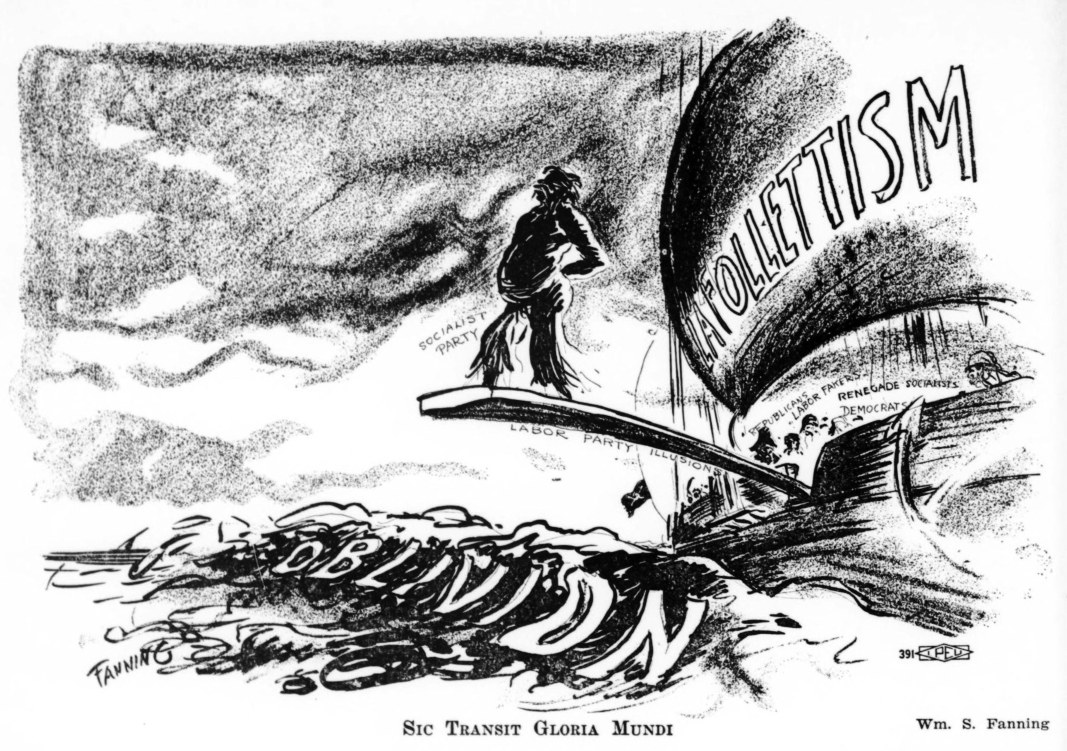
Begun in 1921 as a project of the Socialist Party and allied trade union officials, the Conference for Progressive Political Action originally sought to bring together supporters of a Labor Party. At the 1924 meeting the C.P.P.A. voted to fold into Robert LaFollette’s Progressive Party campaign in that year’s presidential election. Viewed by Communists like Foster as a betrayal by mixing banners with a non-working class and petit-bourgeois forces.
‘The Convention of the Conference for Progressive Political Action’ by William Z. Foster from The Liberator. Vol. 4 No. 8. August, 1924.
RECENTLY, Zinoviev said that American workers are 30 backward politically that the problems they are wrestling with are those that the proletariat in European countries dealt with in 1848. He said that from a proletarian standpoint the United States is to be compared politically with Persia or China, rather than with England or Germany. Never was this criticism more amply justified than by the July 4 convention of the Conference for Progressive Political Action. Based as it was upon the railroad unions, it might have been expected that the C.P.P.A. would have made real progress towards the development of a labor party. But it did nothing more than to give a pitiful exhibition of the political unripeness of the American working class. From the modern class conscious proletarian point of view, the whole affair was a tragic farce.
Surrounded on all sides by the most powerful enemies, who wield a greater power than any other section of the world’s capitalist class, the masses of industrial workers. and exploited farmers have a most urgent need for a definite class program, concrete organization, and militant leadership. But the C.P.P.A. was utterly blind to these burning wants. It failed completely to produce substantial constructive action. It was a hopeless fizzle.
The Question of Program.
Of the many needs suffered by the industrial workers and exploited farmers, none is more burning than a real understanding of the social forces at work about them. A clear analysis of capitalism and the definite development of a class viewpoint is the first essential for effective political action by the workers in the factories and on the farms. In this fundamental matter, the C.P.P.A. convention failed 100 per cent. The drivel it turned out as an analysis of the situation and a program of action is enough to make working class leaders in other countries smile to think that such rot could possibly emanate from an overwhelmingly trade union convention in the greatest capitalist country in the world.
At no time in the proceedings did a single speech or document make any effort whatsoever really to analyze the situation, by pointing out the economic forces leading to the concentration of capital and the sharpening of class antagonisms. Without question or discussion, the pettiest of petty bourgeois conceptions was adopted. From the general confusion of thought, this conception stood forth about as follows: A group of wicked and unscrupulous persons, through the use of unfair methods, have won a privileged position in industry and the government, through which they rob the “people,” and it behooves everybody, the honest elements of the citizenry, to rise and drive the rascals out, thus establishing an era of fair dealing. It has been said that the convention of the Conference for Progressive Political Action sought a basis of class collaboration. That is true, but its action in this respect was un- conscious. It was too stupid even to recognize the concept of social classes, much less to develop the idea of collaboration between them. The whole thing was a petty bourgeois mess, in which the workers did not distinguish themselves from the well-to-do farmers, small merchants, petty manufacturers, and independent bankers. Nor did they understand their relation to the poor farmers and the alliance that they should set up with them. As stated by the Chairman, Johnston, who at one time called himself a Socialist, all these social groups were in the same boat, suffered the same oppression, and had to have the same remedy.
The convention dubbed itself “progressive,” this favorite term being slopped all over the whole proceedings. But the fact is that it was economically the least progressive of the four big political conventions held this year. Whatever else may be said against them, the Republican and Democratic party conventions were progressive in the sense that they stand definitely for the interests of the capitalist class, a class which is driving ahead on a course which leads straight to the revolution. Likewise the St. Paul convention was progressive in the sense that the industrial workers and exploited farmers who made it up understood the principles of capitalist development and sought to free themselves from the evils surrounding them by putting an end to the system that caused these evils. But the C.P.P.A. Convention had no forward look. Its goal was a return to the dead and gone era of free competition, and all its trust-busting program was directed to that end. It sought its inspiration in the petty bourgeois ideals of 1776 and in such moth-eaten documents as the Declaration of Independence. Its motto, real enough even though not clearly stated, was “Backward, turn backward, O, Time, in thy flight.” It had no vision or purpose more definite than that expressed in the endless flood of platitudes about re- establishing “the rule of the people,” setting up “an honest government in the interest of all classes,” “a return to the ideals of true American democracy,” and other similar petty bourgeois slush, ad nauseam. The C.P.P.A. Convention did not understand the class character of society, nor did it make any progress towards the development of a proletarian class program. Its point of view was petty bourgeois through and through, and its whole program is of the same character. It in no way corresponds to the interests of the workers and exploited farmers.
The Question of Organization.
Next to a thorough understanding of their problem and a definite plan of action, the most burning need of the industrial workers and exploited farmers, is a separate political organization of their own. But the C.P.P.A. Convention failed to realize and satisfy even this elemental demand. All that it could muster the initiative to do was to make a weak promise that after the election the question of forming a party would be taken up. It did not dare even to declare in favor of a party, for fear that the autocrat, LaFollette, might be offended. For a time it looked as though the Socialists might possibly make a fight on this issue. But they did not. Hillquit weakly gave in and timidly accepted the orders from LaFollette that no party should be formed.
The failure of the convention to form a party, a course which was supported by the Socialists, was a direct betrayal of the farmer-labor party movement. In many states there are at present struggling Farmer-Labor parties. These will have to confront the hostile LaFollette state movements, which, setting up their own tickets, will demand that they be supported and that those of the Farmer-Labor parties be abandoned. The action of the C.P.P.A. in postponing the question of forming a party, will be used as a convenient club by the LaFollette forces everywhere to beat down the weak Farmer-Labor parties and to turn all support to the LaFollette petty bourgeois candidates. Humanity has much faith; hope springs eternal. But those who are gullible enough to believe, as Debs apparently does, that LaFollette will agree to the formation of a real party of industrial workers and exploited farmers in January, are possessed of a faith capable of moving not only mountains but whole continents. If the C.P.P.A. movement is ever to contribute anything substantial to the formation of a farmer-labor party, it can only do so by the proletarian masses breaking away from the political direction of La Follette and of the trade union bureaucrats of the Johnston stripe, who now control it.
The Question of Leadership.
When the workers venture into a political combination containing or making alliance with farmers and other petty bourgeois, they must, upon pain of certain disaster, retain control of the movement. But in this vital matter of maintaining proletarian leadership, as in so many others, the C.P.P.A. convention failed signally. Johnston and the other trade union and Socialist leaders surrendered the initiative completely to the petty bourgeois champion, LaFollette. Humbly and meekly they did everything he instructed them to. When he sneezed, they all blew their noses. La Follette would not permit the convention to nominate him; he nominated himself. Nor would he let it consider a program; he made up his own program and sent his son to the convention to read it, not deigning to come himself. He ordered that no party should be formed, and he refused to allow the convention even to suggest the name of someone to run as candidate for vice-president. All of which the convention timidly agreed to, without in any way securing control or discipline over him. During the convention there was much talk in favor of democracy and against dictatorship. But no political boss within a generation has dared as undemocratically and dictatorially to treat a convention as LaFollette treated this convention of the Conference for Progressive Political Action.
But LaFollette knew very well whom he was dealing with. He was sure he could get away with his rough stuff. He has seen the C.P.P.A. trade union leaders in action often enough. He knew that they are visionless and spineless. He has seen their unions cut all to pieces, and seen that they have not had sufficient intelligence to profit by their defeat by amalgamating the remaining union fragments and making a fresh start. He knew that their policy of stupidity and betrayal had destroyed their leadership among the masses and that they were hungrily waiting to get on his political band-wagon. He knew that even while they were applauding him in Cleveland, they were also treacherously working for the nomination of McAdoo in New York. He knew they were yellow, so he told them what to do, and they swallowed his whole program without even a grimace. Such an outrageous proceeding could happen in no other modern industrial country but this. It shows the low estate to which the American labor movement has fallen. Gompers keeps one section of it a tail to the Democratic party kite, while Johnston has the rest of it tied to LaFollette’s apron strings.
The Task of the Workers’ Party.
Although the C.P.P.A. Convention failed completely to map out a working class program, to lay the basis for a Farmer-Labor party, and to establish proletarian leadership in the present political turmoil, it did succeed in giving a great impetus to the petty bourgeois united front. This now stretches from Hearst to Debs. Hearst, on the right, says that LaFollette is a trifle too radical, but that he will sup- port him, and Debs, on the left, says, “We need not blush or apologize to give our support to Robert M. LaFollette,” and he calls upon the shades of Marx and Engels to justify his unqualified endorsement of a man who has bitterly fought socialism all through his long public life. Such a broad front, from the reactionary Hearst to the erstwhile revolutionary leader, Debs, indicates a big sweep of the masses and the casting of several million votes for LaFollette in the coming election.
In this situation, with the trade union and exploited farmer masses losing themselves in the LaFollette petty bourgeois movement, the task of the Workers Party is clear. It must do what the C.P.P.A. has failed to do. It must point out to the workers more sharply than ever the class character of society. It must puncture the sophistries of LaFollettism, and demonstrate that the capitalist system is impossible of reform, and must be abolished and superseded by the dictatorship of the proletariat. It must carry on a relentless struggle for the formation of a great mass Farmer-Labor party. It must raise the standard of proletarian revolution against the petty bourgeois platitudes and stupidities of LaFollette.
In order to fulfill this task, the Workers Party must make the election fight under its own banner. With the masses, ignorant of their true interests, rallying to the demagogue, LaFollette, the National Farmer-Labor Party, formed at the St. Paul convention, could not assemble any considerable portion of the masses under its influence. The betrayal at Cleveland made impossible a farmer-labor united front in this campaign. The Workers Party had to recognize this fact. It had to step out into the open, in order to make a clear-cut revolutionary fight against La Follettism. For the Workers Party to have continued behind the candidates of the skeleton National Farmer-Labor Party would have been to accept all the disadvantages of the united front with none of its advantages. The Workers Party would have had to do most of the fighting, with little opportunity to get the benefit of it, either through presenting its program clearly to the people, or through building up its own party membership.
The present campaign in support of a straight Communist ticket for president and vice-president offers the Workers Party many advantages. It gives our party an opportunity for the first time to function nationally in an election, to make the working masses acquainted with its program, and to ask their definite support of Communist principles. In the fight the party will be able to demonstrate itself clearly as the sole representative of the revolutionary program in the American labor movement. It will give the party an opportunity to carry on the membership drive under the most favorable circumstances and otherwise to add substantially to the party’s strength. It is to be hoped that the membership, from top to bottom of the organization, will keenly realize these advantages and will mobilize all its resources for the big struggle ahead. A militant campaign by the Workers Party for revolutionary ends is the only effective reply to the C.P.P.A.-Socialist Party surrender to the LaFollette petty bourgeois movement.
The Workers Monthly began publishing in 1924 as a merger of the ‘Liberator’, the Trade Union Educational League magazine ‘Labor Herald’, and Friends of Soviet Russia’s monthly ‘Soviet Russia Pictorial’ as an explicitly Party publication. In 1927 Workers Monthly ceased and the Communist Party began publishing The Communist as its theoretical magazine. Editors included Earl Browder and Max Bedacht as the magazine continued the Liberator’s use of graphics and art.
PDF of full issue: https://www.marxists.org/history/usa/culture/pubs/liberator/1924/08/v7n08-w76-aug-1924-liberator-hr.pdf

