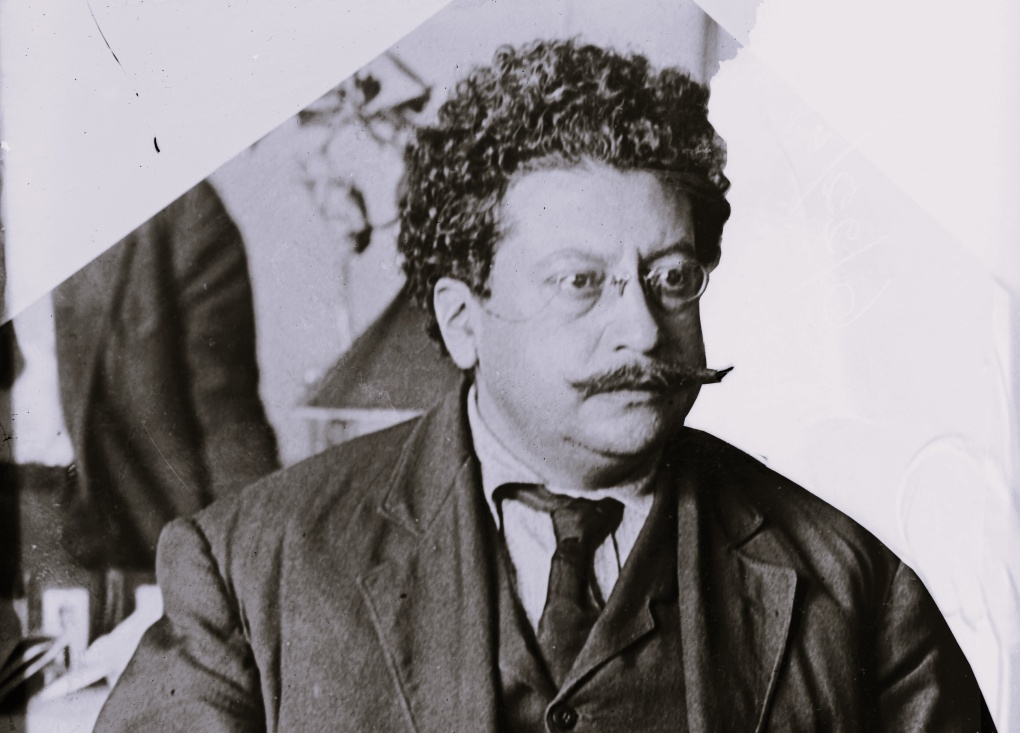
At the end of the Communist Manifesto is a list of demands, the first on that list is ‘the abolition of property in land.’ Without control of a material space, of land, a revolution is immaterial and impossible. Here, Magon on the Revolution’s attempt to make it real.
‘Land!’ by Ricardo Flores Magon from Regeneración (Los Angeles). No. 122. January 1, 1913.
At this very moment millions of human being are casting sad looks to heaven, hoping to find there–beyond the stars they see–that something which is to them everything; because it has been the aim and object of all the grief-stricken efforts and painful battle of the species, Man, from the day when his hesitating footsteps bore him a handbreadth in advance of the unreasoning species. That something is happiness.
Happiness! Happiness is not of this world, say the religions. Happiness is in heaven; there, beyond the tomb. And the human herd lifts up its eyes and, knowing nothing of heaven, thinks that it is there, in the far away; whereas it has its feet on this planet, which, with its brother stars, constitutes the glory and the grandeur of the firmament.
The Earth forms part of heaven, and humanity, by that very fact, is now in heaven. We should not raise our eyes in the hope of finding happiness behind those stars which make our nights so beautiful. Happiness is here; on the Earth Star, and it is not to be conquered by prayers or won by supplications, entreaties, humiliations or floods of tears. It must be battled for on foot and with force, because the Earth Gods are not like those of the religions, who can be softened by supplication and entreaty. The Earth Gods have soldiers, they have policemen, they have judges, they have hangmen, they have penitentiaries, they have scaffolds, they have laws, they have all that constitutes what are known as institutions–rugged mountains which hinder the human race from stretching out its arm and possessing itself of the Earth; making it its own and bringing it under that subjection which would result in happiness being the patrimony of all and not the exclusive privilege of the few who today withhold it from the others.
The Earth is the property of all. When, millions and millions of years ago, the Earth had not yet separated itself from the chaotic cluster which, as time passed on, was to dower the Firmament with new suns; and when, as the result of gradual cooling, planets became more or less fitted for organic life, this planet had no owner. Neither did the Earth have any owner when humanity was converting every old tree-trunk and every mountain cavern into a dwelling place and a refuge from the inclemency of the weather and from wild beasts. Neither did the Earth have an owner when humanity, having advanced still farther along the thorny path of progress, had reached the pastoral period, in which there were pastures whereon, the tribe, which held its herd in common, settled. The first owner appeared with the first man who had slaves to work his fields, and who, that he might make himself master of those slaves and of those fields, found it necessary to take up arms and levy war against a hostile tribe. Violence, then, was the origin of private property in land, and by violence it has been upheld to our own days.
Invasions, wars of conquest, political revolutions, wars for the control of markets, and acts of spoliation carried through by governors or those under their protection–these constitute the titles to private property in land; titles sealed with the blood and enslavement of humanity. Yet this monstrous origin of a right which is absurd, since it is based on crime, does not hinder the law from calling that right “sacred,” inasmuch as those who have withheld the land are the very ones who have written the law.
Private property in land is based on crime, and, by that very fact, is an immoral institution. That institution is the fount of all the ills that afflict the human being. Vice, crime, prostitution, despotism, are born of it. For its protection there have become necessary the army, the judiciary, parliament, police, the prison, the scaffold, the church, the government and a swarm of employes and drones, supported by the very ones who have not so much as a clod of earth on which to rest their heads, since they have come into life after the Earth has been divided up among a few bandits who appropriated it by force, or among the ascendants of those bandits, who have come into possession through the so-called right of inheritance.
The Earth is the element from which everything necessary for life is extracted or produced. From it are extracted the useful metals, coal, rock, sand, lime, salts. By its cultivation we produce every kind of fruit, for nourishment and pleasure. Its prairies yield food for the cattle; its forests offer us their woods, its fountains are the generative waters of life and beauty. And all this belongs to a few; makes happy a few; gives power to a few; though nature made it for all.
Of this tremendous injustice are born all the ills that afflict the human species and produce its misery. Misery makes man vile; misery prostitutes him; misery pushes him to crime; misery bestializes the face, the body and the intelligence.
Degraded, and–what is worse–unconscious of their shame, generations succeed one another, living in the midst of wealth and abundance without tasting that happiness a few have monopolized. With the Earth belonging to a few, these who possess none of it must hire themselves to those who do possess it, if they are to keep their hides and skeletons on foot. The humiliation of hire or hunger–this is the dilemma with which private property in land faces each as he enters life; an iron dilemma which forces humanity itself to put on itself the chains of slavery, if it would avoid perishing by starvation or giving itself up to crime or prostitution.
Ask yourselves today why government oppress, why men rob and murder, why women prostitute themselves? Behind the iron bars of those charnel houses of body and soul which men call prisons, thousands of unfortunates are paying in torture of body and agony of sold, for that crime which the law has lifted into the category of a sacred right–private property in land. In the defiling atmosphere of the house of public prostitution thousands of young women are prostituting their bodies and crippling their self-respect, as the result of private property in land. In the asylums, in the hospitals, in the foundling institutions, in all those gloomy abodes wherein misery, abandonment and human misery take refuge, men and women, the aged and the child, are suffering from the consequences of private property in land. And convicts and beggars, the prostitute, the orphan and the infirm are lifting their eyes to heaven; in the hope of finding there, beyond the stars which they can see, that happiness of which the owners of this Earth are robbing them.
And the human herd, unconscious of its right to life, turns and bends its back to develop by its toil for others this Earth which nature has placed at its own service, thus perpetuating by its own submissiveness the empire of injustice.
But, from the slavish and bemired mass rebels arise; from a sea of backs there emerge the heads of the first revolutionists. The herd trembles, for it foresees chastisement. Tyranny trembles, for it foresees attack. And, breaking the silence, a shout, like the roar of thunder, rolls over the backs and reaches even to the thrones: “The Land!”
“The Land” shouted the Gracchi. “The Land!” shouted Munzer’s Anabaptists. “The Land!” shouted Bakounine. “The Land!” shouted Ferrer. “The Land!” shouts the Mexican Revolution; and this shout, drowned a hundred times in blood during the course of ages; this shout, which echoes the thought guarded affectionately in all times by the rebels of our planet; this hallowed shout will bring the heaven of which the mystics dream down to this vale of tears, when the human herd ceases to throw sad glances at the infinite and fixes itself here on this planet, which shrinks with shame at the thought that, amid the splendor and grandeur of its celestial brothers, it has to drag along the leprosy of human misery.
Silent slaves of the clod; resigned peons of the field; throw down the plough! The clarions of Acayucan and Jimenez, of Palomas and Las Vacas, of Viesca and Valladolid are calling you to war; that you may take possession of this Earth to which you give your sweat, though it denies you its fruits because you have consented, in your submissiveness, that idle hands should become masters of what belongs to you, of what belongs to all humanity, of what cannot belong to a few but to all men and women who, by the very fact that they are living, have a right to profit in common, by reason of their toil, all, that wealth which the Earth is capable of producing.
Slaves! Take the Winchester in hand! Work the Land, but only after you have taken it into your own possession! To work it now is to rivet your chains, for you are producing more wealth for the masters, and wealth is power, wealth is strength, physical and moral, and the strong will hold you always in subjection. Be strong yourselves! Be strong and rich, all of you, by making yourselves masters of the Land! But for this you need the gun. Buy it or borrow it, in the last resort! Throw yourselves into the struggle, shouting with all your strength–“Land and Liberty!”
(From the Spanish of Ricardo Flores Magon, in “Regeneracion” of Oct. 10, 1910. Translated by Wm. C. Owen.)
Escrito Por Trabajadores Y Para Los Trabajadores. Regeneración is easily one of the most important, radical Spanish-language papers in U.S. history, and given its role in an actual revolution, one of the most important in any language. Regeneración was the official organ of the Mexican Liberal Party, an anarchist and later anarcho-syndicalist party. The paper was founded in 1900 by Flores Magón brothers; Jesús published the paper with his brothers Ricardo and Enrique writing, and Liberal Party leader Anselmo Figueroa editing. With imprisonment, illegality, revolution, exile, and war getting in the way of publishing, the paper went through several phases since its beginnings. In 1904, the paper moved its production to San Antonio, then St. Louis, and then Los Angeles where it would stay for nearly a decade. Jesús returned to Mexico City where he published a more moderate version of Regeneración, while Ricardo continued published the increasingly radical one in the U.S. Regeneración, expanded with the revolution, and in 1910, the paper added in English language section, edited by British anarchist William Charles Owen. With natural allies in the growing I.W.W., the paper served as an organizing tool in the Mexican Revolution and was instrumental in popularizing the struggle with U.S. audiences and workers. 20,000 copies were circulated weekly at its height. The paper ran afoul of the U.S. authorities well before the rest of the left did in World War One and ended printing for good in 1918. Ricardo Flores Magón was in constant legal battles until his final arrest in the 1918 Palmer Raids for violation of the Espionage Act, along with thousands of other radicals. He died, some say was murdered, in Leavenworth Prison on November 21, 1922.
PDF of full issue: https://www.marxists.org/history/usa/pubs/regeneracion/1913/n122-jan-01-1913-reg-eng.pdf

