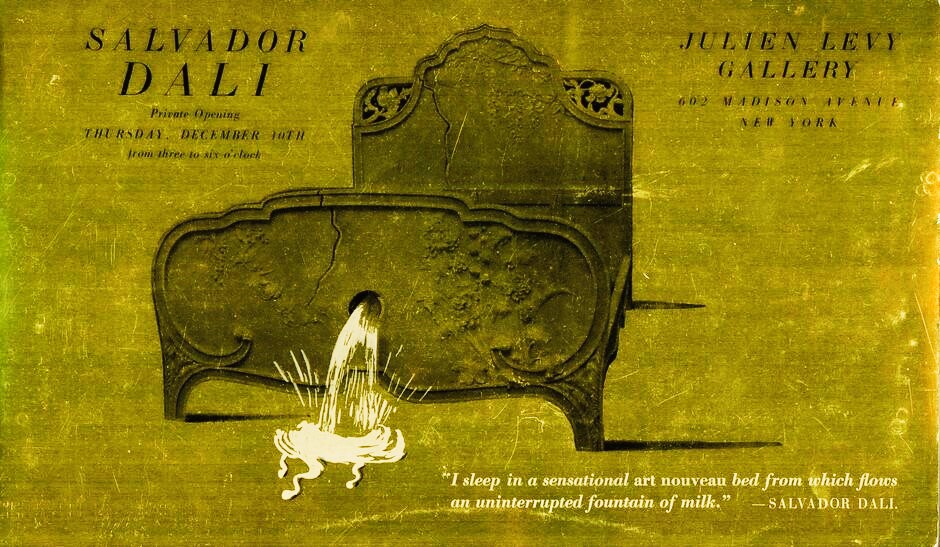
The New Masses art critic reviews Dali’s November-December, 1934 solo showing at New York’s Julien Levy Gallery, which introduced many in the U.S. to his work, and created a media sensation around it.
‘Salvador Dali, or Life is a Nightmare’ by Stephen Alexander from New Masses. Vol. 13 No. 11. December 11, 1934.
WITH the award of the big Carnegie International prize to Peter Blume’s surrealist enigma, and an honorable mention to Salvador Dali, the surrealists suddenly came to the fore in this season’s art activities. The surrealists have had some influence on a few of our artists and in view of the present exhibition of paintings by Salvador Dali (at the Julien Levy Gallery), it is important to consider not only the work of Dali, but the bigger problems raised by the surrealist school.
The abstractionists in modern painting had hardly had time to achieve a limited acceptance and favor in Europe, when in the second decade of this century a slowly-gathering revolt began against the obvious sterility of abstract painting, which denied validity to the “subject.” In Paris a small group, under the leadership of André Breton, their poet and theoretician, was going to attain “absolute reality by solving the disparity between dream and reality.” It was about this time that Freud and his school were coming into wide vogue and not only were artists and writers strongly influenced by him but considerable numbers of the intelligentsia in all walks of life began to learn about the Id, Libido, Ego, Super-Ego, and the Oedipus complex. To the surrealist group Freud’s theories about dreams and their significance must have seemed like the revelation of this world’s last mysteries. Now they understood all about human behavior. So armed with the magic key to the “secret of it all” they began to work away at revealing in paint the Eternal Enigma to a waiting world. These artists may be divided roughly into two main groups: those who used a mystic symbolism (supposedly Freudian), and whose effort remained just as confusedly abstract and meaningless as the abstractions against which they had revolted…(such as Miro, Picabia, Masson, Arp, Léger, Tanguy, etc.)…and those who developed a realistic technique (relatively speaking) to portray the various elements out of which their compositions are built…(mainly Viollier and Dali). Dali has carried this “realism of the unreal” to such a high degree of technical perfection that we can consider him the best exponent of the surrealist school. He, of all of them, has come closest to doing what they have been trying to do. In fact he has done it so perfectly that he can go no further in that direction. He can only repeat himself.
Let us look at these paintings. Here are exquisitely-painted phantasmagoria, stereoscopically real. Pictures of nightmares, weird, grotesque, comic, or gruesome, as the case may be. The titles are quite apt, and may help to convey a better idea of what the paintings are like. Here are a few:
2. Skull and its lyric appendage leaning on a commode which should have the temperature of a cardinal’s nest.
4. The weaning of furniture-nutrition.
15. Paranoiac-astral image.
17. Hypnagogical image of Gala.
Well, what do these paintings mean? In 1932 Julien Levy wrote:
These new painters attempt to discover a world that is objective, non-abstract, meaningful and yet inaccessible to the camera. They depict a world of the subconscious imagination more real than conventional reality, fantastic in so far that it is opposed to the logic of our own everyday life. The surrealist paints the inner significance of the external world.
What is this “inner significance of the external world”? If it is in these paintings it is very well hidden. M. Dali lives in France, I believe. Evidently it does not strike him as absurd that an artist, supposedly intelligent, living in a Europe torn to the death by a struggle between two classes, should paint dreams and hallucinations of the insane as his idea of “reality.” The struggles of the French workers against French imperialism are apparently not real for M. Dali. The tragic and bloody suppression of the workers’ revolt in his native Spain is, I suppose, not real enough. Only dreams are real for M. Dali. Well, perhaps these phantasmagoria are significant to psychopaths, neurotics, and mystics, but where is there in them any relevance to the “external world,” the world we are living in today? What relevance have they for the workers, white-collar employees, professionals, and intellectuals whose reality today consists mainly of starvation wages, exploitation, unemployment, insecurity, fear of war, and increasing misery? These realities that the great majority of working people know and feel do indeed breed neuroses of all sorts, it is true, but M. Dali’s paintings tell us nothing about them.
However they do tell us something about the “inner significance of the external world” which M. Dali never intended them to…a significance of which he is probably unaware. It is no mere accident that M. Dali concerns himself with insanity, abnormal psychology, and psychoanalytic theories. No more than there is accident in the similar characteristics to be found in the poetry of Gertrude Stein. These paintings, like Gertrude Stein’s poetry, are significant only as a pathologic symptom of a decaying society. They are the reflection of the insane nightmare that life under capitalism has become. That is the real meaning of these paintings.
The New Masses was the continuation of Workers Monthly which began publishing in 1924 as a merger of the ‘Liberator’, the Trade Union Educational League magazine ‘Labor Herald’, and Friends of Soviet Russia’s monthly ‘Soviet Russia Pictorial’ as an explicitly Communist Party publication, but drawing in a wide range of contributors and sympathizers. In 1927 Workers Monthly ceased and The New Masses began. A major left cultural magazine of the late 1920s and early 1940s, the early editors of The New Masses included Hugo Gellert, John F. Sloan, Max Eastman, Mike Gold, and Joseph Freeman. Writers included William Carlos Williams, Theodore Dreiser, John Dos Passos, Upton Sinclair, Richard Wright, Ralph Ellison, Dorothy Parker, Dorothy Day, John Breecher, Langston Hughes, Eugene O’Neill, Rex Stout and Ernest Hemingway. Artists included Hugo Gellert, Stuart Davis, Boardman Robinson, Wanda Gag, William Gropper and Otto Soglow. Over time, the New Masses became narrower politically and the articles more commentary than comment. However, particularly in it first years, New Masses was the epitome of the era’s finest revolutionary cultural and artistic traditions.
PDF of full issue: https://www.marxists.org/history/usa/pubs/new-masses/1934/v13n11-dec-11-1934-NM.pdf

