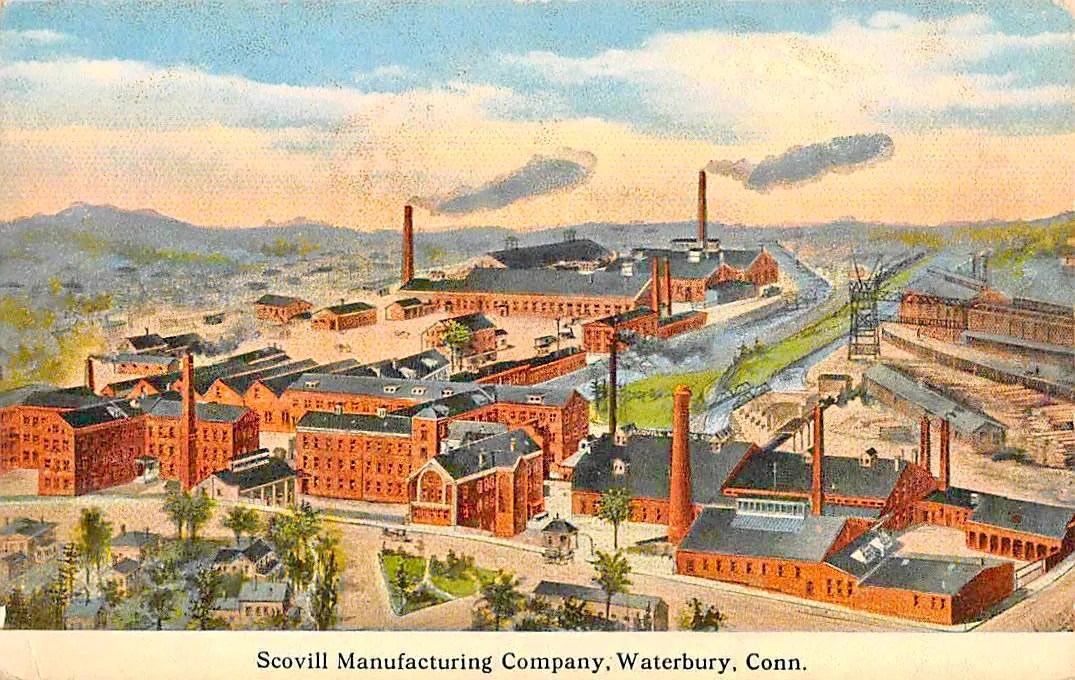
Ten weeks into a strike of nearly 20,000, mostly foreign-born workers, in the center of the brass industry, Waterbury, Connecticut and a confrontation with police took the life of 19 year old striker Alberto Tiso (Liberto Liso below) and saw the National Guard called out.
‘Brass Workers Have Hard Struggle in Connecticut’ from Butte Daily Bulletin. Vol. 2 No. 267. July 1, 1920.
Guns Used in Pitched Battle Between Gunmen and Strikers. To Carry on Strike to the End.
Waterbury, Conn. Stubborn determination by nearly 20,000 brass workers to win their strike, now in its tenth week, continues although the “casualty” list after yesterday’s riot shows one striker dead, several suffering with minor wounds, and seven held on $10,000 bail each for assault with Intent to murder. In spite of the appeals made to the strikers last night by Consular Agent DiCicco of New Haven, the unskilled workmen voted unanimously to carry the strike to a successful conclusion.
It was first announced from St. Mary’s hospital that one lieutenant of police, John J. Bergin, was fatally shot. Then it was announced upon authoritative information that he had died but that the death, and all deaths, were to be kept from the public. Today it is known definitely that Bergin is alive and will recover unless pneumonic complications set in. Lieutenant R.F. LeRoy’s gunshot wound is serious but he will recover. So that there are no deaths among the police.
Liberto Liso, a young striker, of Italian or Portuguese blood, who is charged with shooting the two lieutenants, and was himself riddled with bullets, died four hours after the shooting. He was 19 years of age, and is believed to have been the only one among the strikers with a gun. Strikers deny Liso had a gun but a holster was found on his body at the hospital. Strikers also claim the police began the shooting. Witnesses, mostly women in houses near the scene of the riot, deny this but say that the police had their guns drawn.
It is not understood that any of the seven strikers under arrest are believed to have had any hand in the shooting because not even the police claim anybody but Liso shot at them. Consequently it is thought the seven are held rather as witnesses than as accomplices.
The trouble arose over an attempt of the police to stop mass picketing at the plant of Scovill Manufacturing company at noon hour. The strikers were having a parade about the end of the plant, walking on the sidewalk and in the rear, when the police ordered them to disperse. The street upon which they were marching is a public thoroughfare, but such processions constitute a misdemeanor in Waterbury and are known as “parading without a permit.” The police pulled their revolvers, and shooting began. At the first sound of shots the mass of strikers broke up and fled in all directions with the police in pursuit.) Police reserves with rifles, city guardsmen (military) with bayoneted rifles and machine guns were rushed to the scene, but these had nothing to do because the “mob” had disappeared by the time the heavy artillery arrived.
Today, companies of the state guard, Connecticut militia, are patrolling some of the streets by order of Governor Holcomb. Ordering out the militia is the first sign of recognition by the state of Connecticut that an industrial struggle of more than two months existed within its borders.
The strikers are all brass workers, skilled and unskilled, numbering about 17,000. About 14,000 of these are foreign born laborers. Italian, Lithuanians, Russians, Portuguese and Spanish, with membership in the New England Workers’ association, a purely local organization without competent leadership. The skilled men are being led by the International Association of Machinists. These have had no part in the mass picketing and were not in the riot. The unskilled men have a soup kitchen and are meeting financial difficulties by soliciting aid from fraternal societies, and small business men throughout the vicinity.
Waterbury is the center of the brass industry of America. Here are the mills of the American Brass company, the Chase Companies, Inc. and the Scoville Manufacturing company, probably the three biggest brass and bronze products producers in the country. The American Brass company also has mills in Ansonia and Torrington, neighbors of Waterbury, but mills in these places are not affected by the strike. In fact they are working overtime. The American Brass company also has mills in Buffalo and in Wisconsin, presumably working.
The demands of the strikers are more money, an eight-hour day and shop committees. No recognition of any union is sought. The manufacturers refuse to meet any committee of strikers.
Until yesterday’s riot, strike meetings, in halls or in the open, had been permitted by the police although parades, processions and demonstrations were forbidden. Now all meetings have been forbidden without special permit, and no special permits are going to be granted.
The owners of the brass plants in this city dominate every department of life in Waterbury. The board of safety which has to do with the police department is at all times under the thumb of Ralph E. Day, assistant superintendent of the American Brass company, who besides being on the board of safety is an alderman. One of the judges who sits in cases involving alleged intimidations by strikers is the son of the vice president of the Waterbury Clock company, which is seriously affected by the strike. The chief of police was taken from a local factory to supervise the police force some years ago. Machine guns were brought to Waterbury weeks before the strike began, but thus far the strikers have given them no opportunity for their use.
The cost of living in Waterbury is at the root of the present trouble. Rents have increased 100 per cent, sugar has sold as high as 35 cents, everything has been sky-high. Sugar profiteering has been carried on openly without any governmental interference. Waterbury has no “flying squadron” of the department of justice, except when a “radical” or two are discovered. Then the department of justice acts with amazing speed. For the past two years Waterbury has been a favorite haunt of “radical” baiters.
he Butte Daily Bulletin began in 1917 in reaction to the labor wars in Montana, the Speculator Mine fire killing 168 miners; IWW organizing, and the murder of IWW organizer Frank Little in Butte. Future Communist leader and IWW organizer William F. Dunne and R. Bruce Smith, president of the Butte Typographical Union published the paper as an outgrowth of a strike bulletin with the masthead reading, “We Preach the Class Struggle in the Interests of the Workers as a Class.” It became daily in August 1918 and in September 1818 officers raided their offices and arrested Dunne and Smith on sedition charges. An extremely combative revolutionary paper, while unaligned, it supported the struggles of the Left Wing in the SP, reflecting the large radical Irish working class of Butte also supported Ireland’s and the Bolshevik revolution, as well as the continued campaigns of the IWW locally and national as well as the issues in Butte. It ran until May 31, 1921.

