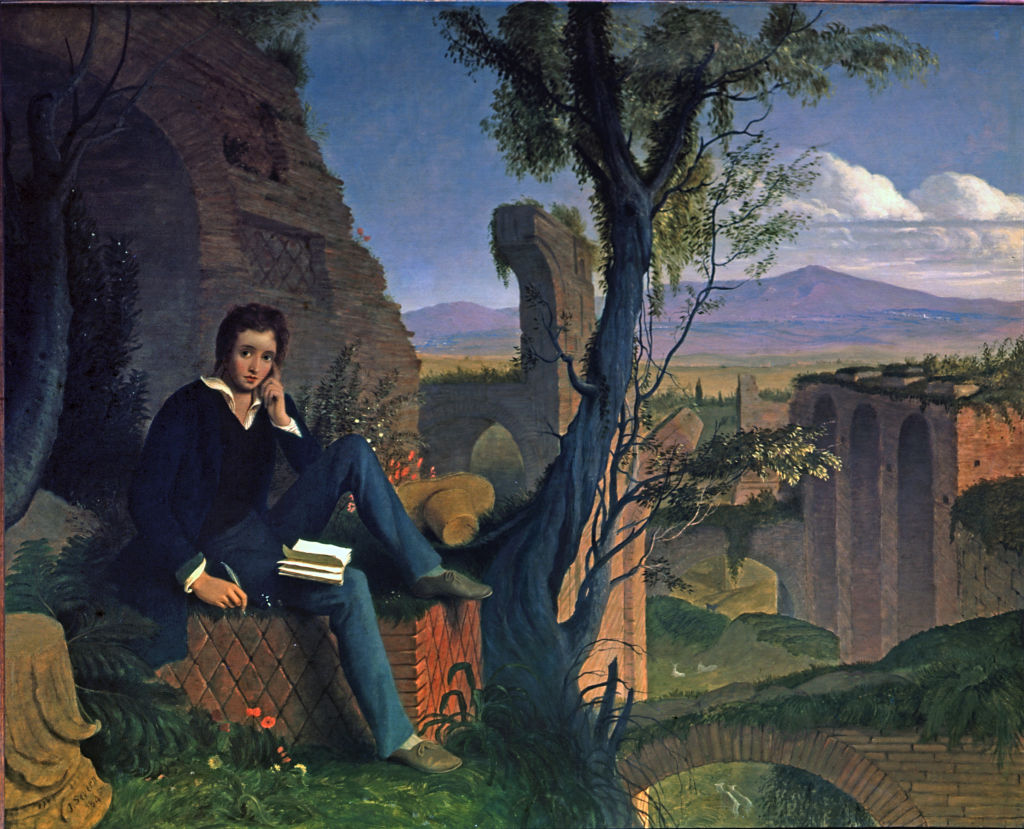
A survey from Percy Bysshe Shelley to Upton Sinclair. Later blacklisted for articles like this, Robert Morss Lovett was long-time professor of English Literature at the University of Chicago and President of the League for Industrial Democracy.
‘The Literature of Revolt’ by Robert Morss Lovett from Student Outlook (S.L.I.D.). Vol. 2 No. 1. November, 1933.
THE FRENCH REVOLUTION was the first great example of revolt as a mass movement. Hitherto rebellion had been impersonated by outstanding personalities, individual heroes. The French Revolution had plenty of such figures, Lafayette, Mirabeau, Danton, Robespierre–how quickly they came and went! Behind them all, however, there was the tremendous power of the people, the mob, which Carlyle was the first historian to recognize in its terrible, unconscious energy.
The influence of the Revolution upon the English romantic poets of the early nineteenth century is shown by the prevalence of the revolt motif. Southey commemorated the rebellion of the workers and peasants in the reign of Richard Second by his drama Wat Tyler, full of excellent proletarian doctrine, discovered and published to the poet laureate’s confusion, long after he had recanted. Byron wrote the poetry of protest during the Tory reaction, typifying under the theological rebellion of Cain and the political conspiracy of Marino Fabiero, the social unrest of all Europe. But the poet of revolution par excellence is, of course, Shelley. His Queen Mab is, I suppose, seldom read today. It is a rhythmic handbook of philosophic anarchy.
Power, like a desolating pestilence,
Pollutes whate’er it touches; and obedience,
Bane of all genius, virtue, freedom, truth,
Makes slaves of men, and of the human frame
A mechanized automaton.
The Revolt of Islam is perhaps even less read; but it is the most completely revolutionary epic in existence, a record not only of the phenomena of revolution, but also of its psychology. The Masque of Anarchy, written after the massacre of English workers at Manchester, is one of the most tremendous arraignments of power in the literature of politics.
I met Murder on the way–
He had a masque like Castlereagh.
Very smooth he looked, yet grim;
Seven bloodhounds followed him.
And finally in the conclusion to Prometheus Unbound, he has set forth in one imperishable stanza the whole ideal of the revolutionist:
To suffer woes which hope thinks infinite;
To forgive wrongs darker than death or night;
To defy power which seems omnipotent;
To love and bear; to hope till hope creates
From its wan wreck the thing it contemplates;
Neither to change, nor falter, nor repent;
This, like thy glory, Titan, is to be
Good, great, and joyous, beautiful and free;
This is alone Life, Joy, Empire, and Victory!
In the years before the French Revolution there developed in England a vigorous fiction of revolt. William Godwin, Shelley’s father-in-law, wrote a profoundly revolutionary critique of the British constitution under the title An Enquiry into the Principles of Political Justice. The finding of this enquiry is that all power of man over man is essentially wrong. This thesis Godwin made the basis of a novel called The Way Things Are, or Caleb Williams, which is a precursor of the novel of social purpose as practised by Dickens, Kingsley, Mrs. Gaskell, Charles Reade, and others. This school of social fiction in the eighteenth century was crushed by the French Revolution, not to resume operations until two generations later. Meanwhile the novels of Sir Walter Scott in their celebration of the past became a powerful reactionary influence. They covered with the ivy of romance the decaying institutions of feudalism which Burke defended. There is one great virtue in Scott’s novels which becomes a literary value of the highest sort–that is, loyalty in the feudal sense, loyalty of the vassal to his lord, loyalty of the clansman to his chief. Everyone remembers the fine scene in Waverley where Evan dhu Maccomlich, on trial with his chief for treason, offers his own life and that of six of his clan if Vich Ian Vohr may go free. Now loyalty in this sense was dissolved by the industrial system. Only for a short time, while capitalism was practised in small units, did the personal bond between employer and worker count for much. Instead there developed an intra class loyalty which we call solidarity. This was accounted a revolutionary symptom of the most menacing character. The combination of workers to fix wages or hours was in England a capital crime, and a century ago four or five farm laborers in Sussex were transported for making such an agreement. This form of loyalty–solidarity–was the basis of the labor movement in the nineteenth century. When the social motive reappears in fiction, the inevitable conflict which was later to be called the class war was perceived by Disraeli, with his uncanny prescience, and set forth by him in his powerful novel Sybil, three years before Marx announced the discovery in The Communist Manifesto.
“Two nations; between whom there is no intercourse and no sympathy; who are as ignorant of each other’s habits, thoughts, and feelings, as if they were dwellers in different zones, or inhabitants of different planets; who are formed by a different breeding, are fed by a different food, are ordered by different manners, and are not governed by the same laws.”
The problem of individual freedom versus class loyalty was attacked by Dickens in Hard Times and Charles Reade in Put Yourself in His Place, which is a terrific arraignment of the unions for their persecution of the independent workman. The right of the workers to organize and to compel loyalty to the organization is explained by Mrs. Gaskell in two novels, Mary Barton and North and South, written out of her own experience as what we should call a social worker–she called it being the wife of a Unitarian clergyman at Manchester. In North and South the heroine is appalled at the cruelty with which the union ostracizes a worker who will not join it. A worker replies:
“He laughed grimly. “My lass,” said he, “yo’re but a young wench, but don’t yo think I can keep three people that Bessy, and Mary, and me–on sixteen shilling a week? Dun you think it’s for mysel’ I’m striking work at this time? It’s just as much in the cause of others as yon soldier–only m’appen the cause he dies for is just that of somebody he never clapt eyes on, nor heerd on all his born days, while I take up John Boucher’s cause, as lives next door but one, wi’ a sickly wife, and eight childer, none on ’em factory age; and I don’t take up his cause only, though he’s a poor good-for-nought, as can only manage two looms at a time, but I take up th’ cause o’ justice.””
Finally, the motive of loyalty toward the close of the nineteenth century takes a new form and inspires some of the most eloquent writing, if not the greatest literature, of that age. It becomes the loyalty of the privileged class to the unprivileged. This motive determined the later work of three writers who had already won the highest fame in criticism, fiction, and poetry–Ruskin, Tolstoy, Morris. Ruskin turned from art criticism to social criticism in Unto This Last which remains still one of the most powerful pleas for social justice. Tolstoy had become by the publication of Anna Karenina in 1878 the leading novelist of Europe. He went to Moscow as a social worker in 1882 and became a revolutionist. His “What to do?” gives a personal answer to the social problem:
“I saw that the cause of the sufferings and depravity of men lies in the fact that some men are in bondage to others; and therefore I come to the obvious conclusion that if I want to help men, I have first of all to leave off causing those very misfortunes which I want to remedy,–in other words, I must not share in the enslaving of men. I was led to the enslaving of men by the circumstance that from my infancy I had been accustomed not to work, but to utilize the labor of others, and I have been living in a society which is not only accustomed to this slavery, but justifies it by all kinds of sophistry, clever and foolish. I came to the following simple conclusion, that, in order to avoid causing the sufferings and depravity of men, I ought to make other men work for me as little as possible, and to work myself as much as possible.”
William Morris was an artist and a craftsman, the poet of the Earthly Paradise who called himself “the idle singer of an empty day,” when he, like Ruskin, realized that art could not exist in a world of social injustice. He joined the Marxians in 1883 and spoke some of the boldest words of his generation in favor of the social revolution.
Morris in his lectures represents the social revolution according to the formula set forth by Marx and Engels in the Communist Manifesto of 1848, an inevitable movement under inexorable economic forces which in the breaking down of capitalism and the increasing misery of the working class result in the dictatorship of the proletariat, the seizure of raw materials and instruments of production, and the establishment of the cooperative commonwealth. Marxism envisages a period of ruthless exercise of power such as we witness today in Russia, but this not the ultimate stage of communism. When men have learned the lesson of cooperation so that they practise it voluntarily and unconsciously, then human society will take on the gracious and generous form which is in harmony with the best that we know of human nature. Morris has imagined the experience of a wanderer from our present day into this world of the future in that most lovely of all Utopian Romances, News from Nowhere, or An Epoch of Rest.
This Utopian dream brings Morris close to another representative of the loyalty of the privileged to the unprivileged, Peter Kropotkin. Kropotkin is of a revolutionary creed opposed to Marx, one which holds that all power is in its nature wrong, that mankind can advance directly into a state of society depending on voluntary cooperation. An anarchist–we politely put the adjective philosophic before it he is the successor of Godwin and Shelley.
It is a remarkable fact that the Autobiography of this extreme radical, the Memoirs of a Revolutionist, is the book through which more American readers have approached the subject of revolution than through any other. It was first published in the conservative magazine The Atlantic Monthly, and now can be obtained from the conservative publishing house of Houghton Mifflin Co. for one dollar. It reveals a most attractive personality, a man filled with love for humanity and belief in the human race, who in this faith would abolish all government, all power of man over man, and in service of this ideal would endure all hardships of poverty, imprisonment, exile risk, all dangers even to death.
Kropotkin’s Memoirs introduced to the American reader a new type of character and experience, a new order of literary values. Our conception of revolution had been limited to the political revolution of which the Daughters of the American Revolution keep bright the memory. Kropotkin illustrates the value of the approach to social theory through human experience–that is, the literary approach. We have had another striking exemplification of this in Emma Goldman’s Living My Life, published last year. And in general for readers who wish to follow in literature the theme of revolt, biography may be prescribed for the first steps. The letters of Alexander Herzen, the life of Marx by Ruhle, the life of Marx’s great rival, Bakunin, the life of Jaures, the life and letters of Rosa Luxembourg–Red Rose, who with Liebknecht fell victim to reaction at the close of the World War, as Jaures at its beginning. The life of Ferdinand Lassalle has been the basis of a literature of its own. The leader of the International Workingmen’s Association in the early sixties he achieved such power in Germany as to bring Bismarck into negotiation with a movement which he hated. He fell in love with Helene von Dönnigers, of an aristocratic family, and was mortally wounded in a duel with a representative of her family. Lassalle’s Leiden was a book of a popularity not incomparable to that of Werther’s Leiden, a century before. George Meredith made this famous love story the theme of his novel The Tragic Comedians. But the best study of Lassalle as a revolutionist is that by Georg Brandes.
In the department of historical writing the literature of revolt is subject to a handicap. History is chiefly written from the point of view of the victors in the class struggle. The history of the French revolution in English is colored by the nationalistic prejudice which developed during the long war which England waged against that movement. Yet Carlyle, as I have pointed out, was the first to see the importance of the mass movement, the people, the mob, as the groundswell of revolution. Carlyle’s French Revolution is a high peak in the literature of revolt-literature, I say, because it is not only a narrative of events but much more a record of the emotional state with which Carlyle reacted to them–it is, in other words, expressionistic history. In French literature the Revolution has naturally been a theme of highest importance. Here again, the reaction blasted the leaders’ reputations and presented them as monsters to frighten children. Of the revolutionary triumvirate, Danton was the first to emerge from the shadows as a great personality. Romain Rolland made him the subject of a tragedy. Robespierre has been rescued from obloquy by the labors of M. Mathiez, I suppose it is fair to assume that Anatole France had Robespierre in mind when he created the hero of that intensive study of revolutionary psychology–The Gods are Athirst. Marat still awaits his apologist. It will be hard for him to make headway against the romantic interest in Charlotte Corday. The story of the Paris Commune of 1871 has been told only by the conquerors. It remains the most conspicuous example of the injustice of history. What is needed at the present time is a factual and impartial history of the revolutionary movement in Europe since 1848–but those who control material like those who merely guess at it, find it difficult to be impartial.
The theme of revolt has penetrated fiction, drama, and especially the moving picture. In America two outstanding cases of social wrong, that of Sacco and Vanzetti and that of Tom Mooney have been the suggestion for novels and plays–Upton Sinclair’s Boston is a powerful example of the journalistic novel and in its heroine, Cornelia, Thornwell who leaves her family and station as dowager of a governor of Massachusetts, to earn her bread in the Plymouth Cordage Company, it presents a striking study of the loyalty of the privileged to the submerged class. Gods of the Lightning by Maxwell Anderson is a play on the distortion of legal justice which follows the lines of the famous case. On its first night in New York the audience stood at its conclusion and applauded for twenty minutes, but it disappeared from the theatre soon afterwards, not without suspicion of discreet suppression.
The drama has always been a powerful instrument of propaganda. One characteristic of the modern stage is its utilization of mass effects, in such plays as Hauptmann’s Die Weber, the second part of Björnson’s Beyond Human Power, Galsworthy’s Strife and Toller’s Masse Mensch. Gorky’s Lower Depths while using selected types is a genuine drama of the Proletariat, as is Elmer Rice’s Street Scene. One of the keenest satires on the present social order was John Lawson’s Processional. The discovery of new material and realistic effects to be drawn from the hitherto submerged class, the signs of the emergence of a proletarian culture, and the romantic appeal of militancy are unquestionably motives inspiring the younger writers of poetry, fiction and drama today. The great rally of these men and women with other artists and intellectuals at Boston to protest against the judicial murder of Sacco and Vanzetti–Edna St. Vincent Millay, John Dos Passos, Paxton Hibben, Powers Hapgood, to mention only a few of them was an event in the history of American literature. It marks the beginning of a change in psychological climate. It was a significant fact that so many of the promising younger writers signed the manifestoes in favor of the radical candidates Norman Thomas and William Z. Foster in the last presidential election.
Should we welcome this new literature of revolt, or deprecate it? Clearly, if we are to expect a radical change in our social order we should welcome it as a preparation of the public mind. That such a change is impending who can doubt? Some years ago, however, Mr. Lyford Patterson Edwards published a volume entitled The Natural History of Revolution, in which he subjected contemporary society to a rough application of tests drawn from evolutionary geology and biology, and showed that we were in a catastrophic period, in which various phenomena indicated a revolutionary movement as certainly as the behavior of a stream and the contour of a mountain-side give warning of precipitous falls. Since Mr. Edwards wrote his book the symptoms have multiplied. The word revolution is no longer one to be expurgated from a sane vocabulary. Even official announcements recognize in cautious language the coming change. The report of the President’s Committee on Recent Social Trends expresses a pious disclaimer “of assuming an attitude of alarmist irresponsibility” but declares that “it would be highly negligent to gloss over the stark and bitter realities of the social situation.” To deal with them it prescribes “willingness and determination to undertake important integral changes in the reorganization of social life, including the economic and political orders”–that is to say in Professor John A. Hobson’s phrase, “revolution by consent,” but nevertheless, revolution. “The report in itself,” says the New Republic, “is both a revolutionary protest and a revolutionary act. It constitutes one of the most important of the processes of a great social change…Without this sort of activity by leaders of intelligence no social revolution, whether violent or non-violent, ever occurred.”
If great changes are to come–and John Stuart Mill said seventy years ago that if the choice were between the present social order and Marxian communism all the chances and dangers of the latter were as dust in the balance–it is of the utmost necessity that the minds of men should be prepared for them. Especially is this true if the changes are to take place without violent opposition and to become permanent. The great enemy of social change is that men having put their hands to the plow will turn back, and that there will be a period of ebb and flow, of disorder and violence, of unsettlement in which civilization and humanity itself may be thrown back, losing the gain made under political democracy and doubtful as we may at times think that gain, it is very real in the right it gives to initiate further advance, more fundamental reformation. If any great and permanent change is to take place in the conduct of human affairs, it is time, as Burke long ago said, that the minds of men must draw that way, that every emotion of hope and fear must forward it. To make opinion tolerant and flexible, to encourage speculation and experiment, to cultivate an aesthetic which will find self-interest vulgar and repulsive, which will purge the mind by pity and terror, pity for the wretched victims of society and terror of the wrath to come upon the oppressors and those who enjoy the fruits of oppression–this is the function of literature in a changing age.
Going through a series of names in the 1930s starting with Revolt, then Student Outlook, then New Frontiers, and finally Industrial Democracy these were the publications of the Socialist Party-allied National Student League for Industrial Democracy. The journal’s changes in part reflected the shifting organizations of the larger student movement.
PDF of full issue: https://www.marxists.org/history/usa/pubs/student-outlook/v02n01-nov-1933-student-outlook.pdf

