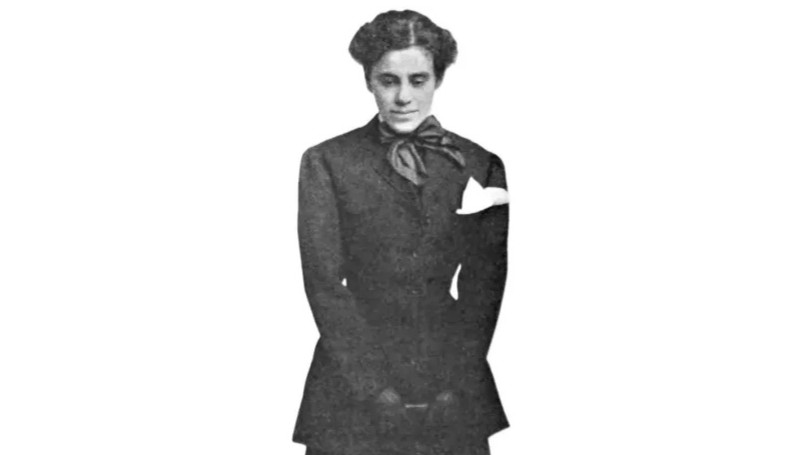
Not from a U.S. publication, but we are Mary E. Marcy completists. Here she is speaking to the premiere British journal of workers’ education on Marxist pedagogy.
‘Our Teaching Methods’ by Mary E. Marcy from Plebs. Vol. 14 No. 9. September,1921.
The following notes on the need for revision of our teaching methods coming from so successful a teacher of the elementary Student as Mary Marcy, will be read with interest by tutors and students alike. They are particularly timely just now when a new winter session is about to open.
FOR a long time I have wondered why we Marxists, who spend so much time and energy in propaganda and educational work, have not devoted more of our efforts to studying and working out scientific methods of teaching. Assuredly, the results of our labours are out of all proportion to what we hope to accomplish.
It is a pleasure to note that The PLEBS is interested in furthering this new and experimental branch of science. It occurs to me that some of the new experimental schools both in Russia and in America may afford a number of helpful suggestions which we may successfully appropriate.
Naturally the first aim of the efficient teacher should be to secure the attention of the student-to-be by making his starting point from things and conditions of interest to the student. We must learn to connect these with the subject we propose to teach. We must show that history, psychology, and particularly economics, possess a relation to his or her own experiences and conditions. Where new students have had no experience in the industries we must acquaint them with conditions, wages, profits, hours of labour, etc., through first-hand observations whenever possible. The beginner should never be approached with a study of abstractions of any science, but should be introduced to concrete, individual examples from which we can easily proceed to the abstract.
One reason why women and professional men so rarely actually absorb the fundamentals of Marxian economics, for instance, is because we have been accustomed to teaching from the abstract, and about abstract conditions and events foreign to their own personal knowledge and experience. These persons ought to be brought in touch with industry, either through personal visits to industrial plants or by close association with the workers in them, so that our theories may seem to them to apply to the actual conditions existing in society to-day. It would well repay those conducting classes to spend a few weeks in acquainting our women comrades or the professional students with industrial conditions, when their experiences have been in widely differing fields.
Careful questionings of students experienced in industry will often elicit replies truly Marxian from those wholly unfamiliar with the economic theories of Marx. Questions of hypothetical or actual conditions may be explained which students may themselves solve and explain. In this way the student learns to think for him or herself and feels that he is contributing toward the work the teacher is carrying on. The more we can interweave these contributions of students with the work we are trying to accomplish, the more eagerly will they study and investigate. And every step they take forward requires more study and more investigating in order that they may keep pace with their own knowledge and discoveries. The capitalist class considers the workers as empty vessels into which they may pour their erroneous, preconceived ideas and thus educate them to follow the rules of conduct the capitalists desire. Fortunately the workers are not nearly so much concerned with capitalist ideas of moral conduct as they are with the mis-called Public Opinion which seems to endorse them. I do not believe the working class is half so devoted to the system of private ownership of the means of production as we imagine it to be. But they bow to the will of what the capitalist press has taught them to call Public Opinion.
If this is true, our educational and propaganda work ought to be more successful. If certain working men possess no actual opinions, it ought to make it easier for us to teach and help them to become correct thinkers. Perhaps our numerous failures in the past have been due to the fact that we have regarded the workers somewhat as the capitalists have considered them: empty vessels into which we might pour our correct, preconceived ideas.
The old method of pedagogy does not develop students who think; who will be versatile in a labour or revolutionary crisis. Stuffing educational methods do not mean growth. New class struggles or labour Struggles leave them repeating the old phrases over and over again. New methods of capitalist attack disconcert them and find them unprepared. They lack adaptability.
Always, that which we teach must be shown to be related to life and industry. It must be shown to be vital to the working class. Classes, lectures, courses are given for the benefit of the students and not the teachers. We must attract and interest the student. When we fail to do this our failure is proof that we have not yet evolved a scientific system of socialist pedagogy.
MARY E. MARCY.
PDF of full issue: https://www.marxists.org/history/england/pubs/plebs/v14n09-sep-1922_The%20Plebs.pdf

