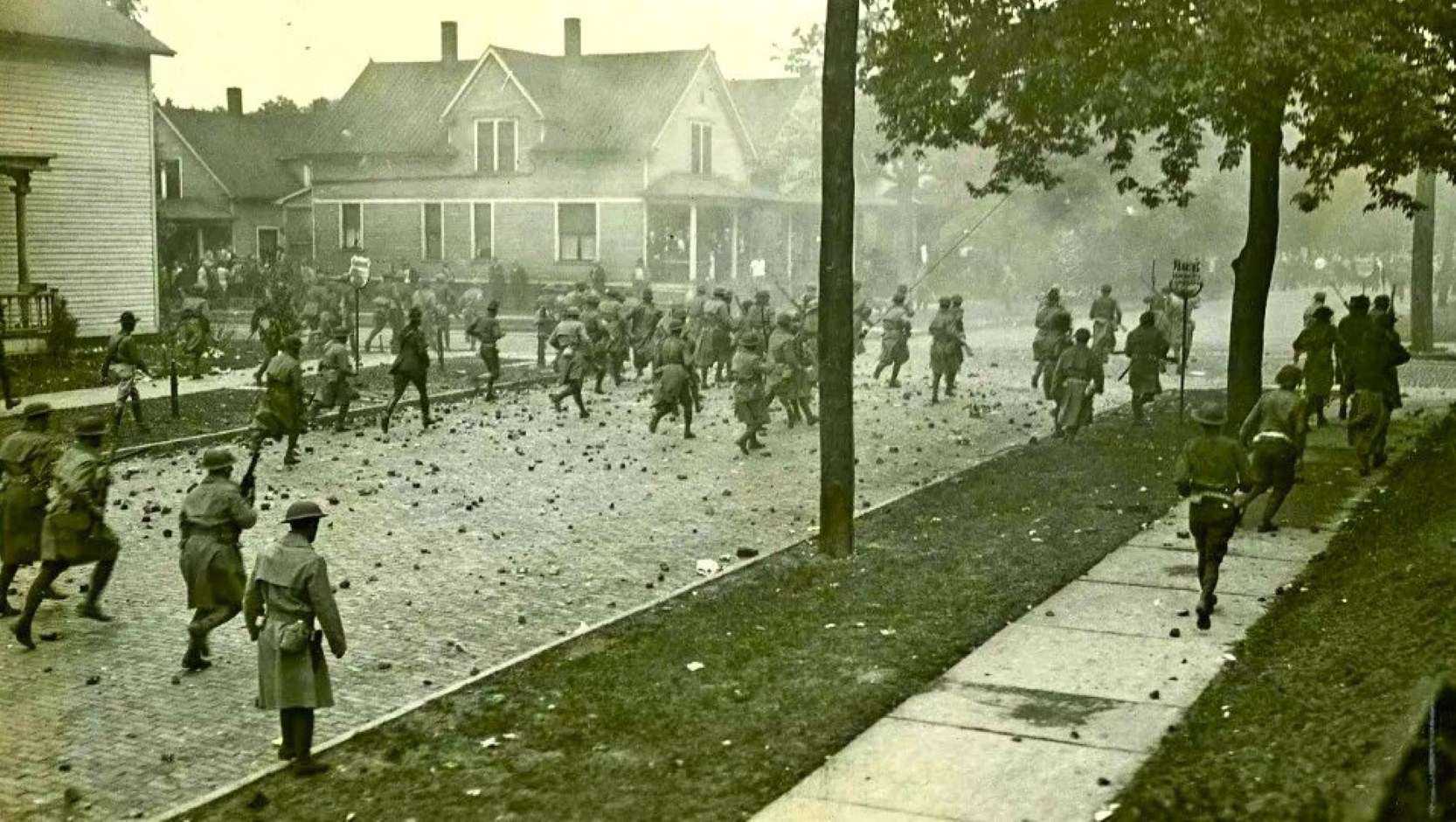
Toledo, on Lake Erie in northwestern Ohio, has a long and rich labor and Socialist history. Here is background to one of the key strikes of that turning-point year of 1934, the struggle at the Auto-Lite and Chevrolet plants led by the American Workers Party of A.J. Muste that soon involved much of working class Toledo. The struggle helped pave the way for the C.I.O. and the U.A.W. A key moment in the strike was the murder of two workers, Frank Hubay and Steve Cyigon by the National Guard on May 23.
‘General Strike Looms in Toledo’ from The Militant. Vol. 7 No. 22. June 2, 1934.
The state authorities of Toledo are making plans to establish martial law as the 110 unions affiliated with the A. F. of L. prepare to walk out in sympathy with the Auto-Lite workers. 68 unions have already voted for the general strike, while the workers of the Toledo Edison Company and its subsidiaries, the Defiance Light and Power Company and Lake Shore Power Company are scheduled to walk out as we go to press. Toledo has already recorded another page in the history of splendid labor battles.
The strike which started at the Electric Auto-Lite Company has cost the lives of two workers while over two hundred have been injured. The bosses and the state have used every means at their disposal to stem the growing militancy of the workers. But the latter have fought back tenaciously and unyieldingly. 31 workers have been arrested and are on trial for violating an injunction against picketing while others have been jailed on other pretexts. This has not however weakened their fighting spirit, or solidarity. The repercussion of the Toledo strike is now being felt from coast-to-coast.
A ware of resentment against the deceptions of the Roosevelt-NRA administration is sweeping the country. It is receiving its inspiration from Minneapolis and Toledo. In San Francisco, San Diego and New Orleans striking longshoremen are waging a militant struggle against the brutal terror of the po lice. Two members of the Communist League were arrested by the police of San Francisco for distributing leaflets to the striking longshoremen. The Amalgamated Association of Iron, Steel, and Tin Workers have decided upon a general strike for June 15th. The United Textile Workers of America threaten a general strike which will bring out 300,000 textile workers. These are but the first rumblings of the storm to come. The strikes are taking on more and more of a political character as the workers come in head-on collision with the forces of the state.
Background of the Struggle
The events leading up to the Toledo strike are as follows:
In June 1931, the Security-Home Trust Company, which held the bulk of the workers’ savings, closed its doors.
The workers were left penniless. Some of the executives of the bank were the very industrialists who used the workers’ money to expand the auto-parts industry. At the same time, three other important banks also closed their doors, after deceptively declaring that a 60 day notice must precede withdrawal of funds. The workers and small business men were stuck to the tune of 150 million dollars. Significantly enough, these banks were controlled by the interests which directed the destinies of the auto-parts industry in Toledo. Moreover, C.O. Miniger, president of the Auto-Lite Company, was a prominent member of the directorates of these four closed banks. In this strategic position he was able to salvage enough funds from the wreckage to keep his plants going. As usual, the workers. were left holding the bag, which Miniger had emptied.
This precipitated the gravest economic crisis in the history of Toledo. Out of a population of 400,000, at least 100,000 workers had to be fed and clothed from relief funds. In 1932, the jobless and moneyless workers had to stand in line like beggars asking for a handout. Miniger had stolen their money. The bank crash had closed most of the factories, leaving them jobless.
Riots broke out among the unemployed because of the inadequacy and inferior quality of the food.
The workers were getting restive under the whip-of hunger. They were losing all hope.
Tricked by Labor Board
A brief strike in February was ended by a truce agreement with the Regional Labor Board. This provided that both sides should negotiate the demands of the union, which included a twenty percent wage increase, a closed shop, better working conditions, recognition of the union, seniority rights, and no discrimination against union employees. The Regional Labor Board succeeded in sending the workers back to their jobs pending a settlement. Consequently the workers found themselves tricked because nothing came of the negotiations.
About five weeks ago the issue again came to a head. The workers, organized into the Automotive Federal Union, declared a second strike. Again the workers insisted that the bosses accede to their demands. The company refused. Instead it continued operations with strike- breakers.
The aroused workers went into action. They stormed the factory.
One striker, looking up at the broken windows of the plant, remarked: “They wanted an open shop-well, now they have it.” Then the National Guard was called in.
When the union organizer, Thomas J. Ramsey, attempted to restrain the workers, he was shoved aside. “To hell with the soldiers. Let’s drive them out of town.” Otto Brach, secretary of the Central Labor Union, bewailed the fact that he “could not do anything to control the boys now.”
No Delay on the General Strike!
The bosses answered the demands of the workers with tear and vomit gas. National Guardsmen, private detectives, thugs, special guards, police, and the most brutal reign of terror. And Governor White who was on a fishing trip stated that he would use the “entire force of the state…to insure life and property”. At the same time the Auto-Lite company, which pays its workers even below the miserable ENRA scale, announced that it will distribute its regular dividend of $71,000 to preferred stockholders. The immediate need of the moment is to intensify and develop the struggle. The strike-breaking role of the Labor Board and its multi-millionaire agent Charles P. Taft, the son of the late president, must be exposed. No illusion must be harbored as to the role of “mediators” and “arbitrators”. The splendid example of the role the women played in the Minneapolis strike must be utilized. The delay in calling sympathetic strikes plays into the hands of the bosses. The militants should press for immediate action from the Central Labor Council so that every labor union in the city of Toledo takes its stand with their striking brothers. The A. F. of L. bureaucracy must not be permitted to postpone the general strike any longer. Nothing can be expected from the strike-breaking Labor Board. The blow must be struck while the iron is hot. The workers have fought magnificently. They are learning to rely upon their own strength. It should be utilized to its fullest extent and every resource drawn upon. Labor defense and relief organizations should be set up immediately to take care of the needs of the workers in the struggle.
Unite in Support of Toledo!
The urgent need for uniting the forces of labor behind the Toledo strikers is emphasized by an announcement that the automotive industry “will back the Auto-Lite Company to the limit in its defiance of labor unions.” The Stalinists as usual are sabotaging all efforts for a united front. In New York City, a meeting called to protest the reign of terror in Toledo was answered by every organization approached with the expectation of the Stalinists who called a “united front” meeting of their own. The organizations participating in the meeting include the Socialist Party, the Communist League, the Lovestoneites, the Jewish Workers Party, the American Workers Party and the I.W.W. Similar meetings should be called throughout the country.
The strike wave spreading throughout the country opens grandiose perspectives for the development of the class struggle on a new level. The place of the militants now as ever is in the mass organizations of the workers where they can lead and guide their struggles.
The Militant was a weekly newspaper begun by supporters of the International Left Opposition recently expelled from the Communist Party in 1928 and published in New York City. Led by James P Cannon, Max Schacthman, Martin Abern, and others, the new organization called itself the Communist League of America (Opposition) and saw itself as an outside faction of both the Communist Party and the Comintern. After 1933, the group dropped ‘Opposition’ and advocated a new party and International. When the CLA fused with AJ Muste’s American Workers Party in late 1934, the paper became the New Militant as the organ of the newly formed Workers Party of the United States.
PDF of full issue: https://www.marxists.org/history/etol/newspape/themilitant/1934/jun-02-1934.pdf

