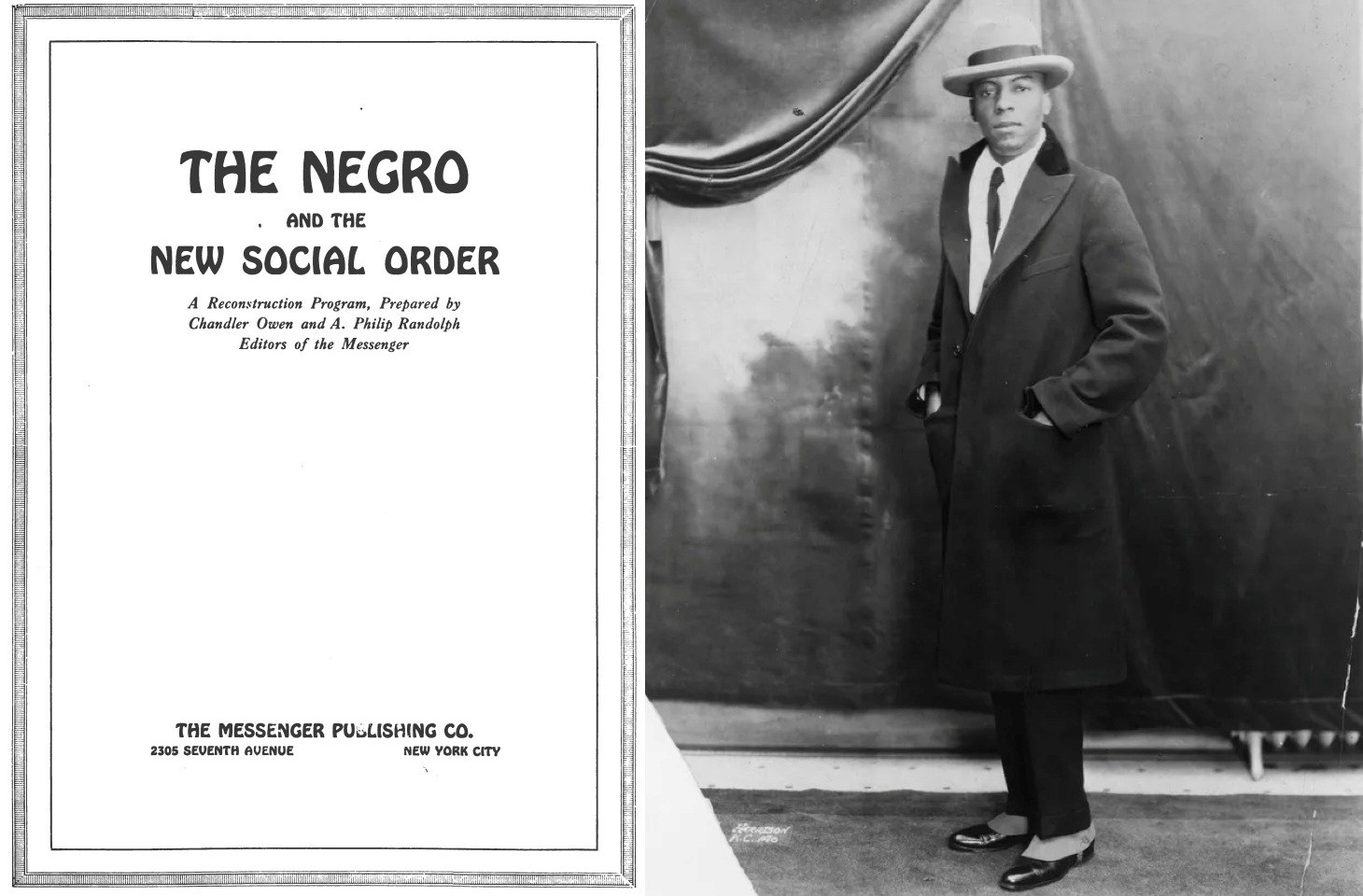
An important document from U.S. Socialist history. What must be among the earliest comprehensive programs put forward by Black Socialists, the editors of The Messenger with a manifesto on the new Reconstruction advocated in Black interests for institutions of industry, society, and government at the end of the First World War.
‘The Negro and the New Social Order: Reconstruction Program of the American Negro’ by A. Philip Randolph and Chandler Owen. Messenger Supplement. March, 1919.
INTRODUCTION
After every war reconstruction follows.
War is an abnormal social state in which the man-power and material resources are mobilized in order to function for destruction. Reconstruction is also an abnormal state in which the social, economic and political forces are organized to function in the interest of construction. But the issue is not between the relative merits of destruction and construction, as such, but as to the kind and purpose, in both instances. The social value of destruction and construction depends entirely upon the object of each. For instance, the destruction of slavery, or the Czar, is valuable; but the construction of the Klu Klux Klan or the Bastille is socially pernicious.
Our reconstruction task then is not merely the reconstituting, the re-building of our pre-war social machinery, but the reconstruction of our social machinery upon a new plan, which shall express the aims of a new spirit which is abroad in the land–a spirit of social service.
In America there are several groups of classes and races. Each has, to a certain extent, special problems, while all are affected by certain general problems.
Among the variegated reasons for divisions in the respective groups (the extreme physical oppositeness and the late emancipation from chattel slavery) which have resulted in widespread poverty and ignorance–present a sharp line of demarcation as respects the Negro.
The reconstruction program for the Negro must involve the introduction of the new social order–a democratic order in which human rights are recognized above property rights. We recognize, in sketching, in broad outline, this new order, that there can not be any separate and distinct principles for the social, political and economic emancipation of the Negro which are not applicable to all other people.
The reason why we present a special program for the Negro is that heretofore, in the United States, programs referring to “all persons,” “all people,” “all men,” have meant all white men. And, consequently, this has become a part of the public psychology. Hence, this brief explanation for our reconstruction program for the Negro.
DEMOBILIZATION
Demobilization must be so planfully conducted as to render the reabsorption of the released soldiers in the most facile manner possible. Men should not be held in the service and under the guise of military conscription be forced into industrial conscription, such as a recent use of Negroes from Camp Pike in the cotton fields of the south. Nor should the military imperialists, foreseeing their being flaunted in their purpose to fasten universal military training upon the country, attempt to make use of a quasi-universal training by undue detention of the conscripted men.
War work should cease at once wherever the work is strictly of a military nature, such as the making of munitions, uniforms, etc. Where possible, however, such work as may be easily converted into social industry should be immediately changed; as for instance, a sock factory for soldiers into a sock factory for civilians. The same is true of a uniform factory. But under no circumstances must military industry continue a day longer than necessary for military needs.
This clearly means that there will be many unemployed–both discharged soldiers and war workers. How may they be absorbed? First the inauguration of public works, such as, road building, canals, etc., and the increase in the building trades.
Second, there should be established, in the interest of creating a job for the jobless man, a universal thirty-four-hour work-week, as a means of enabling the jobless man to meet the manless job.
Third, there should be established a United States employment service to facilitate the placement of released soldiers and discharged munition workers in employment. This service should not supply any employer where a strike is on.
After all these things shall have been done there will still be able-bodied men and women willing to work but unable to secure employment. In order to meet this demand, there should be adopted a thorough-going, scientific system of social insurance, which shall be applicable not only to discharged soldiers and discharged war-workers, but also to any unemployed person able and willing to work. It is necessary to adopt a general policy to regulate employment for all unemployed persons, in order that the menace of unemployment may be entirely removed.
INDUSTRIAL PROGRAM
PEONAGE
Peonage is a system of industrial and agricultural serfdom. It prevents the free mobility of labor. It is supported and maintained by a group of reactionary labor contract laws which operate to fix the Negro worker and poor white farmer to the works, after they have accepted (being usually penniless) a money advance, for their transportation to the works and the maintenance of their families up to the first pay day. In the interest of industrial freedom, peonage or involuntary servitude should be abolished by the strict enforcement of the thirteenth amendment and the statutes against the system.
THE COMPANY STORE
The company store, at which Negro workers are compelled to trade, and which is run by the employer, in order to keep the mill or farm hands in debt by exacting excessively high prices for necessaries, should be abolished by statutory act.
TENANT FARMING
Tenant farming is an agricultural arrangement in which a part of the produce of the farmer is taken by the farm owner for the privilege to cultivate the farm. The share which is usually exacted is such as to result in the farm tenant eventually being reduced to a farm laborer. It is a revival of the old feudal matayer system which made possible the concentration of vast tracts of land in the hands of a few people. The Industrial Relations Commission states that three-fourths of the unused land of the country is held out of use for speculative purposes.
The United States Census of 1900 reveals this alarming condition: One-fourth of the total agricultural acreage of the United States is owned by .0006 per cent of the population. This has produced the social evil of absentee-landlordism. This system is inimical to both the producer or farmer and the consumer, in that it limits the production by holding land out of use, increases the cost of consumption by limiting the amount of goods produced, and produces poverty among the farm tenants by the high crop-liens levied.
With respect to the agricultural problems of the Negro farmer, we adopt, in toto, the agricultural plank in the 1918 Socialist Congressional platform, which reads as follows:
“Exploited by those in control of the railroads, the grain elevators, the creameries, the packing houses, cold storage plants, banks, agricultural machinery, as well as by other owners of land, capital and life’s necessities, many farmers have been reduced to a condition of poverty.
“Their ultimate interest and that of society at large may lie in the public or voluntary co-operative corporation of farms supplied with the most improved machinery and the services of scientific experts free scope being given to those farmers so desiring to continue individual operation. Immediately, however, the workers on the farms should be relieved of the oppression of big business which fixes the prices. Especially designed to afford relief in this direction, the Socialist Party pledges itself to the following:
1. Collective ownership of elevators, warehouses, flour mills, stockyards, packing houses, creameries, cold storage plants, and factories for the production of agricultural implements.
2. Public insurance against diseases of animals, diseases of plants, insect pests, hail, flood, drought, storm and fire.
3. The leasing of farm machinery by public bodies at cost.
4. The encouragement of co-operative societies for agricultural purposes.
5. The application of the land values tax to land held for speculation and exploitation; exemption of farm improvements from taxation.
6. The retention by the national, state and local government of all land owned by them, and the continuous acquirement of other land by reclamation, purchase, condemnation, taxation or otherwise, such land to be organized as rapidly as practicable into socially operated farms.
7. Encouragement of unions of agricultural workers.
8. Extension of labor laws to agriculture and the securing to agricultural laborers of minimum standards requisite for a healthy life and worthy citizenship.
9. We also call attention to the fact that the elimination of farm tenantry and the development of socially owned and operated agriculture resulting from the foregoing measures will open new opportunities to the agricultural wage-worker and free him from dependence on the private employer.”
The chief wealth of the Negro lies in his farms. According to the Census report of 1910, the Negro farmers owned 218,972 farms with a value of 440,992,439 dollars.
Unfortunately, the condition of race prejudice renders it unfeasible to secure a widespread farmers’ organization like the Non-Partisan League of the West, including both white and colored farmers, because the Negro’s farmlands, on the whole, are in the South, and it is there that race prejudice is highest.
We, therefore, recommend that the Negro farmers organize their own non-partisan league, establish their banks, flour mills, stores, and warehouses–not with a view to entrenching the spirit of race prejudice, but with a view to prying open the doors which do not now stand ajar in the white organizations.
On account of the widespread capitalist method of employing Negro labor as strike-breakers, convenient tools to break down the standard of living and then abandoning them after the settlement of the strike; and, also, on account of the labor unions’ neglect to organize their fellow black workers, we recommend the organization of black workers, men and women, into industrial labor unions for the specific and definite purpose of securing higher wages, shorter hours of work and better working conditions.
Where unions refuse black workers admission into them, the black workers should organize separate unions of their own; but where white unions are sufficiently enlightened to appreciate the menace of unorganized labor, white or black, to the march of industrial democracy, we recommend that the Negro workers combine with the white workers for the following reasons, outlined by the National Association for the Promotion of Labor Unionism Among Negroes:
First, as workers, black and white, we all have one common interest, viz., the getting of more wages, shorter hours, and better working conditions.
Black and white workers should combine for no other reason than that for which individual workers should combine, viz., to increase their bargaining power, which will enable them to get their demands.
Second, the history of the labor movement in America proves that the employing class recognize no race lines. They will exploit a white man as readily as a black man. They will exploit women as readily as men. They will even go to the extent of coining the labor, blood and suffering of children into dollars. The introduction of women and children into the factories proves that capitalists are only concerned with profits and that they will exploit any race or class in order to make profits, whether they be black or white men, black or white women or black or white children.
Third, it is apparent that every Negro worker or non-union man is a potential scab upon white union men and black union men.
Fourth, self-interest is the only principle upon which individuals or groups will act if they are sane. Thus, it is idle and vain to hope or expect Negro workers, out of work and who receive less wages when at work than white workers, to refuse to scab upon white workers when an opportunity presents itself.
Men will always seek to improve their conditions. When colored workers, as scabs, accept the wages against which white workers strike, they (the Negro workers) have definitely improved their conditions.
That is the only reason why colored workers scab upon white workers or why non-union white men scab upon white union men.
Every member, which is a part of the industrial machinery, must be organized, if labor would win its demands. Organized labor cannot afford to ignore any labor factor of production which organized capital does not ignore.
Fifth, if the employers can keep the white and black dogs, on account of race prejudice, fighting over a bone; the yellow capitalist dog will get away with the bone–the bone of profits. No union man’s standard of living is safe so long as there is a group of men and women who may be used as scabs and. whose standard of living is lower.
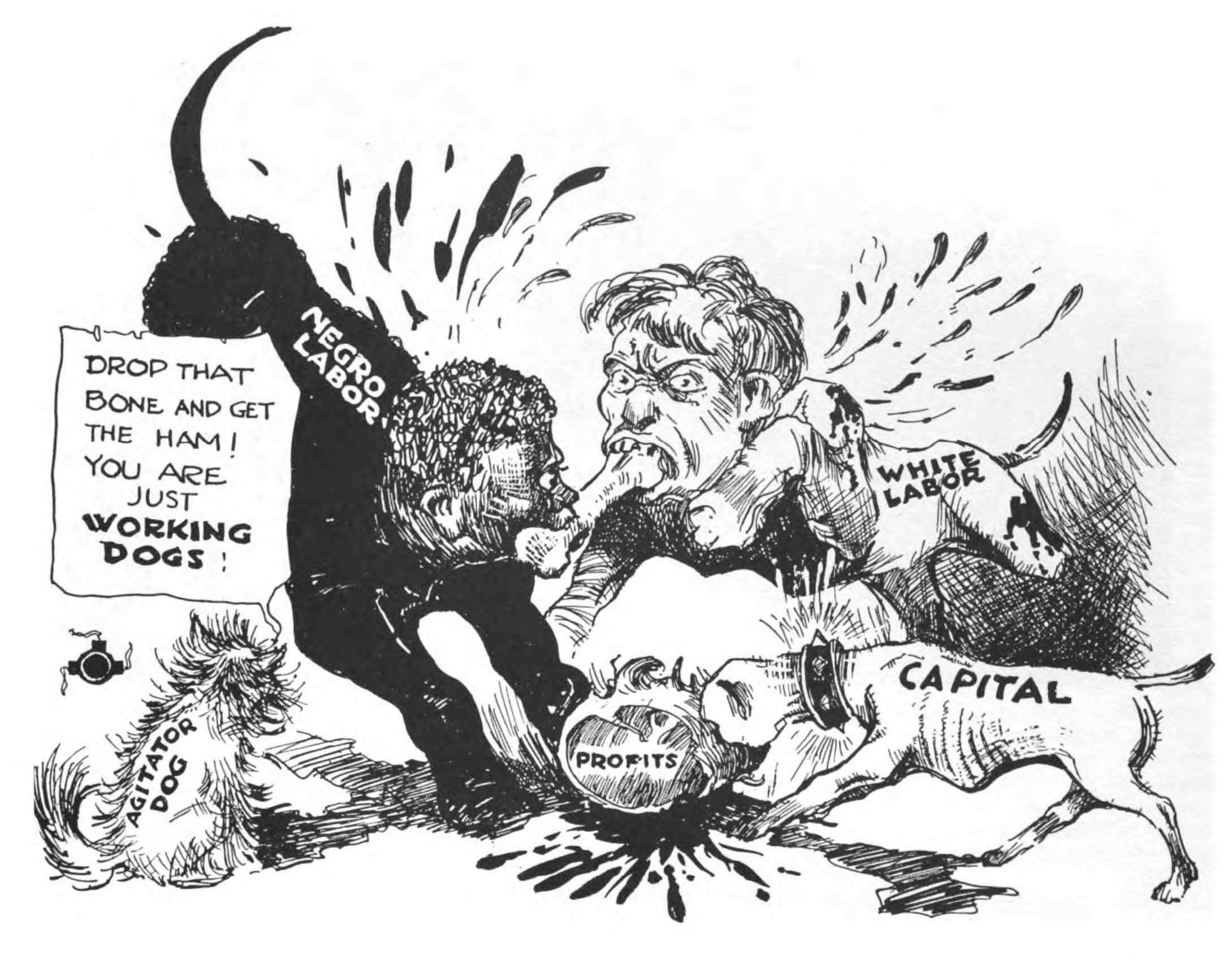
The combination of black and white workers will be a powerful lesson to the capitalists of the solidarity of labor. It will show that labor, black and white, is conscious of its interests and power. This will prove that unions are not based upon race lines, but upon class lines. This will serve to convert a class of workers, which has been used by the capitalist class to defeat organized labor, into an ardent, class conscious, intelligent, militant group.
SOCIO-INDUSTRIAL PSYCHIATRY
1. We oppose the use of the army or navy personnel or the militia either for the breaking or the suppression of strikes. And under no circumstances should white troops be used to break a strike of Negro workers, nor should Negro troops be used to break a strike of white workers. The reason is two-fold: first, the industrial effects are pernicious; and, second, the effect upon race relations is equally sinister, as it tends to inculcate, intensify and perpetuate race prejudice.
INDUSTRIAL ORGANIZATION POLICY
2. (a) We recommend that Negro workers join the Union which controls the industry in which they work, whether it be the American Federation of Labor, the I.W.W. or independent labor organizations, such as, the Amalgamated Clothing Workers of America and the International Federation of Hotel and Restaurant Workers.
We make this recommendation for this reason: We recognize the fundamental difference in principle between the A. F. of L., the I.W W. and the A.C.W. of A., I.F. of H. and R.W., yet we realize that, with regard to the black workers, the issue is chiefly getting them to understand the value of the principle of collective bargaining. The relative merits of pure and simple unionism and industrial unionism will assume their places of vantage in their class consciousness as their industrial education proceeds apace.
CHILD LABOR
(a) Child labor of black or white children under sixteen years of age should be prohibited by Federal and state statutes; and the same should be enforced by Federal inspection.
WOMAN LABOR
(a) No woman should be permitted to work in factory or field within the period of four months before and after child-birth.
(b) We recommend this measure because of the numberless cases of child-births to Negro women upon the Southern cotton fields and to white and colored women in factories.
EQUAL PAY FOR EQUAL WORK
(a) Under no circumstances should employers be permitted to establish two wage-scales for white and black workers, men or women doing similar work.
EQUAL OPPORTUNITY
(a) Negroes should be eligible to all government work upon a basis of merit. We protest against and condemn government advertisements for work bearing such inscriptions as the following, which frequently appeared during the war: “Enemy aliens and Negroes not wanted.”
Neither opportunity to work nor the wages for such work should vary on account of color, race or nationality.
SOCIAL INSURANCE
We recommend the adoption of the following social insurance measures:
(a) A national minimum wage for men and women workers;
(b) Legislation providing against sickness, old age, unemployment, maternity, injury, premature death. No discrimination should be made in the application of these measures on account of race, color or nationality.
CO-OPERATIVE MOVEMENT
(a) The high cost of living which affects Negroes more than any other class on account of the low wages they receive and the high rents they pay, may be effectively reduced by the formation of co-operative consumers’ associations.
We recommend that the government subsidize such associations, as has been done in Russia, Denmark and France.
POLITICAL PROGRAM
Political action must go hand in hand with industrial action. A class of people without the vote or the privilege of determining the kind of government under which they live, has neither security of life nor property from which liberty proceeds. This is shown by the numerous instances where Negroes of wealth have been driven from cities and counties where they live, own and pay taxes on property.
In view of the foregoing we demand the rigid enforcement of the 13th, 14th and 15th amendments to the Constitution which were primarily framed to give such protection to the Negroes, but have been prostituted to the service of corporations and trusts.
(N.B.–Of 228 cases which have been raised under the 14th amendment, only 26 have been related to the Negro, and in only four has any substantial relief been granted. In all the other cases the corporations took refuge under the amendment which is regarded by them as their Magna Charta.)
1. Reduction of Congressional Representation
We demand the reduction of representation in the South upon the basis of actual voting population. At the present time the Negro’s potential votes are counted as a means of determining and increasing the representation of the South in Congress, but the Negro is not allowed to vote. This is done in criminal violation of the federal constitution. We recognize, however, that the mere reduction of Southern representation is a negative force and does not insure to the Negroes their vote. Hence we go further and demand the enforcement of the 15th amendment. We condemn all property and educational tests for suffrage as being unsound, undemocratic and unjust. The history of democratic movements in Europe supports our contention as to the pernicious results of such tests.
2. Repeal of Vagrancy Laws
We demand the repeal of all vagrancy laws, decrees or orders, both state and national–both those adopted during the war just passed and those which still stand on the southern statute books as relics of reconstruction following the Civil War. These latter laws have been especially hard upon the Negroes of the South and have been used to fill the Southern prison camps, which supply the lumber mills, turpentine stills, cotton plantations and railroads with cheap peonage labor. They have also intrenched the system of peonage, which is chiefly responsible for lynchings in the South.
3. Federal Law Against Lynching
Just as economic, political and social reform cannot be left entirely unaided in other fields, they cannot be left alone to do their work in the abolition of lynching. To reach a field so broad and extensive, the arm of the law is needed. We are not sufficiently near the millennium to trust all men to do the right thing. Unfortunately some still have to be restrained and others punished.
It may rightly be said that we have a plenty of law now. What is needed is law enforcement–honest administration of the law. The states have laws against murder, homicide, manslaughter and conspiracy, sufficient to send to the chair or gallows every lyncher. Communities may be sued under the laws of most of the Southern and Western States. Indiana, Ohio, Alabama, South Carolina and Mississippi have laws which give the legal representatives of the lynched victim power and right to sue the county or city for large sums of money; in most cases not less than $1,000 or $2,000 and not more than $10,000 in some cases. Negro families have recovered as high as $5,000 and been paid in South Carolina.
Then, too, there are laws which would remove the sheriff if a prisoner is lynched–without regard to his negligence or responsibility. The legal representatives of the lynched victim, in some states, may recover from the county where the victim was in custody, and that county may recover from another county into which the victim may be carried off and lynched. This is done to stop evasion and fraud.
The much talked of Federal law against lynching is of some value, but the loopholes have seldom been discussed by the Negroes, at least, who so glibly talk about it with an air of cocksureness. The Federal law is especially thought of as a higher and more honestly administered law; and that is true. But either in Federal or State jurisdictions, the prejudiced communities will sit as jurors.
No, say the amateurs. We shall have change of venue. But change of venue, it must be remembered, will not be so favorably considered by the authorities, because that is a recourse usually taken by the defendant for his advantage, namely, in order that he, the defendant, may get a fair and impartial trial. In the proposed cases the lynchers, not the lynched, will be the defendants. Therefore, the plaintiffs would be asking a change of venue because of the greater probability of convicting the defendant. The courts would not be inclined to give ear to this plea.
But even if overriding the blandishments of local prejudice, venue should be granted, unless well stipulated and rather exceptionally, too–the change would be futile. For the general group of lynch-law states is so situated en bloc that the sentiment is sympathetic–about the same. And to try a man in Georgia for lynching a Negro in Florida would be merely beating the winds.
Nevertheless, exceptional cases often require exceptional remedies, and we favor the government’s prescribing such remedies.
We favor a Federal law against lynching. Its penalty ought to be very drastic.
It ought to remove automatically any sheriff whose prisoner is taken from him–without regard to his negligence or good faith. (This will remove all inducement for fraud and collusion.)
It ought to bond the sheriff, with a provision therein that the bond is to go automatically to the victim’s legal representatives upon the lynching of such individual.
The County or City should be liable to the legal representatives for damages automatically, without regard to negligence or intent. The policy of dispensing with intent or negligence is not new to the law, but is adopted in many cases because it tends to make every citizen interested in the enforcement of the law. It makes every citizen interested in the enforcement of right living on the part of his fellows, when each citizen suffers by his fellow citizen’s breach of good faith.
In order to check this lionizing of such negligent sheriffs, the law should make them ineligible for re-election to such office.
If the prisoner is taken out of custody in one county and lynched in another, the legal representatives should be indemnified by the county where the prisoner was in custody, and the county from which the prisoner was taken should recover from the county in which the prisoner was lynched.
Now the objects of both civil and criminal laws are (1) to repair damages, (2) to deter from committing damages, and (3) to punish for violations of the law. All three methods are effective.
Punitive measures are needed to override the present daring defiance of and contempt for, the law. If a few lynchers were executed, we venture to say that this gentle chivalry of the United States would become very unpopular.
Deterrent effects would follow the certainty of the law’s strong arm. As all criminologists know, certainty of punishment is a greater deterrent than severity and more desirable, too. Make the way of the transgressors hard and the arm of the law certain and strong, and you deal lynching a death blow.
And, finally, when the taxpayers have to pay for these lynchings, they are going to stop the source of the expense. When the bonding companies give bond, they are going to protect their bonds. The counties don’t want to pay out five or ten thousand dollars. The sheriff wants his position–his job. He needs the money. And, remember, that it is not cowardice, or inability of the sheriffs to prevent lynchings that cause their prisoners to be taken from them. Not at all. It is simply their sympathy with the mob! But sympathy goes aflying when the sheriff has to pay $5,000 for sympathy. He always sympathizes with his pocket-book most.
4. Jim Crow Laws
Officially and publicly our government is ashamed of its policy of segregation. This has been frequently shown by its attempts to suppress Negro publications exposing this criminal practice. Despite this admission by implication, the Negroes in the South of these United States are set apart as though they were lepers and herded together like cattle when riding upon the railroads for which they pay first class fare. There was a time when under the cover of state’s rights the government claimed that it was unable to interfere with the policies of the states on such matters.
But the railroads are fortunately no longer in private hands and subject to the whims and caprices of the separate states. They are controlled by the government which does not even have to call upon Congress to pass a law to abolish Jim Crowism. It may be done by official order or decree over night, just as the Railroad Director abolished liquor on the railroads even before the Prohibition Amendment was ratified.
We, therefore, demand that the Administration forthwith, both because of its fundamental, social and economic justice, and as tangible evidence of its professions of democratic purpose–give orders to the Director General of the Railroads to issue a decree abolishing the Jim Crow car in every state in the Union where such practice obtains, such action to take effect immediately upon the issuance of the said decree.
5. Industrial Control
“The private domination of industry for private gain has brought such disastrous consequences both among and within the nations of the world as to make public ownership for public service the first necessity in any forward-looking plan of reconstruction both for the nation and the Negro.
“We, therefore, demand that all public utilities and basic industries of the United States be taken over by the people, and that this process shall be undertaken as speedily as is consistent with public order and security, and allowing for the utmost possible degree of local autonomy.”
We demand the full and permanent nationalization of the railroads and other means of transportation such as canals, waterways, etc., steamships and steamship lines, telegraph and telephone lines, power, such as coal mines, oil wells and water power; also large scale industry such as stock yards, grain elevators, flour mills and lumber lands.
This means a reduced cost of food, clothing and fuel, as well as of telephone and telegraph messages, all of which the Negro must use daily and frequently. It will operate to increase the wages of Negro employees, both actually and relatively, because the government pays a larger money income, while the lower price paid for goods and services will increase the purchasing power of the dollar. The government can do this because it pays no profits to private individuals, but runs these utilities for service of the public.
6. Civil Service
The spoils and patronage policies which have characterized all past and present administrations–both Republican and Democratic–have struck at the root of justice, fair play and efficiency. The Negroes have been especially the victims of this notorious, reactionary, corrupt and sinister policy subtly inaugurated, intrenched and perpetuated by an “holy alliance” of a motley crew of hypocritical Republicans and Negro-hating Democrats.
We demand the reconstruction and democratic reorganization of our entire civil service. The merit system alone should be introduced and strictly and scrupulously adhered to. Neither the examiners of the applicants’ papers, nor the appointers of the successful applicants should have any knowledge as to the race, color, nationality, creed or political faith of the applicant. The system of requiring pictures to be submitted should be abolished. Also the rule that any one of the three highest may be selected when a vacancy occurs–should be abolished. The highest on the list should always receive the appointment.
We recommend the establishment of democratic management in civil service works where the employees shall have representatives on the committees or boards which determine the conditions of employment.
The right of collective bargaining, strikes, and organization should not be denied to government employees. The courts should not have the power to issue injunctions against their strikes.
7. Immigration and Emigration
No law should be passed excluding foreigners because of color, race or nationality, nor should these conditions be invoked to prevent any people from owning land.
Free egress and ingress between countries should be unrestricted just as it is between the states of the U.S. Passports should be conditioned on nothing except disease, which precaution is manifestly necessary for the public protection. Neither economic nor political philosophy of persons desiring to leave or come into the country should be invoked against them.
We especially oppose the setting up of criminal records as a bar to immigration, because crime is such a relative term that under the present system of society vast numbers of persons are indicted and convicted for no other crime than that of protecting the public welfare and preventing its systematic exploitation by sinister, privileged and predatory interests. (N.B.–History records that one of the most enlightened countries of the world is Switzerland, which opened its doors to the immigration of the political criminals of Europe, and became a general asylum for the oppressed. It, therefore, received the best elements of all lands, while such lands were emasculated of their most virile intellectual and social benefactors.)
8. Taxation
In 1876 it was alleged that taxation without representation is tyranny, and that it produced the Revolutionary War. We in 1919 reaffirm that taxation without representation is tyranny. We hereby demand that in no political division of the U.S. shall an individual be taxed without receiving representation, whatever his color, race or nationality;
We advocate a radical revision of our system and methods of taxation to the end that all indirect taxes on consumers’ goods shall be abolished. Taxes should be placed upon those most able to bear them. We therefore favor:
1. A progressive income tax, aiming at the abolition of all incomes, above the needs of a comfortable and secure livelihood. 2. A progressive inheritance tax, rising to 100% in large estates. 3. Taxation of the unearned increment of land; all lands held out of use to be taxed at full rental value. 4. A more adequate corporations tax.
These taxes will be of special benefit to the Negro because he buys almost exclusively consumers’ goods, as do the large majority of working white people. He buys little or no producers’ goods, since there are but few Negro capitalists, manufacturers or large bonanza agriculturists.
9. Woman Suffrage
We favor the adoption of the Susan B. Anthony amendment to the Constitution, granting suffrage to women–both white and colored.
10. We favor proportional representation as being the most democratic basis of representation.
11. We favor the initiative referendum and recall.
SOCIAL PROGRAM
Education
(a) Our present educational system is archaic and antiquated. It was formulated in a period when conditions were entirely different from conditions as they are today. The system is now vestigial and no more applicable to present conditions than the flint locks of Continental soldiers would have been in modern warfare with Krupps. Our system of education was not calculated to, and does not supply the mind with useful information.
The object of true education is two-fold: one, the popular dissemination of useful information; two, the stimulation of invention and discovery.
We, therefore, favor the adoption of the following measures:
(1) A system of universal and compulsory education. Every child up to the age of eighteen years should be compelled to go through an approved system of technical and scientific courses.
(2) The extension of high school facilities and the increase in the number of common schools.
(3) A complete revision and change in curricula by a commission of able educational experts. We recommend the teaching of a thorough course in the physical sciences, sociology, economics, and history in the high schools; the subordination of the dead languages, such as Latin and Greek, the Bible and many of the valueless English classics.
(4) We favor a definite increase in the pay of teachers and condemn any variation in the pay, based upon race, color, or nationality. They should also be permitted to organize, collectively bargain working conditions, and strike for more pay, shorter hours and better
(5) The school terms in the rural districts in the South should be extended to eight months in every year.
(6) We demand that equal appropriations be made for white and black children alike.
(7) The school buildings should be uniform in numbers in proportion to population, and equipment, and should be used for all community interests. There should be no bar to the use of the school by any organization whose program does not include the physical destruction of the school plant.
Public Education
(8) A systematic course of public lectures on all subjects should be carried on in the school auditorium for the general education of the community. These lectures should be especially devoted to political, social and economic problems.
(9) All political parties should have access to the school, free of charge, during and after political campaigns. No trick should be used to prevent the use of the school by requiring parties to secure a certain enrolled vote, or vote cast for them, as a condition to qualifying.
(10) Public libraries owned and controlled in toto by the municipality should be established. No censorship should be exercised in the selection of books beyond a reasonable demand for literary form and freedom from obscenity or indecency.
No private contributions should be accepted by the municipality or state for the use of these libraries, but such monies as are needed for their equipment, maintenance and development should be applied from the funds raised through taxation.
The library auditorium, too, should be used for educational meetings, lectures and similar affairs.
CIVIL RIGHTS
Social Equality
We favor “Social equality” in every sense of the phrase. We demand a new order based upon a society of equals. Evasions, pretexts and excuses cannot explain away the fact that no genuine brotherhood can exist so long as the issue of social equality is not squarely met. Democracy cannot exist upon a foundation of caste. We cannot work side by side in factory, field and office and then maintain that we cannot sit side by side in restaurant, theatre, and public conveyance.
How may social equality be achieved? History shows that the growth of equality–political, social and economic–has grown out of the two cardinal and corollary principles of identity of treatment and free interchangeability.
In politics, equality was formally established by the abolition of plural voting and the granting of one vote only–identity of representation–to each man. Before the ballot box, this raised the peasant to the level of the lord.
In economics, the principle is the same. The only guarantee of the equal value of money is its free interchangeability. Anyone may get hold of anybody else’s coin without thereby increasing or decreasing its value.
Identity of opportunity to workmen is an essential basis of equality.
Free interchangeability has been the chief factor in the developing of national equality. China’s wall keeping out goods, persons and ideas arrested her civilization. Africa’s lack of good seaports and coast lines prevented free intercourse with other nations and retarded her development. Even Japan marked time until Perry carried the light of Western European civilization into her oriental backwardness in 1850.
Socially, free interchangeability has been an indescribable impetus to civilization. With railroads and steamships to inter-transport property and persons and books, with the development of the telephone, telegraph and ocean cables for the exchange of ideas, the introduction of exchange professors in universities, where the lecturers of the University of Berlin, Paris or Oxford exchange places for a year or so with the professors and lecturers in Harvard, Yale and Columbia, with the development of the associated press flashing the same news throughout the world–the free interchangeability of ideas, information and science has wrought a wonderful approach to educational equality which has been a marked social advance.
We now approach the American bugaboo–the question upon which Negroes and whites alike evade, equivocate, compromise and set up false theories in flagrant violation and defiance of the most fundamental principles of social evolution. We refer to intermarriage between the whites and Negroes. We favor the intermarriage between any sane, grown persons who desire to marry–whatever their race or color. We favor the intermarriage of white men with colored women as well as colored men with white women. Why?
First, there is no natural or instinctive aversion to this as shown by our four million mullatoes in the United States–most of whom are in the South where it is alleged that the strongest natural antipathy and race antagonism obtain.
Secondly, according to the ablest sociologists, anthropologists and socio-biologists, such as Jacques Loeb, Lester F. Ward, Franz Boas and Maurice Parmalee, society is the beneficiary of race miscegenation. They cite, as instances in proof, the type and character of the offspring of two dissimilar races. In botany and stirpiculture this principle is also found to be basically sound. European crown heads are social manifestations of its effect in maintaining good feeling. Tribal history also confirms it where the chieftains of tribes intermarried among each other’s daughters as a means of truce and keeping the peace.
Third, it is supported by monistic philosophy in that the more complex combinations are the higher and most useful racial forms and organic structures.
Fourth, race purity is both a myth and without any value. There is no pure race in the world. The Indian was probably more nearly so than anybody else, and his inability to assimilate may be a partial explanation of his approximate extinction.
Any restrictions upon intermarriage are particularly objectionable with respect to the subjection and oppression of the Negro woman, the reason being that the Negro woman who becomes the victim of the lust of a southern white man and gives birth to an illegitimate child, has no action or redress in the courts of law to protect either the child or herself. Moreover, with our present social conventions an illegitimate child is the object of reproach, nor can it inherit property of the father.
Again Southern whites claim that mullatoes are particularly brilliant because of the white blood in their veins. Without passing on the soundness or scientific value of this contention, one very logically asks whether it makes a difference if the mullato gets his white blood from a white mother or a white father.
We therefore demand the repeal of all laws against intermarriage as being inimical to the interests of both races. We further call attention to the fact that there is no desire to check the associations of white men with colored women, colored women with white men, nor to serve any interests of Negro men. And inasmuch as no law requires any woman under any circumstances to marry a man whom she does not will or want to marry, these laws narrow themselves down to the prevention of white women marrying colored men whom they desire to marry.
Moreover, social history in the South records in the ineradicable faces of four million mullatoes that there is “social equality galore after dark” when the blackness of night enables the human desires to take their free, unhindered, natural and proper course.
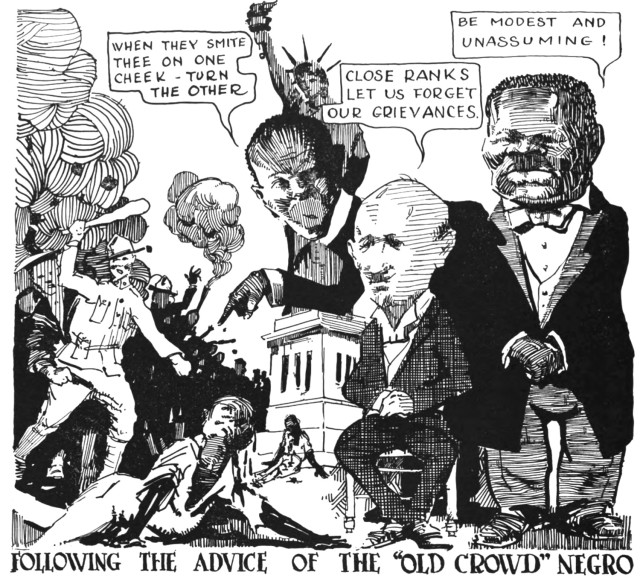
We repudiate and condemn any pretense at opposition to Jim Crowism, segregation and all forms of discrimination which does not accept the principle of social equality, since it is upon the fallacious theory of inequality and racial inferiority that all these evils are established and continued. We do not accept the doctrine of old, reactionary Negroes that the Negro is satisfied to be to himself. We desire as much contact and intercourse–social, economic and political–as is possible between the races. This is not because of our belief in the inferiority or superiority of either race, but because of our recognition that the principle of social equality is the only sure guarantee of social progress–the inevitable trend of evolution.
CIVIL LIBERTIES
Civil liberty in the United States is dead. Any true reconstruction program must deal with its resuscitation and its reintroduction into American life. Civil liberty for the Negro, however, was dead even before the war, killed by a combination of an hypocritical North and an unregenerate South who colluded to sweep from the Negro his last vestige of liberty.
We therefore demand:
(1) The immediate release of all political prisoners as well as persons now imprisoned for their opinions on economic and labor questions, and also conscientious objectors.
(2) Repeal of the Espionage Act and all legislation restricting freedom of speech, assemblage and of the press.
(3) Repeal of the conscription law.
(4) Repeal of all anti-red flag or anti-emblem laws.
(5) Abolition of all extra legal bodies, such as the American Protective League, the National Security League, the American Defense Society, the Vigilantes, the Klu Klux Klan, and such Negro auxiliary bodies and petty Jim Crow stool pigeon adjuncts as may exist.
(6) The immediate repeal of those clauses in the federal statutes which give the Postmaster General powers of censorship over periodicals and printed matter. It should be the business of the post-office department only to transmit mail matter, not to pass upon its mailability. The administration of sedition laws is the function of the Department of Justice.
(7) The immediate reversal of the arbitrary acts of censorship by the Post-office Department, and the re-admission to second-class privileges of all newspapers and periodicals suppressed during the war for criticising the conduct of the war, the acts of government officials, or economic and social conditions, or for discussing terms of peace.
LEGISLATIVE AND ADMINISTRATIVE INVENTION
A careful examination of comparative government reveals that the chief national functions of European countries have centralized power and responsibility reposed in ministries. This insures the uniform application of modern scientific inventions in the fields of politics, economics and sociology. Our variegated, hit-and-miss, unrelated, planless and genetic state programs in the United States render any uniform, systematic, natural development impossible.
To eradicate this evil and to meet the demands of our growing national expansion we recommend that the following departments be created with cabinet officers at their heads:
1. Department of Education. 2. Department of Prisons. 3. Department of Recreation and Amusement. 4. Department of Health. 5. Department of Housing. 6. Department of Fuel. 7. Department of Munitions. 8. Department of Transportation.
The Department of Education should co-ordinate the public, high and state schools, with a view to the adoption of a higher and uniform standard of education.
The Department of Prisons should survey the prison conditions in every state of the Union, review archaic and barbarous sentences, order the destruction of feudal and inhumane prisons and the erection of modern and useful institutions of correction and detention, and institute a radical reconstruction in the prison administration.
The Department of Recreation and Amusement should institute a survey of recreational and amusement needs throughout the country, with a view to establishing parks, playgrounds, public concerts, dancing and an instructive, educational stage and screen.
The Department of Health should recommend uniform health laws, mobilize physicians, nurses, dispensaries and hospitals in each community for collective social service in administering to the health needs of the nation. It should also compile and disseminate popular scientific literature to inform the public on sanitation and hygiene and introduce a system whereby the public may secure cheaply medicines which are wholesome and pure.
The Department of Housing should direct the construction of millions of model tenement houses. It should also supervise city planning.
The Department of Fuel should mobilize the fuel supplies, distribute them according to the needs of the communities, and fix a uniform price for all fuels with a rigidity comparable with postage.
The Department of Munitions should have the exclusive right to manufacture munitions. This will eliminate the incentive of any group to promote armaments, war scares or preparations for war.
The Department of Transportation should control all transportation on land, sea and in the air. It should fix rates of freight and passengers and democratize the dining car and general Pullman service to the end that they could be used by the general public, and not only by the privileged few.
With respect to the existing departments we recommend that the Department of Labor make a special study of the cost of living and at definite periods recommend such changes in the wage scale of government employees as will be commensurate with an increasingly higher standard of living. This will serve as a basis for private employers to follow the government as a model employer.
With respect to the Army and Navy departments we recommend the following:
1. The adoption of a system of technical education with a view to turning the soldier or sailor into a useful service while in the army or navy, and also in order to enable him to be fit to care for himself by some useful occupation when finally turned out.
2. Eligibility to rank based upon merit determined by civil service examination.
3. Abolition of the salute which is undemocratic, unnecessary, and tends to create a spirit of sycophancy and servility. (The Australian army’s splendid discipline without the salute is an example of the worthlessness of the military salute.)
4. Election and recall of officers.
5. Abolition of segregation in the army and navy and in the institutions and academies of military and naval training, such as West Point and Annapolis.
We further recommend that all of these departments of the cabinet be responsible to the House of Representatives, and the cabinet heads subject to interpellation of the House of Representatives.
A commission of each department should also make visits to Europe, Australia, Japan and other countries in order to obtain the most modern information on legislative and administrative changes with a view to instituting them in their respective departments, when feasible.
THE NEGRO AND THE CABINET
The Negro forms one-ninth of the population of the United States. As a producer and a consumer he is inextricably intertwined in the national life of the country. He is affected by every measure which affects the rank and file of the American Republic. He has helped to build and save America, and he now wants to help rule America.
We, therefore, demand that a Negro representative be in every department of the government and that he perform definite and fundamental administrative work. We don’t mean by representation a Negro messenger boy, stool pigeon or janitor, such as heretofore have been in such departments as had them at all.
THE NEW NEGRO
The above program clearly and succinctly sets forth the minimum demands of the New Negro.
He asks no special privileges, he asks no favors. He only asks that rights and privileges be distributed even as the burdens are distributed. He demands a place in the sun of justice. He does not, however, expect that justice will be freely given. He expects to fight for it with the same resolution and courage that he has not infrequently displayed in fighting for others.
It is obvious that the program set forth introduces a new era in the Negro’s life–an era where light rather than heat, where intelligence rather than emotion, shall determine the solution of his problems–the results of which will be at once fraught with bigness and consequence.
PEACE TERMS
We do not expect that out of the Peace Conference will come any justice to Africa or to subject peoples in general. The old school diplomats of the Metternich and Bismarck ilk are at the helm and they will pilot the international ship of peace upon the shoals of imperialism. The peace terms will be equitably revised, however, by the growing international class consciousness of the proletariat within a few years.
We, therefore, urge the following general principles as guides to the conference, conscious of the fact that they will be given a distorted application as conscienceless, undemocratic and unjust as the treaty of Brest-Litovsk:
1. A league of free nations (white and colored). 2. Self-determination for all peoples. 3. No punitive indemnities. 4. No annexations. 5. Freedom of the seas. 6. Internationalization of labor standards. 7. Unconditional withdrawal of Allied troops from Russia. 8. No intervention in Germany, Austria or the democratic countries of Europe. 9. Disarmament. 10. International abolition of conscription. 11. Abolition of secret diplomacy. 12. Universal suffrage without regard to race, color, sex, creed or nationality.
We realize that so long as the profit system continues there will be commercial conflicts which will result in war, and that there can be no honest application of the aforenamed principles.
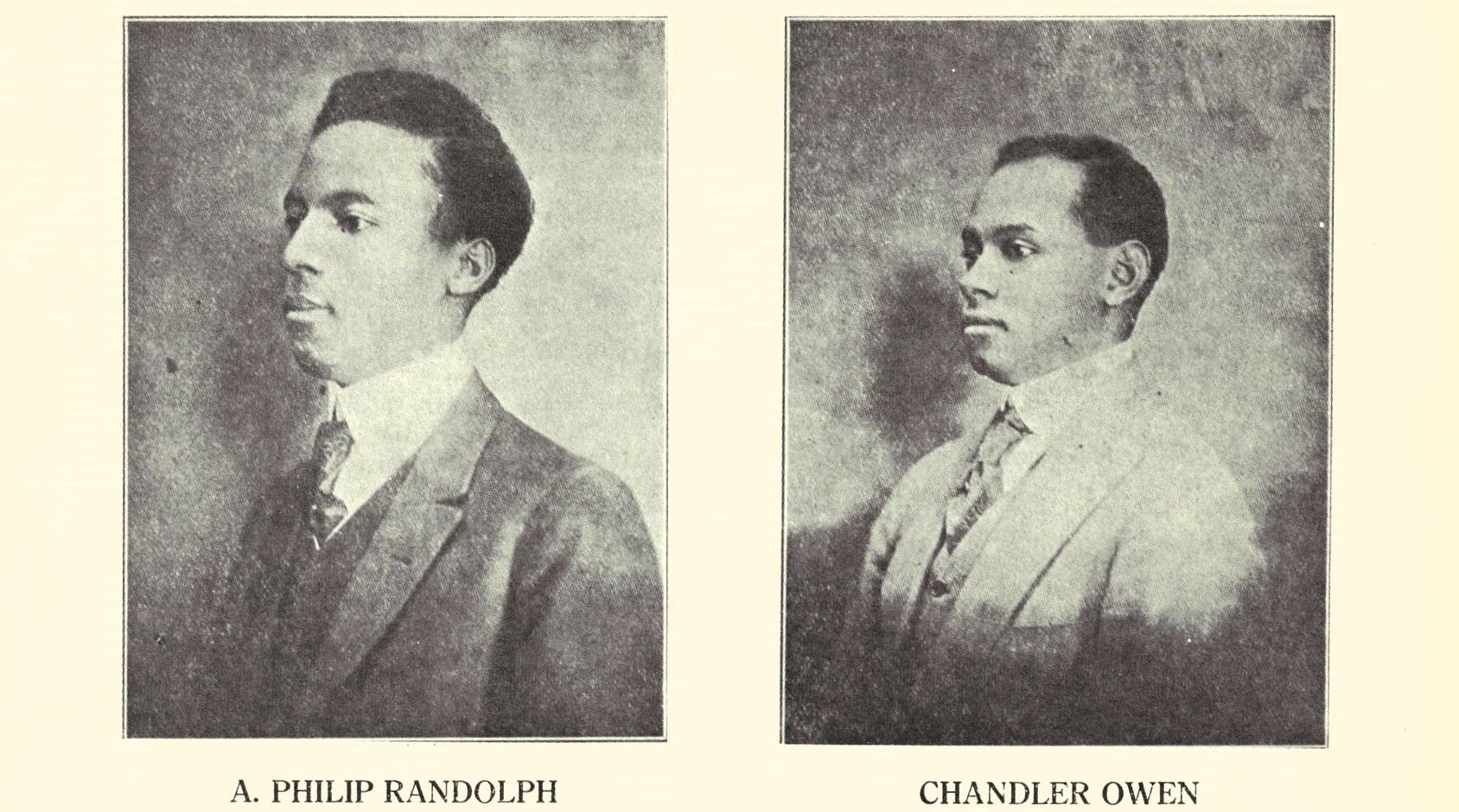
The Messenger was founded and published in New York City by A. Phillip Randolph and Chandler Owen in 1917 after they both joined the Socialist Party of America. The Messenger opposed World War I, conscription and supported the Bolshevik Revolution, though it remained loyal to the Socialist Party when the left split in 1919. It sought to promote a labor-orientated Black leadership, “New Crowd Negroes,” as explicitly opposed to the positions of both WEB DuBois and Booker T Washington at the time. Both Owen and Randolph were arrested under the Espionage Act in an attempt to disrupt The Messenger. Eventually, The Messenger became less political and more trade union focused. After the departure of and Owen, the focus again shifted to arts and culture. The Messenger ceased publishing in 1928. Its early issues contain invaluable articles on the early Black left.
PDF of full issue: https://www.marxists.org/history/usa/pubs/messenger/1919-03-mar-Messenger.pdf

