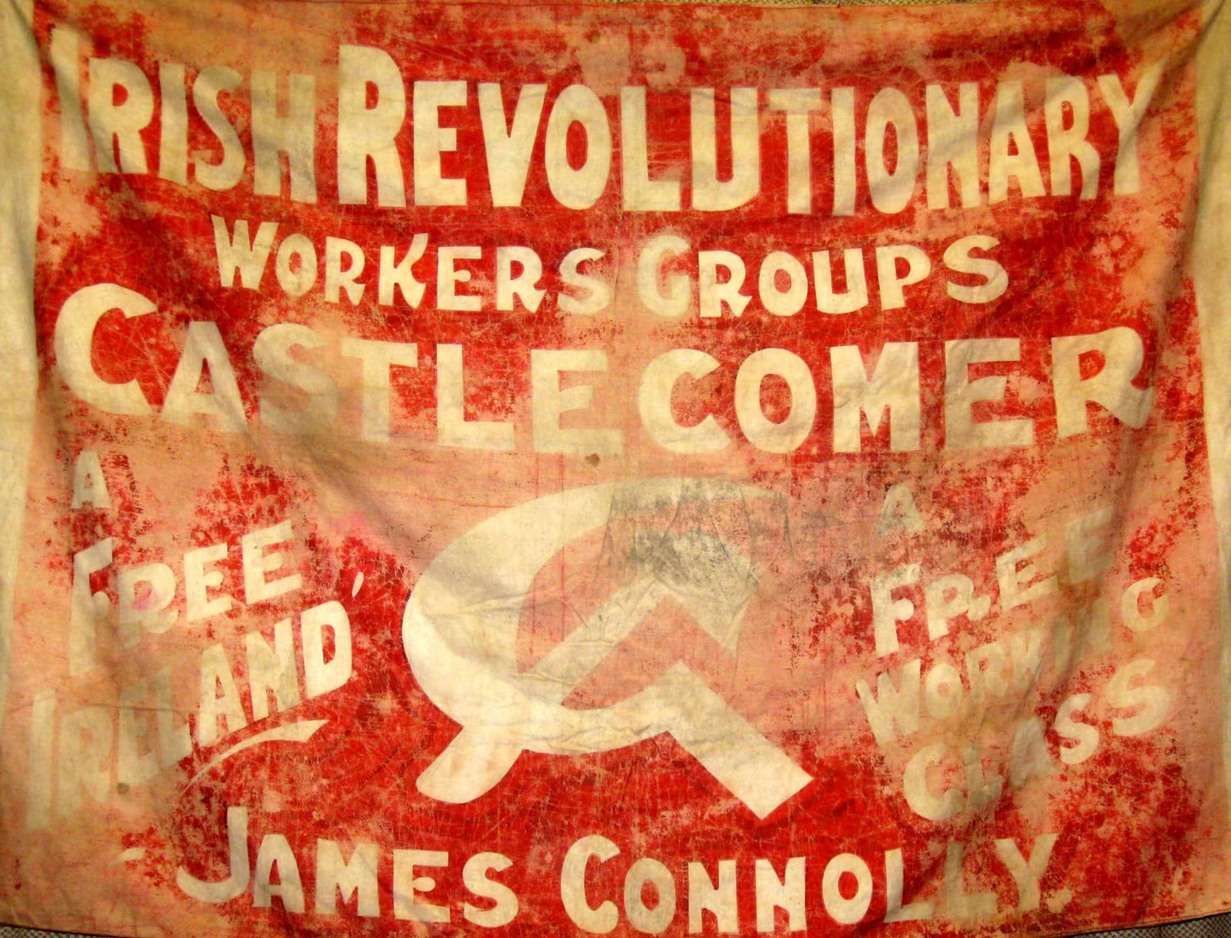
In 1931 the counter-revolutionary Free State government in Ireland passed a severe ‘coercion act’ banning a dozen leftist, Communist, and Republican organizations, including Sean Murray’s Revolutionary Workers Groups, creating a military tribunal for political offenses. Future leader of the Communist Party of Ireland on the draconian measures.
‘The Reign of Terror in Ireland’ by Sean Murray from The Daily Worker. Vol. 9 No. 2. January 2, 1932.
CAUGHT in the throes of the economic crisis and confronted with a revolutionary upsurge among the toiling masses, the Free State Government has dropped its constitutional mantle and donned the Steel Jacket of military Dictatorship.
The Coercion Act passed through the Dail abrogates every vestige of bourgeoisie democracy so far as the toiling masses are concerned.
Military Tribunals–No Appeal
The new act abolishes trial by jury for political offenses. A military tribunal of five army officers is set up, from whose sentences there is no appeal, and whose trials may be held in secret. Coroners inquests are even abolished over “Political” corpses.
The police have power to arrest any person on suspicion of committing, having committed, or being about to commit an unlawful act.
The military tribunal cannot be criticized in the press. It has power to inflict the death sentence on anyone who is a member of an unlawful association.
An unlawful association is any body which advocates or encourages the overthrow of the State by force or promotes or encourages “the attainment of any object of a treasonable or seditious character” or promotes, etc. “The non-payment of monies payable to the central fund or any other public fund,” or the non-payment of local taxation.
The issuance of literature of every description on behalf of an illegal organization is prohibited, drastic penalties including imprisonment and confiscation are made against publishers and printers. Power is given for the suppression of public meetings. The Governor General is given power to suspend Parliament for a month at a time and to appoint deputies without election, etc.
Since the passing of the act the government has proclaimed as illegal 12 organizations, amongst which are the Revolutionary Workers Groups, the forerunners of the Communist Party, the Working Farmers Committee Movement, the Friends of the Soviet Union, and the Irish Labor Defense League.
The new Republican Workers and Peasants Party, Saoire Eire and the I.R.A. (Republican Army) are put under the ban.
The Government has got down in earnest to the work of suppression. Arrests and raids have been carried out all over the country. Meetings are being proclaimed wholesale, the first to be banned being that of the celebration of the anniversary of the Russian Revolution.
The Deep Economic Crisis
The bourgeoisie explains its terror legislation by its concern for the sanctity of life and the protection of religion and morals,” but these vestments fail to hide the cloven hoof of the economic crisis.
The trade returns for the nine months ended Sept. last reveal a fall in exports calculated in money of over 20% compared with last year and in imports of 15%. A fall of over 30% is shown on the total external trade figures. The share of the agrarian crisis in this position is revealed by the live stock exports for the month of Sept. These figures show a fall in volume and value of 23% and 25% respectively.
For the first time since 1926 the adverse trade balance figures have made a right-about-wheel. By its policy of protective tariffs and its drive against the standard of living of the working masses the Free State Government was able to progressively reduce the adverse balance from £19 millions in 1925-26 to £10 millions in 1929-30 or nearly 50%. But the slump in agricultural exports has given the death blow to this process in 1931; an increase of 22 million or 25% is now recorded.
The trade slump has brought about the severest crisis on the railways where the companies are engaged in the most terrific drive against the workers. In Dublin a third of the railway shopmen were recently laid off while the traffic grades are suffering wholesale dismissals through the closing down of branch lines and rationalization generally. The government has not been slow to respond to the cry of the railway magnates they are given a derating bill and a new traffic Act will favor their position at the expense of the workers and the smaller competing road concerns.
Armed with the new dictatorial powers the Cosgrave government has lost no time in interpreting the economic meaning of its terror ac to the workers and peasants. A farmers deputation called to see the Free State President. The deputation assured Cosgrave that they were as near to Rome and as far from Moscow as he, and if only he could give them a moratorium on Land Annuities, or alternatively a derating bill, there would be no danger of their dropping their religion or taking to Communism. With withering bluntness the representative of Irish Capitalism told them they “must pay their debts” and that derating was out of the question. A still worse fate overtook the Civil Service deputation representing 10,000 signatories. Cosgrave point blank refused to see them.
But the bourgeoisie are not relying solely on their police, jails, military and bailiffs in the battle for the maintenance of their rule of hunger and oppression over the toiling masses. The Church is moved into the front trenches of the class fight. “The ruin o fall that is dear to us in history, religion and country” is threatened. The wildest anti-Soviet orgy of propaganda streams forth from press pulpit and platform. The fury of the crusade is a measure of the nervousness of the bourgeoisie and the extent of the crisis.
British Imperialism is also obliged to come directly to the aid of the Cosgrave dictatorship. A sham attack is made in the Imperial parliament on the powers of the Free State Constitution and a “victory” is staged for the Free State Government.
The “Statute of Westminster”
Through the “Statute of Westminster” the impoverished Irish workers and peasants learn that they are nationally free with “full Dominion Status.” Small wonder that the only bonfires to greet the new “Declaration of Independence” was the burning of a Union Jack and a copy of the Free State Constitution by the Dublin workers.
The forces of the Free State Government, the catholic priesthood and the British imperialists are reinforced by the Fianna Fail and Labor parties. The class organizations of the workers and peasants are declared outside the pale of the constitution. It is at this juncture the Fianna Fail Party declares itself completely converted to the constitution. For several years DeValera’s Party declared the Free State Constitution as the main obstacle to Independence. Now that it has been abrogated for the workers and peasants it has become the main instrument of Independence!
The outlawry of the workers and peasants by the Free State Government is supplemented by the ex-communication edicts of the priests. This is the moment chosen by De Valera to declare for an “Irish and Catholic way of solving our difficulties” for invoking the Pope’s Encyclical and setting his new daily paper the task of popularizing Papal “Social Theories” as an alternative to the policy of a revolutionary class struggle for national and social freedom.
New Important Struggle
These pronouncements, made at the Fianna Fail Congress, show the political differentiation now developing as a result of the sharpening of the class issues.
The Congress marks an important stage in the evolution of Parliamentary Republicanism towards more definite forms of collaboration with the national-imperialist counter-revolutionary bloc. It also marks a stage in the break of this party with the militant republican elements within the I.R.A., where De Valera’s influence was hitherto strong. The Republican Leader makes clear his reasons for his present line of policy:
“Everyone must realize that there would be a serious danger if men with arms in their hands were to attack themselves to a special class movement to use them for class purposes against another section of the community.”
Thus do the workers and peasants find themselves deserted by their “national heroes” the moment they take up their own class fight.
A general election is now being prepared in the Free State. Cosgrave, De Valera and Labor will urge the respective merits of their different forms of capitalist rule.
The forthcoming all-in workers Conference in Dublin will raise the class reply to the capitalists and their national and social reformist agents. The fight for the demands of the unemployed, resistance to economy and reductions in wages, will not be shuffled out of the world by the psalm singing altar boys of the bourgeoisie and their juggling with oaths of allegiance and Constitutional trappings.
The Revolutionary Workers Groups will challenge the class enemy in the election and thus put forward the political alternative to the parties of Capitalism–the organization of the Communist Party as the successor of Connolly, the leader of the Irish toilers in the battle for liberation from Irish capitalism and British imperialism.
The Daily Worker began in 1924 and was published in New York City by the Communist Party US and its predecessor organizations. Among the most long-lasting and important left publications in US history, it had a circulation of 35,000 at its peak. The Daily Worker came from The Ohio Socialist, published by the Left Wing-dominated Socialist Party of Ohio in Cleveland from 1917 to November 1919, when it became became The Toiler, paper of the Communist Labor Party. In December 1921 the above-ground Workers Party of America merged the Toiler with the paper Workers Council to found The Worker, which became The Daily Worker beginning January 13, 1924. National and City (New York and environs) editions exist.
PDF of full issue: https://www.marxists.org/history/usa/pubs/dailyworker/1932/v09-n002-NY-anniversary-ed-jan-02-1932-DW-LOC.pdf

