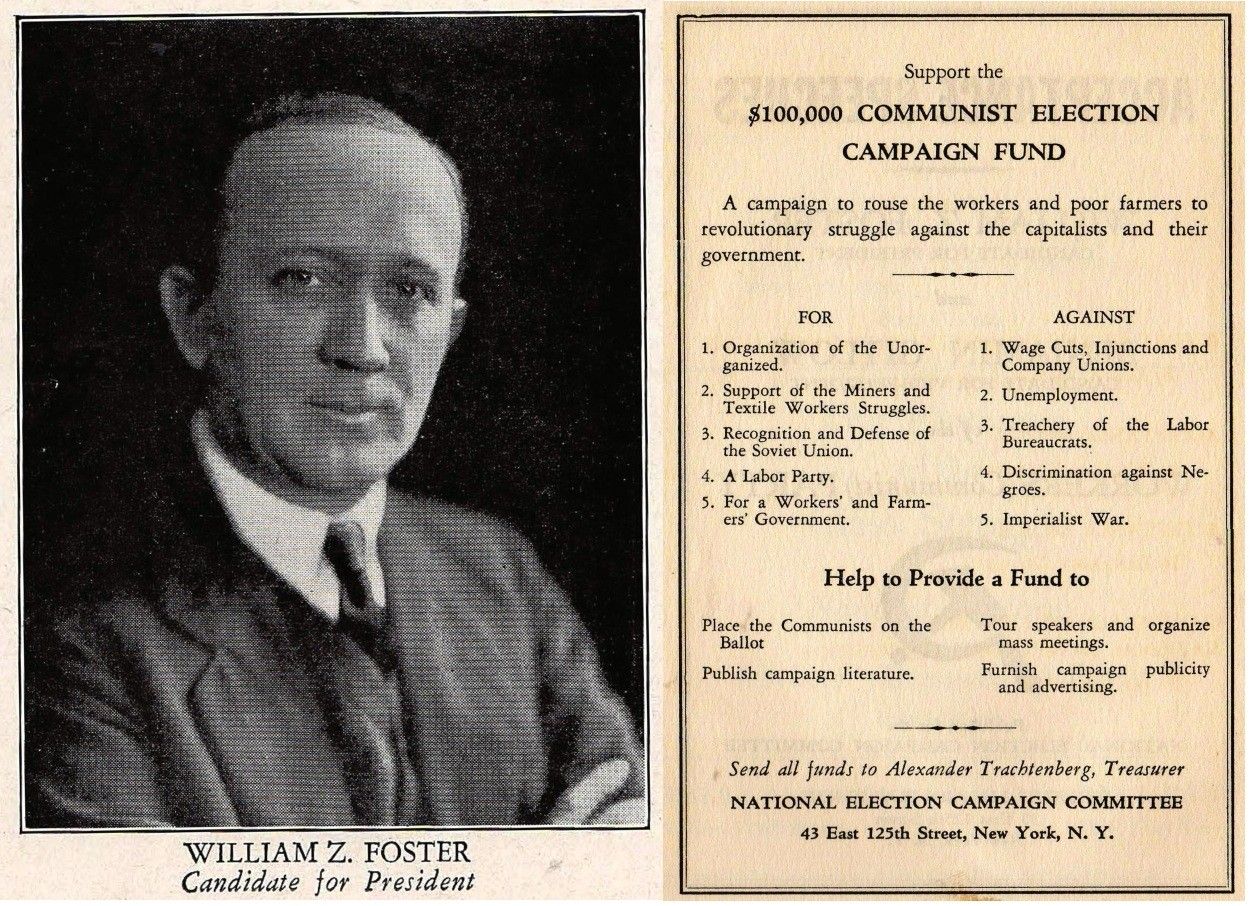
As it is completely devoid of pandering, pettiness, unmeant election promises, and self-aggrandizement, instead cogently summarizing conditions and positions, this is a rare nominee acceptance speech worth reading. Especially as it neatly encapsulates the Communist perspective, as Foster understood it, of the who period. After entering he 1924 at the last minute, the Communist Party was determined to run a proper campaign in 1928, with this speech given at a Nominating Convention on May 27, 1928. Even before the 1929 Wall Street Collapse, it was clear that the Roaring 20s was coming to a close, with the major, multi-sided confrontation in the central coal mining industry setting the tone for the larger crisis in working class representation.
‘Presidential Nomination Acceptance Speech’ by William Z. Foster. National Election Campaign Committee. Workers Library Publishers, New York, 1928.
FOREWORD
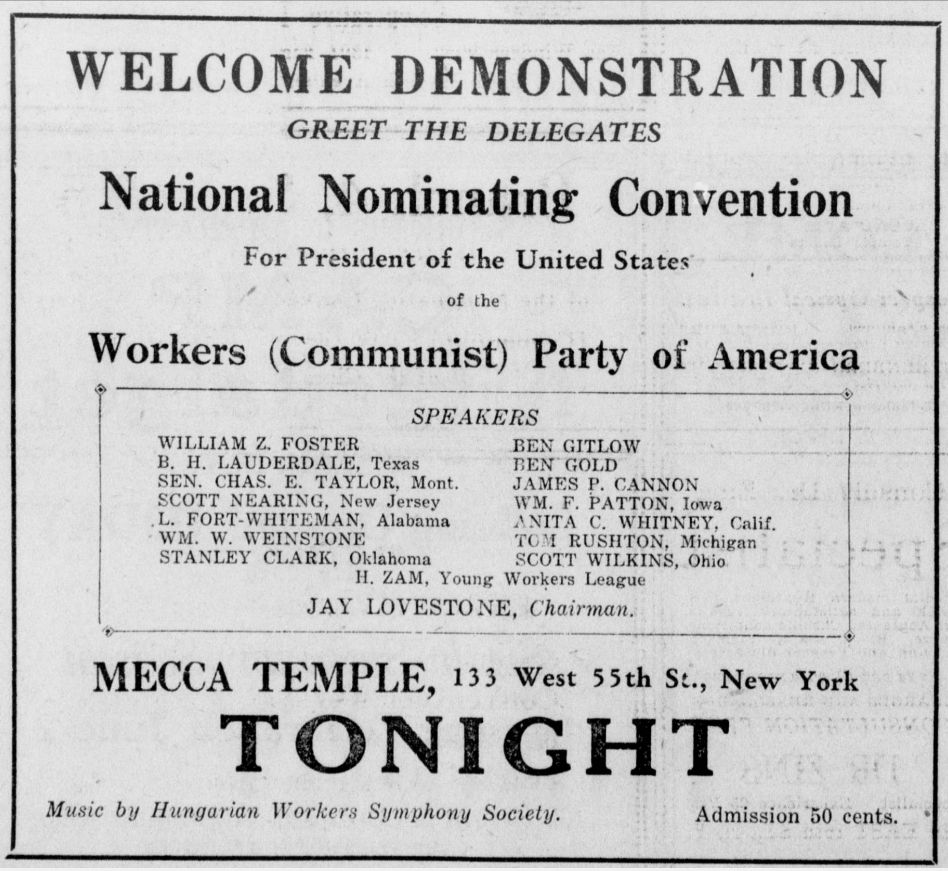
The Acceptance Speeches were delivered at the National Nominating Convention of the Workers (Communist) Party of America held on May 25-27, 1928, in New York City. 296 regular delegates and 150 fraternal delegates, coming from 39 states and the District of Columbia, attended this important working-class gathering. The convention was a true cross-section of the exploited and oppressed masses of this country. Native-born and foreign-born white workers, representatives of the Negro race, exploited farmers, and working women, veterans of the class struggle, delegates of the youth, and representatives of the colonies and semi-colonies of American imperialism joined in a powerful demonstration against their common enemy—capitalism.
The National Convention nominated Comrade William Z. Foster for President and Comrade Benjamin Gitlow for Vice President. Our nominees are fighters in the struggle for the
liberation of the working class and are not servants of Wall Street as are the nominees of the Republican and Democratic parties. The advocates of capitalism—and foremost among them are the corrupt bureaucracy of the American Federation of Labor and the renegade leadership of the Socialist Party—are spokesmen of class collaboration between the working class and the master class.
The National Convention adopted a platform which exposes the whole fraudulence of all the schemes of class collaboration, which serve only one purpose: to perpetuate the rule of capitalism, the wage slavery of the workers, the oppression of the Negro, the exploitation of the working farmers, and the subjugation of the colonial peoples. The keynote of our platform is struggle relentless, uncompromising, determined class struggle against the capitalist world. The Workers (Communist) Party presents its platform as a rallying base for all the exploited and oppressed, as the organizing and mobilizing instrument for all struggles of the toiling masses.
We call upon all workers, exploited farmers, and Negroes to endorse our platform—”The Platform of the Class Struggle” and our candidates! Vote for and join the Communist Party!
Acceptance Speech of William Z. Foster Candidate for President
COMRADES: It is a very great honor offered me, when the Workers (Communist) Party asks me to be one of its standard-bearers in the national presidential elections. In accepting the nomination for president, I do it with full appreciation of this honor. By the fact that it is deemed I can be of service to the Party in such a role, I feel that I am a thousand times repaid for such efforts as I may have put forth in the course of my experience in the struggles of the workers. All I can say is that it will be my best ambition in the coming campaign, and in the years of work before me in the class struggle, to be worthy of this great honor conferred upon me by our Party.
A Wonderful Convention.
Comrades, as we live through this wonderful convention, we must realize the great progress our Party has made. What wonderful enthusiasm, what a splendid fighting spirit! Here we have a fine delegation of militants in the class struggle, from almost all the states, from all the important industries. This shows the grip our Party is getting amongst the very best elements in the American proletariat. This convention marks a new stage in the growth of our Party.
In the recent elections in Germany, in France, and in Poland, the Communist Parties showed greatly increased strength, and I am certain that our Party in the coming elections will also register an important increase in strength over the showing we made in the national elections of 1924. (Applause.)
Party Plays Leading Role
Since 1924 our Party has had much mass experience. We have played a leading role in all the important struggles of the American working class, in the mining, shoe, needle, textile, and other industries. Every effort of the workers in the direction of a labor party has found us in the forefront. We have led the fight against imperialism. During these struggles, we have created around our Party a large body of sympathizers, and in the coming election period one of our principal tasks must be to mobilize these workers politically in favor of our platform, and behind our candidates. It is not enough that these workers follow us in strikes, and general wage movements. We must also teach them to actively accept the leadership of the Workers (Communist) Party in its broad political struggles. We must draw these workers into this general political campaign, and induce them to vote for our candidates. We must draw them into membership in the Workers (Communist) Party. These are among the basic tasks confronting us in the present election campaign.
Our Revolutionary Purpose.
We are not going into the national election campaign solely for the purpose of getting votes. It is of course important that we register the extent of our Party’s support in the working class by mobilizing the maximum number to vote for our candidates. It is also important, should the possibility present itself in any of the state or local elections, to elect Communist candidates, so that they can utilize the legislative bodies as a forum wherefrom to acquaint the workers with the iniquities of capitalism and the necessity of the Communist program. But we also have other, bigger objectives in the national election campaign. Our aim must be to arouse the class-consciousness of the masses in a political sense and to mobilize them for struggle on all fronts. Vote-getting is only one aspect of this general mobilization of the workers.
Our Party, different from the Socialist Party, creates no illusions amongst the workers that they can vote their way to emancipation, that they can capture the ready-made machinery of the state and utilize it for the emancipation of the working class. On the contrary, we must utilize this campaign to carry on a widespread and energetic propaganda to teach the workers that the capitalist class would never allow the working class peacefully to take control of the state. That is their strong right arm and they will fight violently to the end to retain it. The working class must shatter the capitalist state. It must build a new state, a new government, a workers’ and farmers’ government, the Soviet Government of the United States. (Applause.)
No Communist, no matter how many votes he should secure in a national election, could, even if he would, become president of the present government. When a Communist heads a government in the United States—and that day will come just as surely as the sun rises (Applause)—that government will not be a capitalistic government but a Soviet government, and behind this government will stand the Red Army to enforce the Dictatorship of the Proletariat. (Applause.)
As to Immediate Demands
Our convention has just adopted an election platform. This platform outlines a whole series of immediate measures, advocated by us to relieve unemployment, low wages, long hours, discrimination against the foreign-born, women, youth, Negroes, etc. I shall not, in the brief time at my disposal, review these demands. What I wish to say about them now is that we must lay great stress on these demands during the campaign. It is not enough that we simply put forward our revolutionary slogans. We must also organize and lead the workers in their everyday struggles against the most acute evils under capitalism. Our platform demands point the way to do this.
But on the other hand, we must not put forth our immediate demands in the sense that they of themselves make for the emancipation of the working class. In all our agitation around these demands we must emphasize the absolute necessity for the proletarian revolution. Our strategy is to utilize these immediate demands to educate and organize the masses in preparation for the final revolutionary struggle, which will abolish capitalism altogether. Reliance upon immediate demands would lead us merely to reformism. Our Party is a revolutionary Party. It aims not simply to ease conditions a bit under capitalism for the workers but to abolish capitalism altogether. (Applause.)
Permanent improvement in the conditions of the workers under capitalism is impossible. The inevitable crises, born of the contradictions in the capitalist system of production and distribution, deepening and sharpening as world capitalism goes into its period of decline, and marked by chronic unemployment and organized attacks on the workers’ living standards by the employers and the state, sweep away like chaff such reforms as may have been secured by the workers during the periods of capitalism’s upward swing.
The only way the workers can permanently better their conditions is by wiping out capitalism altogether and by laying the basis of a socialist system in which the capitalist principle of the exploitation of the great masses of producers for the benefit of a relatively few owners of the industries shall be unknown and where the workers will receive the full social value of what they produce. All this, and the whys and wherefores of it we must tell the workers in our election campaign.
Reformism Futile
The working class of the world has had a vast experience with reformism and it all goes to show the utter futility of such reformism. All the conquests, all the little improvements in wages, hours, and working conditions that were secured by the reformist policies and organizations in Germany, England, France, etc., during the upward period of development of capitalism in these countries, in the pre-war days, were swept away with one great sweep in the breakdown and decline of European capitalism in the post-war period. About all that is left now of that period is a reactionary leadership, which after betraying the workers in the world war and defeating their revolutionary efforts just following the war, remains fastened upon the organizations of the workers and which now stands as one of the principal obstacles in the way of the emancipation of the working class. Although we advocate actively our immediate demands, we must always do it in this sense: that the workers should fight and struggle for these demands in the present period but that they must educate and organize themselves to put into effect eventually the full Communist program—the abolishment of the capitalist system itself and the establishment of a Workers’ and Farmers’ Government.
On the other hand—if limiting ourselves simply to a program of immediate demands would lose us in the swamp of reformism, failure to put forward such demands would condemn us to sectarianism. It would cut us off from the masses. It would make it impossible for us to participate in the actual everyday struggles of the workers and thus to educate, organize and lead them. The Workers (Communist) Party is a Leninist, Marxist Party. It knows how to participate in the daily struggles of the workers, even for the smallest demands, and it knows how to utilize all these struggles to develop class-consciousness, organization and revolutionary leadership among the masses and thus to begin their mobilization for the eventual overthrow of capitalism.
Our Many Tasks
The Workers (Communist) Party does not go into this campaign simply for the purpose of getting votes or merely to propagate our general Communist program. We enter the election campaign to further all our Party tasks, mobilizing the workers for struggle on every front. And in this period of militant American imperialism, of crisis in the labor movement, of widespread depression in industry, we have many and great tasks. History does not ask us whether we are a big party or a little party when it thrusts these tasks upon us. Small though our Party may be at the present time it must go forward bravely and energetically to the accomplishment of these tasks, however great they may be. I shall touch briefly upon some of the more important of these problems.
The War Danger
One of our principal tasks in the coming election campaign is to arouse the workers to the danger of a new world war. Never was such a war more imminent. This danger manifests itself from various directions. The developing attack of the great imperialist powers upon the Soviet Union; the growing rivalries between the various imperialist powers for markets and world domination, especially between the United States and Great Britain ; the attacks on the colonial and semi-colonial countries, as for instance, on China and Nicaragua at the present time (from the audience: “and Haiti”), yes, and Haiti too, and many other countries—all these tendencies, all these developments are pregnant with the danger of a fresh world war. A world war may start from any of these, and when it does come, the previous war will seem in comparison a pink tea affair.
Today we confront unprecedented preparations for war, armaments without parallel. Did you read in the papers, just a day or two ago, about the gas explosion in Hamburg, when a supply of gas was accidentally released, poisonous enough to have wiped out the entire people of Hamburg? Only a fortunate combination of circumstances prevented the gas from going, with frightful effects, into the most densely populated sections of the city. The militarist program that the world imperialists are developing provides for gases, armaments, instruments of war, more deadly and upon a more gigantic scale than ever before in the history of the world. And the whole thing is developing towards a climax in the sharpening antagonisms that I have just briefly indicated.
Imperialist Armaments
All this great massing of armaments, these gigantic preparations for war, are being carried out under a marvelous camouflage of peace. Since the Versailles Treaty was signed we have been treated to an almost constant series of “peace” conferences, “disarmament” conferences, “anti-war” conferences, a whole stream of them. Yet at the end of all these years the armaments are greater than ever before in history and the war danger grows more and more imminent. The latest pseudo-peace maneuver for covering up the preparations for war by the imperialists originate nowhere else than in the United States. What I refer to is the so-called Kellogg proposal to outlaw war.
It is just a few months ago since the Soviet Union came forward with a proposition to abolish armaments all over the world. This created a great sensation. Among the masses of workers of the world the feeling grew that only the Soviet Union was serious in its proposals for world peace. With their militaristic program thus exposed in its nakedness, the capitalists had to do something to counteract the Soviet Union’s proposition. The first attempted answer to the Soviet Union was that made by the British delegation at the conference where the disarmament proposal was made. And what did the British delegation say in substance? It was an answer of old-time diplomacy, an answer of the naked iron fist. That Great Britain does not agree with the Soviet Union’s proposals for world peace; that she declares world peace to be a chimera, that the proposals for disarmament are impossible, and that she intends to maintain her armies and navies.
Race for Armaments
This was the answer of Great Britain. But the United States, the leading imperialist country in the world, has a much more skillful answer to the Soviet Union than that. What does America say? She says through the mouth of Kellogg, “Let us outlaw war; let us come together and agree that there shall be no more war.” And the leading capitalist countries of the world are accepting this hypocritical proposal of America. What does it all mean? It means simply that under the slogan of “outlawing war,” the world imperialists will continue their race for building up their armaments and preparations for world war. This deceitful, hypocritical slogan is thrown out to blind the eyes of the masses, to make them think that the capitalists are really trying to stop war. The United States, highly expert in fooling the masses, has put out some clever slogans for covering up its war aims. The Kellogg proposal to “outlaw war,” which is being endorsed by reformists all over the world, including the socialist parties, is perhaps the most skillful scheme ever set afloat since the days of Wilson’s famous slogan: that the Allies were fighting the world war “to make the world safe for democracy.”
To expose the real meaning of Kellogg’s proposition, to fight against the vast war plans of the United States, to arouse the American working class against the militaristic program of American imperialism, to mobilize the workers against the war in Nicaragua, against the whole program of imperialist aggression in Latin America, in China, and the militarization of the workers in this country—these are basic tasks of our Workers (Communist) Party, and they must stand in the very forefront of our election campaign.
Defend the Soviet Union
Especially in this connection must we undertake to mobilize the masses of workers in defense of the Soviet Union. Today the Soviet Union advances with giant strides. It is making tremendous progress in building its industries, in establishing a socialist commonwealth in the face of the most tremendous difficulties. The very existence of the Soviet Union is a menace to the capitalist order the world over. It is an inspiration to the workers of the world, a living proof of the feasibility of the proletarian revolution. The capitalists of every country are determined to destroy the Soviet Union at all costs. They want to wreck its working-class government and seize its great natural resources. And now, under the leadership of Great Britain and with the most active participation by the United States, slowly, systematically they proceed with their mobilization of forces. They are awaiting the opportune time to strike at the Soviet Union with all their massed power.
Fundamental to the success of their attack on the Soviet Union will be to keep the world’s workers demoralized and inactive while the counter-revolutionary struggles are being carried on. The capitalists depend on the social- democratic parties of the world, who identify the workers’ interests with those of their respective capitalist classes, to help them cut the Soviet Union to pieces. In the revolutionary upheavals in the years following the world war, it was the socialist parties that beat back the rising tide of proletarian revolt and preserved the capitalist system in Europe. The capitalists believe that the socialists will once more be able to deliver a master betrayal of the revolution, that they can hold back the working masses while the capitalists deliver their carefully prepared attack against the Soviet Union.
War on Capitalism
But this time the imperialists are reckoning without their host. No longer have the social-democratic parties their former undisputed leadership of the working class. In the last few years, in all the important countries, revolutionary Communist parties have been built up. They have sunk their roots deep among the masses. Under the leadership of the Communist International they are mobilizing their forces. The power of this great movement constantly grows. When the international capitalist class, when the imperialists of the world, assisted by their social-democratic lackeys, deem the time opportune and strike at the Soviet Union the blow they are now preparing, they will wake up to a crushing defeat. When that war begins, the Communist International and the millions of workers throughout Europe and other countries that follow its lead will not simply adopt a defensive policy, they will not merely seek to stop their governments from attacking the Soviet Union. On the contrary, they will put into effect the great Leninist strategy. They will turn the imperialist war against the Soviet Union into a civil war of the workers against capitalism. They will destroy the capitalist order and begin the building of the proletarian society. (Applause.)
Economic Depression—Employers’ Offensive
Comrades, the United States is now in the midst of an industrial depression. American imperialism, embarrassed with the enormous masses of commodities produced by millions of super-speeded workers, is not able to dispose of these products. The workers, paid only a fraction of what they produce, cannot buy them back. The employers cannot sell them abroad. Many industries have been closed down. At least four million workers are unemployed at the present time. American capitalism, with all its power, and with all the boasts of its defenders that it has found the formula of continuous prosperity, shows that it, too, is possessed of the weaknesses, and contradictions of capitalism in other countries. It also is subject to crisis. Many signs indicate that we are on the eve of a serious industrial depression.
The employers, quick to take advantage of the situation, are making a great drive against the living and working standards and organizations of the workers. They aim at developing a working class, docile, speeded-up, and a tool in their schemes of world imperialism. Wage cuts have been widespread in the industries, especially among the armies of unorganized, unskilled workers. For the moment the organized skilled workers have mostly escaped the wage cuts, but their turn will come later. The employers forge ahead with their open-shop drive. Wherever the workers resist they are confronted with an unprecedented use of the government against them, injunctions, troops, gunmen, etc.
Labor in Fighting Mood
The workers are becoming increasingly in a fighting mood; especially is this true of the great masses of semi-skilled and unskilled workers in the basic industries who have suffered most from wage cuts, speed-up and unemployment.
The strike of New Bedford amongst the textile workers, the Haverhill shoe strike of a few months ago, the Oshawa strike among the automobile workers, indicate their growing militancy.
General Motors Strike
Perhaps most of you have not heard of the Oshawa strike of some four thousand workers of the General Motors Corporation in Canada. This strike, although a small one, was very significant and an indicator of conditions prevailing widespread in American industry at the present time. The automobile workers for years were among the best paid workers in the United States. But recently their wages have been repeatedly cut, they have been speeded up enormously; unemployment has borne down upon them; in short, their former relatively favorable conditions have been taken from them to such an extent that a growing spirit of resistance is spreading among them, in Canada as well as in the United States. The strike of the Oshawa workers is a signal of the growing discontent among the great masses of automobile workers. The automobile industry has been held up, not only in this country but all over the world, as a most decisive achievement of American capitalism; as the industry in which American capitalism, with a formula of mass production and high wages, had laid the basis for a contented working class. Yet we see that under the weight of wage cuts, speed-up, unemployment and generally worsened conditions the privileged automobile workers are being forced down to such a position that sentiment for organization and struggle is rapidly developing among them.
And what is true of the automobile workers is becoming the case in the various other basic industries. There the workers have been confronting wage cuts and similar conditions. A fighting mood develops among them. Undoubtedly they will wage many important struggles in the near future.
The Crisis in the Labor Movement
In this situation the reactionary trade-union leaders have proved themselves absolutely incapable of organizing and leading the masses. They refuse to fight the bosses. Their aim is to become the industrial drivers of the bosses, to speed up the workers. Their aim is to company-unionize the trade unions of the United States, and to become the personnel managers of the employers. Under the leadership of this reactionary bureaucracy the trade-union movement of the United States, built by seventy years of bitter struggles by the workers, is being gradually destroyed.
Now it is not too much to say that under the combined efforts of the employers’ offensive and the leaders’ treachery, the American trade-union movement is in a death crisis. It is in danger of being either wiped out completely or so deeply degenerated in the direction of company unionism as to be of no value to the workers. Loss of members, loss of militancy, loss of control in strategic industries, restriction of the unions to skilled workers this is the experience of the American trade-union movement. With its antiquated structure, craft policies and reactionary leaders, the trade-union movement is unable to stand in the face of the great open-shop attack by trustified capital. The craft-union movement, hopelessly antiquated, is slated for destruction.
Reactionary Labor Leaders
As the trade-union movement goes more deeply into the crisis we find that the trade-union leaders turn more and more to the right. The latest example of this policy, fatal to the development of organization amongst the workers, fatal to a successful defense of the workers’ standards of living, was the surrender of the Street Carmen’s Union to the Mitten Plan of Philadelphia. Here was a direct amalgamation of trade unionism and company unionism. Such is the program of the American Federation of Labor and the conservative independent unions. It is the ideal of the misleaders of labor. This is their fondest desire–to bring about an agreement with the capitalists so that the trade-union leaders can turn the trade unions into company unions and use them as instruments for the exploitation of the workers. Then, although the interests of the workers would be sacrificed, the group interests of the labor bureaucracy would be conserved.
In the Coal Industry
Another example of policy which I may briefly cite to indicate the general tendency of the labor leaders to the right, is what is taking place in the coal industry. John L. Lewis had several points in his program. One was that instead of a militant campaign to organize the unorganized miners in West Virginia, he demanded the removal of the railroad rate discrimination in favor of the West Virginia mines against the mines in the Pittsburgh district This he declared, would win the strike and solve the union’s problems. But now this rate discrimination has been abolished and who have been the gainers? The Pittsburgh Coal Company and the other big coal companies in the Pittsburgh district who are fighting the miners. That first point of Lewis’ was capitalist in character.
Lewis has a second point in his program, equally capitalistic. This is that the industry shall be monopolized, the “uneconomic” mines closed down and 250,000 surplus miners driven out of the industry. Now we seem to be on the way also to have this point accomplished. The recent announcement by the Rockefeller interests that they will close down many of their “uneconomic mines and turn loose into the surfeited labor market the surplus miners from the shut-down mines, is the beginning of the acceptance of the second proposal of John L. Lewis. In fact, Rockefeller publicly thanks Lewis for his assistance to the capitalists in monopolizing the industry.
Who will profit by such a procedure? Will the miners gain by it or the coal operators? It does not require much analysis to show which. What will happen in the Rockefeller properties and in the other districts where similar plans may be put into effect? The operation of the “uneconomic” mines, so-called, constitutes a sort of division of work amongst the great body of miners. What work there is, is spread over most of the workers. But now the proposal to throw large numbers of these miners into unemployment altogether and to give the others relatively steady work. The displaced miners will be thrust into the great army of the unemployed, there to starve. They have that alternative. Or, they may try to stay in the industry and compete with the workers who have jobs and in this way serve as an industrial reserve army to break down the conditions of the miners as a whole.
Lewis Is Bosses’ Man
Lewis, instead of organizing the unorganized miners and making a fight to establish the 6-hour day, 5-day week, and thus to reabsorb the unemployed miners and to protect their interests during the impending reorganization and trustification of the coal industry, acts as an efficiency expert of the operators by co-operating with them to close down the “uneconomic” mines at the expense of the miners. His policy sacrifices the interests of the workers and proteas those of the capitalists. The whole thing is an open-shop proposal. It means more economy in production, elimination of competitors, and hence more profits for the employers. It means starvation for hundreds of thousands of miners, the breakdown of wage and working standards, and the ruin of the United Mine Workers of America. It is such policies as this, with the union leaders acting as the agents of the bosses, that are liquidating the unions.
The socialist trade-union leaders are proving themselves as reactionary as the old A. F. of L. leadership. In fact they are often taking the lead in the movement to the right, of surrender to the employers. The standards of production of Sidney Hillman were among the first signs of real company unionism in the American labor movement. It was the socialist trade-union leaders in the needle trades who intensified the struggle against the left wing in the unions to the extent of splitting the organizations. In the needle trades they are the champions of piece work, of a “union management cooperative” and the whole employer program of devitalizing and company-unionizing the trade unions. The socialists are every bit as incapable of leading the workers in this crisis as the most reactionary fakers of the American labor movement.
The Struggle of the Coal Miners
The debacle now taking place in the United Mine Workers of America is a basic expression of the crisis in the labor movement, a conclusive example of the absolute incapacity of the present leadership of the trade unions to organize and lead the masses. The U.M.W.A., which just a few years ago controlled 80 per cent of production in the bituminous fields, has been reduced by the loss of district after district, to where it now controls not more than 20 per cent of the bituminous production. In the present strike the employers are destroying three of the key regions of the U.M.W.A. and thereby destroying the base of the whole union All the heroic struggles of these miners have not been able to avail them against the treachery of their leaders in the face of this great attack by the employers. The present miners’ strike is the most important strike in the history of America. Bound up with this strike is the very life of the old trade-union movement. The breakdown of the miners’ union in this struggle throws the whole trade-union movement of the country into jeopardy.
It is not my point here today to dwell upon the heroic struggle of these miners, as it has been very much discussed during this convention. The rank and file miners seem to realize the tremendous significance of the strike. They have fought for 14 months against the coal operators, against the government, with a heroism unparalleled. One of the things, comrades, that we must do with all our vigor when we return to our various districts, is to mobilize all our forces to gather every possible dollar of relief for the brave coal miners of the strike districts. This relief money we must not send to the American Federation of Labor or to the U.M.W.A. where it would be used for the shameful purpose of paying the huge salaries of John L. Lewis and his labor grafter friends (which run to $12,000 a year) while the striking miners starve. Send it to the National Miners’ Relief Committee in Pittsburgh which will use the money for actually feeding the impoverished miners who are out on strike. (Applause.)
The hope and promise of the coal industry is the growing revolt of the rank and file miners. More and more they are learning the futility of Lewis’ policies, and realizing that such policies can only lead to the loss of their union conditions and the liquidation of all union organization. The Save-the-Union movement, with its historic slogans of “Lewis Must Go” and “Workers, Take Control of Your Union,” is the greatest upheaval ever known in the American labor movement. From among the ruins of the U.M.W.A., wrecked by the treachery of the Lewis regime, the rank and file miners are building a new organization, one which, animated by a spirit of class struggle, will organize the great mass of miners and lead them victoriously against the operators. Our Party may well be proud of the role played by it in the present great struggle of the miners. (Applause.)
The present great task of our Party is to organize the millions of unorganized workers and lead them in struggle against the employers and the state. With ever-larger numbers of unskilled and semi-skilled workers developing more militant moods, under the pressure of wage cuts, speed-up, etc., the possibilities for mass organization and mass struggles become brighter. In the strikes of the workers in the coal, textile, needle, shoe and other industries during the recent period, our Party has played a central role. No big strikes take place now in the United States without the Communists taking a decisive part. But in the still bigger struggles not far ahead, our Party will have to play an even more decisive role.
The organization of the unorganized, the unification of the great masses of unorganized exploited workers, is our basic task in the industrial work and we must further that task with all our forces. Some may ask why it is that during a political campaign we talk about organizing the unorganized. This is because our Party is not merely a party of vote-getters. It is a revolutionary party of struggle. It organizes the workers for the fight on every front. It is especially in the election campaign when we have the ear of many thousands of workers that we must drive home to them the fundamental necessity of building great mass organizations in the industries.
More than ever it becomes necessary for us to take the lead in the formation of new unions in the industries. The old unions have been wiped out of many industries and have become hopelessly decrepit in many more. The reactionary leaders will not organize the unorganized. This is the task of the left wing. We must not limit ourselves to the old unions. We must be the champions, the leaders in the formation of new unions among the unorganized industries. Here we must place the great emphasis of our efforts to organize the unorganized.
But does this mean that we shall desert the old trade unions? By no means. The Communists will never surrender the control of 3,000,000 organized workers to the reactionary leadership of the A. F. of L. (Applause.) We will fight to save, to build up, and to revolutionize all those trade unions which possess a mass character and real vitality. We will give active support to the T.U.E.L. and to all kinds of left opposition movements in these organizations aiming to revolutionize them.
The present situation teaches us this: the old trade unionism is going. American imperialism with its monopolized, highly mechanized industry, mass production, speed-up system, company unionism, open-shop drive and ruthless use of state power, is too much for traditional craft unionism. The old unionism is being crushed and liquidated. A new and more revolutionary unionism is being born. It will be industrial in form and founded principally on the semi-skilled and unskilled in the trustified industries. It is a basic task of our Party to lead in the foundation of this new unionism.
Oppression of Negroes
Comrades, one of the planks in our Party platform deals with the question of the oppression of the Negro race. This plank I want to emphasize here. The Workers (Communist) Party appears in the United States as the sole champion, organizer, and defender of the Negro race. Our fight is for full social, political, and industrial rights for Negroes. In all our work we must keep this phase of our Party program squarely before our eyes. In the past we have been all too inactive in this respect. But we must make this campaign the beginning of fresh efforts to unite the Negroes in behalf of their race and class interests, so that the world can recognize that the Workers (Communist) Party is really the defender and leader of the oppressed Negroes in this country. (Applause.)
At this time I shall not deal with the whole Negro question. There is only one angle that I want to touch upon now. Our election campaign will take us into the southern states. (Applause.) We have a plank in our platform on the Negro question that will arouse the most violent opposition in every element in the South that is determined to hold the Negro race in subjection. Nevertheless, we will go into the ultra-reactionary South and we will speak for the Negro. We will defend our platform. (Applause.) In the land of lynch law we will denounce lynching. (Applause.) In the home of Jim Crow, we will attack segregationism. (Applause.) The entry of the Workers (Communist) Party into the South, and the bold raising of the issue of the emancipation of the Negroes during the coming election campaign, will stand out as one of the historical events in the development of the class struggle in the United States. (Applause.)
The Political Parties
Comrades, let me give you just a brief characterization of the various political parties. The workers have nothing to look for from the Republican and Democratic Parties except a continuation and intensification of the hardships under which the workers suffer. Both are controlled by big capital. A list of the campaign fund donators to either party reads like a roster of trustified industry. Both represent the interests of big business. Their whole record is one of oppression of the workers for the benefit of the employers. In its policies the Democratic Party is as much the party of big capital, of big bankers and manufacturers, as the Republican Party itself. Smith is just as loyal a servant of capitalism as Hoover.
Between the two old parties there are no real issues. The issues that once divided them, the tariff, states’ rights, etc., money question, etc., no longer play this role. Such differences as exist over farm relief, prohibition, religion, etc., are not differences between the old parties but of groups within each of them. The capitalists have made themselves masters of both big parties, with their miscellaneous following, and use them to further their own class interests.
The reactionary trade-union officials who call upon the masses of workers to vote for the candidates of these two old parties are misleaders of labor. They betray the workers into the hands of their class enemies. They are the political lickspittles of the Republican and Democratic politicians, the agents of the exploiters of labor.
What is true for the workers regarding the two old parties is equally true for the poor farmers. All that the farmers can expect from the Republican and Democratic Parties is support of the railroads, banks, meat packers, elevator combines and various other capitalistic interests robbing the farmers. Coolidge’s recent cold-blooded, sneering, sarcastic veto of the McNary-Haugen bill shows the contempt with which the Republican Party, controlled by the great financiers of the country, looks upon the demands of the farmers for relief in their present crisis.
The Socialist Party is equally a blank so far as the workers and poor farmers are concerned. The Socialist Party, which carried the revolutionary traditions in the United States when the left wing was a section of that party, now has nothing to offer to the toiling masses but sellouts. It is an ally of the corrupt trade-union bureaucracy. Its policy of betrayal expresses itself on both the political and industrial fields.
On the industrial field the Socialist Party makes no campaign for the organization of the unorganized masses, no struggle for amalgamation of the old trade unions, no fight against the widespread wage cuts and speed-up; on the contrary it accepts the craft-union, class collaboration policy of Green, Woll, etc., to company-unionize the trade unions. The socialist trade-union leaders, who are the mainstay of the Socialist Party, are part and parcel of the corrupt dominant union leadership. They make no fight against Green and Woll but war to the death against the left wing, against every Communist in the labor organizations, against every element trying to build the labor movement and make it a fighting weapon in the interest of the workers. The Socialist Party is hopelessly wedded to the trade-union bureaucracy and its corrupt practices.
On the political field the Socialist Party likewise makes no attack on capitalism. The Socialist Party cultivates amongst the workers every illusion and practice tending to strengthen capitalism. It preaches pacifism, class collaboration, parliamentary opportunism, capitalist efficiency socialism. It makes no effective fight for the workers’ interests now, it does nothing to educate and organize them for the eventual revolution. Its impossible programs of trying to reform capitalism amount in reality to a surrender to the present social system. Norman Thomas, the nominee of the Socialist Party for president, is in fact only a camouflaged defender of capitalism, a disguised supporter of the present system of exploiting the workers. The Socialist Party program tends to break up all real militancy amongst the workers. In a more revolutionary period it would express itself by the most flagrant betrayal of the revolution. This is amply proved by experiences in Germany, France, in every country in Europe. Had it not been for the flagrant sellout of the workers’ cause by the social-democratic party, capitalism would have been destroyed in Europe in the great revolutionary struggles immediately following the world war.
The Proletarian Party and the Socialist Labor Party are but phrasemongering sects. They play no part in the struggles of the working class.
Only the Workers (Communist) Party offers a program capable of organizing the workers for their everyday struggles and to prepare them for the revolution. I have already given you some broad outlines of this program. I shall not repeat what I have already said. But I must emphasize one more phase of our program. We must advocate energetically and clearly in the present campaign the formation of a Labor Party based on trade unions and other labor organizations. So long as the great masses of workers affiliate themselves to follow the line of the two capitalist parties, so long will they be poisoned by capitalist propaganda and so long will they be a zero politically.
The Workers (Communist) Party is the real fighter for the Labor Party. The Socialist Party, the ally of Green, Woll & Co., sabotages on all fronts the fight for the Labor Party. The Workers (Communist) Party makes a militant struggle to establish the Labor Party. But our Party has no illusions that the Labor Party will lead the masses to their emancipation. It will not. That is the task of the Communist Party. Inevitably a mass Labor Party in the United States will be filled with reformist illusions. But in the present period, when we have to break the masses from the old parties, it is a step forward. On this basis the Workers (Communist) Party supports the Labor Party.
Build the Party
Now, comrades, let me emphasize a matter of basic importance for us in the present campaign. That is the building of the Workers (Communist) Party. Tremendous tasks confront our Party. I have already cited some of the most important of these. Our Party is small. Our Party is weak. But it must be made large and strong. Our Party must be built up vastly in order to carry on the great struggles confronting it. This party-building can be done if we but proceed energetically along the proper lines. Around our Party are thousands, tens of thousands, yes, I can say a couple of hundreds of thousands of workers who sympathize in a general way with our struggle. From this great mass of workers, just awakening to the class struggle, we must draw new elements in large amounts to fill up and build our Party. In this way it can be made strong to carry out the great tasks confronting it.
The presidential election campaign must be utilized definitely for the building of our Party, and its press. The campaign will be a failure if we do not succeed in doubling the membership of the Workers (Communist) Party. (Applause.) And all that I have said about the necessity of building the Workers (Communist) Party applies with equal force to the building of the Young Workers League. (Applause.) In every struggle in which our Party participates we find that the youth, the young workers, are playing an increasingly important role. In the industries they form a bridge between the native-born workers and foreign workers. In the new unionism that is now beginning slowly to emerge the leaders will not be the old fossils and reactionary figures of the old trade unions, but new elements recruited from the youth of the country. We must build the Young Workers League. (Applause.)
Comrades, just a word in conclusion. Let us go into the election campaign in the sense that I have expressed our tasks. Let us not be discouraged by the magnitude of the problems confronting us, by the strength and arrogance of the enemy, by the weakness of our own forces. Today our Party is small and the parties of the capitalists are large and strong, but the day will surely come when the Communist Party will be the only political party in the United States. (Applause.) On that day it will be the Party of the victorious proletarian revolution. (Applause.)
In this period the American working class is relatively apathetic. But forces are at work, forces bred of the failures and contradictions of the capitalist system itself, forces that drive the workers into deeper oppression, that will one day, sooner perhaps than we realize, awaken them, radicalize them, revolutionize them and prepare them for a real attack against capitalism. Let us then build our Party in the daily struggles and in preparation for the revolution. Let us make our Party into a worthy brother of the Communist Parties of the Soviet Union, Germany, France, England, Czecho-Slovakia, China, and other countries, which under the leadership of the Communist International, are gradually mobilizing the working masses of the world for the overthrow of world imperialism and the establishment of the International Socialist Republic. (Applause.)
Workers Library Publishers replaced Daily Workers Publishers as the main pamphlet printing house of the Communist Party in 1927. International Publishers was originally meant to translate works into English, but became the CP’s main book publisher.
PDF of full pamphlet: https://archive.org/download/AcceptanceSpeeches/AcceptanceSpeeches.pdf

