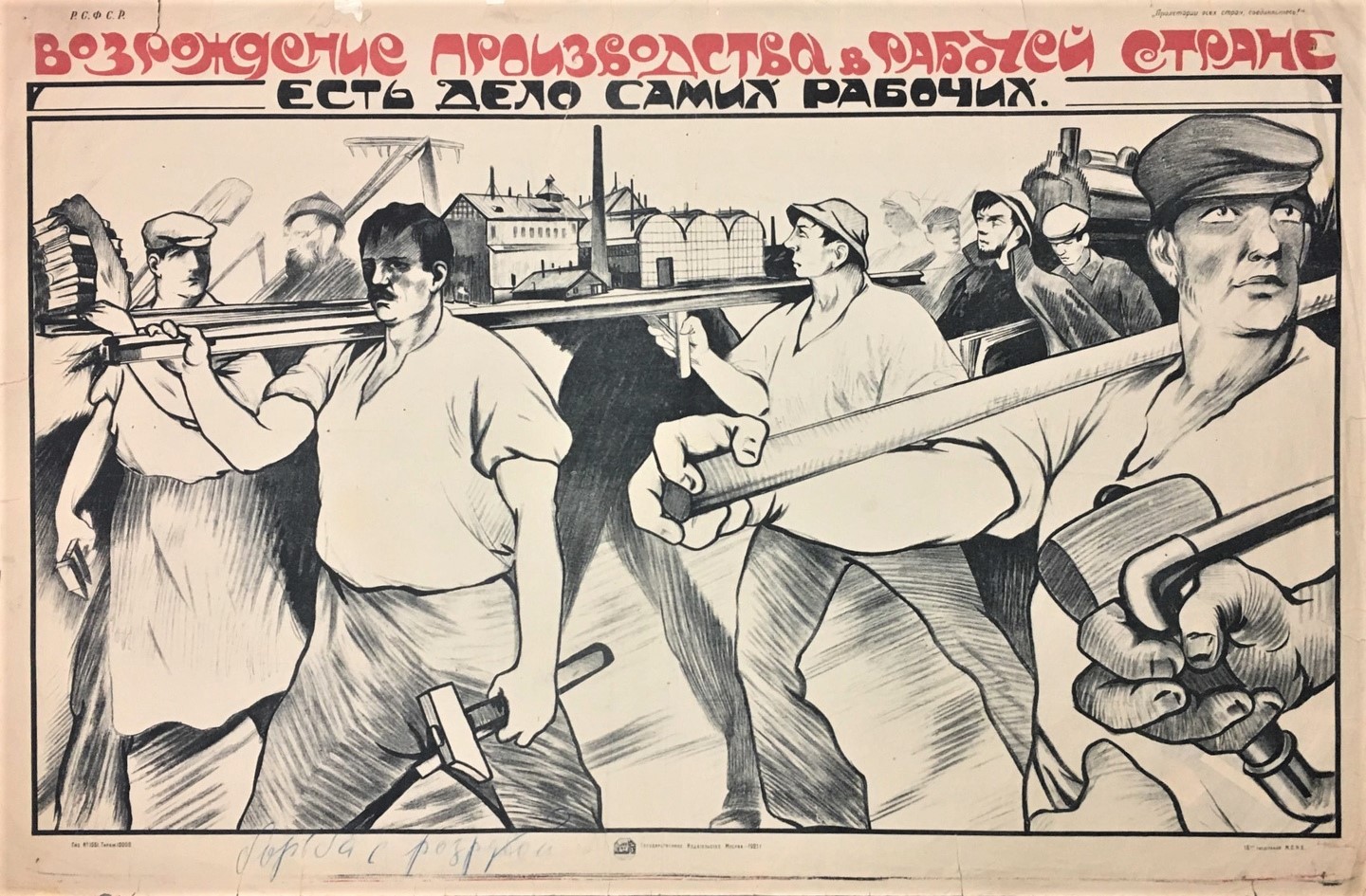
The Secretary of the All-Russian Central Trade Union Council on the state of Soviet workers, with the facts and figures, a couple of years into the New Economic Policy.
‘The Position of the Trade Union Organisations in the Soviet Union’ by Dogadov from International Press Correspondence. Vol. 5 No. 9. January 29, 1925.
In considering the situation and the work of the trade unions of the U.S.S.R., we notice in the first place the increase of membership of the federations of the U.S.S.R. Two years ago. the All-Russian Central Trade Union Council included 4,547,000 members, whilst at present there are 6,036,000. Of these members 61% are workers and 38% employees.
The relative percentage of organised women has fallen in this period from 28 to 24%, the number of organised juveniles from 3,7 to 3,1%. This does not however indicate an absolute reduction in the number of organised women and juveniles, but is explained by the fact that the number of men has increased decidedly more rapidly than the number of women and juveniles. There are 391,000 unorganised wage-earners and salaried workers, i.e. 8%.
The financial position of all trade union organisations has considerably improved during the time of the 5th Congress. On Oct. 1st 1924, the All-Russian Central Trade Union Council had no longer a deficit. Whilst among 23 central trade union committees, only 11 were in a stable financial position at the time of the 5th Trade Union Congress, all the unions, with the exception of two or three, have now closed their budgets without deficits and many have accumulated an appreciable surplus.
As regards wages, they have on the average, risen in industry by 63% since the 5th Congress. As regards separate branches of industry, the following figures are valid for the wages of today. The average wage of a metal worker is 56,6% of the pre-war wages, of the textile worker 91,7% of the miners 52,2 %, of the chemical workers 89,2%. on the average wages are 75% of the pre-war wages in the whole Union of SSR.
In Leningrad there are 148,000 workers, i.e. about 60% of the pre-war number. In the chief branches of industry, the number of workers has reached the pre-war number. Of the total number of workers, 43% are now metal workers, before the war 45%; textile workers 16%. before the war 17%; chemical workers 9%, before the war 11%.
The average wage in Leningrad is 86% of the pre-war wages, and in light industry, i.e. textiles, leather, food and luxury industries however, wages are even above the pre-war rates.
The favourable influence of the increase in the productivity of work on the reduction of unemployment is shown by the reduction of unemployment brought about by the revival of industry in the U.S.S.R. in the years 1923 and 1924. Thus on Jan. 1st 1923, 1,410,000 workers were employed in factories, on July 1st 1924 this number had increased by 300,000.
Wages, Policy and Practice.
In the two years between the 5th and 6th All-Russian Trade Union Congresses, i.e. from 1922 onwards, workers’ wages have considerably changed.
At the time of the 5th Trade Union Congress, the average wage of an industrial worker was 11 roubles 29 kopeks a month, i.e. 30% of the pre-war rate.
At the time of the 6th Trade Union Congress, the average wage is 75% of the pre-war rate and wages have considerably increased in those branches of industry in which, up to the present, the smallest possible wages existed.
In deciding the rate of wages, the trades’ unions always take into consideration the total condition of the branch of industry in question, so as to give them the possibility of developing and strengthening themselves, which again is the best guarantee for the possibility of a further increase of wages.
Successes and Tasks of the Trade Unions.
In summing their successes on the 7th anniversary of the October revolution, the trade unions of the U.S.S.R. can quote the following positive results:
The central committee of the metal workers’ union considers the chief result of its seven years of work to be the establishment of the closest and firmest connection between the trade union organisation and the large number of members. Now the individual trade union member knows not only what the union is, but also what every one of its organsations is doing. The percentage of members who pay their subscriptions unpunctually, when individual collection is made, does not exceed 15%.
As regards unemployment pay, the union now supports one third of its unemployed members from its own funds. The workers are beginning to take an interest in questions of production, and at general meetings and conferences, pay more attention to these questions than to any others.
All these results are closely connected with the growth and improvement of the situation in the metal industry. The chief task of the union in the immediate future is the reduction of the cost of production in the metal industry by good organisation of production and by increasing the productivity of labour which makes a further rise of wages possible.
The central committee of the railway workers’ union states that in the seven years since the revolution, the union has attracted 60,000 members to its work. The apparatus of the union was reduced. The union intends to attract on the broadest lines the most active members to responsible work. As regards wages, it is the opinion of the central committee that further increase of wages is only possible at the cost of economy in the means of transport, for which reason the chief attention of the union must be directed towards cheapening the cost price of the management and to the increase of productivity of labour.
The builders’ union has at the present moment 350.000 members. In the seven years since the revolution, the political consciousness of the workers in the building trade, the majority of whom are half peasants, has considerably increased. The wages amount to 90% of the pre-war rate, and in some cases are higher. The tasks immediately before the union are, the improvement of the work of the union, the development of the self-activity of the masses, the strengthening of the connection with the rural population, the increase of the productivity of labour, the perfecting of production.
The union of chemical workers has 164,000 members. Since the revolution, the chemical workers union has accomplished a tremendous amount of work in the restoration and consolidation of the chemical industry. The result of this work was that in the last business year the chemical industry as a whole made a profit of about 5 million roubles. This position of the chemical industry has had a beneficial effect on the workers’ wages, which, on the average amount to 78% of the pre-war rates.
The productivity of labour of the miners, which in 1921 amounted to 51% of the productivity of the year 1913, rose in this year to 64%. There are union nuclei in every mine, in every shaft, in every mining concern. Schools are to be found in every district, clubs at every mine. Soon there will be no miners who cannot read and write.
The greatest achievement of the leather workers’ union since the revolution is the firm connection of the organisations of the union with the masses of the people and the resulting great activity of the members of the union.
The clothing workers’ union has 58,000 members, of whom about 30,000 are employed in the works of the State clothing industry. The wages amount to 70% of the pre-war rates.
The textile workers’ union has now more than half a million members. The material position of the workers improves in proportion with the development of the textile industry, even though the wages of the textile workers are rather behind the wages of the other branches of industry.
Among the achievements of the unions, the successful fight against the lack of housing accommodation must be emphasised. A great deal has been accomplished in the domain of culture and education. Among the textile workers (the majority of the members of the textile workers’ union are women) there are now only about 8% who cannot read and write.
The wood-workers’ union has 131,000 members. Of these 86% work in the State wood industry. The productivity of labour amounts to 86% of the pre-war production, the wages on an average, to 65% of the pre-war wages.
Health Measures for the Workers.
In 1912, the employers, according to the insurance act, were only obliged to provide at their own cost, out-patient treatment and first aid in cases of sudden illness for the workers. And even this law only included the workers of the wholesale industry, i.e. about 20% of the wage earners. The remaining 80% of the proletariat did not participate even in this help and were obliged to employ private doctors and chemists. State before the revolution. health measures for the working class hardly existed at all.
Nowadays every insured person (and all wage earners without exception are insured at the cost of the employer) and the members of his family have a right to free medical treatment, including midwifery, dental treatment, treatment, in sanatoria and bathing resorts, home treatment etc. etc. Special attention is given to prophylactic medicine. The workers and employees in branches of industry, which are injurious to health, and all juveniles are periodically medically examined. Compulsory small-pox vaccination has been introduced etc.
The chief kinds of medical treatment, out-patient and hospital treatment are guaranteed to all insured persons. Before the revolution there were only 8 physioterapeutic institutions, in 1924 already about 30. Dispensaries for treatment of venereal diseases did not exist at all, now there are more than 40. Before the revolution there were hardly any municipal clinics for tuberculous patients, now there are about 100. A special institute has been opened in Moscow for the study of occupational diseases.
After the October revolution, the working class in the union of the S.S.R. was afforded the possibility of making use of sanatoria, bathing resorts and convalescent homes which had previously been inaccessible to them. The fact that in the Summer of 1924 about 200,000 workers were accommodated in 30 convalescent homes, is an evidence of the wide spread of convalescent homes.
The Workers’ Budget.
In the 7 years since the October revolution, the standard of living of the Russian worker has seen many ups and downs. While being very low in the first half of this period, it began to improve steadily at the beginning of the second half. The civil war, armaments and the intervention, the economic blockade and the famine catastrophe in 1921 are all factors which necessarily had a distinctly negative influence on the workers’ budget.
The actual wages of the industrial worker which, in 1913 was on the average 25 roubles a month throughout Russia, sank in 1917 to 17 roubles and 79 copeks and continued to fall in the following years until in 1921 it reached 6 roubles and 95 kopeks.
Before the war the cost of a worker’s food was 40-45% of his total expenses. During the civil war, in spite of the prices of products necessary to life and foodstuffs being fixed extremely low, the cost of a worker’s food was in 1918 70% of his total expenses and in 1920 74%.
The present budget of a worker, according to the statistics for November, consists of the following items in pre-war roubles. Of the total average monthly earnings of a worker’s family, amounting to 39 roubles 43 kopeks, only 14 roubles 2 kopeks, i.e. 40,5% are required for food and on an average 1,62 roubles for rent, instead of 3 roubles before the war.
The amount spent on spirits has also greatly decreased (almost 20 times in comparison to pre-war times). The expenses in connection with religion have also decreased (from 10-20 kopeks per worker to 2-5 kopeks). The expenses for social, cultural and political needs on the other hand, have increased from 2,5% before the war, to 5% now.
One other factor must be stated, i.e. through whom the worker makes his purchases. Here we see that, for instance in Leningrad (June-August 1924) the worker made two thirds of his purchases at the private market, whilst he bought the last third at the co-operative stores (26%) and in the State ware- houses (7,6%). In other workers’ districts, as for instance in the Donetz basin, the worker makes about 50% of all his purchases at the co-operative stores. The credit which is granted him at the co-operative stores and at the State warehouses is a great convenience for the worker.
International Press Correspondence, widely known as”Inprecorr” was published by the Executive Committee of the Communist International (ECCI) regularly in German and English, occasionally in many other languages, beginning in 1921 and lasting in English until 1938. Inprecorr’s role was to supply translated articles to the English-speaking press of the International from the Comintern’s different sections, as well as news and statements from the ECCI. Many ‘Daily Worker’ and ‘Communist’ articles originated in Inprecorr, and it also published articles by American comrades for use in other countries. It was published at least weekly, and often thrice weekly. A major contributor to the Communist press in the U.S., Inprecorr is an invaluable English-language source on the history of the Communist International and its sections.
PDF of full issue: https://www.marxists.org/history/international/comintern/inprecor/1925/v05n09-jan-29-1925-inprecor.pdf

