Articles on the early development of the proletarian literature and workers arts movement in New Zealand and Australia from two of its leading representatives.
‘The Literary Scene and Workers Art Movement in Australia’ by Katherine Susannah Prichard & Jean Devanny from International Literature. No. 5. 1933-34.
The Literary Scene by Katherine Susannah Prichard
(Author of Working Bullocks, Black Opal, Coonardoo and other novels)
Literature in Australia has a hard tow to hoe. First of all because it has to overcome all the difficulties incidental to creative effort in any of the countries dominated by capitalist ideology, and secondly, because as a dominion of the British Empire, its writers are forced to -seek publication in London or America for their work to have circulation of any significance.
There are publishers in Melbourne and Sydney, but their output is very limited. Until recently, the writing of books about Australia was discouraged by publishers who happen also to be booksellers, on the grounds that: “Australians do not want to read books about Australia.”
That this is not true, but a trade shibboleth, is generally recognized. A new firm, The Endeavour Press, has sprung up to give it the lie direct. The fact of the matter is that a majority of the Australian people cannot afford to buy books by their own writers, published abroad, and sold locally for 6/—or 7/6 a copy; and while the market is flooded with cheap reprints of popular books by English and American writers, these sell more readily than the highly priced works of Australian writers which do not achieve many editions.
For this reason many young writers of talent seek fame and fortune abroad, rather than eke out a miserable existence on the smell of an oil tag at home. They invariably become anglicized, or americanized, away from Australia, and lose any intimate quality of the soil. Several writers of ability have been working at home, though, in recent years; and there is a growing feeling for novels, poems and plays which reveal the life and work of the people of Australia.
But the writing of novels remains rather a costly hobby. Few, if any Australian writers could earn a living by the royalties they receive for their books. Most of them have to depend on-some other trade as a means of existence, or write stories and articles for the newspapers and their weekly editions. The Sydney Bulletin provides two or three pages for short stories and verses. The daily newspapers and weekly journals accept topical articles and short stories of a light popular kind. “Art in Australia” concentrates on the decorative arts, reproduces the work of painters, etchers and sculptors, with critical sketches. There is no outlet for the serious work of independent literary craftsmen in prose or verse.
Dramatists are handicapped even more than other writers. Dramatic production in Australia is controlled by one firm which presents all manner of shoddy American and English farces and melodrama rather than give the writers of the country an opportunity to prove their metal. Amateur companies have set up small theatres in every state of the Commonwealth, and occasionally the work of Australian playwrights has an airing in them. Betty Davies’ play, The Touch of Silk, for example, has been produced by repertory companies in Melbourne, Sydney, Brisbane and Adelaide, with great success; but still the commercial theatre is indifferent to its appeal for wider audiences.
These amateur companies, mostly bourgeois in character, retreat from anything in the nature of revolutionary propaganda. So that the future of free expression, both for literature and the theatre, in Australia, seems to be bound up with the development of the Workers’ Art Clubs.
Workers’ Art Clubs have been established in Sydney and Melbourne, with a magazine and company of players to produce work bearing on the life and struggles of the working class. The Clubs are as yet, in their infancy; but already Toller’s Masses, Tretyakov’s Roar China, and two or three short plays by young Australian writers have been produced in Melbourne. In Sydney, the work of other Australian writers was tried out, and the W.A.C. is girding its loins for a strenuous season next winter.
A stupid and very absurd censorship is another difficulty Australian writers have to contend with. Books which circulate quite freely in England and America are detained by the customs’ officials in Australia. Norman Lindsay’s Redheap for instance, a realistic study of life in an upcountry town was banned by the censor in Australia and nowhere else. Even International Literature it seems is now to be on the list of prohibited publications.
***
Workers Art Movement in Australia by Jean Devanny
(Author of The Butcher’s Shop and other novels)
Though the organizational and cultural level of the Workers Art Movement, in Australia a movement only recently initiated, is extremely low, yet the potentialities for a rapid swing towards and the development of higher standards, is everywhere discernible.
Even bourgeois art in Australia has been circumscribed and stultified to a degree probably not experienced in any other country, the reason being the peculiar conditions of the country’s settlement and development coupled with its isolation. Few indeed are the worthwhile products of Australian literature, and in painting and sculpture one doubts if a single piece displays unusual talent or workmanship. In cartooning and caricature alone Australian artists have commanded a world position inferior to none, and of these George Finey, who played a most prominent part in the formation of the Sydney Workers Art Club, probably ranks first. Finey’s genius, however, failed to secure him against persecution for his rebel ideas. From the foremost and highest paid position in Australia he has been driven to an insecure freelancing. As with John Reed, his finest work has been done for the working class organizations, members of which have watched with interest this evolution from the influence of reformism to a sounder political basis. Australian writers and platform artists in the bourgeois world have almost without exception gained recognition overseas and few of them are more than a name, even if that, to the mass of Australians.
As for revolutionary art, until recently in literature the writers who have succeeded in bringing even the germs of working class influence before the public could be counted on the fingers of one hand. The “democratic” traditions. of “Australian social-political life have been a sturdier clamp upon the growth of proletarian art than the aristocratic and undemocratic traditions of the older countries have been. The liberal magazines and press of the Old World and America, which have provided channels of expression, to some extent at least, for the aspirations of the workers, has had now, no counter-part here. In the whole six states of Australia, with its population of near seven million, outside of the new worker press and that of sympathetic organizations like the Melbourne University Labor Club, there is scarcely an avenue for proletarian or even radical liberal expression. And until recently the widely distributed population (Australia is the same size as the United States of America) has mitigated tremendously against a market for proletarian group views.
Revolutionary Culture Grows
Of present day fiction writers the justly renowned Katherine Susannah Prichard alone shows working class influence and of the past the poet Henry Lawson alone produced at least some fine rebel poetry. The writer of this letter is a New Zealander resident for some time in Australia. Of her own published novels and short stories only a few contain germs of working-class ideology, all of them being written while she was still confused by reformism. Though she has written much revolutionary material she has been unable to secure publication of such. On her return from her tour of the Soviet Union in 1932 she wrote a long book on her travels only to have it rejected by her English and American publishers for its revolutionary bias, her agents refusing even to negotiate it.
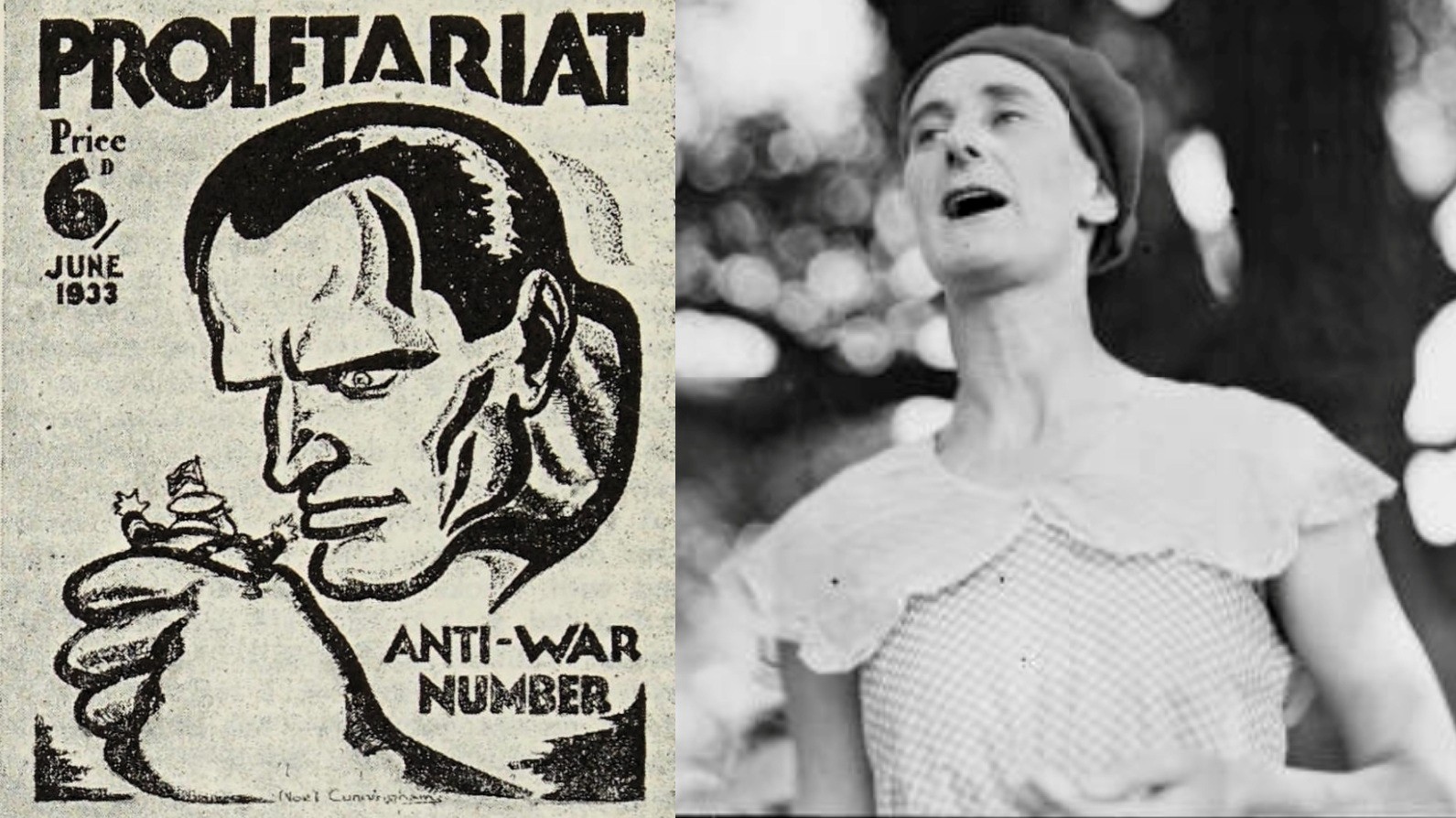
In 1932 an attempt was made by a non-party group in Melbourne to float a working-class monthly called Proletarian, but it disappeared after a few issues. The pre-social-fascist era knew some good reformist papers but today one can find only sporadically featured working-class ideas. During recent years unorganized attempts have also been made by the labor movement to develop the drama but not until the beginning of 1932 did there appear any organized effort in this direction. This organizational activity can, of course, be traced to the revolutionary upsurge of working-class ideology under the leadership of the Communist Party. The establishment of the fraternal organizations was the forerunner to the appearance of a number of weekly and monthly working-class journals. At the same time the Melbourne University Labor Club issued a most successful and theoretically fine magazine entitled Proletariat. Recently news comes from New Zealand that some young radical enthusiasts connected with the Auckland University have issued a quarterly of the same nature.
In 1931 the Sidney Friends of the Soviet Union gave impetus to the development of an art movement proper by establishing a drama group. The groping first efforts were marked by the presentation of some execrable stuff as Workers Art yet the impulse was virile and when the original group broke down by reason of its Own anarchy its component parts reappeared as separate entities functioning on a much higher level.
Melbourne, Victoria, started a Workers Art Club which under “left” influence, titulated for some time between dissolution and Bohemianism, finally settling down. Nevertheless, even at that period it achieved some notable effects, chief of which was the exhibition of painting by Jack Maugham, wherein for the first time in Australia worker and anti-war art gained recognition, and the single issue of a magazine. Attempts at dramatic production were mostly unsuccessful because of lamentably weak direction.
Sydney Workers Art Club
1932 saw Sydney, New South Wales, throwing up not only a Workers Art Club but numbers of dramatic groups as well, independent or attached to the Workers International Re lief, the Friends of the Soviet Union, or the Left Wing of the Labor Party. In Brisbane, Queensland, a group of Proletarian Players was formed.
So far, Sydney’s Workers Art Club shows most promise. The mistakes and the difficulties inseparable from a building period, involving the adaption of utter novices to a new and difficult medium and the at least partial overcoming of “right” and “left” deviations, are being rapidly replaced by vigorous development with truer class direction. The great fault of the young worker dramatists (practically all dramatic programs have been created by club members themselves) has been crudity; the tendency to hang slabs of blatant political propaganda on the barest of dramatic threads. They have not yet learned to advantage themselves of bourgeois technique; nor do they correctly estimate the importance of Workers Art. However, the Club, by virtue of its virility, is not only reacting constructively upon the many dramatic groups which have sprung up in the suburbs of Sydney but further in radiating an influence upon the other States and New Zealand as well. It recently motivated the formation of a Central Committee, composed of delegates from the different groups to function in a directive and advisory capacity.
The literary section of the Club has been the most backward and this despite that the prerequisites for growth in that sphere were most favorable. Uneven attention by the directing organ and underestimation of the section in comparison with the more spectacular drama have been responsible for this. One issue of a magazine occurred, inexcusably rough and rude technically, though containing some good material.
The art section, which set out with a great flourish of trumpets has as yet, owing to difficulties arising out of petty-bourgeois influence, confined its production with minor exceptions to poster and slogan work. In its forthcoming issue of a magazine of anti-war and working-class cartoons it will approach fulfilment if the talented workers associated with it.
Of the other Art groups, most of which confine themselves to dramatic and concert work, the most important and one wielding a real influence, is the “Ragged Trousered Philanthropists” group. The name is derived, palpably, from Tressal’s book of that name, a most successful production of which (unfortunately with its weaknesses included) in suburban and urban areas, was the initial presentation of the group. This was followed by Tretyakov’s Roar China on a much higher level of technical and artistic merit and Sinclair’s Oil and The Jungle will follow suit.
Generally speaking, the prime need of our worker artists, painters, writers, dramatists, is a much higher GENERAL cultural level, as distinct from a certain knowledge of the drama and economics. The artistic method has yet to be studied and applied, and the tendency, borrowed from the bourgeois art world, to simply imitate overseas productions, must be eradicated, but no doubt practice, with due willingness to learn, will ensure progress in these directions, Of supreme value is the information and direction contained in the articles of Lunacharsky, Kirpotin, Elistratova and Bukharin in International Literature and the matter in the American New Masses dealing with the John Reed Clubs. Most discernible throughout the young but valiant Workers Art Movement of Australia is the leaven of proletarian pluck and revolutionary enthusiasm, expressing itself in a self-imposed discipline and in an unmistakable evincing of the mighty creative powers of the workers when released from bourgeois repression.
Literature of the World Revolution/International Literature was the journal of the International Union of Revolutionary Writers, founded in 1927, that began publishing in the aftermath of 1931’s international conference of revolutionary writers held in Kharkov, Ukraine. Produced in Moscow in Russian, German, English, and French, the name changed to International Literature in 1932. In 1935 and the Popular Front, the Writers for the Defense of Culture became the sponsoring organization. It published until 1945 and hosted the most important Communist writers and critics of the time.
PDF of full issue: https://www.marxists.org/subject/art/literature/international-literature/1933-34-n05-IL.pdf

