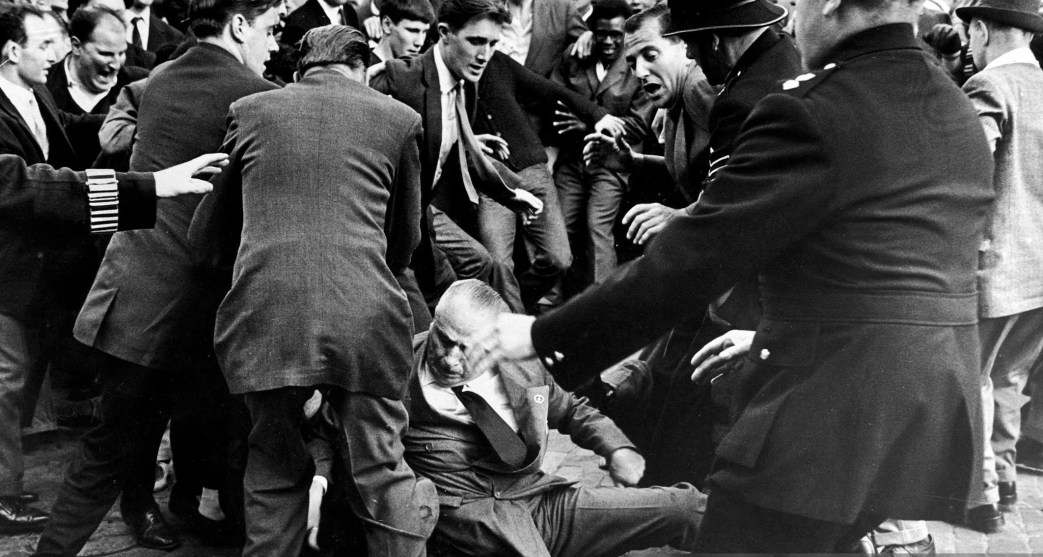
Leaders of British fascism are a definite type; aristocrats making their bona fides bending elbows with the yobs while plotting concentration camps at the club. The sordid history of Oswald Mosley, his blackshirts, and their moneyed backer up to 1934.
‘Mosley: Lap-Dog of British Imperialism’ by Harold Ward from New Masses. Vol. 13 No. 5. October 30, 1934.
EVERYBODY KNOWS by now–and John L. Spivak, America’s ace-journalist, has been driving it home as a carpenter might hammer nails into a coffin–that Fascism, Wealth and the Best People go together. This is quite as it should be. For have not the Best People, after centuries of self-sacrificing effort–and with the unfailing support of gold, guns, greed and God brought forth upon this earth a society in which bread lines shuffle darkly before glutted warehouses, banks, and arsenals? Who, if not they, can be counted upon to preserve a world so colorful, so rich in brilliant contrasts, so full of that “danger and play” eloquently celebrated by one of their unjustly neglected philosophers?
And Fascism looks after its own, as is but right at a time when loyalty to those who have is one of the few remaining marks of the true gentleman. Certainly it has no reason to be ashamed of its latest, most picturesque and romantic child, Sir Oswald Mosley: whose name, if we are to believe one of his latest stooges, “will not be second to either Mussolini or Hitler” in future histories of Europe. Thanks to a remarkable pamphlet entitled “Who Backs Mosley?” just published by the admirable Labor Research Department of London, we are now able to learn enough regarding this Little Lord Fauntleroy of British imperialism to make us blush for the plebeian origin of his Italian and British confrères.
It seems that the power, if not yet the glory, of the House of Mosley started back in 1596, when (quoting from The Town Labourer by the Hammonds) “a Mr. Oswald Mosley…bought the land on which Manchester now stands for £3,500. In 1846 the town of Manchester bought the manor and all the rights and incidents from Sir Oswald Mosley for £200,000. The town could have acquired it in 1808 for £90,000” (Emphasis mine). With such a nest egg of solid gold to brood over it could not be long before the blue-blooded family had a try at producing a genius or at least a national hero eager to save his country from something or other. This blessed event coincided with the birth of the present Oswald, whose early education at Winchester and the Royal Military College of Sandhurst showed him to be (it is a former classmate speaking) “precocious, impatient, full of contempt for most boys of his own age, and a complete hedonist” (A hedonist, in case you have forgotten, is a person who manages to eat other people’s cakes and have his own). These qualities, so wonderfully suited to a future leader of men, were not allowed to languish in the hard school of adversity. The death of his grandfather in 1915 left him the richer by a personal fortune of £60,000, to which was added “the lion’s share in land worth £247,000 in respect of settled land left by the late Baroness.” Five years later Fortune–who, though not blind like Justice, is a trifle dumb–smiled again. Our l’Aiglon of a decrepit society married Lady Cynthia Curzon, a granddaughter of the Chicago millionaire, Levi Zeigler Leiter. This was in the august presence of four crowned heads and to the tune of another £28,000 a year income–nonetheless acceptable for being distinctly non-Aryan in origin. Sir Oswald, however, not to be outdone in tolerance by the Emperor Vespasian, will readily concede that “money does not smell.”
By 1924 the gallant Oswald was fully launched on his political career: oddly enough, as a member of the Labor Party, to which he had deserted from the then unappreciative Conservatives. Socialism appeared to him a charming philosophy which not only made for “unselfish service” on the part of those who might lack a Baronet’s advantages, but frowned upon all ill-bred violence (“Labor doesn’t intend to bring any sudden revolutionary changes”), increased the value of stocks, enjoyed the benefit of clergy–and even promoted brotherly love in the Army and Navy. As for Fascism, that horrid ghoul of Reaction–such a “frenzy of Continental hysterics” must by no means be permitted a foothold in democratic England: and the exasperated (or was it secretly jealous?) Mosley pointed with righteous scorn at Winston Churchill, “strutting in a borrowed shirt–a black shirt–which he had begged, borrowed or stolen from Signor Mussolini.”
Defeated in his maiden campaign for election on the Labor ticket, Sir Oswald, accompanied by his wife, fortified himself by a grand luxury tour through India, Irak, Spain, Palestine, Egypt, the Riviera, America and Russia. Returning home our Rolls-Roisterer promptly set about acquiring “one of the most beautiful and ancient manor houses in all England,” two new town houses in fashionable Smith Square, and a miscellaneous assortment of motor cars, servants, etc. Much of this was made possible by the considerate death of his father–who, however, once cynically remarked that Oswald “had never done an honest day’s work in his life,” and lacked the elementary courage to relinquish even some of his wealth (not just his income) to prove the sincerity of his so-called. “convictions.”
1926 found Mosley again preaching his upholstered brand of socialism–this time in the stark slums of Smethwick and with the generously bought support of the Smethwick Trades Council. However, despite his “old hired car,” boarding house manners and heroic beer-drinking with the rabble, he was shouted down and the Labor Party was compelled in mere decency to repudiate his candidature. Four years later the iron Fascist hand in the velvet Liberal glove appeared in the famous “Memorandum” which Mosley presented to the then Labor Government. This astounding piece of demagogy proposed to salvage British capitalism by turning the unemployed loose on a variety of “public works” to be financed by a £200 million loan (interest charges on which, naturally, would be borne by them and their descendants, in the form of rising taxes and diminishing wages); and by setting up an Imports Control Board ingeniously designed to make British goods more costly at home than abroad.
Even the excessively craven Labor Government gagged at this. Mosley was forced to resign from the Cabinet and devise other, less public ways to express his bitter hatred of the proletariat, the class struggle and revolution in any genuinely creative form. Accordingly he laid elaborate plans to woo the Labor Party to a more “purified” Socialism–which in England is already so “pure” that the slightest contact with brute reality makes it shudder like a demi-vierge on the brink of mortal sin. The pamphlet tells how Mosley issued 250 invitations to key-men in the Labor and Trade Union movement “to discuss a proposal to start a new Socialist movement or group pledged to a form of economic nationalism.” In this proposal appeared the first vague but unmistakable outlines of the Corporate State: all industries to be held as it were “in trust” by the Government, for the material benefit of the capitalist owners and the high moral good of the workers–concerning whom Mosley, as a full-fledged Fascist, was later to say that “material plenty produces physical enervation and weakness, just as, with the same opposing friction, adversity breeds character and struggle fertilizes virility.”
This ruse also failed, and in 1931 the Labor Party–which, after all, has its own well-tried and more discreet ways of delivering the masses up for slaughter–bounced Sir Oswald Mosley. The Baronet was in bed with pneumonia at the time, so that he was able to recover from two serious illnesses at once: the second being his morbid love for Socialism. “Anybody who declared that the Labor Party would introduce Socialism,” he stated, with surprising insight, “was dishonest or stupid”; the Party had “grossly and shamefully betrayed its pledges.” Brooding thus over his lost illusions in a sumptuous villa by the sea in Monaco, our “complete hedonist” experienced the great revelation which led to his concocting, with Dr. Robert Forgan, the witch’s brew which presently was to become the British Union of Fascists.
In January, 1932, Mosley had an hour’s discussion on shirts and fasces with Premier Mussolini; he had previously admired the swastika in Germany. British imperialism had at last found the leader who would support it to the bitter end–“as the rope supports a hanged man.”
Socialism is dead–long live Fascism! Bluntly, in his Manual of Reaction, The Greater Britain Mosley celebrated the death of one enemy–and prepared for combat with an immeasurably stronger one. “When we are confronted by red terror,” warned this hero of Oxford, Olympia and Hyde Park, “we are certainly organized to meet force by force, and will always do our utmost to smash it.” And again–conclusive retort to the petty-bourgeois argument that Fascism owes its grandeur and strength to a denial of class struggle; “In the final economic crisis… the eternal protagonists in the history of all modern crises must struggle for the mastery of the State. Either Fascism or Communism emerges victorious.” (My emphasis. Is it possible that Sir Oswald had dipped into an obscure little book written back in 1917 by an obscure little man baptized Vladimir Ilyitch Ulyanov, alias Nikolai Lenin, and had there learned that “the theory of the class struggle was not created by Marx but by the bourgeoisie before Marx and is, generally speaking, acceptable to the bourgeoisie”?)
Thoroughly acceptable, at any rate, did the British Union of Fascists prove to be among the Empire Builders of Downing Street, Mayfair and the City. As also to the somewhat sour skimmed milk of the intelligentsia. For, “in the black shirt” proclaimed the Leader, “all men are the same, whether they are millionaires or on the dole.” Such a ringing defense of the democratic ideal merited encouragement from the wolves who were to be thus carefully reconciled with the sheep. There were, however, even stronger reasons for this encouragement: for it soon got about that the B.U.F. stood inflexibly for private ownership and public violence camouflaged as “control”; for an economic nationalism supported by ruthless exploitation of colonial markets; for a financial system wholly under the dominance of predatory capital; for the transformation of diminishing wages into increasing profits, of restricted domestic production and foreign exports into higher prices, and of “redundant” enterprises into a closely-held network of corporations responsible to a National Investment Board representing only finance-capital and its small army of parasites. All of which, with true Fascist showmanship, is decked out in the shoddy glories of every cheap Utopia created by masters for the drugging of slaves and defended by Pretorian Guards skilled in all the techniques of repression and terror.
Who backs Mosley? How is it that an organization so bitterly hated and so numerically weak (the B.U.F. claimed less than 18,000 dues-paying members in February, 1934) is able to do what it likes with a government whose formal protests merely disguise a systematic and growing encouragement? Partial, but very revealing answers to these questions are supplied by the Labor Research Department pamphlet.
It is asserted that generous financial assistance was and possibly still is, given by:
“Lord Inchcape, the shipping king. In addition to vast shipbuilding interests, this man is a director of about 24 companies, including five banking or insurance concerns (one being the powerful Westminster Bank). The suggestion that he aided Mosley with money has never been convincingly denied.
“Sir William Morris (Lord Nuffield). Director of six British motor firms and of numerous Continental ones. Denies that he is now contributing to the B.U.F.
“Courtauld’s, the British textile and artificial silk colossus, also tries to whitewash itself, though its long record of exploitation and its fabulous wealth automatically throw it into Mosley’s camp.
“Sir A.V. Roe, one of the leaders of the flourishing British aircraft industry, may deny active support–but Mosley’s equally active Air Defense units are not likely to antagonize such men.
“Baron Tollemache, a confessed supporter of the Fascist movement, is connected with the Tollemache Breweries, and proprietor of nearly 36,000 acres of valuable land in Cheshire.
“Viscount Rothermere–who, however, is still trying to make up his profound mind about Mosley and his program. This deluxe British edition of Hearst is chief proprietor of the Daily Mail, Mirror and Evening News; vice-chairman of Associated Newspapers, Inc.; president of the Anglo-Canadian Pulp & Paper Mills; a director of the British Columbia Power Corporation and the Daily Mail Trust. His experience as pre-war Director of the Royal Army Clothing Department, and as Air Minister in the last year of the War, further qualify him as a future propaganda expert for Adolf–pardon me, Oswald–Mosley’s Totalitarian Empire under the Union Jack.
These are some of Mosley’s angels–men who love “their” country so much that they would rather destroy it with fire and sword than see it actually being used and enjoyed by 45,000,000 Englishmen. But Fascism does not live by gold alone: blood, “brains” and “culture” are very necessary links between the check book at one end and the blackjack, glass-filled stocking and knuckle-duster at the other. These links are being generously supplied. And so we come to the “January Club.” Inaugurated on New Year’s day, 1934, this replica of the Berlin Herren Club which had so much to do with the triumph of Hitler has the definite object of forming a solid Blackshirt front. Its Chairman is Sir John Squire, editor of the London Mercury and one of the most offensive literary sycophants on the planet. Its assemblies–held usually at the Savoy or the Hotel Splendide, favored haunts of the Leader–are “distinguished by evening dress, wines, flowers and a general air of luxury.” Distinguished also by the presence, among many others, of the following actual or potential supporters of the B.U.F.:
“Colonel Lord Middleton, a director of numerous companies, owner of 15,000 acres of mineral lands in Nottinghamshire, and member of the Club Committee.
“General Sir Hubert de la Poer Gough, K.C. V.O, etc., etc., Commander of the Fifth Army, 1916-18, Chief of Allied Mission to the Baltic, 1919 (Russian Intervention); Director of Siemens Bros., Caxton Electric Development, etc. Air-Commander Chamier, late of the Indian Army, now aviation consultant to, and lately a director of, Vickers Aviation, Ltd.
“Vincent C. Vickers, of Vickers, Ltd. and London Assurance Corporation.
“Earl of Glasgow, brother to Sir John Inskip, the Attorney-General responsible for the infamous Sedition Bill now before Parliament.
“Captain Liddell Hart, military critic and historian.
“Mr. Ward Price, special correspondent of the Daily Mail and a director of Associated Newspapers and British Movietone News.
“Wing-Commander Sir Louis Greig, a director of Handley-Page Aircraft, partner in the brokerage firm of J. & H. Schrimageour–and Gentleman Usher in Ordinary to His Majesty the King.
“Sir Charles Petrie, historian attached to the War Cabinet, 1918-19; author of Mussolini and The Case for Monarchy.
“Hon F.J. Rennell Rodd, heir to Baron Rennell and a partner in Morgan, Grenfell & Co. Formerly Manager of the Bank of International Settlements (Geneva), and of the Intelligence Service in Italy and the ear East.
“Mr. Ralph D. Blumenthal, former editor of the Daily Mail and the Daily Express; founder of the Anti-Socialist Union.”
And so on. With such a galaxy of reactionary stars revolving around the still nebulous British Union of Fascists, it is only a question of time-aided by an entirely mistaken attitude of laissez-faire seasoned with that wonderful narcotic, “British honor”–before England swings into the orbit of Mussolini, Hitler, Marshal Pilsudski and the late King Alexander of Jugoslavia. For all its tinsel trappings, raw demagogy, luxury banquets and sporadic outbreaks (fully protected by the police), the B.U.F. means business.
That business–carried on with a calculating realism and an unflagging patience–has one clear-cut objective: the perpetuation, at whatever cost of social progress and human life, of British imperialism, of the dominance over world markets of British industrial power and British finance-capital. So far from being a fantastic, and somewhat tiresome young political Lochinvar, Sir Oswald Mosley, by virtue of the gigantic material interests he represents, is the most ominously significant public character in England today. This fact is clearly known only to the Communist Party, whose German brothers, back in 1932, issued warning after warning that “a vote for Hindenburg is a vote for Hitler.”
And Mosley understands this well. Ten years ago he saw the alternatives: “Two distinct and conflicting mentalities”–so the Daily Herald quoted him in 1924–“are preparing to battle for the mastery of the world the mind of progress–the mind of reaction…”
He has made only one–and fatal-mistake: by clothing Progress in a Blackshirt.
The New Masses was the continuation of Workers Monthly which began publishing in 1924 as a merger of the ‘Liberator’, the Trade Union Educational League magazine ‘Labor Herald’, and Friends of Soviet Russia’s monthly ‘Soviet Russia Pictorial’ as an explicitly Communist Party publication, but drawing in a wide range of contributors and sympathizers. In 1927 Workers Monthly ceased and The New Masses began. A major left cultural magazine of the late 1920s to early 1940s, the early editors of The New Masses included Hugo Gellert, John F. Sloan, Max Eastman, Mike Gold, and Joseph Freeman. Writers included William Carlos Williams, Theodore Dreiser, John Dos Passos, Upton Sinclair, Richard Wright, Ralph Ellison, Dorothy Parker, Dorothy Day, John Breecher, Langston Hughes, Eugene O’Neill, Rex Stout and Ernest Hemingway, Artists included Hugo Gellert, Stuart Davis, Boardman Robinson, Wanda Gag, William Gropper and Otto Soglow. Over time, the New Masses became narrower politically and more journalistic in its tone.
PDF of full issue: https://www.marxists.org/history/usa/pubs/new-masses/1934/v13n05-oct-30-1934-NM.pdf

