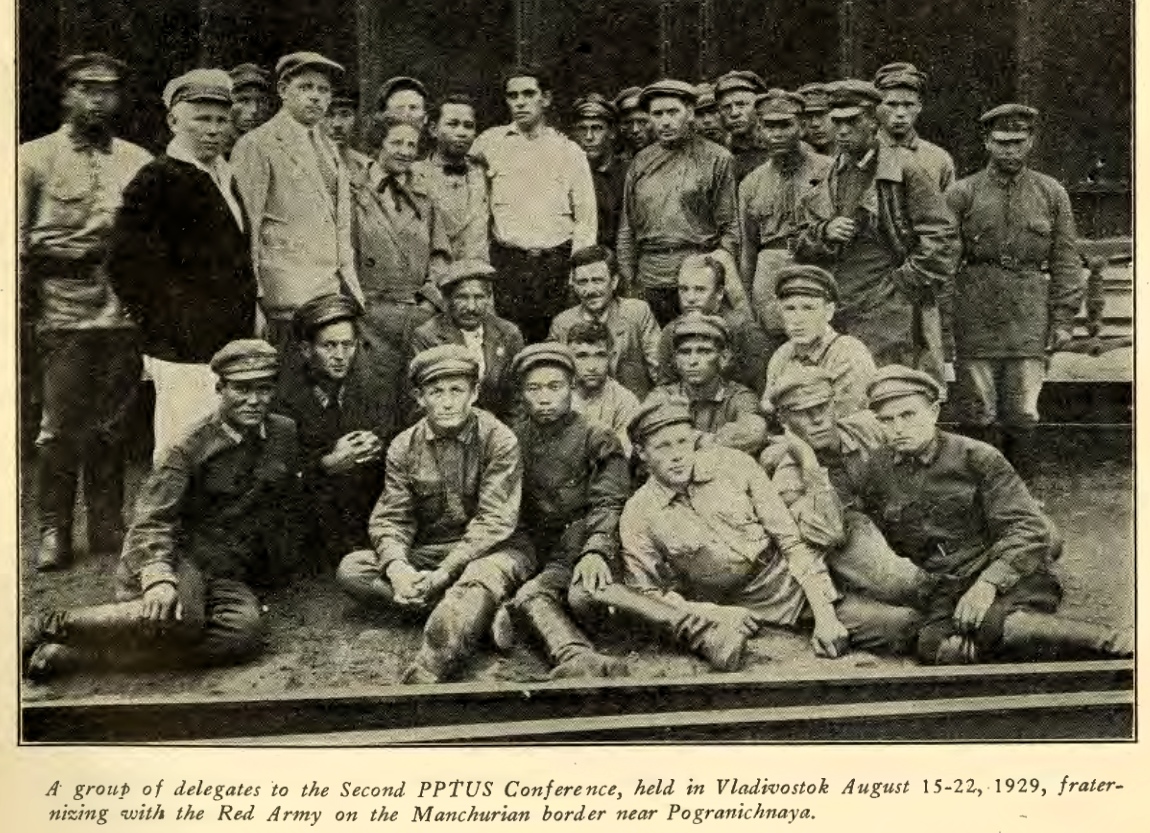
A resolution emerging from the P.P.T.U.S.’s Second International Conference held in Vladivostok during August, 1929 on Communist labor organizing in those countries defined by colonial and semi-colonial oppression.
‘Immediate Tasks of the Pan-Pacific Trade Union Secretariat’ from Pan-Pacific Monthly. No. 32. November, 1929.
I.
THE Second Pan-Pacific Trade Union Conference reaffirms the Economic Program adopted by the First Conference in Hankow, May 20th, 1927, which declared as follows:
(1) “In all the colonial and semi-colonial countries, we witness an unlimited exploitation of labor. The working day is as long as sixteen and eighteen hours; the workers slave away the whole year round without holiday or vacation; the wages received by the workers do not secure for them even the barest existence; there exists no labor legislation whatever to protect the workers; in many of these countries corporal punishment is still practised, etc., etc.”
(2) Women and children are subjected to extremely inhuman exploitation. Their wages are considerably lower than those of the male workers; they often receive less than one dollar a month for the very same work performed by men. They work as long as men, and because of their physical weakness and defenseless state they are very often subjected to insults and corporal punishment. In China, Indonesia, India, Corea, Indo-China and on the islands of the Pacific Ocean the very same conditions prevail as prevailed in the early period of primitive capitalist accumulation. At the same time the cruel and brutal exploitation is intensified by a highly developed system of racial oppression on the part of the imperialist powers.
(3) National capitalism which is developing in all the colonial countries takes advantage of the system of exploitation introduced by the imperialists and cloak the unheard-of slavery with patriarchal and nationalistic phraseology. The imperialist and national bourgeoisie have formed a strong united front against the most elementary economic demands of the workers by force and cunning they prevent the rising of the living standard of the toiling masses.
(4) This condition by which the cheap slave-labor power is applied to an ever-greater extent because of the phenomenal profits it brings, causes one section of the working class to be turned and used against another section of the working class. The bourgeoisie, in investing capital in colonial industries and in building factories and shops, not only pursues the aim of reaping high profits, but also that of lowering the living and working standards of the workers in the capitalist countries. This they achieve by exploiting the cheap labor of the colonial and semi-colonial countries.
(5) This difference in living and working conditions puts the greatest obstacles in the way of creating a united front of all the workers of the different races and nationalities of the Pacific. These obstacles and difficulties are increased and complicated by the bourgeois ideological influence over the masses, which encourages racial hatred and prejudices in respect to the colored races which are considered “inferior.” These artificially-created prejudices are intended by the imperialists and capitalists to render an understanding and agreement between the exploited of all races against their exploiters impossible.
In order to put an end to such a state of affairs, in order to do away with restrictive legislation directed against colored labor, in order to deprive the imperialist-bourgeoisie of their most important weapon which is used to lower the standard of living of the working class, and in order to liberate the toiling masses in the colonial countries from medieval slavery, the Pan-Pacific Trade Union Conference hereby decides to carry on a determined struggle in all colonial and semi-colonial countries for the following ten demands:
1. Introduction of the 8-hour day.
2. Introduction of a regular, continuous 42-hour weekly rest for all workers.
3. Introduction of social insurance in case of illness, accident, incapacitation and unemployment. The whole burden of social insurance to be borne by employers and government.
4. Prohibition of night work for women. Eight weeks of paid vacation before, and eight weeks after confinement.
5. Absolute prohibition of sale and purchase of children for purposes of exploitation. Prohibition of child labor for all persons under 14 years.
6. Equal wages for equal work.
7. Freedom of organization; freedom of assembly and the press; freedom to organize and carry on strikes.
8. Introduction of a Labor Inspection whose organs are to be elected by the trade unions.
9. Abolition of corporal punishment, fines, the practise of docking off wages or of paying wages with products from factory stores.
10. The organization of labor pickets for struggle against fascism and blacklegging.
II.
The Second Conference declares that the struggle for the 8-hour day must now be supplemented by the slogan of “The seven-hour day,” which is already achieved for a large section of the workers of the Soviet Union. The following points must be added to the program:
1. The establishment of a minimum wage in each country, and constant struggle to raise this minimum to the level of the highest standard obtaining in the Pacific.
2. Absolute equality of working conditions for all workers of different races and nationalities working in the same enterprises.
3. The abolition of forced labor and of forcible recruiting of labor, as it is practised by French imperialism on Indo-China, by Dutch imperialism in Indonesia; and the abolition of contract labor which makes strikes impossible and ties the worker to the employer as a slave to his master. Struggle against the slavery methods of French imperialism in Indo-China (forcible transportation of coolies from Tonkin to the New Hebrides, etc.), also against corporal punishment and the tortures practised by the imperialists against the workers of all colonial countries.
III.
The Conference declares that one of the first tasks of the trade unions, especially in the colonial and semi-colonial countries, is the systematic training of new cadres of leaders in economic struggles, taking into consideration the best experience of the national and international movements. Especially is it necessary that the questions of strike strategy, of independent leadership of conflicts with the capitalists shall be studied. The conference emphasizes the necessity and great importance of creating in every strike and in every economic conflict special leading organs (strike committees, anti-lockout committees, etc.) elected by all workers, men, women and youths, involved in the struggle, and serve to draw in the masses to active participation. The strike committees must conduct the struggles in such manner as to dissolve the “Yellow” and governmental organizations among the workers, and break up all so-called conciliation schemes and compulsory arbitration, brought forward by the capitalist agents in order to strangle the working class struggle. Struggle against the indirect forms of forced labor (poll taxes, house taxes, etc., designed to force native peasants on to the capitalist plantations).
IV.
The Conference recognizes that in the different countries of the Pacific the utmost variety prevails in the stage of development of trade unions, in economic development of industry, and in forms of imperialist oppression and the struggle for national liberation. This variety of conditions reflects itself in putting different phases of our general program into the foreground of practical struggle. The Secretariat is charged, as one of its principal duties, to maintain and establish contact with the organizations in each country, and work out in connection with them, concrete directives for the development of the programs of economic struggle, for the solution of political and organizational problems and for concentrating attention in each country upon the most important and pressing questions of the moment.
V.
The Second Pan-Pacific Trades Union Conference, approving the economic program, passed by the First Conference in Hankow; declares that the fight for these demands is part and parcel of the general fight for the common aims and tasks, decided upon by the first and second Conference of the Pan-Pacific Trade Unions. The work of the class labor organizations in the Pacific must be permeated with the spirit of internationalism. It is necessary to mobilize the masses of the colonies and imperialist countries for a decisive and irreconcilable fight for national and social liberation of the exploited peoples and exploited classes in the countries of the Pacific. Such a class organization, as the Pan-Pacific T.U. Secretariat, must coordinate and connect its struggle with those organizations in the various countries and with the international organizations, such as the Latin-American Confederation and the R.I.LU., which have as their aims and are really carrying out a decisive struggle against imperialism, against racial barriers, against colonial oppression and exploitation of man by man. The Second Pan-Pacific T.U. Conference will call upon all organizations affiliated to the P.P.T.U.S. to co-ordinate all of their activities in the fight for the immediate and general demands of the working class with all the organizations, which recognize the principles of the class struggles and which pursue the same aims and tasks as the P.P.T.U.S.
The Pan-Pacific Monthly was the official organ of the Pan-Pacific Trade Union Secretariat (PPTUS), a subdivision of the Red International of Labor Unions, or Profitern. Established first in China in May 1927, the PPTUS had to move its offices, and the production of the Monthly to San Francisco after the fall of the Shanghai Commune in 1927. Earl Browder was an early Secretary of tge PPTUS, having been in China during its establishment. Harrison George was the editor of the Monthly. Constituents of the PPTUC included the Australian Council of Trade Unions, the All-China Federation of Trade Unions, the Indonesian Labor Federation, the Japanese Trade Union Council, the National Minority Movement (UK Colonies), the Confédération Générale du Travail Unitaire (French Colonies), the Korean Workers and Peasants Federation, the Philippine Labor Congress, the National Confederation of Farm Laborers and Tenants of the Philippines, the All-Union Central Council of Trade Unions of the Soviet Union, and the Trade Union Educational League of the U.S. With only two international conferences, the second in 1929, the PPTUS never took off as a force capable of coordinating trade union activity in the Pacific Basis, as was its charge. However, despite its short run, the Monthly is an invaluable English-language resource on a crucial period in the Communist movement in the Pacific, the beginnings of the ‘Third Period.’
PDF of full issue: https://www.marxists.org/history/international/profintern/pan-pacific-monthly/n32-nov-1929-PPM.pdf

