Divided by shop, industry, and union, militant rank-and-file clothing workers organized by T.U.E.L. meet in conference to discuss organizing the left wing across unions, and the amalgamation of the different labor bodies into one, industrial union for the entire industry.
‘The Second Conference of the Needle Trades Workers’ by I.L. Davidson from Labor Herald. Vol. 3 No. 1. March, 1924.
WHEN the Second Conference of the rank and file workers in the Needle Trades gathered at New York City on February 8-9, the delegates faced a situation based upon the realities of the struggle, only the theoretical plan for which was or could be laid when the First Conference gathered in the same city last May.
After nine months of work in the field 87 delegates from ten cities of the United States and Canada came into report, to reaffirm their adherence to programs adopted at the First Conference as fundamental, and to work out such tactics as are necessary to put these programs into effect.
Unity the Leading Issue
Two immediate issues of importance were, firstly, organization of the left wing in such manner, that a closer co-operation of the militants in all organizations in the industry becomes a living thing making for unity of policy and unity of action; secondly, the organization of the left wing’s work, a) to work for the adoption and practical application of the progressive union and trade policies of the T.U.E.L. and, b) to contest vigorously the expulsions, disfranchisements, sluggings and general official disruption of the union as carried on particularly in the I.L.G.W. and Furriers’ against the T.U.E.L. militants. In the latter connection the fight against union-wrecking reactionary officials is to be carried to the floor of the next International convention by delegates from the rank and file.
There were many items on the agenda. Enough to last a less unified body weeks instead of days. First came the report of the National Committee upon past activities. This was quite comprehensive, but dwelt especially upon the brutal opposition raised to progressive policies in the I.L.G.W. and the Furriers’ Union.
With the report of delegates this opposition was revealed in great detail. In Philadelphia, the reactionary officials have gone to such extremes that the I.L.G.W. is practically ruined. Reorganization by registration, with every member forced to sign a registration card pledging him or her to no connection with the left wing in any way whatsoever, either to belong to the T.U.E.L., to attend meetings, to go to dances given by the left wing groups or to sell tickets or subscriptions to Freiheit or THE LABOR HERALD, this is the tactic that has wrecked the I.L.G.W. in the “City of Brotherly Love.” Locals of Dressmakers and Cloakmakers had to combine, and still so few workers would submit to Sigman’s tyrannical “registration” that one local office cannot maintain itself.
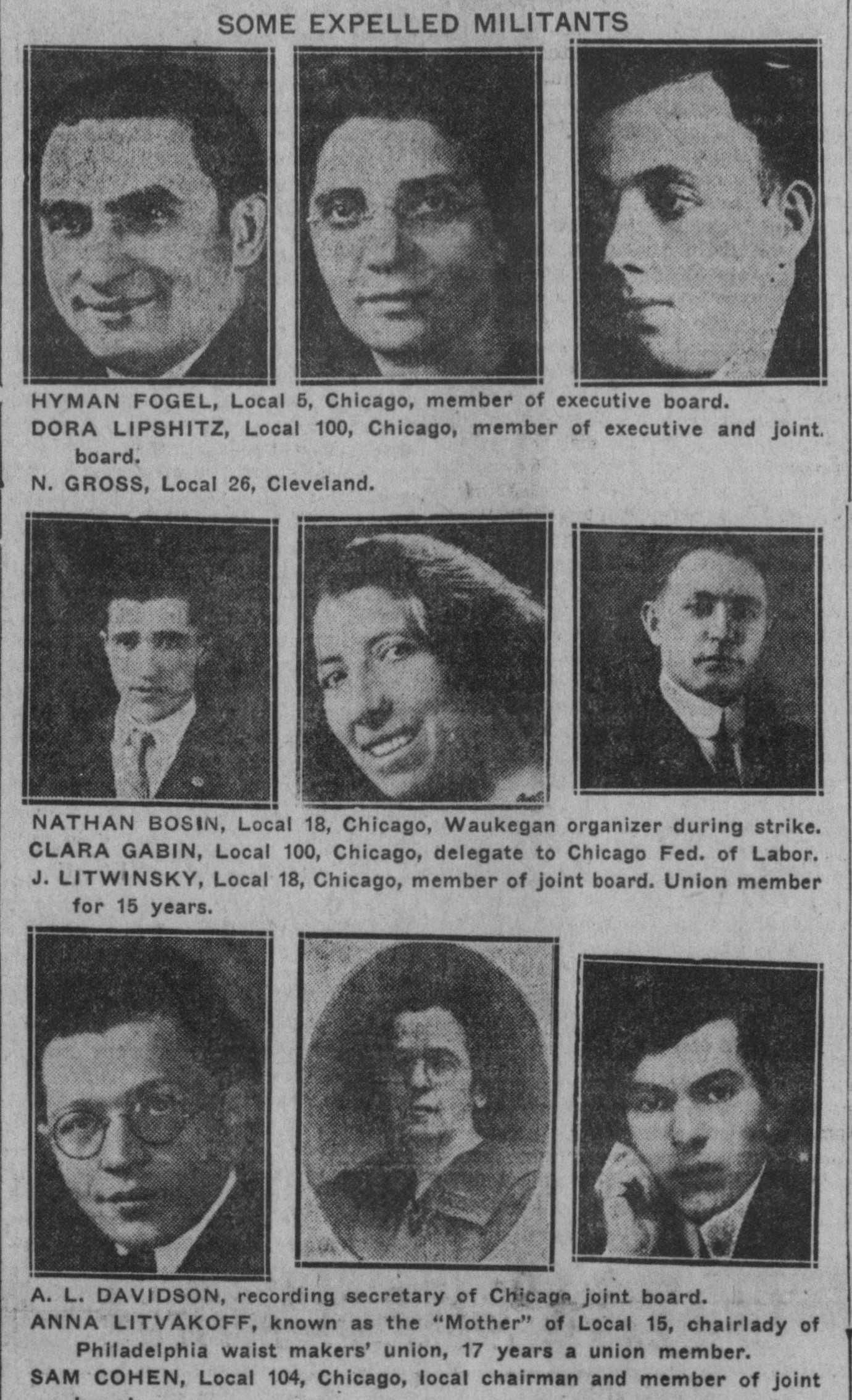
In Cleveland the organization drive stopped and the disorganization drive began with expulsions and disfranchisements. Likewise in Chicago, with some of the oldest and most devoted members of the I.L.G.W. expelled, disfranchised and cut off from making a living by being thrown out of the shops–this under cover of an “organization drive.” Canada as a whole remains crippled by the International’s insistence on placing an inefficient Vice-President similar to “Sheik” Perlstein in charge of organization work instead of allowing the rank and file initiative and support. The whole I.L.G.W. faces bitter struggles with the bosses while weakened and demoralized by treachery and disruption of officialdom.
The Furriers’ Union in New York had its records of black-jacking and slugging reported by delegates. The power behind the sluggers is sufficiently illustrated by the report that when Kaufman of the Furriers got sick of the job he started he was forced on by the yellow “socialist” Forwards gang of Abe Cahan. In fact the slugging campaign may be called the “yellow terror.” Even the Amalgamated in New York is affected by the Forwards gang, and the rank and file is reported in bitter opposition to ex-bosses who are favorites of Abe Cahan being appointed to high and responsible union positions.
Problems Identical in all Trades
The delegates from the Journeymen Tailors reported that the present Secretary, who was delegate to the Portland Convention of the A. F. of L. has been widely discredited by the revulsion of the rank and file to his vote to unseat W.F. Dunne. The militants among the Tailors are bending their efforts to elect Sillinsky as Secretary, since Sillinsky has been a consistent fighter for amalgamation, a labor party, and other progressive measures.
The Cap-Makers’ problems center around organization of the unorganized, and this comes back to amalgamation as the only solution whereby such small international bodies can really organize the unorganized, since they have no capacity at present for extensive work. More and more the progress of application of left-wing progressive measures reverts to amalgamation as of primary practical importance. Especially is this seen when all trades from all cities get together. Conditions and problems are then found to be similar, even identical, in all. And in all the big step is industrial unionism through amalgamation.
As predicted in the First Conference, the so-called “Needle Trades Alliance,” which was invented by the reactionary officials of the unions to off-set the rank and file demand for unity by amalgamation, has failed to function. In fact it was not intended to function except to confuse the rank and file on amalgamation. But it has failed even there. In condemning the evasion of the demand for amalgamation by such ridiculous makeshifts, the Conference reaffirmed amalgamation as the industry’s leading problem.
Taking heed of the practical obstacles in the organization of the workers of the needle trades, such as the percentage of production carried on in non-union shops, sweat-shops and out-of-town shops, the Conference reindorsed the shop delegate system to draw the workers into union activities, and laid down the policy toward the great problem of organization of the unorganized as to be based, firstly, on unity in each trade by stopping expulsions and other official disruption; secondly, to unify the industry by amalgamation and upon this basis to begin efficient and wide campaigns to organize the unorganized.
Charge of Dualism a Subterfuge
To accomplish unity in the separate trades by cessation of expulsions and “reorganization,” a fight against the reactionary machine control in the next International convention is proposed. Rank and file delegates are not going to permit themselves to be disqualified and the membership will back them up in action. This is expected in spite of the fact that locals have been practically dissolved like the Czar dissolved the Duma when it went against his will.
At the Convention, which will take place in May, Sigman will be challenged to prove his contention that the T.U.E.L. is in any way dual in the face of his own admission made recently in Chicago where he stated: “I know that the League is not a dual organization. But the purpose of the League members is to gain leadership little by little over the masses of workers. We are not going to permit it. We are going to do everything to keep the administration. We are not going to permit you to go to, or to work in, the convention.” So calling the League a dual organization is exposed by Sigman himself as only a subterfuge.
Upon those trade questions which affect the very lives of the workers, the Conference shaped out a program that reflects the real interests of the workers, and which for that reason is in marked contrast to the boss-serving and class-collaborative measures advocated by the present officials. Week work was set as an objective to attain in all trades as against piece work, with the standard to be the forty hour week, and a guaranteed number of weeks of employment to be given each worker in the season.
Trade Problems Squarely Met
The Conference voiced a sharp opposition to the speeding-up system the bosses are launching everywhere under guise of a so-called “Standard of Production.” This is simply a name to cover up the insatiable desire of bosses to drive the workers faster and faster without limits until the shops resemble a mad-house full of frenzied workers trying to out-speed each other. It is known that the nervous strain on the worker’s health is terrific under such speeding. As it is today, any tailor who works every week in the year for three years is reduced to a nervous wreck and must quit the trade or take a long rest. The Conference decided that the fundamental necessity of safeguarding the health and life of the workers demanded a check on the lust for profits, and against the so-called “Standard of Production” the left wing must propose the week-work system and a living wage.
The Conference endorsed the National Committee starting a Defense Council for financial relief and defense of those expelled, disfranchised, or otherwise discriminated against. Local branches in each needle trades center are to be organized to take care of this important phase of the League work.
The problem of unifying the leadership for coordination of activity throughout the industry on a national scale was settled by the election of a National Committee of 17 to be located in New York composed of five members from the I.L.G.W., five from the Amalgamated, three from the Furriers and one from the Journeymen Tailors. In addition, one member from each of sixteen needle trade centers throughout the country is to be elected by local groups. The Conference authorized the Chicago group to elect a subcommittee, under jurisdiction of the National Committee, to supervise activity in the Middle West and to function as headquarters for the militants in the needle trades.
While the First Conference was one devoted wholly to devising plans for action, this Second Conference faced the problems of action itself, the problems arising from struggle. The delegates adjourned with the expectation that the unification of the left wing movement and its beneficial effect on the organizations would record material successes for the workers before the next conference is held.
The Labor Herald was the monthly publication of the Trade Union Educational League (TUEL), in immensely important link between the IWW of the 1910s and the CIO of the 1930s. It was begun by veteran labor organizer and Communist leader William Z. Foster in 1920 as an attempt to unite militants within various unions while continuing the industrial unionism tradition of the IWW, though it was opposed to “dual unionism” and favored the formation of a Labor Party. Although it would become financially supported by the Communist International and Communist Party of America, it remained autonomous, was a network and not a membership organization, and included many radicals outside the Communist Party. In 1924 Labor Herald was folded into Workers Monthly, an explicitly Party organ and in 1927 ‘Labor Unity’ became the organ of a now CP dominated TUEL. In 1929 and the turn towards Red Unions in the Third Period, TUEL was wound up and replaced by the Trade Union Unity League, a section of the Red International of Labor Unions (Profitern) and continued to publish Labor Unity until 1935. Labor Herald remains an important labor-orientated journal by revolutionaries in US left history and would be referenced by activists, along with TUEL, along after it’s heyday.
PDF of full issue: https://www.marxists.org/history/usa/pubs/laborherald/v3n01-mar-1924.pdf

